Edible
Where Is Ginger Root Grown? (Origins + Top Producers)
Where is ginger root grown? Native to Maritime Southeast Asia, today the top growers are India, China, Nigeria, Nepal, Indonesia, and Thailand — plus your kitchen.
On this page
- Quick answer
- Where ginger originally came from
- Top ginger-producing countries today
- Where ginger is grown in the United States
- What climate does ginger need?
- USDA hardiness zones for outdoor ginger
- How to grow ginger anywhere — even outside the tropics
- Watch: how ginger is grown and harvested
- Common myths about where ginger grows
- Quick troubleshooting
- Bottom line
- Related reading
Watch the visual walkthrough
How to Grow Ginger in Containers And Get a Huge Harvest
Get free seeds, shipping, and returns: https://www.epicgardening.com/greenhouse/ Learn more: ...
If your store-bought ginger sprouted on the counter and you’re wondering whether you can grow it where you live, the answer depends on geography — but probably yes, with the right setup. Ginger (Zingiber officinale) is native to Maritime Southeast Asia, and today most of the world’s ginger is grown commercially in India, China, Nigeria, Nepal, Indonesia, and Thailand. It’s a tropical crop, but home gardeners in nearly any climate can grow it indoors or as a summer-only outdoor crop.
This guide covers where ginger originally comes from, which countries dominate today’s supply, and exactly which climates and zones it grows in — including how to grow it yourself anywhere in the world.
Quick answer
Ginger is native to Maritime Southeast Asia and is today grown commercially across the tropics. India is the largest producer (~40% of world supply), followed by Nigeria, China, Nepal, Indonesia, and Thailand. Outdoors, ginger thrives in USDA zones 9–12 with 22–30°C (72–86°F) days, high humidity, and a frost-free 8–10 month season. Anywhere colder, grow it indoors or in a greenhouse.
Where ginger originally came from
Ginger has been cultivated for so long — at least 5,000 years — that no truly wild population survives. Botanists trace its origin to Maritime Southeast Asia, the band of islands and peninsulas between southern China, the Indian subcontinent, and the western Pacific. Modern Indonesia, Malaysia, the Philippines, and southern Thailand sit at the centre of that range.
From this cradle, ginger spread along ancient trade routes:
- West into India more than 3,000 years ago, where it became central to Ayurvedic medicine and cuisine
- North into southern China, mentioned in Confucius’s writings around 500 BCE
- Across the Indian Ocean to East Africa through Arab spice traders
- To the Caribbean during the 16th-century Spanish colonial period
- To the Pacific Islands with Polynesian voyagers, where it joined taro and breadfruit as a staple
Today, “wild” ginger plants in the rainforest are almost always escapes from old cultivation, not original native populations.
Top ginger-producing countries today
Global ginger production is concentrated in just six countries, which together grow over 85% of the world’s supply, according to FAO statistics.
| Country | Approx. share of world output | Key growing regions |
|---|---|---|
| India | 40–45% | Kerala, Karnataka, Meghalaya, Sikkim, Assam |
| Nigeria | 12–15% | Kaduna, Bauchi, Benue states |
| China | 10–12% | Shandong, Sichuan, Guizhou provinces |
| Nepal | 5–8% | Eastern hills (Ilam, Salyan, Palpa) |
| Indonesia | 4–6% | Java and Sumatra |
| Thailand | 2–4% | Northern provinces (Chiang Mai, Chiang Rai) |
India’s dominance is partly geography (its monsoon-fed hill states match ginger’s ideal climate) and partly history — it has cultivated ginger longer than almost anywhere else and built a vast domestic market for fresh, dried, and pickled ginger.
Nigeria’s ginger is famous for its high oil and pungency content, and most of it is exported dried. China grows fat, mild “stem ginger” and is the world’s biggest exporter to North America and Europe.
Where ginger is grown in the United States
The U.S. is a small player in commercial ginger but does grow it in a few places:
- Hawaii — by far the largest U.S. producer. The Big Island’s wet windward side has the warm, humid, frost-free climate ginger evolved for, and Hawaiian “yellow” ginger is sold across the mainland.
- Florida and Puerto Rico — small specialty operations, often shaded under citrus or banana.
- Southern California, Texas, and Louisiana — boutique farms, mostly under tunnels.
- Pacific Northwest, New England, and the Midwest — increasing numbers of greenhouse and high-tunnel growers, often selling tender “baby ginger” at farmers markets.
Outside Hawaii, virtually every U.S.-grown ginger root is started in a heated greenhouse in late winter, moved outdoors after the last frost, and dug up before October.
What climate does ginger need?
Ginger is fussy about three things: warmth, humidity, and time.
- Temperature: ideal day range 22–30°C (72–86°F), nights 18–24°C (65–75°F). Growth slows below 13°C (55°F) and stops below 10°C (50°F). Frost kills the foliage and rots the rhizome.
- Humidity: above 60%, ideally 70–90% during the active growing months.
- Light: bright dappled shade. Direct midday tropical sun scorches the leaves; deep shade weakens the rhizome.
- Soil: rich, loose, free-draining loam with plenty of organic matter. pH 5.5–6.5. Compacted clay or boggy ground rots the rhizome.
- Season length: 8–10 frost-free months from planting to harvest.
These requirements explain the world map: the equatorial belt within ~25° latitude north or south covers nearly every commercial growing region.
USDA hardiness zones for outdoor ginger
| USDA zone | Outdoor ginger? | Notes |
|---|---|---|
| 9–12 | Yes, year-round | Plant once, leave in ground, divide every 3–4 years |
| 7–8 | Yes, as annual | Plant after last frost, dig up by October |
| 5–6 | Container only | Move pots indoors before nights drop below 13°C (55°F) |
| 3–4 | Indoor only | Treat as a houseplant year-round under grow lights |
If you don’t know your zone, the USDA Plant Hardiness Zone Map covers the United States, and most other countries publish equivalent maps based on the same average minimum winter temperatures.
How to grow ginger anywhere — even outside the tropics
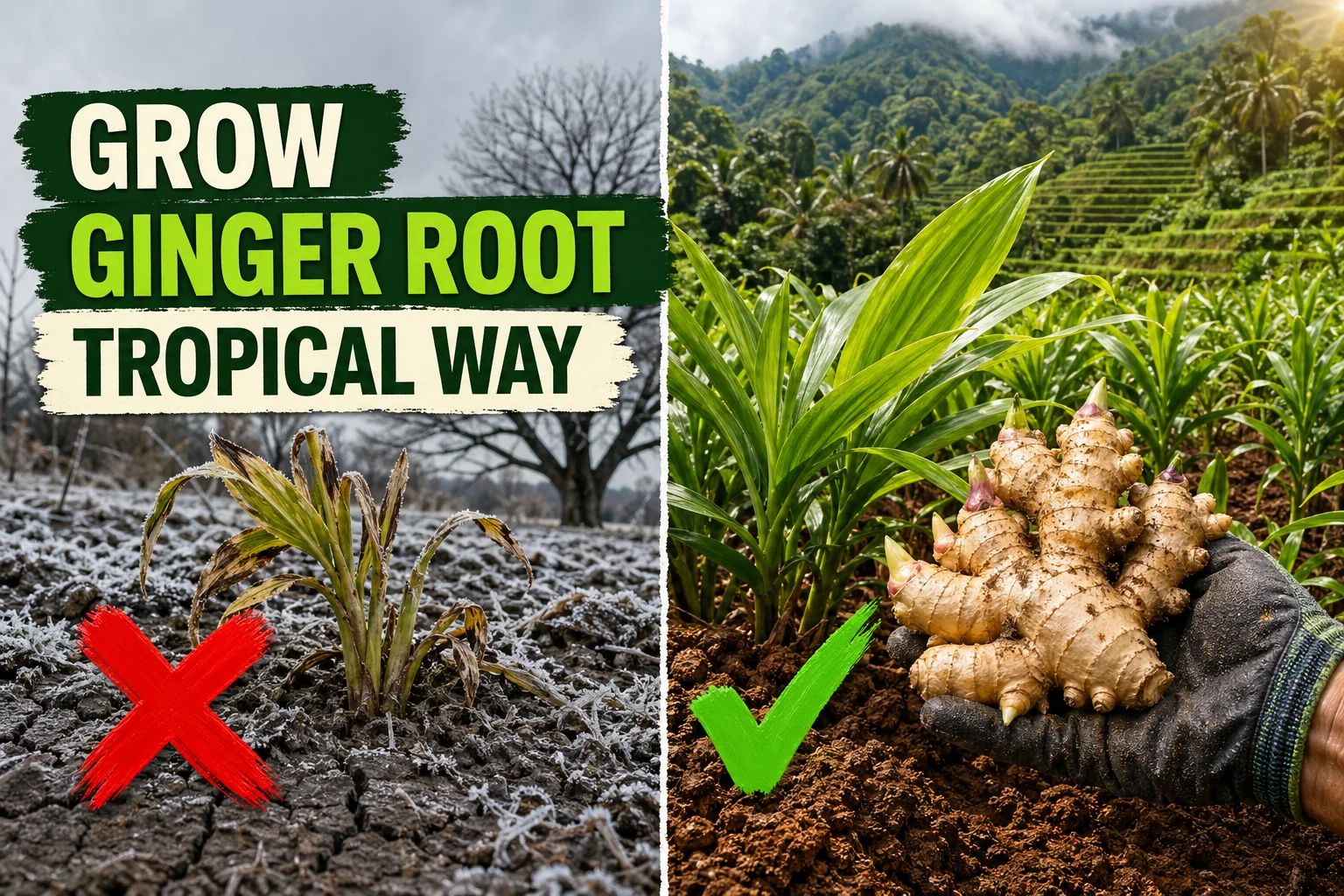
You don’t need to live near the equator to harvest your own ginger. The trick is to mimic the tropics in a pot.
- Start with a fat, plump rhizome from the supermarket or a seed catalogue, with several visible “eyes” (growth buds). Soak it overnight in lukewarm water to wake it up.
- Cut into pieces so each chunk has at least two eyes. Let cut surfaces dry for a day to skin over.
- Plant in a wide, shallow pot at least 30 cm (12 in) across and 20 cm (8 in) deep, with drainage holes. Lay the rhizome flat, eyes up, and cover with 5 cm (2 in) of rich potting mix.
- Keep warm and humid — minimum 18°C (65°F) at the soil. A heat mat helps in cool homes.
- Water lightly until sprouts appear (this can take 2–8 weeks). Once leafy stems are growing, water more freely but never let the pot sit in standing water.
- Feed monthly with a balanced organic fertilizer once the stems are 30 cm (12 in) tall.
- Harvest by digging up the whole pot when the leaves yellow at 8–10 months. Save a few rhizome pieces to replant for next year.
The tropical-inspired conditions inside a warm, humid home are exactly what ginger evolved for — which is why a pot in Wisconsin or Yorkshire can produce as good a rhizome as a smallholder field in Kerala, just on a smaller scale.
Watch: how ginger is grown and harvested
Seeing a tropical ginger field in action is the fastest way to understand the climate, soil, and timing the crop needs.
Watch: How Ginger Is Grown and Harvested in Tropical Farms
This short video pairs well with the steps above and shows the size of mature rhizome clumps after a full season.
Common myths about where ginger grows
Myth 1: “Ginger needs full sun like tomatoes.” No — ginger is an understory plant. In its native range it grows beneath the dappled shade of taller forest plants. Direct overhead sun in temperate gardens often scorches the leaves.
Myth 2: “Ginger only grows in pure jungle soil.” No — what it actually needs is texture: a loose, organic-rich, free-draining loam. A bag of good potting mix amended with extra perlite reproduces this perfectly.
Myth 3: “Supermarket ginger won’t grow because it’s irradiated.” Mostly false. Most fresh ginger sold in U.S. and U.K. supermarkets is treated with a sprout inhibitor, not irradiated, and a fat piece with visible eyes will sprout once the inhibitor wears off (usually 1–2 weeks of warm soaking).
Quick troubleshooting
| Symptom | Likely cause | Fix |
|---|---|---|
| Rhizome rots before sprouting | Soil too cold or too wet | Wait for 18°C (65°F) soil; reduce watering |
| Stems sprout but stay short | Not enough warmth or light | Move to a warmer, brighter spot |
| Leaves brown at the tips | Humidity below 50% | Group with other plants or run a humidifier |
| No rhizome at harvest | Harvested too early or too cool | Wait the full 8–10 months in 22–30°C (72–86°F) |
Bottom line
Ginger root is a tropical crop with deep roots in Maritime Southeast Asia and a global supply chain dominated by India. But the conditions it needs — warm, humid, bright shade, rich soil, and time — are easy to recreate in a pot almost anywhere on earth.
If you can grow a houseplant, you can grow ginger.
Related reading
- How to plant garlic cloves — another long-season root crop with global origins
- How to grow mint — a hardy companion herb with similar moisture needs
- How to start a vegetable garden — bed prep, climate, and planning basics
Highly recommended
The supplies that make this guide work
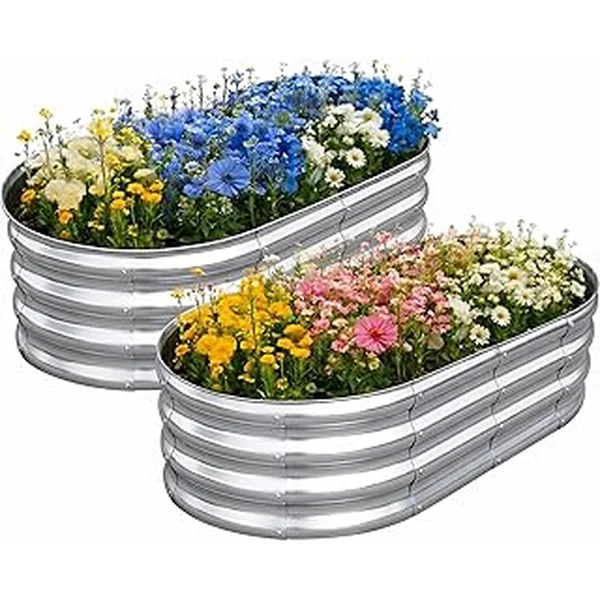
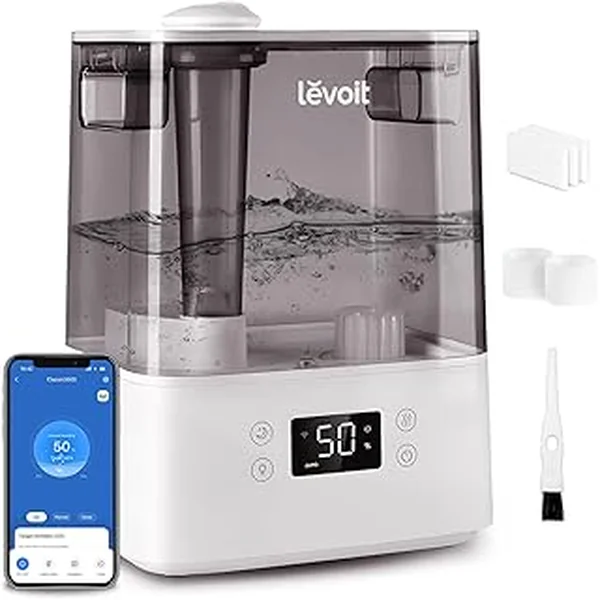
Tazart is an Amazon Associate — we earn from qualifying purchases at no extra cost to you. Thank you for helping us keep these guides free.
Frequently asked questions
Where is ginger root originally from?
Ginger (Zingiber officinale) is native to Maritime Southeast Asia and the islands of the Indian Ocean — most botanists trace its wild origins to a region spanning southern China, India, and the Indo-Malayan archipelago. It does not exist truly wild today; the plant has been cultivated by humans for so long (well over 5,000 years) that it now only reproduces from rhizome cuttings under cultivation.
Which country grows the most ginger?
India is the world's largest producer of ginger, accounting for roughly 40–45% of global output, according to FAO data. Nigeria, China, Nepal, Indonesia, and Thailand round out the top six. Within India, the states of Kerala, Karnataka, and northeastern states like Meghalaya and Sikkim are the dominant growing regions.
Where is ginger grown in the United States?
Commercial ginger in the United States is grown mostly in Hawaii — particularly on the Big Island, where the warm humid climate matches its native range. Smaller specialty farms grow ginger under shade or in greenhouses in Florida, southern Texas, and parts of California. In the rest of the country it's grown in tunnels, greenhouses, or large pots indoors.
Can you grow ginger outside the tropics?
Yes — but only with help. Ginger is reliably hardy outdoors in USDA zones 9–12 (roughly 20°C/68°F average). In zones 7–8 it can be grown as an annual that is dug up before the first frost. In colder climates it grows perfectly in a 30 cm (12 in) pot indoors near a bright window, treated as a houseplant for 8–10 months and harvested when the leaves yellow.
What climate does ginger need?
Ginger wants warmth, humidity, partial shade, and a long growing season. The ideal range is 22–30°C (72–86°F) day temperatures, 18–24°C (65–75°F) nights, humidity above 60%, rich free-draining soil, and 8–10 months frost-free. Below 13°C (55°F) growth slows; below 10°C (50°F) the plant goes dormant; frost kills the foliage outright.
Is ginger native to India or China?
Both regions sit inside its likely original range, but the strongest botanical evidence points to Maritime Southeast Asia — modern Indonesia, Malaysia, southern Thailand, and the Philippines — as the cradle of cultivated ginger. From there it spread west into India over 3,000 years ago, east into China, and later to East Africa, the Caribbean, and the Pacific islands through trade routes.
How long does ginger take to grow from a rhizome?
A piece of ginger rhizome with two or three healthy 'eyes' (growth buds) takes about 8–10 months to mature into a harvestable clump. You can start digging young 'baby ginger' at 4–5 months for a milder, fiber-free root, or wait the full 10 months for the brown-skinned mature ginger you see in supermarkets.