Guide
How to Use Grow Lights for Indoor Plants
Learn how to use grow lights for indoor plants: right type, PPFD intensity, color temp, distance, photoperiod, and timer setup to keep any plant thriving indoors.
On this page
- Quick answer
- Table of contents
- Types of grow lights
- Light intensity: PPFD, PAR, and DLI explained
- Color temperature: 3000K vs 6500K
- How far from your plant
- Photoperiod: how many hours per day
- Using a timer
- Signs your plant needs more light
- Signs your plant is getting too much light
- Best LED grow light brands and price ranges
- DIY positioning: clamp lamps and shelf systems
- Common mistakes
- Watch: how to use grow lights for indoor plants
- Related reading
- Sources
Watch the visual walkthrough
How Long Should Your Grow Lights Be ON Each Day For Best Results
We do more than, JUST, YouTube! Check more MIgardener below: Start growing! Visit our online store for $2 heirloom seeds, ...
Most indoor plants fail not because of bad watering or wrong soil — they fail because the room is too dark. Grow lights fix that. A single full-spectrum LED panel on a timer can turn a north-facing bookshelf or a basement into a genuinely viable growing environment for houseplants, herbs, seedlings, and even vegetables.
This guide covers everything you need to set up grow lights correctly: light types, intensity metrics, color temperature, distance rules, photoperiod schedules, and how to read your plant’s feedback so you always know if you’re on track.
Quick answer
Use a full-spectrum LED grow light positioned 20–30 cm (8–12 in) above your plant canopy. Run it on a timer for 12–16 hours per day depending on the species, always allowing a dark rest period. Target 150–400 µmol/m²/s PPFD (measured at leaf level) for most tropical houseplants. Watch for bleaching (too close) or stretching (too dim) and adjust accordingly.
Table of contents
- Types of grow lights
- Light intensity: PPFD, PAR, and DLI explained
- Color temperature: 3000K vs 6500K
- How far from your plant
- Photoperiod: how many hours per day
- Using a timer
- Signs your plant needs more light
- Signs your plant is getting too much light
- Best LED grow light brands and price ranges
- DIY positioning: clamp lamps and shelf systems
- Common mistakes
- FAQs
Types of grow lights
Full-spectrum LED (the modern standard)
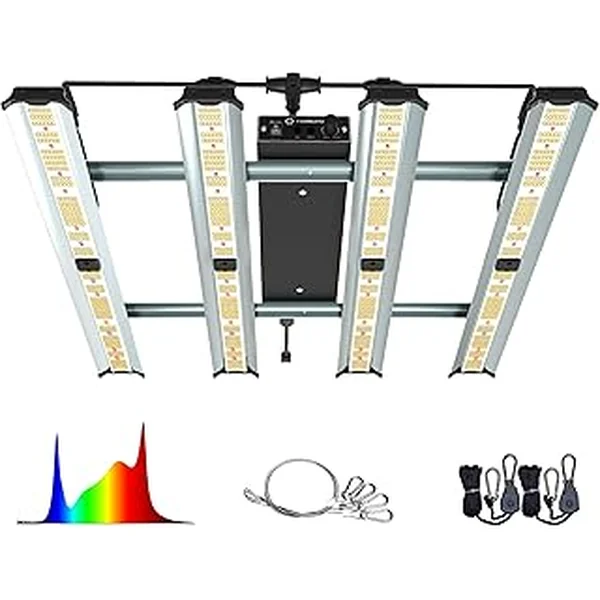
Full-spectrum LEDs are the dominant choice today for a clear reason: they produce the right wavelengths for photosynthesis (red around 660 nm, blue around 440 nm, plus a broad middle spectrum) at a fraction of the electricity cost of older technologies. They run cool, last 25,000–50,000 hours, and are available in every form factor from clip-on bars to large panel arrays.
For home use, a bar-style LED (40–100W) is the most practical. It mounts above a shelf or hangs from a hook, covers a 30–60 cm (12–24 in) footprint, and costs between $25–$80 USD depending on brand and wattage.
T5 fluorescent
T5 fluorescent tubes were the grow-light standard before quality LEDs became affordable. They still have valid use cases: seedling trays, propagation stations, and low-budget starter setups. T5 tubes are cheaper upfront, produce gentle, even light with very little heat, and work well when placed just 5–10 cm (2–4 in) above seedlings.
The downside is running cost — they draw more watts per lumen than LEDs, and bulbs degrade after 8,000–10,000 hours, requiring replacement.
HPS (high-pressure sodium)
HPS lights are the traditional choice for high-intensity indoor growing. They produce an intense warm-spectrum output that suits fruiting and flowering crops and were the commercial standard for decades. Today, however, they are largely obsolete for home houseplant use. HPS bulbs run extremely hot, require ballasts, and consume far more electricity than equivalent LED setups. Unless you are running a dedicated indoor growing room for vegetables, there is no practical reason to choose HPS over modern LED.
Bottom line: For the vast majority of home growers and houseplant owners, a full-spectrum LED panel or bar is the right answer.
Light intensity: PPFD, PAR, and DLI explained
PAR (Photosynthetically Active Radiation)
PAR refers to the range of light wavelengths — 400 to 700 nanometres — that plants can use for photosynthesis. It is not a measurement, but a definition of the relevant spectrum.
PPFD (Photosynthetic Photon Flux Density)
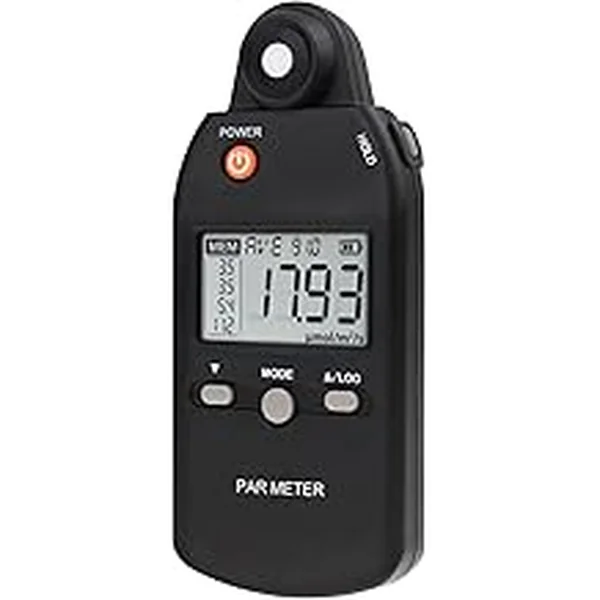
PPFD is the actual measurement you care about: how many photons in the PAR range land on a given area per second. Units: µmol/m²/s.
| Plant type | Target PPFD at leaf level |
|---|---|
| Low-light houseplants (pothos, snake plant, ZZ) | 50–150 µmol/m²/s |
| Medium-light tropicals (monstera, peace lily, ferns) | 150–300 µmol/m²/s |
| High-light species (succulents, herbs, croton) | 300–600 µmol/m²/s |
| Edibles and flowering crops | 600–1000+ µmol/m²/s |
A cheap light meter (lux meter) gives an approximation, but a true PAR meter reads µmol/m²/s directly. If you only have a lux meter, divide the lux reading by roughly 50–70 to estimate µmol/m²/s for white LED light.
DLI (Daily Light Integral)
DLI is PPFD multiplied by the number of seconds the light is on per day, then converted to moles: it tells you the total photon “dose” a plant receives in 24 hours. Target DLI for most tropical houseplants is 10–20 mol/m²/day. For edibles, aim for 20–30 mol/m²/day.
Example: A light delivering 200 µmol/m²/s for 14 hours gives a DLI of about 10.1 mol/m²/day — right in the sweet spot for most houseplants.
Color temperature: 3000K vs 6500K
Color temperature in grow lights is measured in Kelvin (K). Lower numbers are warmer (more red); higher numbers are cooler (more blue).
| Kelvin range | Light character | Best for |
|---|---|---|
| 2700K–3000K | Warm white, heavy red | Flowering, fruiting, late-stage growth |
| 3500K–4500K | Neutral white, balanced | General houseplant maintenance |
| 5000K–6500K | Cool white, heavy blue | Seedlings, vegetative leafy growth, compact stems |
For most houseplant owners who want one light that does everything, choose a full-spectrum panel rated at 3000K–6500K (often marketed as “full spectrum” or “sunlight spectrum”). These mimic the broad range of natural daylight and support every stage of growth without switching bulbs.
If you are starting seeds, lean toward 5000K–6500K — the blue-heavy spectrum keeps seedlings compact and prevents the stretching (etiolation) that happens under warm-only light.
How far from your plant
Distance dramatically affects intensity. PPFD falls with the square of distance — doubling the height quarters the light reaching the leaf surface.
Recommended starting distances
| Light type | Starting distance |
|---|---|
| Full-spectrum LED bar (40–80W) | 20–30 cm (8–12 in) |
| High-intensity LED panel (150W+) | 45–60 cm (18–24 in) |
| T5 fluorescent tube | 5–15 cm (2–6 in) |
| CFL bulb | 10–20 cm (4–8 in) |
Start at the greater end of the range and lower the light incrementally over 5–7 days while watching the plant. Signs you have gone too close include bleaching (white or yellow patches on the sunniest leaves), leaf curl, or crispy tips. Signs you are still too far include slow growth and stretching stems.
Measure from the top of the plant canopy to the light source, not from the pot rim.
Photoperiod: how many hours per day
Why a dark period matters
All plants need darkness. During the dark period, plants complete cellular respiration, convert stored starches to sugars, and — in photoperiod-sensitive species — measure the length of the night to decide whether to flower. Running lights 24/7 is not beneficial and actively harms many species.
Photoperiod guidelines by plant type
| Plant type | Light hours per day | Dark hours |
|---|---|---|
| Seedlings (first 4–8 weeks) | 16–18 hours | 6–8 hours |
| Fast-growing tropicals, herbs | 14–16 hours | 8–10 hours |
| Standard houseplants (pothos, monstera, peace lily) | 12–14 hours | 10–12 hours |
| Low-light species (snake plant, ZZ, pothos in rest) | 10–12 hours | 12–14 hours |
| Short-day flowering plants (Christmas cactus, poinsettia) | 8–10 hours (to trigger bloom) | 14–16 hours |
| Long-day plants (most summer vegetables) | 16–18 hours | 6–8 hours |
Using a timer
A mechanical or smart outlet timer is not optional — it is mandatory for a well-run grow light setup. Manually remembering to switch a light on and off every day at the same time is unreliable, and inconsistent photoperiods stress plants, especially short-day species that depend on night length for flowering cues.
Mechanical outlet timers cost $8–$15 USD and work perfectly for a simple on/off schedule. Set the “on” peg to your start time and the “off” peg to 12–16 hours later.
Smart plugs (Wi-Fi enabled, $12–$25 USD) let you schedule from a phone app, set sunrise/sunset offsets, and monitor electricity use. They also let you adjust the schedule remotely if you change your plant lineup.
Setup steps:
- Plug the timer into the wall outlet.
- Plug the grow light into the timer.
- Set the on-time to early morning (e.g. 06:00) and off-time 14 hours later (e.g. 20:00).
- This matches a natural summer day pattern and keeps the dark period during human sleeping hours.
Signs your plant needs more light
Watch for these signals that current light levels are insufficient:
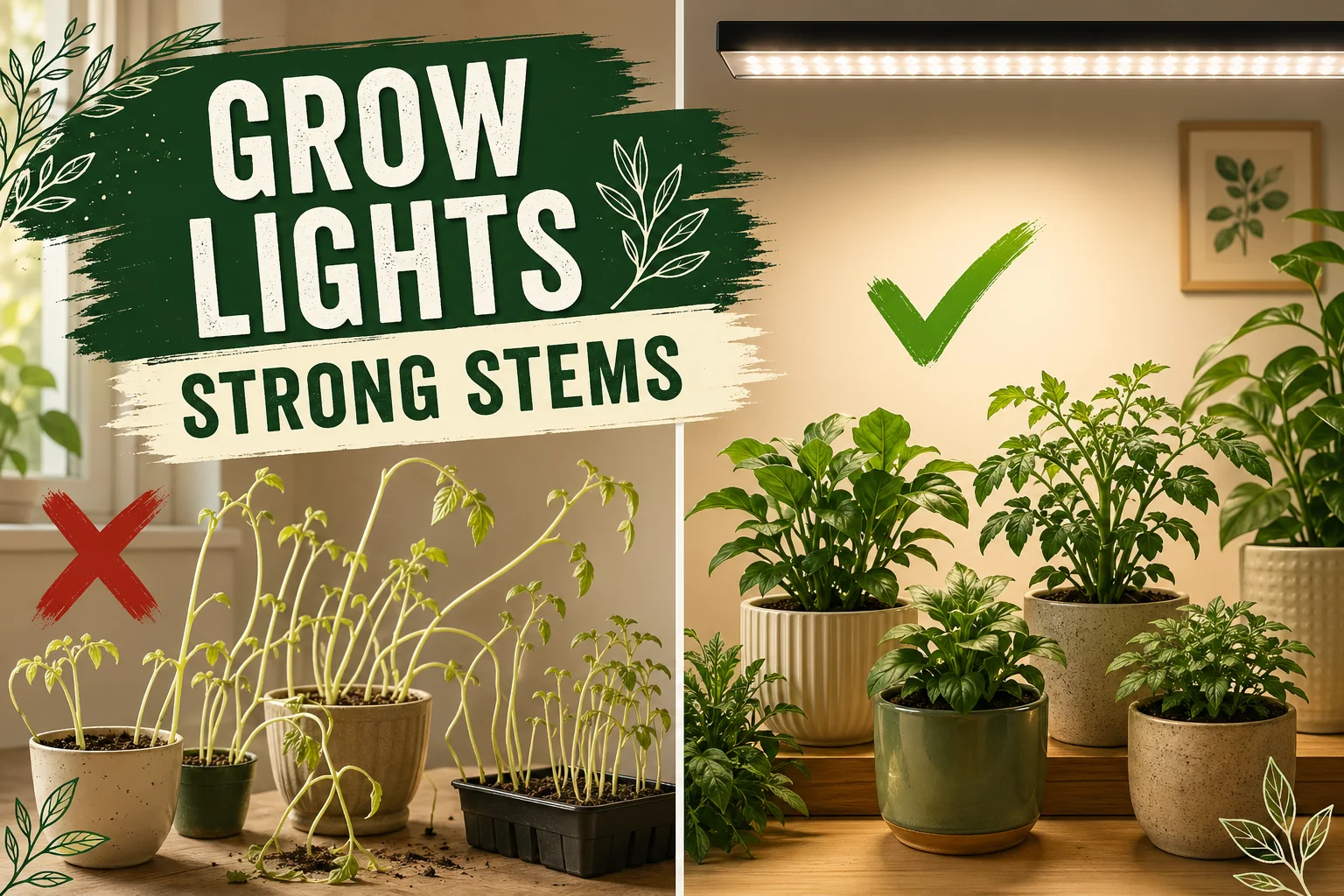
- Etiolation — stems grow long and spindly, reaching toward the nearest light source. Internodal spacing (gap between leaves) becomes unusually long.
- Small new leaves — new growth is noticeably smaller than mature leaves on the same plant.
- Pale or washed-out color — leaves that should be deep green appear lime green or yellowish, even when watering and feeding are correct.
- Variegation loss — variegated species (pothos, monstera, calathea) revert toward plain green as the plant prioritizes chlorophyll in low light.
- No new growth in the growing season — a healthy plant with adequate light should push new leaves throughout spring and summer.
- Flowering plants stop blooming — most flowering houseplants need 200 µmol/m²/s or more to set and sustain buds.
If you see two or more of these signs and watering, soil, temperature (18–24°C / 65–75°F), and humidity are in good range, add or upgrade the grow light first.
Signs your plant is getting too much light
Excessive light intensity causes its own set of problems:
- Bleaching or whitening — leaves directly under the light develop pale, washed-out patches or turn white. This is photobleaching of chlorophyll.
- Leaf curl or cupping — leaves curl inward (upward cup) to reduce surface area exposed to intense light.
- Brown crispy tips or edges — common in species with thinner leaves such as calathea, ferns, and peace lily.
- Wilting despite moist soil — intense light raises leaf-surface temperature and accelerates transpiration faster than the roots can replenish moisture.
Fix: raise the light by 5–10 cm (2–4 in) increments until symptoms stop.
Best LED grow light brands and price ranges
The grow light market is cluttered. Here is an honest breakdown by budget tier.
Budget tier ($15–$40)
GE Lighting Grow Light LED and Ankace clip-on bars are the most reliable names at this price. Output is modest — suitable for low-to-medium light houseplants like pothos, snake plants, and peace lily. Not powerful enough for high-light herbs or succulents unless positioned very close.
Mid-range ($40–$100)
MARS HYDRO TS600, Spider Farmer SF-1000, and Barrina T5 LED bars sit in this tier. These deliver genuine PPFD in the 200–400 µmol/m²/s range at the recommended working distance. The Barrina T8 6-pack (around $50) is the best-value option for long shelf systems.
High-end / enthusiast ($100–$300+)
Spider Farmer SE3000, MARS HYDRO FC-E3000, and HLG (Horticulture Lighting Group) 100 V2 Rspec are well-regarded in this bracket. HLG panels use Samsung LM301 diodes and produce genuine quantum-board efficiency. These are overbuilt for a windowsill but ideal for a dedicated plant room, large shelf setup, or if you want one light that handles everything from seedlings to fruiting tomatoes.
Quick recommendation by need:
- Single houseplant on a shelf: clip-on LED bar, $20–$40
- Multiple plants on a 90–120 cm (3–4 ft) shelf: Barrina T8 6-pack or MARS HYDRO TS600
- Dedicated growing tent or room: HLG or Spider Farmer quantum board panels
DIY positioning: clamp lamps and shelf systems
You do not need specialist equipment to mount a grow light effectively.
Clamp lamp setup
A clip-on grow light (bar or bulb-socket style) attached to a shelf edge or pole is the simplest option. Position the clamp so the light hangs directly above the plant canopy at the correct distance. Zip-tie a small hook to the shelf above to allow height adjustment with an S-hook and chain.
Shelf system
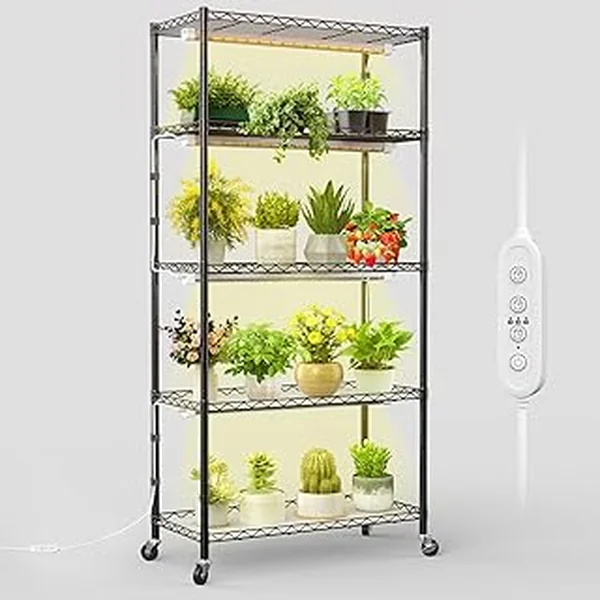
A steel wire shelving unit (the kind sold in kitchen supply stores) is ideal. The open wire shelves allow you to mount Barrina T8 bar lights directly beneath each shelf with the included mounting clips, creating a multi-tier growing station:
- Top shelf: seedlings under bright light (16 hours / 20 cm / 6500K)
- Middle shelf: medium-light tropicals (14 hours / 25 cm / 4000K)
- Bottom shelf: low-light species (12 hours / 30 cm / 3500K)
A 4-tier unit measuring 90 × 45 cm (36 × 18 in) holds 20–30 houseplants and costs around $40–$60 for the rack plus $50–$80 for lights — a complete grow station under $150.
Ceiling hooks and hanging systems
For grow tents or larger spaces, hang lights from adjustable ratchet rope hangers (included with most panel lights, or $8–$12 separately). These let you raise the light as plants grow taller without re-rigging. Mark the rope at the correct position with a cable tie so you can reset quickly.
Common mistakes
Using a regular LED bulb. A household LED bulb produces mostly green and yellow light at very low intensity. It looks bright to human eyes but delivers almost no usable photons to plant chlorophyll. Use a designated grow light.
Leaving lights on 24 hours. More is not better. Plants need darkness. Short-day plants will not flower; other species develop tip burn and reduced vigor.
Ignoring heat buildup. In enclosed spaces, lights can raise the ambient temperature above 27°C (80°F), which stresses most houseplants. Ensure adequate airflow around the growing area.
Not using a timer. A single missed or late switch creates inconsistent photoperiods that stress plants and confuse short-day species.
Positioning plants too far to the sides. Light intensity drops sharply at the edges of any panel. Keep your most light-hungry plants directly below the center of the light source.
Buying on wattage alone. Wattage tells you electricity consumption, not PPFD output. A 1000W “blurple” LED from an unknown brand may deliver less usable light than a 100W Samsung LM301-based panel. Look for actual PPFD data at a specified distance, published in the product spec sheet.
Watch: how to use grow lights for indoor plants
This video gives a practical visual walkthrough of grow light setup and positioning that pairs well with the steps in this guide.
Search YouTube for: "how to use grow lights for indoor plants" — look for channels like Summer Rayne Oakes or Harli G for well-researched practical walkthroughs.
Related reading
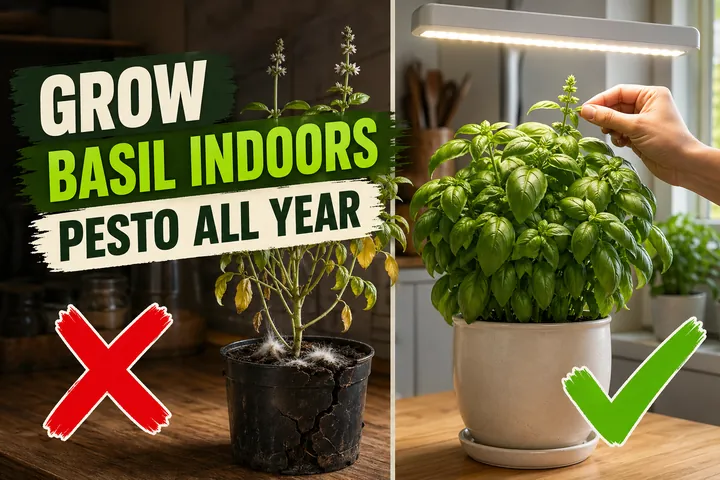
- How to grow basil indoors — basil is one of the best grow-light test plants; it makes visible growth within a week of correct setup.
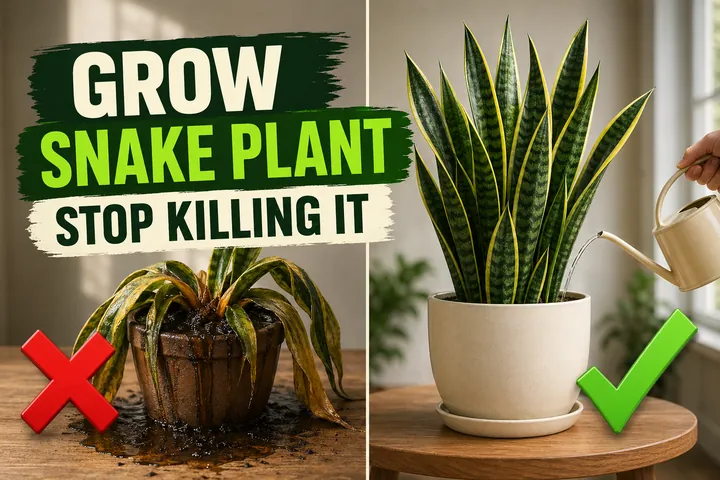
- How to take care of a snake plant — snake plant is a low-PPFD species that thrives at the bottom tier of any shelf system.
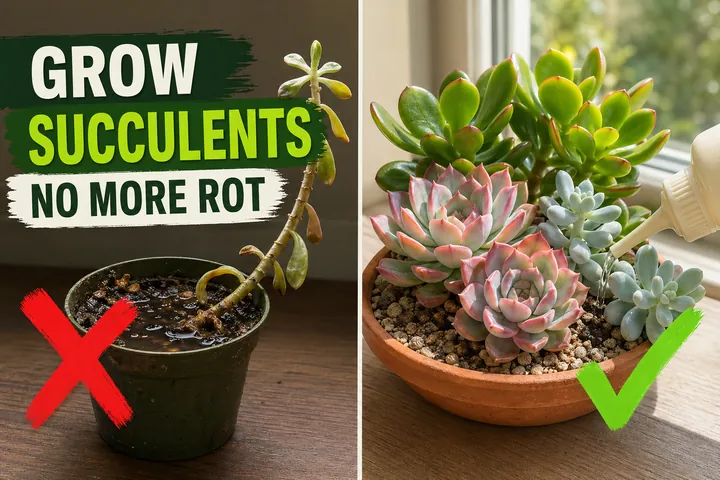
- How to take care of a succulent plant — succulents need the highest PPFD of any common houseplant and benefit most from high-intensity grow lights.
Sources
- University of Vermont Extension. “Lighting Indoor Houseplants.” uvm.edu
- University of Minnesota Extension. “Lighting for Indoor Plants and Starting Seeds.” extension.umn.edu
- Missouri Botanical Garden. “Grow Lights for Home Use.” missouribotanicalgarden.org
- North Carolina State Extension. “Understanding Daily Light Integral (DLI).” content.ces.ncsu.edu
Highly recommended
The supplies that make this guide work
Tazart is an Amazon Associate — we earn from qualifying purchases at no extra cost to you. Thank you for helping us keep these guides free.
Frequently asked questions
How far should a grow light be from plants?
For most full-spectrum LED panels, 20–30 cm (8–12 in) above the canopy is the standard starting position. High-intensity LEDs (200W+) may need to sit 45–60 cm (18–24 in) away to avoid bleaching. T5 fluorescent tubes work best at 5–15 cm (2–6 in) because they produce less heat and intensity. Always start at the greater distance and move the light closer every few days while watching for bleaching (pale or yellow patches) or stretching (sparse, leggy growth).
How many hours a day should grow lights be on?
Seedlings and fast-growing plants need 16–18 hours of light per day. Most tropical houseplants thrive on 14–16 hours. Low-light species such as pothos or snake plant do fine on 12–14 hours. Short-day flowering plants (e.g. Christmas cactus, poinsettia) need 12 hours or fewer to trigger blooms. Never run lights 24 hours a day — all plants need a dark period for cellular respiration and rest, even if they do not show obvious stress immediately.
What color temperature is best for grow lights?
For most houseplants, a balanced full-spectrum light in the 3500K–4500K range works well year-round. For seedlings and leafy growth, cooler white (5000K–6500K, more blue) promotes compact stems and dense leaves. For flowering and fruiting, warmer white (2700K–3000K, more red) triggers reproductive growth. The best practical choice is a single full-spectrum LED panel that covers 3000K–6500K, mimicking natural sunlight and covering every growth stage.
What is PPFD and why does it matter?
PPFD stands for Photosynthetic Photon Flux Density — it measures how many light particles (photons) in the 400–700 nm range hit a square metre of leaf surface each second. Units are µmol/m²/s. Low-light plants need 50–150 µmol/m²/s. Medium-light plants (most tropical houseplants) need 150–400 µmol/m²/s. High-light plants and edibles need 400–800+ µmol/m²/s. DLI (Daily Light Integral) is simply PPFD multiplied by the number of seconds of light per day — a useful target is 10–20 mol/m²/day for most houseplants.
How do I know if my plant needs more light?
The clearest signs are etiolation (long, thin, pale stems stretching toward the light source), small leaves that stay smaller than normal, pale green or yellowish color despite healthy watering and feeding, and very slow growth even during the growing season. Variegated plants may lose their pattern under low light. Flowering plants stop producing buds. If your plant shows two or more of these signs and the soil, water, and temperature are correct, insufficient light is almost certainly the cause.
Can I use any LED bulb as a grow light?
No. Standard household LED bulbs are tuned for human vision — they emit light biased toward green and yellow wavelengths, which plants reflect rather than absorb. Plants absorb mostly red (around 660 nm) and blue (around 440 nm) wavelengths for photosynthesis. A true grow light emits a full spectrum spanning those peaks at sufficient intensity (PPFD). A regular 9W LED bulb directly above a plant produces perhaps 20–40 µmol/m²/s at best — far below the 150+ µmol/m²/s most houseplants need.
Do plants need a dark period when using grow lights?
Yes, always. Even species that appear unaffected by continuous light undergo cellular processes at night including respiration, starch conversion, and hormone regulation. Short-day plants (poinsettia, Christmas cactus, kalanchoe) will refuse to flower without a dark period of 12+ hours. Running lights 24 hours can also cause leaf curl, tip burn, and reduced overall vigor in sensitive species. A simple mechanical or smart outlet timer set to 14 hours on / 10 hours off solves this completely.