Houseplants
How to Take Care of a Snake Plant (The Hardest-to-Kill Houseplant)
Snake plant care made simple — light, watering, soil, and the one mistake that kills 9 out of 10. A complete Dracaena trifasciata guide for beginners.
On this page
- Quick answer
- Why the snake plant is unkillable (almost)
- Light
- Water
- Soil
- Pot size
- Temperature and humidity
- Fertilizer
- Cleaning the leaves
- Common mistakes that kill snake plants
- Troubleshooting
- How to tell when your snake plant is happy
- A simple care schedule
- Watch: snake plant care walkthrough
- Related reading
- A note on conditions
Watch the visual walkthrough
Snake Plant Care Guide - Pick, Placing, and Parenting Your Plant
A short visual walkthrough that pairs with the steps above.
A snake plant (Dracaena trifasciata, formerly Sansevieria, sometimes called mother-in-law’s tongue) is the hardest-to-kill houseplant you can buy. It tolerates low light, dry air, missed waterings, and busy schedules — and it still pushes out tall, sword-shaped, variegated leaves year after year.
The only way to kill one is to water it like a normal houseplant. This guide shows you how not to.
Quick answer
Plant your snake plant in cactus or succulent soil mix in a pot with drainage holes. Place it in bright indirect light. Water only when the soil is completely dry to the bottom of the pot — usually every 2 to 6 weeks. Skip misting, skip frequent fertilizer, and repot every 2 to 3 years. Done correctly, a snake plant lives 10 to 25 years.
Why the snake plant is unkillable (almost)
The snake plant evolved in dry rocky regions of West Africa. Its thick upright leaves and underground rhizomes act as water tanks — the plant can survive months of drought by drawing on its own stored moisture.
That’s why it forgives almost every mistake except one: wet feet.
Sitting in soggy soil, the rhizome rots in days. By the time the leaves yellow, mushy collapse is already underway underground. Get the watering right and a snake plant essentially takes care of itself.
Light
Snake plants are famously flexible about light, but they’re not actually low-light plants — they just tolerate low light better than most.
| Light level | Where | What happens |
|---|---|---|
| Bright indirect | 1 m (3 ft) from a south or west window | Best growth, vivid variegation, new pups |
| Medium indirect | A few feet from a north or east window | Steady growth, slightly slower |
| Low light | Hallway, bathroom, dim office corner | Survives for years; almost no new growth; variegation fades |
| Direct hot sun | South window in summer with no curtain | Tip scorch, faded yellow patches |
If you only have one window, put the plant within 1.8 m (6 ft) of it and rotate the pot a quarter turn every couple of weeks so it grows evenly upright.
Water
This is the section that decides whether your snake plant lives or dies.
The rule
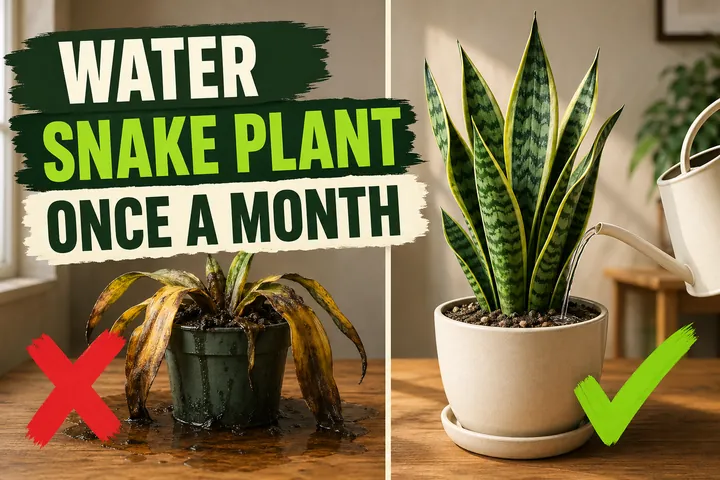
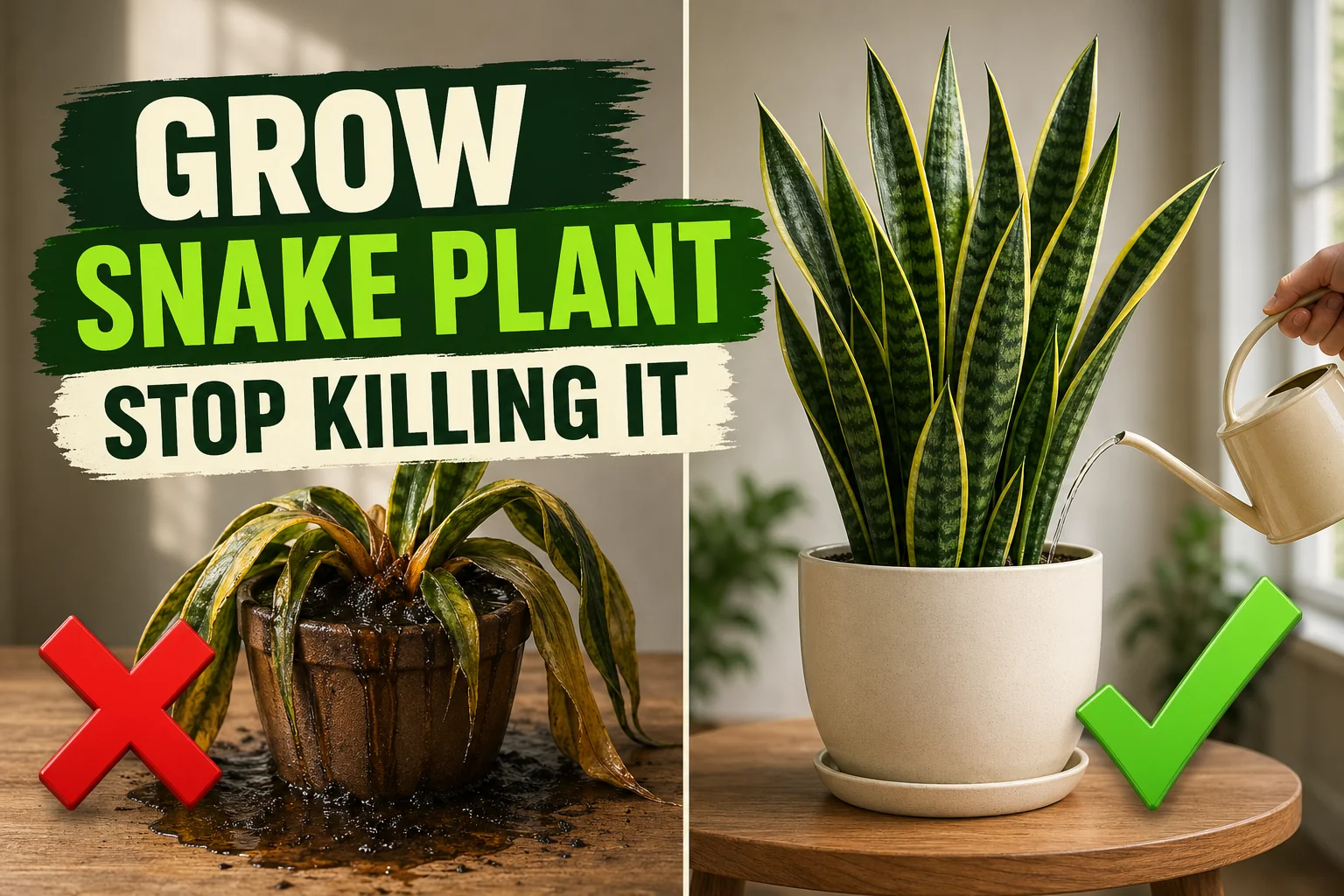
Water only when the soil is completely dry from top to bottom, then water deeply until it drains out the bottom of the pot. Empty the saucer 10 minutes later. Don’t water again until it’s bone dry.
How often that actually is
- Bright warm room: every 2 weeks
- Average indoor light, 18–22°C (65–72°F): every 3 to 4 weeks
- Low light or cool room: every 5 to 6 weeks (sometimes more)
- Winter, cool rooms below 16°C (60°F): cut watering in half
The number isn’t the rule — the dryness is. A finger pushed 5 cm (2 in) into the soil should feel completely dry. A wooden chopstick pulled out should come up clean and pale, not dark and damp. Cheap soil moisture meters work too — wait until the meter reads “dry” before watering.
When in doubt, don’t
If you’re unsure, wait another 3 to 5 days. A snake plant can go a month thirsty without complaint. It cannot bounce back from a rotted rhizome.
Soil
Snake plants need fast-draining soil. Standard houseplant potting mix holds too much water against the rhizome.
The simple fix:
- Buy a bagged cactus and succulent mix (it has more sand and perlite than peat).
- Or mix your own: 2 parts standard potting mix + 1 part coarse perlite + 1 part coarse sand.
The pot must have drainage holes. A pot without drainage will kill a snake plant faster than any other mistake on this list.
Unglazed terracotta is ideal — its porous walls pull moisture out so the soil dries faster. Glazed ceramic and plastic work, but you’ll water even less often.
Pot size
Snake plants like to be slightly root-bound. A pot 2.5 to 5 cm (1 to 2 in) wider than the root ball is plenty. Going too big means too much wet soil sitting around the roots between waterings, which leads to rot.
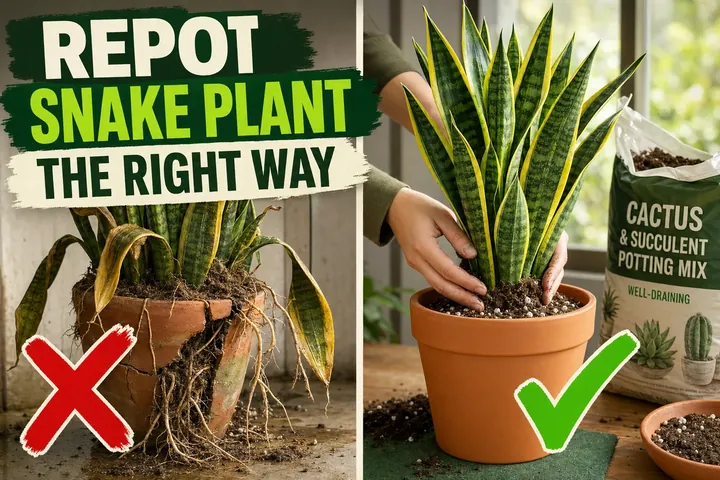
You only need to repot every 2 to 3 years — when the rhizomes are visibly pressing against the pot or splitting it. We’ve covered the full process step by step in our snake plant repotting guide.
Temperature and humidity
| Condition | Range |
|---|---|
| Ideal day temperature | 18–27°C (65–80°F) |
| Survival low | 10°C (50°F) |
| Damage threshold | Below 5°C (41°F) — leaves get mushy fast |
| Humidity | Whatever your house has — they don’t care |
Keep snake plants away from cold drafts, AC vents, and uninsulated windows in winter. They genuinely don’t care about humidity, so don’t bother with a humidifier or pebble tray.
Fertilizer
Less is more. A snake plant in fresh soil doesn’t need fertilizer for the first 6 months.
After that:
- A weak balanced liquid fertilizer (diluted to half strength)
- Once a month in spring and summer only
- No fertilizer in fall or winter
Over-fertilizing causes leggy floppy leaves and fertilizer salt burn at the leaf tips. Most underperforming snake plants suffer from too much food, not too little.
Cleaning the leaves
Dust blocks light. Once a month, wipe each leaf top and bottom with a damp microfiber cloth, supporting the leaf with your other hand so it doesn’t bend at the base.
Skip leaf-shine sprays — they clog the pores. Plain water on a soft cloth is all you need.
Common mistakes that kill snake plants
- Watering on a fixed schedule. Once a week, every Sunday — this is the #1 killer. Water by feel, not by calendar.
- Pots without drainage holes. Pretty cachepots are fine as outer covers, but the actual planting pot must drain.
- Standard houseplant soil. Holds water too long against the rhizome. Use cactus mix.
- Misting. Snake plants hate humidity on their leaves. Wipe with a damp cloth instead.
- Repotting too often, into pots too big. Both create extra wet soil that sits around the roots. Stay tight, repot rarely.
- Too much fertilizer. Half strength, once a month, growing season only.
- Leaving them in cold rooms. Below 10°C (50°F), the leaves go mushy. Move them off cold windowsills in winter.
Troubleshooting
| Symptom | Likely cause | Fix |
|---|---|---|
| Yellow mushy leaves at the base | Overwatering — rhizome rot | Tip out of pot, cut away mushy roots and bases with clean shears, repot in dry cactus mix, wait 7 days before watering |
| Leaves wrinkled and curling inward | Severe underwatering | Water deeply once, let drain fully, resume normal “fully dry” rule |
| Brown crispy leaf tips | Fluoride or chlorine in tap water, or fertilizer salt buildup | Switch to filtered or rainwater; flush soil with plain water every 6 months |
| Drooping floppy leaves | Too little light, or rhizome rot starting | Move to brighter spot; check the soil — if wet for days, repot |
| Pale washed-out leaves | Too much direct sun, or low light too long | Move to bright indirect light, away from harsh afternoon sun |
| Black soft spots on leaves | Fungal infection from misting or wet leaves | Stop misting; let air around the plant; cut away black tissue with sterile shears |
| Tiny black flying insects | Fungus gnats from soil staying too wet | Let soil dry completely; top with 1 cm (½ in) dry sand to block egg laying |
| White cottony patches on leaves | Mealybugs | Wipe each spot with a cotton swab dipped in 70% isopropyl alcohol; check the plant weekly for 4 weeks |
How to tell when your snake plant is happy
- Leaves are stiff and stand fully upright
- Variegation is bright and well-defined
- New shoots (pups) push up from the soil edge once or twice a year
- The soil dries out predictably between waterings
If all four are true, do nothing. The biggest favor you can do a snake plant is leave it alone.
A simple care schedule
Snake plant care is mostly knowing when not to act. Here’s the whole schedule on one page:
- Weekly: glance at the soil — if dry to the bottom, water deeply; otherwise wait
- Monthly (spring/summer): half-strength balanced liquid fertilizer with one watering
- Monthly: wipe dust off leaves with a damp cloth
- Every 2–3 months: rotate the pot a quarter turn for even growth
- Every 2–3 years: repot when the rhizomes are pressing against the pot wall
A free plant care app like Tazart can hold the watering reminder for you and adjust it for your local weather and the season — useful because snake plants need radically different watering frequencies in summer and winter, and most apps and humans get that wrong.
Watch: snake plant care walkthrough
A short visual walkthrough pairs well with the steps above. If you’re a visual learner, watch a quick beginner-focused snake plant care tutorial on YouTube and then come back to follow the watering and light timing in this guide.
Related reading
- How often to water a snake plant (without killing it) — the dedicated watering cadence guide with seasonal frequencies, pot-size adjustments, and the three thirst checks.
- How to repot a snake plant without killing it — the full step-by-step for the once-every-2-to-3-years repot, including the 5 to 7 day no-water rule.
- How to propagate a snake plant (water, soil, division) — three reliable methods to multiply one snake plant into many, plus why variegated cultivars revert from leaf cuttings.
- Pothos plant care guide — another nearly-unkillable houseplant that pairs beautifully with a snake plant in a low-light room.
- How to care for an aloe vera plant — same drought-tolerant, cactus-mix, water-rarely playbook applied to a different succulent.
- How to fix root rot on houseplants — snake plants are the most rot-prone houseplant in the world; bookmark the rescue protocol before you need it.
- Set up the watering schedule automatically with the free Tazart plant care app and stop worrying about whether it’s been 3 weeks or 4.
A note on conditions
Every home is different. Light, pot size, soil mix, room temperature, season, and your local weather all change how often a snake plant actually needs water. Use the ranges above as a starting point and adjust based on how dry the soil really is in week two — that’s how every good plant grower learns.
Highly recommended
The supplies that make this guide work
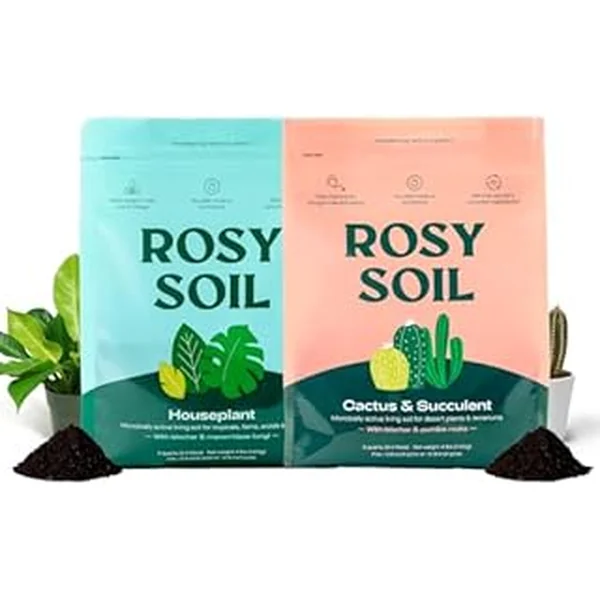
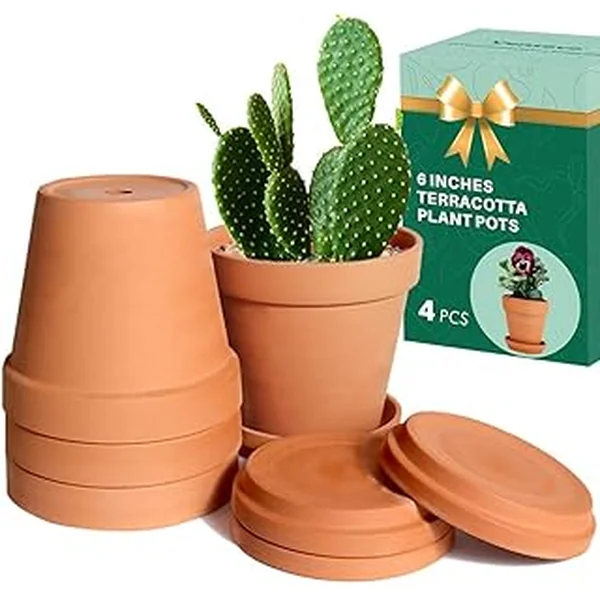

Tazart is an Amazon Associate — we earn from qualifying purchases at no extra cost to you. Thank you for helping us keep these guides free.
Frequently asked questions
How often should I water a snake plant?
Every 2 to 6 weeks — only when the soil is bone dry all the way to the bottom of the pot. In bright light and warm rooms, that's about every 2 weeks. In low light or cool rooms, it can stretch to 6 weeks or more. Snake plants store water in their thick leaves and rhizomes, so they'd rather be too dry than too wet.
Does a snake plant need sunlight?
It tolerates low light, but it grows best in bright indirect light. A few hours of soft morning sun makes the variegation more vivid and pushes new pups. Avoid harsh afternoon sun through glass — it can scorch the tips. A north or east window is ideal; a south window works if you set the plant a meter (3 ft) back from the glass.
Why are my snake plant leaves turning yellow?
Yellowing leaves on a snake plant almost always mean overwatering. The roots and rhizome rot first, then the damage shows in the leaves. Stop watering, tip the plant out of the pot, cut away any mushy tissue with clean shears, and repot in dry cactus mix. Wait 5 to 7 days before watering again.
How do you take care of a snake plant indoors?
Three rules cover 95% of indoor snake plant care: (1) plant it in cactus or succulent mix in a pot with drainage; (2) put it in bright indirect light; (3) let the soil dry completely between waterings. Skip misting. Skip frequent fertilizer. Repot every 2 to 3 years when the rhizomes start splitting the pot.
Is a snake plant easy to care for?
Yes — it's the easiest mainstream houseplant on the market. It survives forgotten waterings, low light, dry indoor air, and most beginner mistakes. The only thing it won't survive is constant overwatering, which causes the rhizome to rot. Water less than you think and it will outlive your interest in it.
Can a snake plant survive in low light?
Yes. Snake plants can live in a windowless office or a dim corner for years, but they grow extremely slowly there and the variegation fades. For real growth, give it bright indirect light. For pure survival, low light is fine.
How long do snake plants live?
Indoors, a healthy snake plant easily lives 10 to 25 years and produces multiple offshoots (pups) over its lifetime. Repot it every few years and it'll keep going indefinitely — you essentially never replace it, you just divide it.
Should I mist my snake plant?
No. Snake plants are native to dry rocky areas of West Africa and prefer low humidity. Misting raises humidity around the leaves and increases the risk of fungal spots and crown rot. Wipe dust off the leaves with a damp cloth instead — that's all the moisture they need on top.