Beginners
Best Low-Light Houseplants for Beginners (Top 10 That Actually Thrive)
Discover the best low light houseplants for beginners — 10 truly shade-tolerant picks, what low light really means scientifically, and how to keep them alive.
On this page
- Quick answer
- Table of Contents
- What does low light actually mean?
- Top 10 best low-light houseplants for beginners
- Plants commonly mislabelled as low-light
- Care basics for low-light plants
- Signs your plant is not getting enough light
- When to add a grow light
- Track your plant’s needs with Tazart
- Conclusion
- Frequently asked questions
Watch the visual walkthrough
5 Low-Light Houseplants 🌿 // Garden Answer
Here are some ideas for indoor plants that can take low light areas in your home or office. 1. Peace Lily 2. Pothos 3. Sansevieria 4.
The best low-light houseplants for beginners genuinely survive in dim conditions — not just on the store shelf. This guide separates the real performers from the popular mislabels, and covers care basics for each.
Quick answer
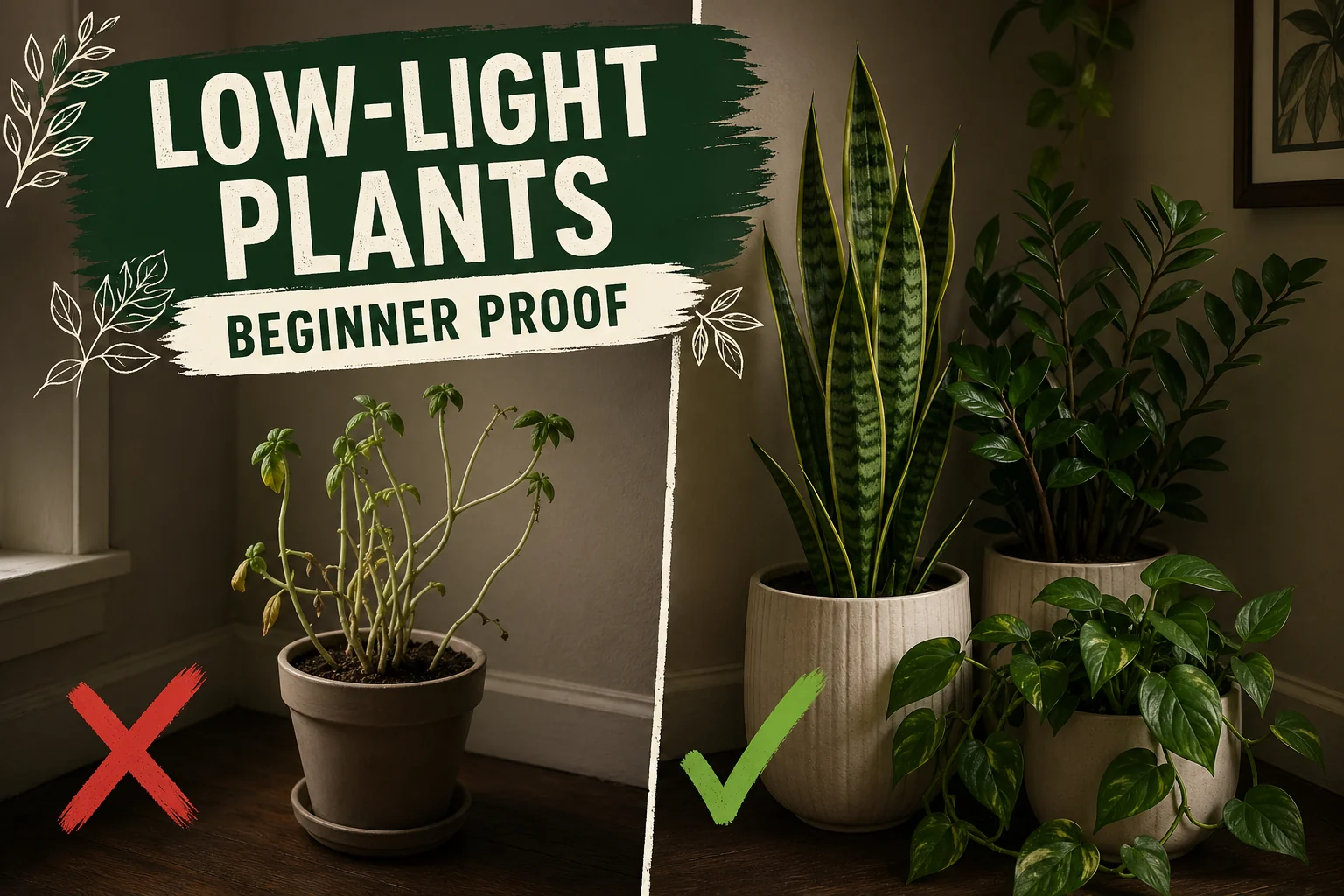
The top 10 truly low-light tolerant houseplants for beginners are: ZZ plant, snake plant, golden pothos, lucky bamboo, cast iron plant, parlor palm, peace lily, Chinese evergreen (Aglaonema), heartleaf philodendron, and Dracaena Janet Craig. All tolerate 50–150 foot-candles of ambient light with no direct sun. They all need far less water in low light than the label suggests — always check the soil before watering.
Table of Contents
- What does low light actually mean?
- Top 10 best low-light houseplants for beginners
- Plants commonly mislabelled as low-light
- Care basics for low-light plants
- Signs your plant is not getting enough light
- When to add a grow light
- Frequently asked questions
What does low light actually mean?
Low light is not “no light” — it’s a specific measurable range.
Plants scientists measure light in foot-candles (fc) or lux:
| Light level | Foot-candles (fc) | Where you typically find it |
|---|---|---|
| Full outdoor sun | 10,000–12,000 fc | Direct sun outside |
| Bright indirect | 500–2,000 fc | 0–1 m (0–3 ft) from a south or west window |
| Medium indirect | 150–500 fc | Centre of a sunny room, or near an east window |
| Low light | 50–150 fc | Far from any window, north windows, dark corners |
| Very low / no light | Below 50 fc | Windowless rooms, hallways, basements |
Low light means 50–150 fc of ambient light with no direct sun touching the plant. A dim hallway, the far end of a living room, or a frosted north window all qualify.
Quick field test: hold your hand 30 cm (12 in) above white paper. Faint shadow = low light. Sharp shadow = medium to bright. No shadow = even the toughest plants will struggle long-term.
Top 10 best low-light houseplants for beginners
1. ZZ plant — Zamioculcas zamiifolia
The undisputed champion for beginners in dim spaces. The ZZ plant stores water in underground rhizomes that look like small potatoes, making it capable of surviving weeks of neglect.
- Light: 50–150 fc — thrives in dim offices, hallways, apartment corners
- Water: Every 3–6 weeks in low light; only when the soil is bone dry to the bottom
- Temperature: 15–30°C (60–86°F); keep away from drafts below 10°C (50°F)
- Why beginners love it: Glossy, architectural leaves; near-impossible to kill; air-purifying; slow but steady grower
Warning: ZZ plant is toxic to pets and humans if ingested. Wash hands after handling.
2. Snake plant — Dracaena trifasciata
Formerly Sansevieria, the snake plant is almost as indestructible as the ZZ plant. Thick sword-shaped leaves store water like a cactus.
- Light: 50–300 fc — survives in low light, grows faster in medium light
- Water: Every 4–8 weeks in low light; only when soil is completely dry
- Temperature: 16–27°C (60–80°F); avoid below 10°C (50°F)
- Why beginners love it: Upright form; works anywhere; filters formaldehyde from air
Toxic to cats and dogs if chewed.
3. Golden pothos — Epipremnum aureum
One of the fastest-growing, most forgiving houseplants on the planet. Golden pothos trails or climbs and fills a shelf or corner in months.
- Light: 50–200 fc — variegation fades in very low light, but the plant stays alive
- Water: Every 1–3 weeks in low light; when the top 5 cm (2 in) of soil feel dry
- Temperature: 15–30°C (60–86°F)
- Why beginners love it: Extremely fast growth; propagates easily in water; trails beautifully from shelves
4. Lucky bamboo — Dracaena sanderiana
Despite the name, lucky bamboo is not a true bamboo — it’s a Dracaena that grows in water or moist soil and is one of the most shade-tolerant plants you can buy. It’s commonly sold in decorative vases and requires almost no care.
- Light: 50–150 fc — thrives in rooms with no direct sun
- Water: Grown in water: change the water every 1–2 weeks using filtered or distilled water. In soil: keep lightly moist.
- Temperature: 18–30°C (65–86°F); avoid cold drafts
- Why beginners love it: No soil needed; striking architectural form; widely available; nearly indestructible
5. Cast iron plant — Aspidistra elatior
True to its name, the cast iron plant is one of the most shade-tolerant plants in existence. Victorian parlours with gas-lit rooms were famous for growing it. It grows very slowly, but it virtually never dies.
- Light: 25–100 fc — the genuine champion of low-light tolerance
- Water: Every 3–6 weeks; extremely drought tolerant
- Temperature: 7–27°C (45–80°F); one of the most cold-tolerant indoor plants
- Why beginners love it: Works in near-windowless rooms; pest-resistant; virtually maintenance-free
6. Parlor palm — Chamaedorea elegans
The parlor palm is one of the few true palm trees that tolerates indoor low light. It grows in graceful fronds up to 1.2 m (4 ft) tall and brings a tropical feel to dim corners.
- Light: 75–150 fc — tolerates low light; keep away from direct sun
- Water: Every 1–2 weeks in low light; keep the top 3 cm (1 in) of soil slightly moist
- Temperature: 18–27°C (65–80°F)
- Why beginners love it: Non-toxic to pets; elegant tropical look; relatively pest-free indoors
7. Peace lily — Spathiphyllum wallisii
Peace lilies are one of the few flowering plants that bloom in low light. The white spathe flowers appear 1–2 times per year even in dim conditions, making them a favourite for offices and bathrooms.
- Light: 50–150 fc — one of few flowering plants that actually blooms in low light
- Water: Every 1–2 weeks; the plant will visibly droop slightly when thirsty (a helpful signal)
- Temperature: 18–30°C (65–86°F); keep away from cold windows in winter
- Why beginners love it: Blooms without direct sun; tells you when it’s thirsty; removes toxins from air
Also mildly toxic to cats and dogs.
8. Chinese evergreen — Aglaonema spp.
Chinese evergreens come in dozens of colour varieties — green, silver, red, pink — and most tolerate low light well. The darker-leafed varieties (green and silver) tolerate lower light than the bright red or pink varieties.
- Light: 50–200 fc for dark varieties; pink/red varieties need 150–300 fc
- Water: Every 1–3 weeks; allow the top 3–5 cm (1–2 in) to dry before watering
- Temperature: 16–30°C (60–86°F); dislike cold drafts
- Why beginners love it: Stunning foliage patterns; widely available; adapts well to indoor conditions
9. Heartleaf philodendron — Philodendron hederaceum
The heartleaf philodendron is a trailing vine with glossy heart-shaped leaves. It’s slightly more light-hungry than pothos but tolerates low-light rooms well and grows fast enough to feel rewarding.
- Light: 75–200 fc; can handle low light, prefers medium indirect
- Water: Every 1–2 weeks in low light; top 3 cm (1 in) of soil should dry between waterings
- Temperature: 18–30°C (65–86°F)
- Why beginners love it: Lush tropical look; fast growth; easy to propagate in water
10. Dracaena Janet Craig — Dracaena fragrans ‘Janet Craig’
The Janet Craig is the classic office plant — a tall Dracaena with broad, deep-green strappy leaves. It has earned a reputation in interior design as a dependable anchor plant for low-light corners.
- Light: 50–150 fc — genuinely thrives in office-level light
- Water: Every 2–4 weeks in low light; very sensitive to fluoride in tap water (use filtered water or let tap water sit overnight)
- Temperature: 16–27°C (60–80°F)
- Why beginners love it: Bold architectural presence; extremely low maintenance; long-lived
Plants commonly mislabelled as low-light
Many popular plants are sold as “low maintenance” but actually need bright indirect light to survive long-term. Putting them in a dark corner causes slow decline.
| Plant | What stores say | Reality |
|---|---|---|
| Fiddle leaf fig (Ficus lyrata) | “Easy statement plant” | Needs 6+ hours of bright indirect light; leaf drop is rapid in low light |
| Succulents (echeveria, aloe, haworthia) | “Thrives anywhere” | Need 4–6 hours of direct or very bright light; etiolate (stretch out) fast in low light |
| Bird of paradise (Strelitzia) | “Tropical accent” | Needs full bright indirect light; refuses to flower below 1,500 fc |
| Rubber plant (Ficus elastica) | “Low light tolerant” | Tolerates medium light but needs 300–500 fc minimum; will drop leaves in true low light |
| Calathea | ”Perfect for dim rooms” | Tolerates medium-low light but is sensitive to cold, dry air, and inconsistent watering |
If a store tells you a fiddle leaf fig or succulent is “perfect for a dim corner,” it is not accurate. These plants need real light to survive.
Care basics for low-light plants
Water less than you think
In low light, plants photosynthesize slowly and use far less water. The same pot that needs weekly watering near a bright window may only need water every 3–4 weeks in a dim corner.
Push your finger 5 cm (2 in) into the soil before every watering. Damp = wait. Completely dry = water thoroughly.
No direct sun
Every plant on this list is shade-adapted. Even an hour of afternoon sun through glass can burn leaves. Place them away from south and west windows, or use a sheer curtain.
Consistent temperature
Most of these plants prefer 15–27°C (60–80°F). Drafts from hallways, air conditioning vents, or cold north windows can shock them — keep plants away from all vents and cold glass in winter.
Keep leaves clean and feed lightly
In low light every bit of photosynthesis counts — wipe leaves with a damp cloth every 4–6 weeks to remove dust. Fertilise at quarter-strength with a balanced liquid feed once a month from spring through early autumn. Stop entirely in winter.
Signs your plant is not getting enough light
Even “low-light” plants have a threshold. If your plant shows any of these signs, it needs more light — or a grow light:
| Sign | What it means |
|---|---|
| Leaves are pale or yellowing (without overwatering) | Chlorophyll production is failing from insufficient light |
| New leaves are smaller than old ones | The plant is rationing energy; not enough light to build full-sized tissue |
| Leggy stems with wide gaps between leaves (etiolation) | The plant is stretching toward any light source |
| Variegated plants turning solid green | The plant is sacrificing variegation to maximise chlorophyll |
| Plant leans dramatically toward the window | Phototropic response to insufficient ambient light |
| Growth has fully stopped for more than one season | Below the plant’s survival threshold |
If you see two or more of these signs, act quickly. Move the plant closer to a window, rotate it weekly, or add a grow light.
When to add a grow light
You need a grow light when:
- Your apartment has no south or west windows — only north-facing or frosted glass
- Your room stays below 50 fc even on bright days
- Your plants show two or more of the insufficiency signs above
- You want to grow plants in a windowless room, bathroom, or office interior
A full-spectrum LED grow light bar at 12–14 hours per day and 200–400 fc at leaf level is sufficient for all 10 plants on this list. A clip-on bar in the $20–$50 range works well. Set it on a timer — consistency matters more than intensity. A free lux meter app on your phone can confirm the light level at the plant’s location (aim for at least 500 lux / 50 fc).
Track your plant’s needs with Tazart
The Tazart plant care app lets you set custom watering reminders per plant and ask Dr. Afrao. — the in-app AI assistant — for care advice tailored to your conditions.
For deeper dives on specific plants from this list, see: how to take care of a snake plant, how often to water a snake plant, and how to propagate a ZZ plant.
Conclusion
Low-light houseplants genuinely thrive without direct sun — but “low light” means 50–150 foot-candles of ambient light, not zero light. The 10 plants above (ZZ plant, snake plant, pothos, cast iron plant, parlor palm, peace lily, Chinese evergreen, heartleaf philodendron, lucky bamboo, and Dracaena Janet Craig) are the most beginner-proof options in that range.
The single most important habit: water less in low light. The soil dries far more slowly in a dim corner than near a window, and overwatering kills more low-light plants than shade ever does. Check the soil every time before you water, and you will keep these plants alive for years.
Frequently asked questions
Sources: University of Vermont Extension · Missouri Botanical Garden · Royal Horticultural Society · University of Minnesota Extension
Highly recommended
The supplies that make this guide work
Tazart is an Amazon Associate — we earn from qualifying purchases at no extra cost to you. Thank you for helping us keep these guides free.
Frequently asked questions
What is considered low light for houseplants?
Low light is typically 50–150 foot-candles (fc) of illumination — the level found in the centre of a room without windows nearby, or beside a north-facing window. It means no direct sun rays touch the plant. A simple way to test it: hold your hand 30 cm (12 in) above a white sheet of paper. If you can barely see a shadow, you have low light. If there is no shadow at all, most plants will struggle to survive long-term.
Can plants actually survive without any sunlight?
No plant can survive at zero light — photosynthesis requires some light energy to function. What the 'no sunlight needed' label really means is that the plant tolerates very low ambient indoor light (50–150 fc) with no direct sun rays. In a truly dark room with no windows, even the most shade-tolerant plant will slowly decline over months. A full-spectrum grow light set to 12–14 hours per day solves this completely.
Which is the easiest low-light houseplant for a beginner?
The ZZ plant (Zamioculcas zamiifolia) is the single easiest low-light houseplant for beginners. Its underground rhizomes store months of water, it tolerates serious neglect, it thrives in dim corners, and it survives irregular watering better than any other common houseplant. If you have killed every plant you have ever owned, start with a ZZ plant.
Is the fiddle leaf fig a low-light plant?
No. The fiddle leaf fig (Ficus lyrata) is one of the most light-demanding houseplants sold in mainstream garden centres. It needs bright indirect light for at least 6 hours per day — ideally a south or west window. Putting a fiddle leaf fig in a dim corner will cause leaf drop within weeks. It is one of the most commonly mislabelled 'easy' plants on the market.
Do I need a grow light for low-light plants?
Not always — genuine low-light plants (ZZ, snake plant, cast iron plant, pothos) do fine in a room with at least one window. But if your apartment has no windows or only tiny north-facing skylights, a small full-spectrum LED grow light bar (set to 12–14 hours per day at 200–400 fc) will keep any low-light plant healthy indefinitely. It also speeds up growth noticeably.
How do I know if my plant is not getting enough light?
Look for these signs: leaves are paler or yellowing even without overwatering; new leaves are noticeably smaller than older ones; stems are long and leggy with wide gaps between leaves (etiolation); variegated plants lose their pattern and turn solid green; the plant leans sharply toward the nearest light source; growth has completely stopped for more than a season.
Should I water low-light plants the same as bright-light plants?
No — water significantly less. In low light, plants photosynthesize more slowly and use far less water. The same pot that needs watering weekly in a bright window may only need water every 3–4 weeks in a dim corner. Always check the soil with your finger or a moisture meter before watering. The number-one killer of low-light plants is overwatering, not the lack of light.
Are succulents good low-light plants?
No. Succulents require very bright light — at least 6 hours of direct or intense indirect light. They are among the worst choices for a dark corner. In low light, succulents stretch out (etiolate), lose their compact form, and eventually collapse. If you love the look of succulents but have a dim room, use a pothos or ZZ plant instead, and add a grow light if you really want to attempt succulents.