Guide
What Part of the Canola Plant Does Canola Oil Come From?
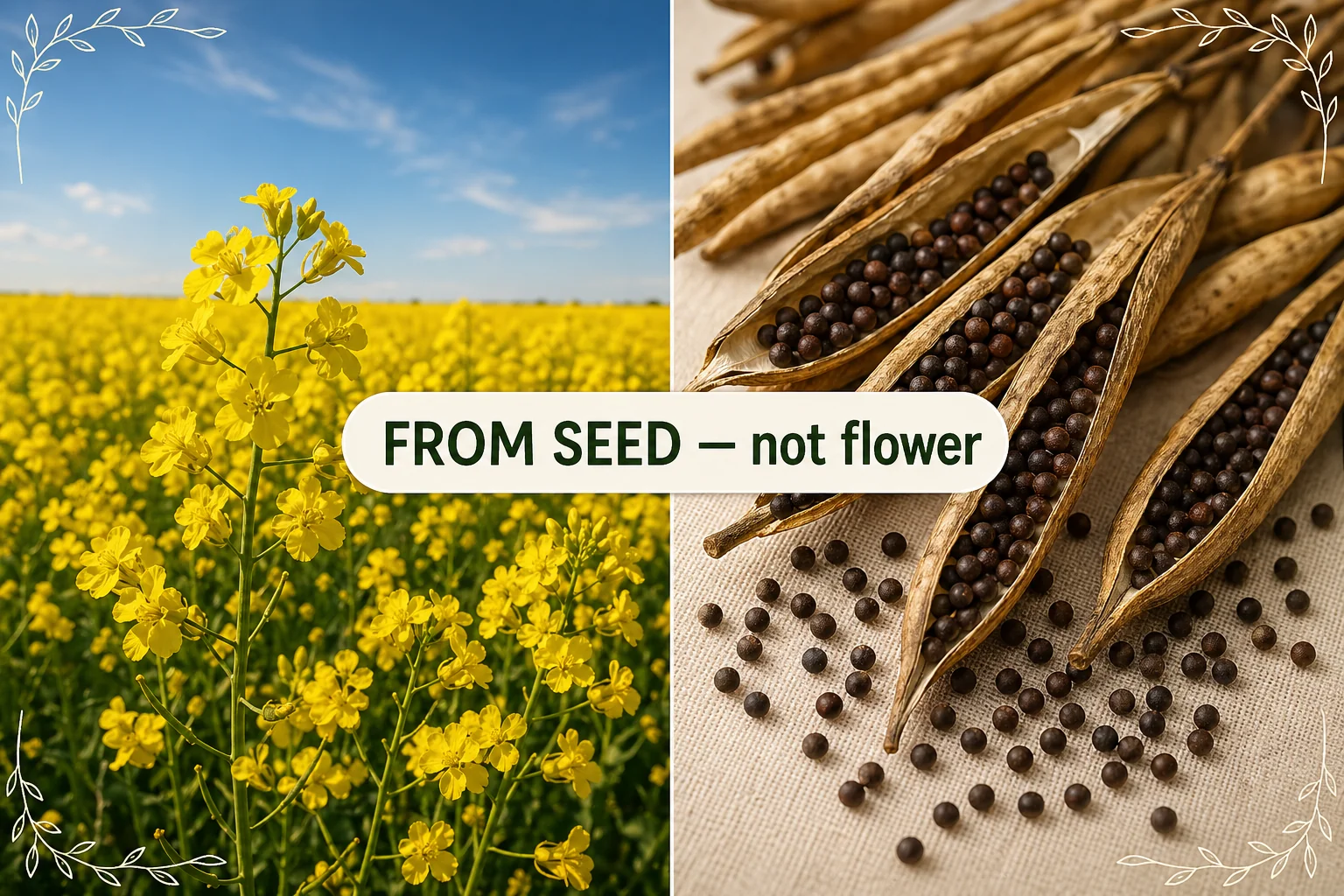
Canola oil comes from the tiny seeds inside the plant's seed pods. Learn how Brassica napus goes from yellow flower to refined cooking oil — step by step.
On this page
- Quick Answer
- Table of Contents
- The Plant Behind the Oil: Brassica napus
- The Canola Lifecycle — From Seed to Harvest
- What Part of the Plant Produces Oil?
- Inside a Canola Seed Pod
- From Seed to Bottle: How Canola Oil is Extracted
- Canola vs Rapeseed: The Canadian Breeding Story
- Cooking With Canola Oil: What the Seed Tells You About the Oil
- Common Misconceptions
- Troubleshooting Table: Canola Oil Questions
- Watch: How Canola Oil is Made (Video Guide)
- FAQs
- Conclusion
- Related Reading
Watch the visual walkthrough
WHERE DOES CANOLA OIL COME FROM?
A short visual walkthrough that pairs with the steps above.
Quick Answer
Canola oil comes from the seeds of the canola plant (Brassica napus) — not the bright yellow flowers that make canola fields so recognisable. After the flowers drop, small seed pods (called siliques) form and mature over 6–8 weeks. Each pod holds 15–30 tiny oil-rich seeds. Those seeds are harvested, pressed, and refined to produce canola oil. The yellow flowers play no role in the oil itself — they are simply the pollination stage of the plant’s lifecycle.
Table of Contents
- The Plant Behind the Oil: Brassica napus
- The Canola Lifecycle — From Seed to Harvest
- What Part of the Plant Produces Oil?
- Inside a Canola Seed Pod
- From Seed to Bottle: How Canola Oil is Extracted
- Canola vs Rapeseed: The Canadian Breeding Story
- Cooking With Canola Oil: What the Seed Tells You About the Oil
- Common Misconceptions
- Troubleshooting Table: Canola Oil Questions
- FAQs
The Plant Behind the Oil: Brassica napus
Canola is the trade name for a specific cultivated form of Brassica napus, a flowering plant in the cabbage family (Brassicaceae). It is closely related to broccoli, kale, mustard, and turnip — all members of the same genus.
The plant grows 1–1.8 m (3–6 ft) tall, develops clusters of bright yellow four-petalled flowers, and produces slender seed pods after pollination. Those pods are where the oil story begins.
Canola is now one of the world’s most important oilseed crops, grown across Canada, Australia, Europe, and China. Canada alone produces roughly 18–20 million metric tonnes per year.
The Canola Lifecycle — From Seed to Harvest
Understanding where canola oil comes from means following the plant through its full growing season. Each stage feeds into the next.
Stage 1 — Germination and Seedling (Days 1–14)
Canola seeds are sown in spring (or autumn in warmer climates) at a shallow depth of 1–2 cm (0.5–1 in) into well-prepared soil. The seed germinates within 5–10 days when soil temperature is above 7°C (45°F). Tiny seed leaves (cotyledons) emerge first, followed by the true leaves.
Stage 2 — Rosette and Stem Elongation (Weeks 3–6)
The plant builds a dense rosette of blue-green waxy leaves, then rapidly extends a central flower stem. This vegetative growth period is when the plant stores energy for flowering and seed production.
Stage 3 — Flowering (Weeks 7–10)
Clusters of vivid yellow flowers open from the bottom of the flower stem upward. Each flower has four petals arranged in a cross shape (hence “Cruciferae,” the old family name). Bees and wind carry pollen between flowers.
This is the stage most people associate with canola — sweeping yellow fields photographed in spring. But the oil is nowhere near ready yet.
Stage 4 — Pod Formation and Seed Fill (Weeks 11–17)
After pollination, each flower’s petals drop and a narrow green pod (silique) begins to elongate. The pod reaches 5–7 cm (2–3 in) long. Inside, seeds develop in two rows, filling with oil and protein over the next 6–8 weeks.
This is the critical stage. The seeds accumulate 40–45% of their final weight as oil.
Stage 5 — Maturation and Harvest (Weeks 18–22)
Pods turn yellow-tan. Seeds inside shift from green to dark brown or black. Farmers monitor moisture content — harvesting begins when seed moisture drops to around 8–10%.
Canola is typically swathed (cut and left to dry in windrows) or straight-combined depending on climate and crop evenness. The combine separates seeds from pods and stalks. The seeds go to a drying facility, then to the crushing plant.
What Part of the Plant Produces Oil?
The answer is unambiguous: the seeds only.
Here is why the other parts of the plant do not contribute:
| Plant part | Role | Oil content |
|---|---|---|
| Yellow flower | Pollination only | Negligible |
| Stem and leaves | Photosynthesis, structural support | Negligible |
| Root | Nutrient uptake | Negligible |
| Seed pod (silique) wall | Protects seeds while they develop | Very low |
| Seeds | Oil-rich reproductive structures | 40–45% oil by weight |
The seed is essentially a concentrated package of oil, protein, and a small embryo — the plant’s investment in its next generation. That oil-dense composition is exactly what makes Brassica napus worth growing as a crop.
A single seed weighs roughly 3–5 mg. One kilogram (2.2 lb) of harvested seed yields approximately 400–450 ml (13.5–15 fl oz) of oil after full commercial extraction.
Inside a Canola Seed Pod
The pod (botanically a silique) is one of the most important structures in oilseed crops, yet most people have never looked closely at one.
Pod anatomy:
- Length: 5–7 cm (2–3 in)
- Seeds per pod: 15–30
- Arrangement: two rows separated by a thin papery septum (replum)
- Outer wall: thin and brittle when mature — this is intentional, as the pod must shatter or be threshed to release seeds
One reason canola can be tricky to harvest is that mature pods will shatter open and drop seeds if left too long in the field or handled roughly. Modern canola varieties are bred for shatter-resistance to reduce these harvest losses.
A plant under good growing conditions produces 50–100 pods. At 15–30 seeds per pod, that is 750–3,000 seeds per plant — each one holding its cargo of oil.
From Seed to Bottle: How Canola Oil is Extracted
Once seeds arrive at the processing plant, extraction happens in well-defined steps.
Step 1 — Cleaning and Conditioning
Seeds pass through screens and air separators to remove dirt, weed seeds, and pod fragments. They are then tempered with light heat and moisture to make the seed coat easier to crack without shattering the kernel.
Step 2 — Flaking and Cooking
Seeds are rolled into thin flakes to rupture the oil-bearing cells. The flakes are heated to 80–90°C (175–195°F) in a stack cooker to reduce viscosity and destroy enzyme activity that would otherwise cause quality problems in the oil.
Step 3 — Expeller / Mechanical Pressing
Flakes pass through a screw press (expeller). Pressure squeezes out 60–70% of the available oil. The remaining solid material — called press cake or canola meal — still contains 12–18% residual oil and is high in protein (roughly 36%).
Step 4 — Solvent Extraction (Commercial Only)
The press cake is treated with food-grade hexane solvent, which dissolves the remaining oil. The solvent is then evaporated and recovered for reuse. This recovers nearly all remaining oil, bringing total extraction efficiency to about 95–98%.
Cold-pressed canola skips this step entirely. It uses only the mechanical press, leaving more natural compounds in the oil but at a lower yield.
Step 5 — Refining (Degumming, Bleaching, Deodorising)
Raw pressed oil contains phospholipids, waxes, free fatty acids, colour pigments, and volatile flavour compounds. Refining removes these through:
- Degumming — water and acid treatment to remove phospholipids
- Bleaching — clay treatment to adsorb pigments and some impurities
- Deodorising — high-temperature steam stripping at 230–270°C (445–520°F) under vacuum to remove volatile compounds
The result is the clear, neutral-flavoured canola oil on supermarket shelves.
Cold-Pressed vs Refined: What’s the Difference?
| Property | Refined canola oil | Cold-pressed canola oil |
|---|---|---|
| Colour | Very pale yellow | Golden yellow |
| Flavour | Neutral | Mild nutty |
| Smoke point | ~204°C (400°F) | ~177–190°C (350–375°F) |
| Natural tocopherols | Partially reduced | Better retained |
| Price | Lower | Higher |
| Best use | High-heat cooking, frying, baking | Dressings, light sautéing, dipping |
Canola vs Rapeseed: The Canadian Breeding Story
Canola did not exist before the 1970s. Here is how it was created.
The problem with traditional rapeseed
Rapeseed (Brassica napus and Brassica rapa) had been grown in Europe and Asia for centuries as a lubricant oil. But it contained high levels of erucic acid — a long-chain fatty acid comprising up to 40–50% of the oil. Animal studies in the 1950s and 1960s raised concerns that high erucic acid intake could cause cardiac lesions. Traditional rapeseed oil also had high glucosinolate content in the meal, making it less useful as livestock feed.
The Canadian breeding solution
In the early 1970s, plant breeders Baldur Stefansson at the University of Manitoba and Keith Downey at Agriculture Canada developed new varieties of Brassica napus and Brassica rapa with dramatically reduced erucic acid and glucosinolate levels through conventional selective breeding.
In 1974, the trade name “canola” was coined — derived from Canadian oil, low acid — to distinguish these new low-erucic-acid varieties from the traditional high-erucic rapeseed oil.
The legal standard
To carry the canola name today, oil must meet two thresholds set by Health Canada and the Canola Council:
- Erucic acid: less than 2% of total fatty acids
- Glucosinolates in the seed meal: less than 30 micromoles per gram
Modern canola oil typically contains less than 0.5% erucic acid — a fraction of the original rapeseed’s content.
Nutritional profile of canola oil (per 14 ml / 1 tbsp)
| Nutrient | Amount |
|---|---|
| Total fat | 14 g |
| Saturated fat | 1 g (7% — lowest of common cooking oils) |
| Monounsaturated fat (oleic acid) | 8.9 g (64%) |
| Polyunsaturated fat — omega-6 (linoleic) | 2.6 g (19%) |
| Polyunsaturated fat — omega-3 (alpha-linolenic) | 1.3 g (9%) |
| Vitamin E | ~2.4 mg |
Canola oil’s omega-3 to omega-6 ratio of approximately 1:2 is among the most favourable of any common cooking oil, which is why dietitians and the USDA have recommended it as a heart-healthy cooking fat.
Cooking With Canola Oil: What the Seed Tells You About the Oil
Knowing canola oil comes from seeds — and specifically what those seeds contain — helps you use the oil smarter.
High smoke point for high heat
The extensive refining that commercial canola oil goes through removes compounds that would otherwise smoke or burn at moderate temperatures. The result is a smoke point of about 204°C (400°F) — higher than butter (150°C / 302°F), extra-virgin olive oil (~160–190°C / 320–375°F), and coconut oil (~177°C / 350°F). This makes refined canola ideal for:
- Deep frying
- Stir-frying
- Roasting at 200°C (390°F)
- Searing
Neutral flavour for baking
Because refining strips out the seed’s natural volatiles, canola oil contributes no perceptible flavour to baked goods. It substitutes 1:1 for vegetable oil in cakes, muffins, and quick breads — a practical benefit that traces directly back to the deodorising step at the processing plant.
Cold-pressed canola for finishing
If you find cold-pressed canola oil, treat it more like olive oil: use it for salad dressings, drizzling, and light sautéing rather than deep frying. The lower refining level means more flavour compounds remain, but also a lower smoke point of 177–190°C (350–375°F).
Common Misconceptions
“Canola oil is made from the yellow flowers.” No. The flowers are pollinated, then drop. Oil develops in seeds that form in the pods after flowering. The flowers contain no commercially usable oil.
“Canola is a genetically modified plant.” Most canola grown today is not GMO — especially European and Australian varieties. In Canada and the United States, a significant portion of commercial canola acreage is herbicide-tolerant GMO varieties (primarily Roundup Ready), but the genetic modification relates to herbicide resistance, not the oil composition or extraction process. Non-GMO certified canola oil is widely available.
“Rapeseed oil and canola oil are the same thing.” They are from the same plant species but are not the same product. Traditional rapeseed oil (still sold in Europe as “rapeseed oil”) may contain higher erucic acid than the canola standard. Always check the label for erucic acid content if you are purchasing European rapeseed oil.
“The solvent hexane leaves toxic residues in canola oil.” Hexane is fully evaporated and recovered during processing. Residual hexane levels in refined canola oil are typically below 1 part per million — well within food safety standards and comparable to naturally occurring background levels.
Troubleshooting Table: Canola Oil Questions
| Question | Answer |
|---|---|
| My canola oil smells slightly fishy — is it rancid? | Yes, likely. Omega-3 fatty acids in canola oxidise faster than saturated fats. Store in a cool, dark pantry and use within 6–12 months of opening. |
| Can I reuse canola oil after frying? | Up to 2–3 times if oil stays below 180°C (356°F) and is filtered between uses. Discard when it darkens, foams, or smokes prematurely. |
| Is cold-pressed canola worth the price premium? | For finishing and dressings, yes — the flavour is noticeably better. For high-heat frying, refined canola is the better (and cheaper) choice. |
| Does canola oil go solid in the fridge? | It may turn cloudy or partially solidify below 4°C (39°F) due to wax crystallisation — normal and reversible at room temperature. |
| What is the shelf life of sealed canola oil? | Typically 1–2 years from pressing when sealed and stored away from light and heat. Check the best-before date on the bottle. |
| Can I use canola oil to season a cast iron pan? | Yes. Canola’s low saturated fat content means it polymerises (bonds to the iron) well at oven temperatures of 230–260°C (450–500°F), creating a good non-stick layer. |
Watch: How Canola Oil is Made (Video Guide)
This short educational video gives a clear visual walkthrough of the canola seed-to-oil extraction process — from field harvest through mechanical pressing and refining. It pairs well with the extraction section above.
FAQs
What part of the canola plant does canola oil come from? Canola oil is pressed from the plant’s seeds — tiny round seeds about 1–2 mm (less than 1/10 in) in diameter that develop inside the seed pods (siliques) after the yellow flowers drop. Each mature plant carries 50–100 pods, and each pod holds 15–30 seeds. Those seeds contain roughly 40–45% oil by weight.
Is canola oil made from the flower or the seed? It is made entirely from the seed, not the flower. The bright yellow flowers are pollinated, then wither and fall. In their place a green seed pod grows, elongates, and matures. The seeds inside are harvested and pressed.
What is the difference between canola and rapeseed? Canola is a specific low-erucic-acid variety of rapeseed (Brassica napus) developed in Canada in the 1970s. It must contain less than 2% erucic acid to be legally sold as canola. Traditional rapeseed oil can contain 40–50% erucic acid.
How is canola oil extracted from the seeds? Seeds are flaked, cooked, then pressed in a mechanical expeller. The press cake is solvent-extracted with hexane to recover remaining oil. The crude oil is refined — degummed, bleached, and deodorised — to produce the clear, neutral product sold in stores.
How do canola seed pods form after flowering? After pollination, the flower’s petals drop and the base swells into a narrow pod (silique) about 5–7 cm (2–3 in) long. Seeds develop inside over 6–8 weeks. When pods turn yellow-brown and seeds turn dark, the plant is ready to harvest.
What does a canola seed look like? Canola seeds are tiny, spherical, and dark brown to reddish-black, roughly 1–2 mm (about 1/16 in) in diameter — similar in size to a poppy seed. Each seed contains approximately 40–45% oil by weight.
What is canola oil’s smoke point and why does it matter? Refined canola oil has a smoke point of approximately 204°C (400°F), making it suitable for frying, stir-frying, and roasting. Cold-pressed canola has a lower smoke point of around 177–190°C (350–375°F). Heating oil above its smoke point degrades it and produces off-flavours.
Conclusion
The short answer to “what part of the canola plant does canola oil come from” is the seeds. The yellow flowers that make canola fields so photogenic are simply the pollination stage — the oil develops later, in the seeds maturing inside the plant’s slender pods.
Understanding the full lifecycle — germination, flowering, pod fill, harvest, pressing, and refining — makes it easier to understand why canola oil behaves the way it does in your kitchen: its high smoke point, neutral flavour, and excellent fatty acid profile are all a direct result of where it comes from and how it is processed.
If you want to understand more about the edible plants and crops behind your kitchen staples, explore the related guides below.
Related Reading
- Best Conditions for Ginger to Grow — another rhizome crop with a fascinating lifecycle and strict growing requirements.
- How to Grow Basil Indoors — the most popular edible herb for home growers, explained in full.
- How to Grow Mint — a vigorous grower that pairs naturally with cooking oils and fresh cuisine.
Highly recommended
The supplies that make this guide work
Tazart is an Amazon Associate — we earn from qualifying purchases at no extra cost to you. Thank you for helping us keep these guides free.
Frequently asked questions
What part of the canola plant does canola oil come from?
Canola oil is pressed from the plant's seeds — tiny round seeds about 1–2 mm (less than 1/10 in) in diameter that develop inside the seed pods (siliques) after the yellow flowers drop. The flowers themselves contain no usable oil. Each mature plant carries 50–100 pods, and each pod holds 15–30 seeds. Those seeds contain roughly 40–45% oil by weight, which is extracted by mechanical pressing and, in commercial production, solvent extraction.
Is canola oil made from the flower or the seed?
It is made entirely from the seed, not the flower. The bright yellow flowers of Brassica napus are pollinated, then wither and fall away. In their place a green seed pod grows, elongates over 6–8 weeks, and matures to a brown or tan colour. Inside those pods the oil-rich seeds have developed. The plant is harvested at that pod-maturity stage, the seeds are separated, dried, and pressed to extract oil.
What is the difference between canola and rapeseed?
Canola is a specific low-erucic-acid, low-glucosinolate variety of rapeseed (Brassica napus) developed by Canadian plant breeders at the University of Manitoba in the early 1970s. Traditional rapeseed oil contained high levels of erucic acid (up to 40–50%) which raised health concerns. The name 'canola' is a contraction of 'Canadian oil, low acid.' To be legally called canola, the oil must contain less than 2% erucic acid and the meal must contain less than 30 micromoles of glucosinolates per gram.
How is canola oil extracted from the seeds?
Commercial canola oil extraction happens in two stages. First, seeds are cleaned, heated to about 80–90°C (175–195°F), and mechanically pressed in an expeller to squeeze out roughly 60–70% of the oil. Second, the remaining seed cake is treated with a solvent (usually hexane) to recover the remaining oil. The raw oil is then refined — degummed, bleached, and deodorised — to produce the clear, flavour-neutral product you buy in stores. Cold-pressed canola oil skips solvent extraction and most refining steps, retaining a slightly nuttier flavour.
How do canola seed pods form after flowering?
After a canola flower is pollinated (by wind or bees), the petals drop and the base of the flower swells into a narrow green pod called a silique. The silique grows to roughly 5–7 cm (2–3 in) in length over 6–8 weeks. Inside, seeds develop in two rows separated by a translucent membrane. When the pods turn yellow-brown and the seeds inside turn dark, the plant is ready to harvest. A single Brassica napus plant produces 50–100 pods, each containing 15–30 seeds.
What does a canola seed look like?
Canola seeds are tiny, spherical, and dark brown to reddish-black, roughly 1–2 mm (about 1/16 in) in diameter — similar in size to a poppy seed. They have a slightly waxy coat. Despite their small size, each seed contains approximately 40–45% oil by weight, making them one of the most oil-dense agricultural crops in the world. A kilogram (2.2 lb) of canola seed yields roughly 400–450 ml (13–15 fl oz) of oil after full extraction.
What is canola oil's smoke point and why does it matter for cooking?
Refined canola oil has a smoke point of approximately 204°C (400°F), which makes it suitable for pan-frying, stir-frying, roasting, and deep-frying. Cold-pressed or expeller-pressed canola has a slightly lower smoke point of around 177–190°C (350–375°F) because some natural compounds remain in the oil. Heating any oil above its smoke point breaks down fatty acids, generates acrolein (an acrid compound), and degrades the oil's nutritional profile, so matching oil to cooking temperature matters.