Houseplants
How to Plant a Mango Seed (Paper Towel & Direct Soil)
Plant a mango seed by extracting the inner kernel from the husk, germinating in a damp paper towel for 2–3 weeks, then potting up. Sprouts in 6–8 weeks at 24–27°C.
On this page
- Quick answer
- Husk vs. kernel: the make-or-break step
- Polyembryonic vs. monoembryonic seeds
- Method 1: paper towel germination
- Method 2: direct soil germination
- Extracting the kernel: step-by-step
- Caring for the seedling
- Will it ever fruit?
- Common mistakes
- Troubleshooting table
- Related reading
- A note on conditions
Watch the visual walkthrough
What to Do When Your Mango Seed Makes Multiple Sprouts Polyembryonic Mangos
Some mango seeds produce multiple shoots. Those are known as polyembryonic. They've got some very interesting properties.
A grocery-store mango pit is a viable houseplant tree waiting to happen. The seed inside that woody hairy husk is fresh, fertile, and capable of sprouting into a beautiful tropical foliage plant within a month — if you know one trick.
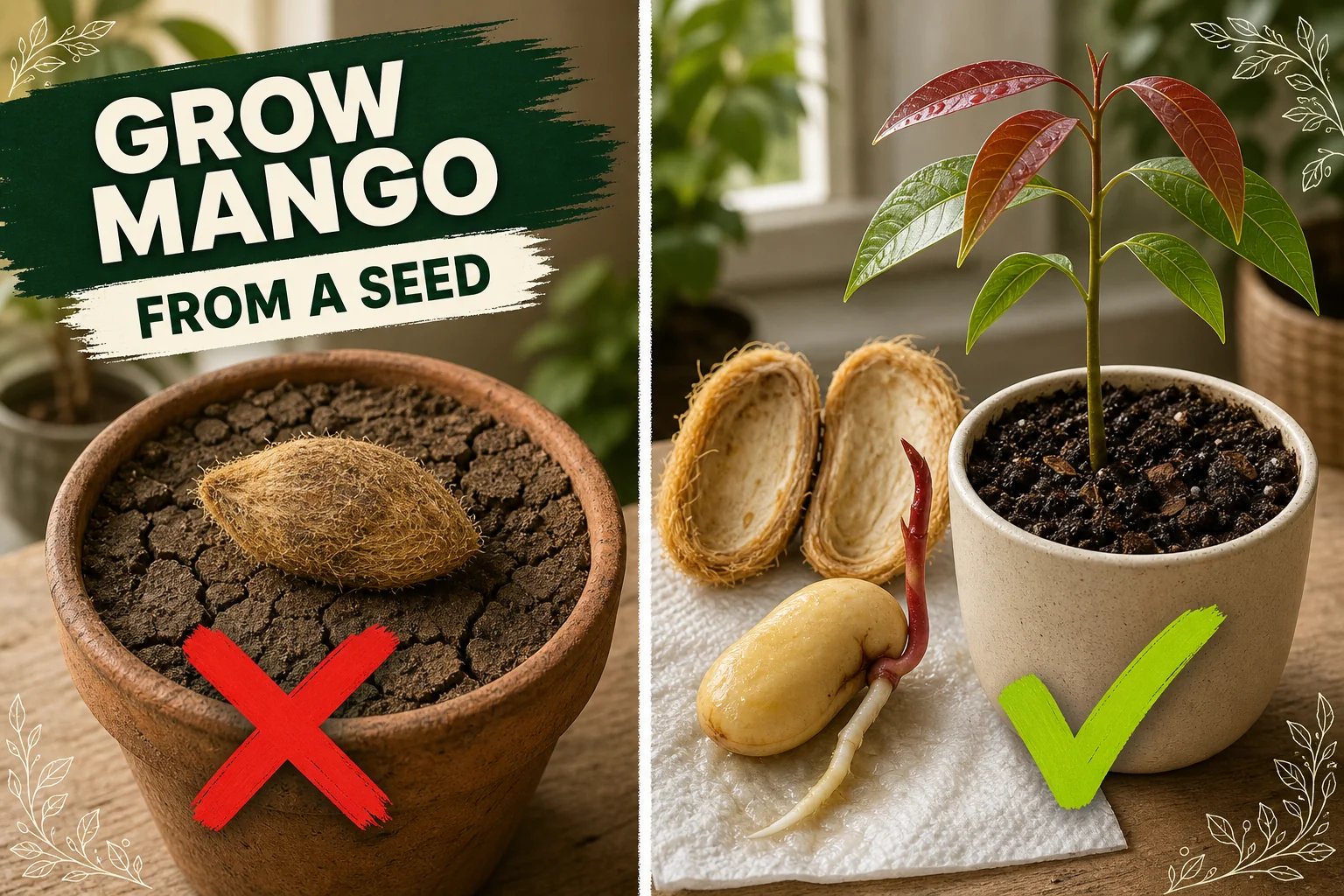
Most people fail at growing mango from seed because they plant the whole pit, husk and all. The husk is a hard moisture barrier evolved to delay germination in the wild. Crack it open and plant only the bean-shaped kernel inside, and germination drops from 4–8 weeks to 2–3 weeks with dramatically higher success rates.
This guide walks through both methods (paper towel and direct soil), the husk-extraction technique, the warmth requirements, and what to realistically expect: a gorgeous houseplant tree, with very low odds of indoor fruiting.
Quick answer
Cut the mango open and clean the pit. Dry the husk 1–2 days, then carefully crack it open with shears or a knife to extract the bean-shaped kernel inside. Wrap the kernel in a damp paper towel and seal in a plastic bag at 24–27°C (75–81°F), or plant directly in moist tropical potting mix at 2.5 cm (1 in) deep. Sprouts emerge in 2–3 weeks (paper towel) or 4–6 weeks (direct soil). Pot up to a 25 cm (10 in) deep pot once the root is 2.5–5 cm (1–2 in) long. Outdoor fruiting requires USDA zones 9b–11.
Husk vs. kernel: the make-or-break step
A mango pit is not the seed itself — it’s a protective package. The pit’s hairy woody outer shell is called the husk, and inside it sits the actual seed: a smooth bean-shaped kernel about 3–5 cm (1–2 in) long.
In the wild, the husk evolved to:
- Resist rotting in tropical rain
- Survive being eaten and passed by animals
- Delay germination until consistent moisture arrives
For your kitchen-counter seed-starting project, those traits become obstacles. A whole husked pit takes 4–8 weeks to sprout in soil, with a roughly 50% success rate. An extracted kernel sprouts in 2–3 weeks with success rates above 85%.
Removing the husk is the single biggest factor in mango germination success — bigger than soil mix, bigger than container choice, bigger than sunlight.
Polyembryonic vs. monoembryonic seeds
Mangoes come in two seed types, and which one you have affects what tree you’ll grow.
Polyembryonic seeds (most Asian, Indian, and Caribbean varieties):
- The kernel contains multiple embryos (often 3–5)
- Multiple shoots emerge from a single seed
- The seedlings are usually clones of the parent — fruit will match the original variety
- Common varieties: Alphonso, Kesar, Carrie, Manila
Monoembryonic seeds (most Florida varieties and many grocery store mangoes):
- The kernel contains a single embryo
- One shoot emerges
- The seedling is a hybrid of the parent and an unknown pollen donor — fruit will vary
- Common varieties: Tommy Atkins, Keitt, Kent, Haden
If your kernel produces multiple shoots, it’s polyembryonic. The strongest shoot is usually the “true” seedling that matches the parent variety; some growers cull the weaker shoots, others let all of them grow and separate at potting up.
For most people growing mango as a houseplant for the foliage, this distinction is academic — both types make beautiful indoor trees.
Method 1: paper towel germination
The paper towel method is the easier of the two methods because you can see exactly what’s happening.
You need:
- 1 mango kernel (extracted from husk — see below)
- 2–3 paper towels
- 1 sealed plastic sandwich bag
- A warm spot at 24–27°C (75–81°F)
Steps:
- Dampen the paper towels with room-temperature water — wet but not dripping.
- Wrap the kernel in 2–3 layers of damp paper towel.
- Seal the wrapped kernel inside the plastic bag, leaving a small air gap (don’t squeeze flat).
- Place in a warm spot — top of the fridge, near a heating vent, or on a seedling heat mat.
- Check every 3 days. Re-moisten the paper towel if it’s drying out. Discard and re-wrap if any mold appears.
Expected timeline:
- Day 5–7: kernel begins to swell and may crack open along the seam
- Day 10–14: a thick white root emerges from one end
- Day 14–21: a red or purple-tinged shoot appears from the other end
Once the root reaches 2.5–5 cm (1–2 in) long, transfer to a deep pot with tropical potting mix.
Method 2: direct soil germination
If you’d rather skip the paper towel step, plant the kernel directly in moist potting mix.
You need:
- 1 mango kernel
- 1 deep pot, minimum 25 cm (10 in) tall, with drainage holes
- Free-draining tropical houseplant potting mix
- A warm spot at 24–27°C (75–81°F)
Steps:
- Fill the pot with moistened potting mix to within 5 cm (2 in) of the rim.
- Make a small depression 2.5 cm (1 in) deep in the center.
- Place the kernel in the depression with the concave (curved-in) side facing down — this is the side the root will emerge from.
- Cover lightly with mix.
- Water gently to settle the soil.
- Place in a warm spot. A clear plastic bag loosely tented over the pot creates a humidity dome that speeds germination.
Expected timeline:
- Week 2–3: the kernel begins absorbing water and sprouting underground
- Week 4–6: the shoot emerges through the soil surface
- Week 6–8: first true leaves appear, often deeply red or purple before turning green
The direct soil method has a slightly lower success rate than the paper towel method because you can’t see what’s happening — molded or dud kernels go unnoticed. But it skips a transplant step and produces a stronger taproot.
This direct-soil-from-fruit approach is the same logic behind growing an avocado seed in soil and starting a pineapple top — kitchen-scrap propagation that actually works.
Extracting the kernel: step-by-step
Opening the husk is the trickiest physical step. Take your time.
Step 1: Clean and dry the husk. After eating the mango, scrub all flesh and fibers off the pit under warm running water. A stiff vegetable brush works well. Set the clean pit on a paper towel in a warm dry spot for 24–48 hours. The husk shrinks and cracks slightly as it dries, making it much easier to open.
Step 2: Find the seam. Look at the dried husk — you’ll see a faint seam running around its longer edge. This is where the husk naturally separates.
Step 3: Cut along the seam. Use kitchen shears or a sharp knife to carefully cut along the seam, avoiding the kernel inside. Don’t try to cut all the way through in one pass — cut a small section, pry it open slightly, and continue.
Step 4: Pry the husk apart. Once you’ve cut around the seam, gently pry the two halves of the husk apart with your fingers or a butter knife. The smooth bean-shaped kernel sits inside, often loosely attached to the husk on one side.
Step 5: Inspect the kernel. A viable kernel is plump, pale tan to brownish, and feels firm. Discard kernels that are shrivelled, dark brown, mushy, or have visible mold — they won’t germinate.
If you can’t open the husk despite drying, soak the whole pit in warm water for 24 hours to soften it, then try again. Some pits have very tough husks that need 2–3 days of soaking before they’ll open.
Caring for the seedling
Once the kernel sprouts and is potted up, mango seedlings are surprisingly hardy houseplants — but they have specific tropical requirements.
Light:
- Brightest indirect light available — south-facing window 30–60 cm (12–24 in) back from glass
- Direct afternoon sun is tolerated once plants are over 6 months old
- Indoor grow lights help significantly during winter
Temperature:
- Active growth: 21–27°C (70–81°F) day, 18–21°C (65–70°F) night
- Mango seedlings die below 4°C (40°F) — never expose to frost
- Avoid drafts from cold windows in winter
Watering:
- Water when the top 2.5 cm (1 in) of soil dries
- Typically every 5–7 days indoors during warm months
- Less frequent in winter — every 10–14 days
- Always allow drainage to flow through the pot — standing water in the saucer kills the taproot
Feeding:
- Apply a balanced liquid houseplant fertilizer at half strength once a month from spring through early fall
- Skip feeding from late fall through winter
- Avoid high-nitrogen formulas — they push leaf growth at the expense of the trunk
Potting up:
- Year 1: 25 cm (10 in) deep pot
- Year 2: 30 cm (12 in) pot
- Year 3 onward: 38 cm (15 in) pot or larger
- The taproot grows fast and deep — width matters less than depth
Will it ever fruit?
Be honest with yourself before investing 5+ years.
Indoor mango trees grown from seed almost never fruit. Insufficient light intensity (mangoes need 6+ hours of direct sun for flower induction), lack of seasonal temperature cues, and limited root space all conspire against indoor fruiting.
Outdoor mango trees in USDA zones 9b–11 from seed:
- 5–8 years to first fruit (vs. 2–4 years for grafted nursery trees)
- Variable fruit quality — could match parent or could be smaller/different
- Polyembryonic varieties give better odds of true-to-type fruit
- Tree size at maturity: 9–18 m (30–60 ft) — much smaller in container culture
For people growing mango as a houseplant project, fruit isn’t the point. The wide glossy leaves, the dramatic red-bronze new growth, and the satisfaction of growing a tropical tree from a kitchen scrap are the real rewards. Treat any fruit as a happy accident.
Common mistakes
- Planting the whole pit without opening the husk. The single biggest reason mango seeds fail. Always extract and plant the kernel.
- Planting in cold soil or cold rooms. Below 21°C (70°F), germination is slow and unreliable. Use a heat mat or warm spot.
- Letting the paper towel dry out. A dried-out kernel mid-germination dies. Check every 3 days.
- Wrong kernel orientation. The concave (curved-in) side faces down so the root grows into the soil. The convex (curved-out) side faces up so the shoot grows toward light.
- Planting in shallow pots. Mango seedlings produce a long taproot fast. Start in a 25 cm (10 in) deep pot, not a 10 cm (4 in) seedling tray.
- Overwatering once potted. Mango roots rot in soggy soil. Let the top 2.5 cm (1 in) dry between waterings.
- Expecting indoor fruiting. Indoor mango trees produce stunning foliage but rarely fruit. Plan for the houseplant, not the harvest.
- Cold drafts in winter. A mango next to a cold winter window can lose all leaves in one night. Move away from windows in cold months.
Troubleshooting table
| Symptom | Likely cause | Fix |
|---|---|---|
| Kernel never sprouts after 4 weeks | Cold soil, dud kernel, or rotted | Try fresh kernel with heat mat |
| Mold on paper towel | Too wet, not enough air | Re-wrap in lighter dampness, add small air gap to bag |
| Shoot emerges then collapses | Damping-off fungus, overwatering | Improve drainage, let soil dry between waterings |
| Yellow lower leaves | Overwatering or nitrogen deficiency | Check drainage; if drainage is good, apply half-strength fertilizer |
| Leggy stretched stem | Insufficient light | Move closer to window, add grow light |
| Leaves brown crispy edges | Low humidity or fluoridated water | Pebble tray, switch to filtered water |
| New growth red/purple, then green | Normal — anthocyanin pigment | No action needed; this is healthy mango growth |
Related reading
- How to plant an avocado seed (toothpick & soil methods) — another grocery-store kitchen-scrap propagation project with similar warm-soil and indoor-tree-only outcomes.
- How to plant a pineapple top — the third great kitchen-scrap tropical propagation, this time using the leafy crown of a fresh pineapple.
- How to grow passion fruit at home — another tropical fruit-from-seed project with similar warmth requirements and longer time-to-fruit.
- How to grow dragon fruit at home — tropical fruit propagation from cuttings, another great houseplant-with-eventual-fruit project.
- How to fix root rot — overwatered mango seedlings die from root rot fast. This guide covers signs and recovery.
- Track your germination dates, transplant timing, and seasonal feed reminders with the free Tazart plant care app — it adjusts watering and feeding for your indoor conditions.
A note on conditions
Mango germination success depends heavily on the freshness of the seed and consistent warmth. A pit from a mango eaten today germinates better than one stored in the fridge for two weeks. Polyembryonic varieties give better results for home growers. If you live in zones 9b–11 with year-round warmth, planting outdoors in the ground will produce a full-sized tree within 5–8 years. Everywhere else, embrace the houseplant identity — a 1.5 m (5 ft) potted mango with glossy red-flushed leaves is a better win than a struggling outdoor specimen that dies in the first frost.
Highly recommended
The supplies that make this guide work


Tazart is an Amazon Associate — we earn from qualifying purchases at no extra cost to you. Thank you for helping us keep these guides free.
Frequently asked questions
How long does a mango seed take to sprout?
Mango seeds sprout in 2–3 weeks when extracted from the husk and germinated in a damp paper towel at 24–27°C (75–81°F). Whole pits planted directly in soil take 4–8 weeks because the woody husk delays moisture absorption. Polyembryonic varieties (most Asian and Indian mangoes) often sprout multiple shoots from a single seed; monoembryonic varieties (most Florida and grocery Tommy Atkins) produce just one shoot.
Do you peel a mango seed before planting?
Yes — for fastest germination, you crack open the woody hairy outer husk and plant only the smooth bean-shaped kernel inside. Use a knife or kitchen shears to carefully cut along the seam of the dried husk, then peel it apart to reveal the kernel. The kernel sprouts roughly 3 times faster than a whole pit and has a higher success rate. You can plant the whole pit, it just takes longer.
Should you plant the whole mango pit or just the kernel?
Plant just the kernel for fastest results. The husk is a moisture barrier evolved to delay germination until ideal conditions arrive — useful in the wild, frustrating at home. Removing it lets the kernel absorb water immediately and sprout in 2–3 weeks instead of 4–8. If you can't open the husk, soak the whole pit in warm water for 24 hours first to soften it, then plant.
Can a mango tree grown from seed produce fruit?
Yes, but with caveats. Trees grown from seed typically take 5–8 years to fruit (versus 2–4 years for grafted nursery trees), and the fruit may not match the parent variety. Polyembryonic varieties often produce true-to-type seedlings (the fruit will resemble the parent). Monoembryonic varieties produce variable seedlings — fruit could be smaller, larger, or different in flavor than the parent. Trees grown indoors rarely fruit at all.
What temperature do mango seeds need to germinate?
Mango seeds germinate best at 24–27°C (75–81°F) — consistent warmth is more important than the exact number. Below 21°C (70°F) germination is slow and unreliable; below 18°C (65°F) it often fails entirely. A seedling heat mat under the pot or paper-towel bag is the single biggest investment you can make for mango germination success. Top of a fridge or warm windowsill also works in heated homes.
Can you grow a mango tree indoors?
Yes, as a houseplant. Mango trees from seed make beautiful tropical foliage plants with glossy red-tinged new leaves that age to deep green. Expect 30–60 cm (12–24 in) of growth per year for the first 3 years. They rarely flower or fruit indoors due to insufficient light intensity and lack of seasonal cues. For fruit you need outdoor planting in USDA zones 9b–11 or a heated greenhouse.