Edible
How Far Apart to Plant Zucchini (Hill Spacing for Big Yields)
Plant zucchini 90-120 cm (3-4 ft) apart in hills, with rows 1.2-1.8 m (4-6 ft) wide — full guide to bush vs vining types, succession sowing, and pollination.
On this page
- Quick answer
- Why zucchini spacing matters
- Spacing at a glance
- Bush vs vining varieties
- Why 90-120 cm (3-4 ft) hill spacing
- Hill formation
- Soil preparation
- When to plant
- How many plants per family
- Succession planting
- Pollination
- Watering and feeding
- Harvesting
- Container growing
- Common spacing mistakes
- Common problems
- Related reading
- A note on conditions
Watch the visual walkthrough
How to Grow Squash Vertically...EVEN ZUCCHINI! Small Space Gardening.
The perfect option for small space gardening. You can grow squash vertically. All kinds! Zucchini, Summer Squash, Winter ...
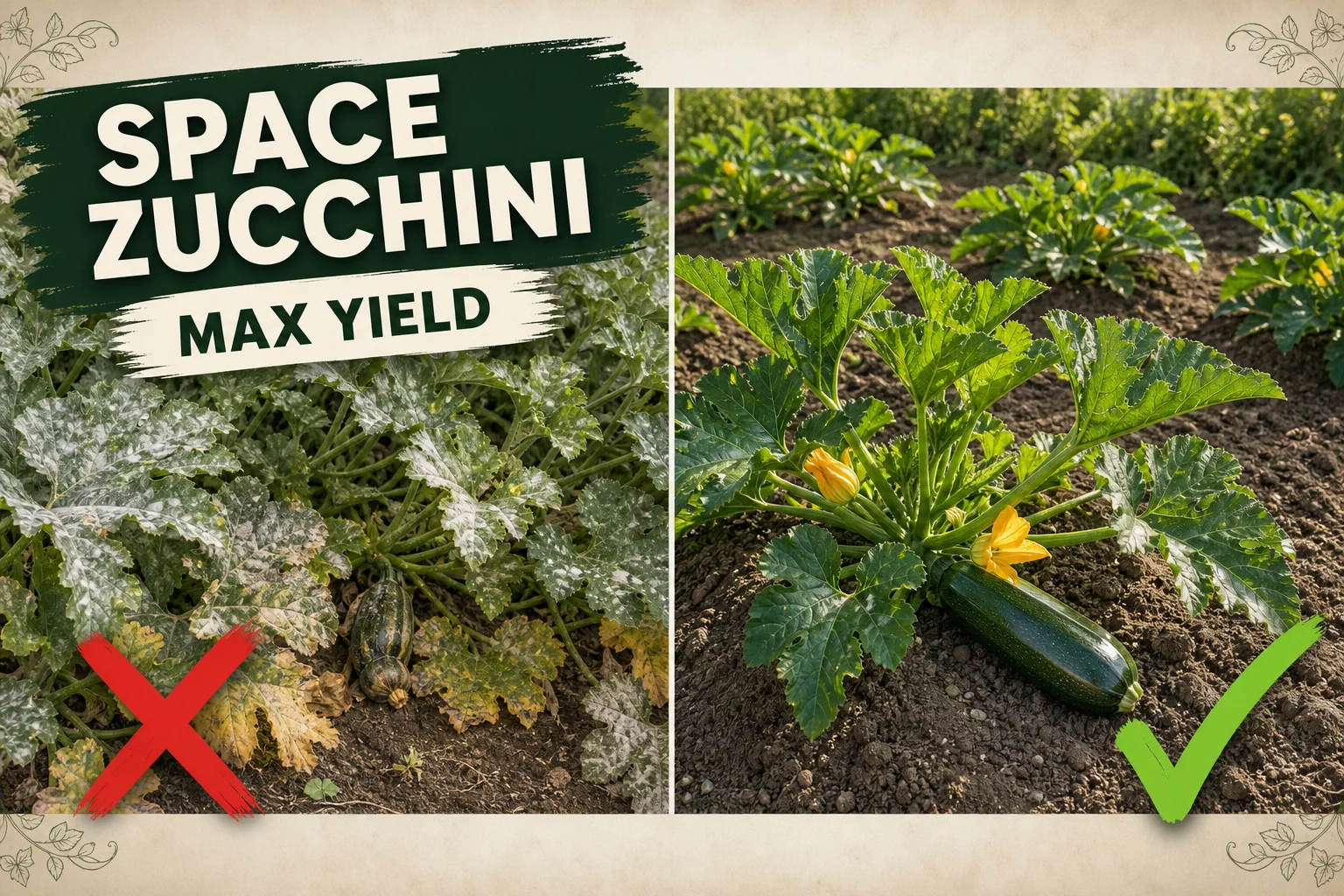
Spacing makes or breaks zucchini. Plants too close stay diseased and produce few fruits; spacing done right gives you 6-10 fruits per plant per week through peak summer. This guide covers exact hill spacing, row width, the bush-vs-vining trade-off, and the succession schedule that keeps zucchini coming until frost.
Quick answer
Plant zucchini 90-120 cm (3-4 ft) apart in hills, with rows 1.2-1.8 m (4-6 ft) wide. Bush varieties at 90 cm (3 ft); vining varieties at 1.2 m (4 ft). Form hills 30 cm (12 in) tall before planting. Sow 2-3 seeds per hill, thin to 1-2 strongest. Wait for soil at least 18°C (65°F). Plan 1-2 plants per family of four.
Why zucchini spacing matters
Zucchini (Cucurbita pepo) is one of the most generous garden crops — a single mature plant produces dozens of fruits across the season. But three things go wrong with tight spacing:
- Powdery mildew explodes mid-summer as airflow drops between crowded plants. PM is the #1 disease that ends zucchini production.
- Pollination fails because bees can’t reach flowers buried inside dense leaf canopy. No pollination = no fruit set, even with healthy plants flowering heavily.
- Fruit goes unharvested when you can’t reach into the center of the plant. Missed zucchini turn baseball-bat-sized in 48 hours and signal the plant to stop producing new fruit.
Wide spacing fixes all three. It’s not optional — it’s the foundation of a productive zucchini bed.
Spacing at a glance
| Parameter | Bush varieties | Vining varieties |
|---|---|---|
| In-row hill spacing | 90 cm (3 ft) | 1.2 m (4 ft) |
| Row spacing | 1.2 m (4 ft) | 1.5-1.8 m (5-6 ft) |
| Mature plant width | 60-90 cm (2-3 ft) | 1.5-3 m (5-10 ft) |
| Plants per hill (after thinning) | 1-2 | 1 |
| Hill height | 30 cm (12 in) | 30 cm (12 in) |
| Hill width at base | 60-90 cm (24-36 in) | 60-90 cm (24-36 in) |
| Sowing depth | 2.5 cm (1 in) | 2.5 cm (1 in) |
Bush vs vining varieties
Variety choice determines spacing strategy and bed footprint:
| Type | Examples | Width | Yield per plant | Best use |
|---|---|---|---|---|
| Bush | Black Beauty, Patio Star, Bush Baby, Spineless Beauty | 60-90 cm (2-3 ft) | 25-40 fruits per season | Raised beds, small gardens, containers |
| Semi-vining | Cocozelle, Costata Romanesco | 1-1.5 m (3-5 ft) | 30-50 fruits per season | Standard in-ground rows |
| Vining | Tromboncino, Italian Striped | 1.5-3 m (5-10 ft) | 40-60 fruits per season | Trellised or sprawled in large beds |
For 90% of home gardeners, bush varieties are the right call — manageable size, productive at 90 cm (3 ft) spacing, and easy to harvest through.
Vining varieties produce more total fruit per plant and resist squash vine borers (the borer struggles to attack the long thin vines), but they need much more space and benefit from trellising for tidy growth.
Why 90-120 cm (3-4 ft) hill spacing
Many older garden books recommend 60 cm (2 ft) spacing. That’s too tight for modern productive varieties.
The 90-120 cm (3-4 ft) spacing exists because:
- Mature plants spread 60-90 cm (2-3 ft) wide — leaves overlap heavily at 60 cm (2 ft) spacing, killing airflow
- Bees need access to female flowers for pollination — closed canopy reduces visits and fruit set
- You must walk and harvest every 1-2 days at peak season — narrow spacing means stepped-on stems and broken fruit
- Powdery mildew prevention — the single biggest factor in extending the harvest window
Bush varieties can use the tighter end (90 cm / 3 ft); vining varieties need the wider end (1.2 m / 4 ft) plus trellising or sprawl room.
Hill formation
Hills are critical for zucchini — they’re not optional like for some vegetables.
Why hill:
- Drainage — zucchini roots rot in waterlogged soil. Hills shed rain.
- Warmer soil — a hill catches more sun and warms 3-5°C (5-10°F) faster than flat ground.
- Loose deep growing room — roots expand outward and downward in soft soil; compact subsoil stunts plants.
How to form hills:
- Use a hoe or shovel to mound soil into mounds 30 cm (12 in) tall and 60-90 cm (24-36 in) wide at the base
- Form hills 1-2 weeks before planting so soil settles and warms
- Work 5-7 cm (2-3 in) of compost into the top of each hill
- Add a handful of balanced organic fertilizer per hill at hill formation
Soil preparation
Zucchini are heavy feeders that reward soil prep with sustained production.
What zucchini needs:
- pH 6.0-7.0 — slightly acidic to neutral
- Loose, deep, well-draining — roots expand 60-90 cm (24-36 in) wide in mature plants
- High organic matter — zucchini consume nutrients fast and respond to compost
- Adequate calcium — calcium deficiency causes blossom end rot on developing fruit
How to prepare:
- Test soil pH if you’ve never tested the bed.
- Work 5-7 cm (2-3 in) of finished compost into the top 30 cm (12 in) of soil.
- Add bone meal or balanced organic fertilizer (e.g. 5-5-5) to each hill at planting.
- If your soil is heavy clay, build deeper hills (35-40 cm / 14-16 in) and amend with sand or perlite.
When to plant
Zucchini are warm-season crops. They’re frost-sensitive at both ends of the season.
Planting requirements:
- All risk of frost passed
- Soil temperature at 5-7 cm (2-3 in) deep at least 18°C (65°F), ideally 21-24°C (70-75°F)
- Daytime temperatures consistently above 15°C (60°F)
- Typically 1-2 weeks after the last frost
| Region | Typical planting window |
|---|---|
| Gulf Coast / Florida | March – April |
| Mid-South / Southwest | April – early May |
| Mid-Atlantic / Midwest | Mid-May – early June |
| New England / Pacific NW | Late May – mid-June |
| Northern Plains / Zone 4 | Early June |
You can also start zucchini indoors 2-3 weeks before the last frost and transplant — but direct sowing works just as well in most climates and avoids transplant shock.
How many plants per family
Zucchini is famously productive. Plan conservatively:
| Household | Plants |
|---|---|
| Single person, casual use | 1 bush plant |
| Family of 4, regular use | 1-2 bush plants |
| Large family or canning | 3-4 plants |
| Sharing with neighbors | Add 1-2 more |
A single mature bush zucchini produces 6-10 fruits per week at peak. Two plants is plenty for most families.
Succession planting
Zucchini plants peak for 6-8 weeks before powdery mildew or vine borers begin to slow them. Succession planting extends the harvest:
| Sow date | Peak production |
|---|---|
| Mid-May | Late June – mid-August |
| Mid-June | Early August – late September |
| Early July (long-season regions) | Mid-September – first frost |
The second sowing replaces tired first-sowing plants just as they decline. The third sowing extends production into early fall in long-summer regions.
Pollination
Zucchini have separate male and female flowers on the same plant. Both must be open at the same time, and bees must transfer pollen from male to female flowers, for fruit to set.
What goes wrong:
- Few or no bees: spray-blanket pesticides, urban environments, or cold rainy weather all reduce bee activity. Hand-pollinate by transferring pollen with a small brush from male to female flowers.
- All male flowers, no females: normal at the start of the season — males appear first by 1-2 weeks, then females begin. Patience.
- Female flowers wither and fall without forming fruit: classic pollination failure. Hand-pollinate or check for absent pollinators.
Identifying flowers:
- Male: long thin stem, no swelling at the base, abundant pollen on stamens inside
- Female: short stem with a small zucchini-shape swelling at the base (the immature fruit)
Watering and feeding
| Stage | Water | Feeding |
|---|---|---|
| Germination (days 1-10) | Top 2.5 cm (1 in) moist daily | None |
| Establishment (weeks 2-4) | 2.5 cm (1 in) per week, deep | Once at first true leaf — light liquid feed |
| Flowering (weeks 4-8) | 2.5-5 cm (1-2 in) per week | Side-dress with balanced organic granular |
| Fruit production (weeks 6+) | 5 cm (2 in) per week in heat | Side-dress every 4-6 weeks |
Always water at the base, never overhead. Wet foliage in summer heat is the #1 trigger for powdery mildew. A drip line or soaker hose at the hill base is ideal.
Harvesting
Pick zucchini young — at 15-20 cm (6-8 in) long for slicing varieties, or 7-10 cm (3-4 in) for round zucchini. Past that size, seeds enlarge, texture becomes spongy, and the plant slows new fruit production.
Rules:
- Check plants every 1-2 days at peak season — fruit grows 2-5 cm (1-2 in) per day in summer heat
- Use a sharp knife or pruning shears — twisting can damage the stem
- Harvest male flowers occasionally (most are excess) for stuffing or frying — leaves don’t reduce future fruit set
- Even oversized “missed” zucchini must be removed — leaving them on the plant signals it to slow new fruit production
Container growing
Bush zucchini grow well in large containers:
| Container size | Plants | Variety |
|---|---|---|
| 38 L (10 gal) | 1 | Patio Star, Bush Baby |
| 57 L (15 gal) | 1 | Black Beauty, Spineless Beauty |
| 75 L (20 gal) | 1-2 | Any bush type |
Container zucchini needs daily watering in summer (check twice daily in 32°C / 90°F+ heat), monthly liquid feeding, and the same 90 cm (3 ft) clearance from neighbors for airflow.
Common spacing mistakes
”Tomato spacing” applied to zucchini
Some gardeners default to 60 cm (2 ft) spacing because that’s their tomato standard. Zucchini need more — 90-120 cm (3-4 ft) — because of the spread of the leaf canopy.
Bush spacing for vining varieties
Planting Tromboncino at 90 cm (3 ft) creates a tangled mess by mid-July. Vining varieties need 1.2 m (4 ft) minimum, plus trellis or vertical support.
Skipping the hill
Flat planting works in well-drained sandy soil but fails in clay or wet climates. The hill is what makes drainage and soil temperature work in zucchini’s favor.
Crowding for “more yield”
Two plants at 60 cm (2 ft) produce roughly the same total fruit as one plant at 90 cm (3 ft) — and the crowded plants get more disease, less pollinator access, and harder harvesting. Wider always wins for zucchini.
Common problems
Female flowers dropping without setting fruit
Pollination failure. Either hand-pollinate or attract more pollinators (skip pesticides, plant pollinator flowers nearby like cosmos, zinnias, or borage).
Fruit rotting at the blossom end
Blossom end rot — calcium uptake issue caused by inconsistent watering or low calcium soil. Mulch heavily, water consistently, add bone meal at planting next season.
White powdery coating on leaves
Powdery mildew — the inevitable late-summer zucchini disease. Wide spacing, base watering, full sun, removing infected lower leaves, and potassium bicarbonate or neem oil sprays slow it. Once heavily infected, succession plants take over.
Vines wilt suddenly mid-season
Squash vine borer — larvae tunnel inside the stem at the base. Slit the affected stem with a sharp knife, remove the larva, bury the affected section in soil to encourage rerooting. Vining varieties resist borers better than bush types.
Yellow leaves at the base
Normal as the plant ages — lower leaves yellow and die back as the plant grows up. Remove them to improve airflow. If all leaves are yellowing, check for nitrogen deficiency or root rot from over-watering.
Related reading
- How to grow zucchini — full season-long care guide that pairs with this spacing-focused post.
- How far apart to plant cucumbers — spacing for another cucurbit family member with similar but slightly different needs.
- How to plant okra — warm-season companion that fits well in the same bed rotation.
- How to grow bell peppers — another summer staple that complements zucchini in mixed beds.
- Track your zucchini hill spacing, succession sowings, and daily-harvest reminders with the free Tazart plant app — set alerts for first flower, first fruit set, and powdery mildew prevention.
A note on conditions
Zucchini spacing rules vary slightly by climate — humid southeastern gardens benefit most from the wider 1.5-1.8 m (5-6 ft) row spacing (disease pressure is higher), while drier western gardens can use the tighter end. Variety matters too — Italian heirlooms often outgrow modern compact bush types. Use this guide as your baseline and adjust based on what your plants show you in the first month.
Highly recommended
The supplies that make this guide work


Tazart is an Amazon Associate — we earn from qualifying purchases at no extra cost to you. Thank you for helping us keep these guides free.
Frequently asked questions
How far apart should zucchini plants be spaced?
Plant zucchini 90-120 cm (3-4 ft) apart in hills, with rows 1.2-1.8 m (4-6 ft) wide. Bush varieties need 90 cm (3 ft) hill spacing; vining varieties need 1.2 m (4 ft). The wide spacing gives airflow that prevents powdery mildew (the #1 zucchini disease), allows full leaf expansion, and gives bees access for pollination — critical for fruit set.
How wide should zucchini rows be?
Space zucchini rows 1.2-1.8 m (4-6 ft) apart. Bush types can use 1.2 m (4 ft) rows; vining types need 1.5-1.8 m (5-6 ft) so vines don't tangle with neighbors. Wide rows are essential because mature zucchini plants spread 90-120 cm (3-4 ft) wide, and you need walking room to harvest every 1-2 days during peak season.
How many zucchini plants per family?
Plan 1-2 zucchini plants per family of four for fresh eating. A single mature plant in good conditions produces 6-10 fruits per week at peak — easily 25-50 fruits across the season. Two plants is enough for a family that uses zucchini regularly. For canning, freezing, or large families, 3-4 plants is plenty.
Can zucchini be grown in raised beds?
Yes, raised beds suit zucchini well — they warm faster in spring, drain freely, and have loose deep soil. In a raised bed, plant one bush zucchini per 1.2 m × 1.2 m (4 ft × 4 ft) section. A standard 1.2 m × 2.4 m (4 ft × 8 ft) bed comfortably holds 2 bush plants. Don't crowd — even raised beds need the full 90-120 cm (3-4 ft) spacing for airflow and pollinator access.
Should zucchini be succession planted?
Yes — succession planting extends the harvest and gives you fresh productive plants when older ones tire or get hit by powdery mildew. Sow a second round 4-6 weeks after the first. In long-season regions, a third round 6-8 weeks after the second extends production into early fall. Newer plants resist disease better than tired older ones.
What is the difference between bush and vining zucchini?
Bush zucchini varieties (Black Beauty, Patio Star, Spineless Beauty) stay compact at 60-90 cm (2-3 ft) wide and produce in a tight space — ideal for raised beds and containers. Vining varieties (Costata Romanesco, Tromboncino, Italian Striped) sprawl 1.5-3 m (5-10 ft) and need more space but produce more total fruit per plant and resist squash vine borers better. Bush types are the standard home garden choice.
How big should zucchini hills be?
Form zucchini hills 30 cm (12 in) tall and 60-90 cm (24-36 in) wide at the base. Hilling improves drainage, warms soil faster, and gives roots loose deep room. For each hill, work in 5-7 cm (2-3 in) of compost. Plant 2-3 seeds per hill, then thin to 1-2 strongest seedlings.
Can zucchini be grown in containers?
Yes, but use a large container — minimum 38-57 L (10-15 gal) for one bush zucchini plant. Choose dedicated container varieties like Patio Star or Bush Baby. Container zucchini needs daily watering in summer (containers dry fast), more frequent feeding, and the same 90 cm (3 ft) clearance from neighbors for airflow.