Flowers
How Far Apart to Plant Dahlias (Spacing by Variety + Depth)
Plant border dahlias 30 cm (12 in) apart and dinnerplate dahlias 60–90 cm (24–36 in) apart, 10–15 cm (4–6 in) deep — the spacing that decides bloom count.
On this page
- Quick answer
- Why spacing matters more than fertilizer
- Spacing by variety size
- How deep to plant dahlia tubers
- Row spacing for cutting gardens
- Stakes belong at the planting stage
- Spacing in pots and containers
- How spacing affects watering and feeding
- Common spacing mistakes
- Watering after planting
- Troubleshooting
- A 1.2 m (4 ft) example bed
- Related reading
- A note on conditions
Watch the visual walkthrough
Get started with dahlias 🌿 A guide to the basics
Don't be afraid of dahlias: They aren't the divas you might think they are. I'm sharing all the basics you need to know to start ...
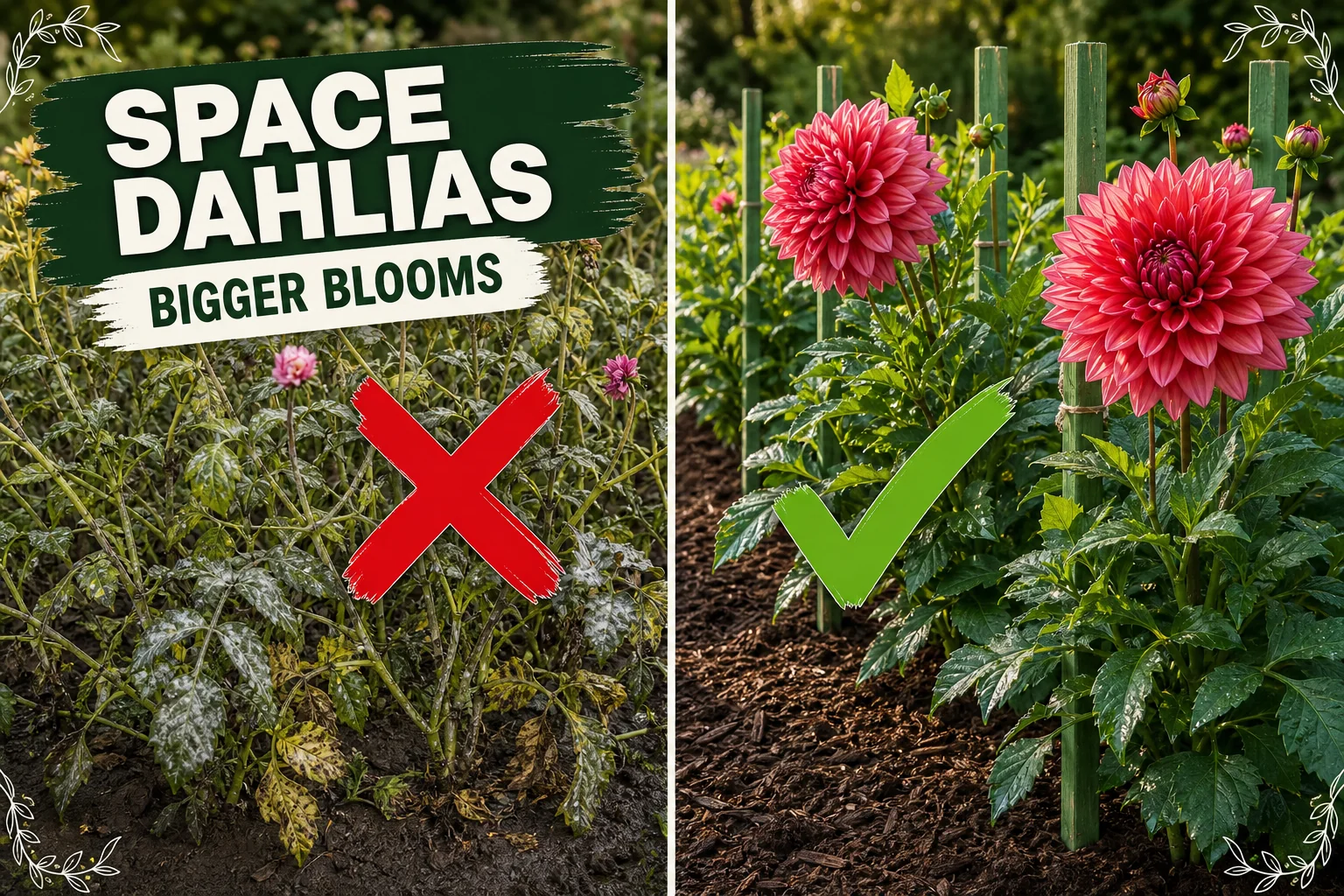
How far apart you plant dahlias is the single biggest decision you make about how many flowers you get. Get the spacing right and a single tuber will throw out a 90 cm (36 in) wide bush covered in 20+ blooms. Get it wrong — usually too tight — and the same tuber will produce a leggy stem with three or four flowers hidden in shade.
The rule is: space dahlias by their mature width, not by what looks good in May. A 5 cm (2 in) tuber takes a season to grow into a metre-wide plant.
This guide covers spacing by variety size, depth, row layout, stake placement, and the airflow rule that decides whether your bed sails through summer or collapses under powdery mildew in August.
Quick answer
Plant border dahlias 30 cm (12 in) apart, mid-size garden dahlias 45 cm (18 in) apart, and dinnerplate or tall varieties 60–90 cm (24–36 in) apart. Plant tubers 10–15 cm (4–6 in) deep with the eye facing up. Space rows 60–90 cm (24–36 in) apart by variety. Set stakes at planting and water once after the first shoot emerges, never before.
Why spacing matters more than fertilizer
A dahlia is essentially a small tropical bush by August. Its top canopy can spread 60–90 cm (24–36 in) wide on a tall variety, and that canopy needs full sun on every leaf to feed the flowers above it.
Three things go wrong when dahlias are crowded:
- Lower leaves stay damp. Powdery mildew and leaf rust spores germinate on wet leaf tissue overnight. Damp foliage from neighbours’ leaves keeps spores alive all summer.
- Stems weaken. Plants that compete for light grow taller and thinner. Thin stems flop in wind and snap during summer storms.
- Bud count drops. A dahlia that gets shaded by 11 a.m. switches energy from bud production to leaf production. You end up with a leafy plant and few flowers.
University of Minnesota Extension’s dahlia guide is explicit: spacing follows mature size, not tuber size, and tighter spacing means fewer flowers — not more.
Spacing by variety size
Dahlias are sold in a confusing mix of size categories (lilliput, mignon, ball, decorative, dinnerplate, etc.), but for spacing purposes only one number matters: mature plant height, which correlates almost exactly with mature width.
| Variety class | Mature height | Plant spacing | Row spacing | Bloom size |
|---|---|---|---|---|
| Border / patio / pompon | 30–60 cm (12–24 in) | 30 cm (12 in) | 60 cm (24 in) | 5–10 cm (2–4 in) |
| Garden / decorative | 60–90 cm (24–36 in) | 45 cm (18 in) | 60–75 cm (24–30 in) | 10–15 cm (4–6 in) |
| Tall / cactus / waterlily | 90–120 cm (36–48 in) | 50–60 cm (20–24 in) | 75 cm (30 in) | 15–20 cm (6–8 in) |
| Dinnerplate | 120–150 cm (48–60 in) | 60–90 cm (24–36 in) | 90 cm (36 in) | 20–30 cm (8–12 in) |
When in doubt, go to the wider end of the range. You can always tuck a summer annual between dahlias if the bed looks bare in early summer — but you can’t pull a dahlia out without snapping its sister’s stems.
How deep to plant dahlia tubers
Plant tubers 10–15 cm (4–6 in) deep, measured from the top of the tuber to the soil surface. Eye faces up.
- Sandy soil: plant 15 cm (6 in) deep. Sand drains fast and tubers can dry out at shallow depth.
- Heavy clay: plant 10 cm (4 in) deep. Clay holds water — shallower planting helps the tuber warm up faster and dry out between rains.
- Cold zones (USDA 3–6): plant 10 cm (4 in) deep so the tuber warms up faster.
- Warm zones (USDA 8–10): plant 12–15 cm (5–6 in) deep so the tuber doesn’t bake during summer heatwaves.
Avoid planting deeper than 18 cm (7 in). The tuber sits in cooler, wetter soil and the first shoot has too far to climb before it can photosynthesize. For full step-by-step planting, see the how to plant dahlia tubers guide.
Row spacing for cutting gardens
If you’re growing dahlias for cut flowers in a row layout, row spacing matters as much as plant spacing because you need to walk between rows to disbud, stake, and cut.
| Variety class | Row width |
|---|---|
| Border | 60 cm (24 in) |
| Garden | 75 cm (30 in) |
| Tall | 75 cm (30 in) |
| Dinnerplate | 90 cm (36 in) |
A path of 75–90 cm (30–36 in) between rows lets you walk through with cutting buckets, secateurs, and a stake mallet without crushing foliage.
For dense market-cutting layouts, growers sometimes use a 30 cm × 45 cm (12 in × 18 in) grid with corral netting overhead instead of individual stakes — but that’s an advanced setup with its own ventilation concerns.
Stakes belong at the planting stage
Any dahlia variety taller than 90 cm (36 in) needs a stake. Drive the stake before you set the tuber, off to the side of the hole. Adding a stake after the plant grows skewers the tuber and damages roots almost every time.
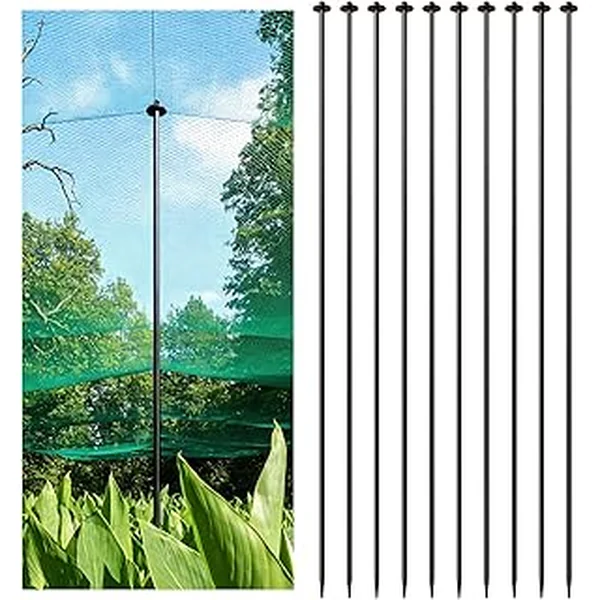
For dinnerplate dahlias, use a 1.5 m (5 ft) stake — green bamboo, fibreglass, or steel. Tie the main stem in loosely with soft jute twine or vinyl plant tie every 30 cm (12 in) of growth, never tight against the stem.
A useful rule: if you can grip the top of the stake with one hand and shake it without the stake itself bending, it’s strong enough for a dinnerplate variety in a windy spot.
Spacing in pots and containers
One tuber per pot is the rule, regardless of variety size:
- Border varieties: 30 cm (12 in) wide, 30 cm (12 in) deep pot
- Garden varieties: 35–40 cm (14–16 in) wide, 30 cm (12 in) deep pot
- Tall / dinnerplate: 40–50 cm (16–20 in) wide, 35 cm (14 in) deep pot
Multiple tubers per pot crowd quickly and the smaller volume of compost can’t support the resulting root mass. If you want a “fuller” look, use multiple pots staged together at the spacing you’d use in the ground.
How spacing affects watering and feeding
Tighter spacing means the bed dries out faster as roots compete for the same volume of soil.
Understanding how spacing interacts with feeding is only part of the picture — the dahlia plant care guide ties together watering, fertilizing, and staking across the full season. A bed planted at the recommended spacing needs roughly 25 mm (1 in) of water per week through summer; a crowded bed often needs 40 mm (1.5 in) and still wilts at midday.
Wider spacing also gives roots access to more nutrients between fertilizer applications. Most garden dahlias do well with a phosphorus-rich slow-release feed mixed into the planting hole and a top-dress of the same feed once buds set.
A free plant care app like Tazart tracks tuber planting dates, your local weather, and feeding intervals so you don’t miss the bud-set top-dress that drives heavy flowering.
Common spacing mistakes
- Spacing by tuber size, not mature plant size. A 5 cm (2 in) tuber and a 15 cm (6 in) tuber both grow into 90 cm (36 in) wide plants if they’re a dinnerplate variety. Spacing is about the bush, not the seed-piece.
- Filling gaps in June. Dahlia beds look empty for the first 6 weeks. Resist filling the gaps — adding more tubers when leaves emerge means the bed crowds itself by August.
- Treating border varieties like dinnerplates. Border types planted at 60 cm (24 in) spacing leave wide gaps and look unfinished all season. Tighten to 30 cm (12 in).
- Skipping rows entirely. Mass-planted dahlias without paths look beautiful in catalogue photos but become impossible to stake, disbud, or harvest. Always build a path every 1–1.5 m (3–5 ft) of bed depth.
- Planting against a wall or fence. Dahlias need airflow on all sides. A bed that’s only accessible from one side mildews on the back row first.
Watering after planting
Do NOT water at planting. Dahlia tubers absorb water through cuts and scars, and cold wet soil before sprouting is the fastest way to rot them. Wait until the first green shoot clears the soil — anywhere from 2–6 weeks depending on warmth — then water deeply once a week.
Once the plant is established, water deeply 1–2 times a week so the top 15 cm (6 in) of soil stays evenly moist. In heatwaves above 30°C (86°F), water every 4–5 days. Avoid overhead watering after midday: damp leaves overnight invite powdery mildew on tightly spaced beds.
Troubleshooting
| Symptom | Likely cause | Fix |
|---|---|---|
| Powdery white film on leaves | Crowded planting + damp foliage | Space at full mature width; thin lower leaves for airflow; avoid overhead watering after midday |
| Tall plant flopping | Stake added late or no stake at all | Set 1.5 m (5 ft) stake at planting; tie in every 30 cm (12 in) of growth with soft twine |
| Few small blooms instead of large ones | Crowded plants competing for light | Move tubers to recommended spacing next season; pinch at 30 cm (12 in) tall and disbud side buds |
| Bare soil for weeks after planting | Normal — tubers take 2–6 weeks to surface | Don’t replant; keep mulch on; label every spot to avoid digging up by accident |
| Lower leaves yellow and shed | Too little airflow + too little light | Widen spacing next year; remove lowest 15 cm (6 in) of leaves to improve airflow |
| Stems break in wind | Too tall + too thin from light competition | Wider spacing + sturdier stakes + earlier pinching to force shorter, branching growth |
| Tuber rotted in storage | Stored too wet or too warm | Air-dry 1 day before storage; pack in dry peat or vermiculite at 4–10°C (40–50°F), never freezing |
A 1.2 m (4 ft) example bed
Imagine a single 1.2 m × 3 m (4 ft × 10 ft) cutting bed. Here’s how spacing changes the layout:
- 6 dinnerplate dahlias in a single row down the centre at 50 cm (20 in) spacing, with 1.5 m (5 ft) stakes — leaves 35 cm (14 in) of bare bed on each side for short annuals.
- 9 garden dahlias in 3 rows of 3 at 45 cm (18 in) spacing both ways — fills the bed but leaves no walking path.
- 18 border dahlias in 6 rows of 3 at 30 cm (12 in) spacing — solid colour from June through October.
The dinnerplate layout produces the largest individual blooms; the border layout produces the heaviest total stem count for cutting.
Related reading
- How to plant dahlia tubers — depth, eye orientation, and timing — the full planting walkthrough that pairs with this spacing guide.
- How to plant peony bulbs for years of blooms — peonies pair beautifully behind dahlias and bloom early before the dahlia bed fills in.
- How far apart to plant gladiolus bulbs — spike-shaped blooms behind rounder dahlia clumps with the same airflow rules.
- How to plant canna lily bulbs — tropical rhizomes that share dahlia’s love of warm soil and full sun.
A note on conditions
Every garden is different. USDA zone, soil texture, summer rainfall, and how exposed the bed is to wind all change how dahlias respond to spacing. Use the numbers in this guide as a starting point and adjust based on how your plants behave in their first season — that’s how every good dahlia grower learns the bed.
Highly recommended
The supplies that make this guide work


Tazart is an Amazon Associate — we earn from qualifying purchases at no extra cost to you. Thank you for helping us keep these guides free.
Frequently asked questions
How far apart should dahlias be planted?
Spacing depends entirely on the variety's mature size. Border and patio dahlias (30–60 cm / 12–24 in tall) go 30 cm (12 in) apart. Mid-size garden dahlias (60–90 cm / 24–36 in tall) go 45 cm (18 in) apart. Tall and dinnerplate varieties (1.2 m / 4 ft and up, with 20–25 cm / 8–10 in blooms) need 60–90 cm (24–36 in) between plants. Crowding looks lush in June but cuts flower count by midsummer because foliage shades buds and powdery mildew sets in.
How far apart do you plant dinnerplate dahlias?
Plant dinnerplate dahlias 60–90 cm (24–36 in) apart, in rows spaced 90 cm (36 in) apart. These varieties (e.g. 'Café au Lait', 'Kelvin Floodlight', 'Thomas Edison') reach 1.2–1.5 m (4–5 ft) tall and grow into 90 cm (36 in) wide bushes by late summer. Tighter spacing forces the plants to compete for light, weakens stems, and slashes the number of show-sized 25 cm (10 in) blooms each plant can support.
How deep do you plant dahlia tubers?
Plant dahlia tubers 10–15 cm (4–6 in) deep, measured from the top of the tuber to the soil surface, with the eye facing up. Use the deeper end (15 cm / 6 in) in sandy soil so the tuber doesn't dry out, and the shallower end (10 cm / 4 in) in heavy clay or cold zones so the tuber warms up faster. Set stakes for tall varieties at planting time — pushing stakes in later skewers the tuber.
How far apart should dahlia rows be?
Border dahlias do well in rows 60 cm (24 in) apart. Mid-size dahlias need 75 cm (30 in) row spacing for airflow and access. Dinnerplate and tall varieties need 90 cm (36 in) between rows so you can walk in to stake, disbud, and cut without crushing leaves. In a cutting garden, wider row spacing also gives you room to net the bed for hail or wind protection.
Can dahlias be planted close together?
Border dahlias can go as tight as 25 cm (10 in) in a mass-planted display where the goal is solid colour, not individual blooms. But every variety has a real airflow minimum below which powdery mildew, leaf rust, and earwig damage spike. For dinnerplate types, never go below 50 cm (20 in) — even a few centimetres tighter and the lower leaves stay damp all summer, which is exactly what mildew spores need.
How many dahlias fit in a 1 m square bed?
About 4 border dahlias, 4 mid-size dahlias (laid out in a 2×2 grid at 45 cm / 18 in spacing), or just 1 dinnerplate dahlia in a 1 m × 1 m (39 in × 39 in) bed. A common beginner mistake is fitting 9 dahlias in that square at 30 cm (12 in) spacing — by August the bed is a shaded jumble with one or two stems flowering and the rest hidden in shade.