Flowers
Water Avens Plant Care (Geum rivale): Bog & Streamside Guide
Grow Geum rivale (water avens) for nodding rose-pink bell flowers in damp shade. Full care guide: moist soil, part shade, USDA zones 3-7, division, deadheading.
On this page
- Quick answer
- Table of contents
- What water avens actually is
- Light: part shade is the sweet spot
- Soil and moisture
- Watering through the year
- Feeding
- Deadheading and cutting back
- Common problems and how to fix them
- Best cultivars to plant
- Dividing water avens
- Water avens vs common avens (Geum urbanum)
- Companion planting
- A note on conditions
- Related reading
Watch the visual walkthrough
How to find and identify Wood Avens, AKA, herb Bennet, AKA Clove Root, Geum urbanum
Today we are out foraging wood avens, also known as clove root ad herb Bennet, Geum urbanum. Learn where to find wood ...
Water avens (Geum rivale) is one of the quiet stars of the damp-shade garden. Where most perennials sulk in heavy moist soil, it lifts wiry stems above a low rosette of rounded leaves and unfurls nodding bell-shaped flowers in shades of dusty rose, salmon, peach, and burnt apricot. Native to streamsides and wet meadows across Europe, northern Asia, and parts of North America, it is the plant for the soggy corner of the border that defeats almost everything else.
This guide covers everything you need to grow Geum rivale well: the moisture sweet spot, the part-shade preference, how to tell it apart from its weedier cousin common avens (Geum urbanum), and the division schedule that keeps clumps blooming for decades.
Quick answer
Plant water avens (Geum rivale) in part shade in reliably moist, humus-rich soil at pH 6.0-7.5. Keep the soil consistently damp — never bone dry, never permanently waterlogged. Mulch 5 cm (2 in) deep in spring and autumn to lock in moisture. Deadhead spent flowers to extend bloom from late spring through midsummer. Hardy in USDA zones 3-7. Divide every 3-4 years to refresh the woody crown.
Table of contents
- What water avens actually is
- Light: part shade is the sweet spot
- Soil and moisture
- Watering through the year
- Feeding
- Deadheading and cutting back
- Common problems
- Best cultivars to plant
- Dividing water avens
- Water avens vs common avens (Geum urbanum)
- Companion planting
- FAQ
What water avens actually is
Water avens is a clump-forming herbaceous perennial in the rose family, Rosaceae. The Latin name Geum rivale translates as “the avens of streams” — which tells you exactly where it wants to grow.
The plant forms a low rosette of rounded, lobed, slightly hairy basal leaves around 10-15 cm (4-6 in) tall. From late spring through early summer, wiry burgundy-purple flower stems rise to 30-60 cm (12-24 in), each carrying a few nodding bell-shaped flowers. The petals curl back from a deep maroon calyx, giving the bloom a demure, downward-facing silhouette unlike most border perennials.
Geum rivale is hardy across USDA zones 3-7. It dies back to a low rosette or fully to ground level in cold winters, then re-emerges from the woody crown in early spring. It grows wild across most of Europe, parts of North America (from Newfoundland south to West Virginia and west to British Columbia), and the cooler bands of northern Asia.
Light: part shade is the sweet spot
Garden centres often display water avens in full sun next to brighter sun-loving perennials, which leads people to assume it wants the same conditions. It does not.
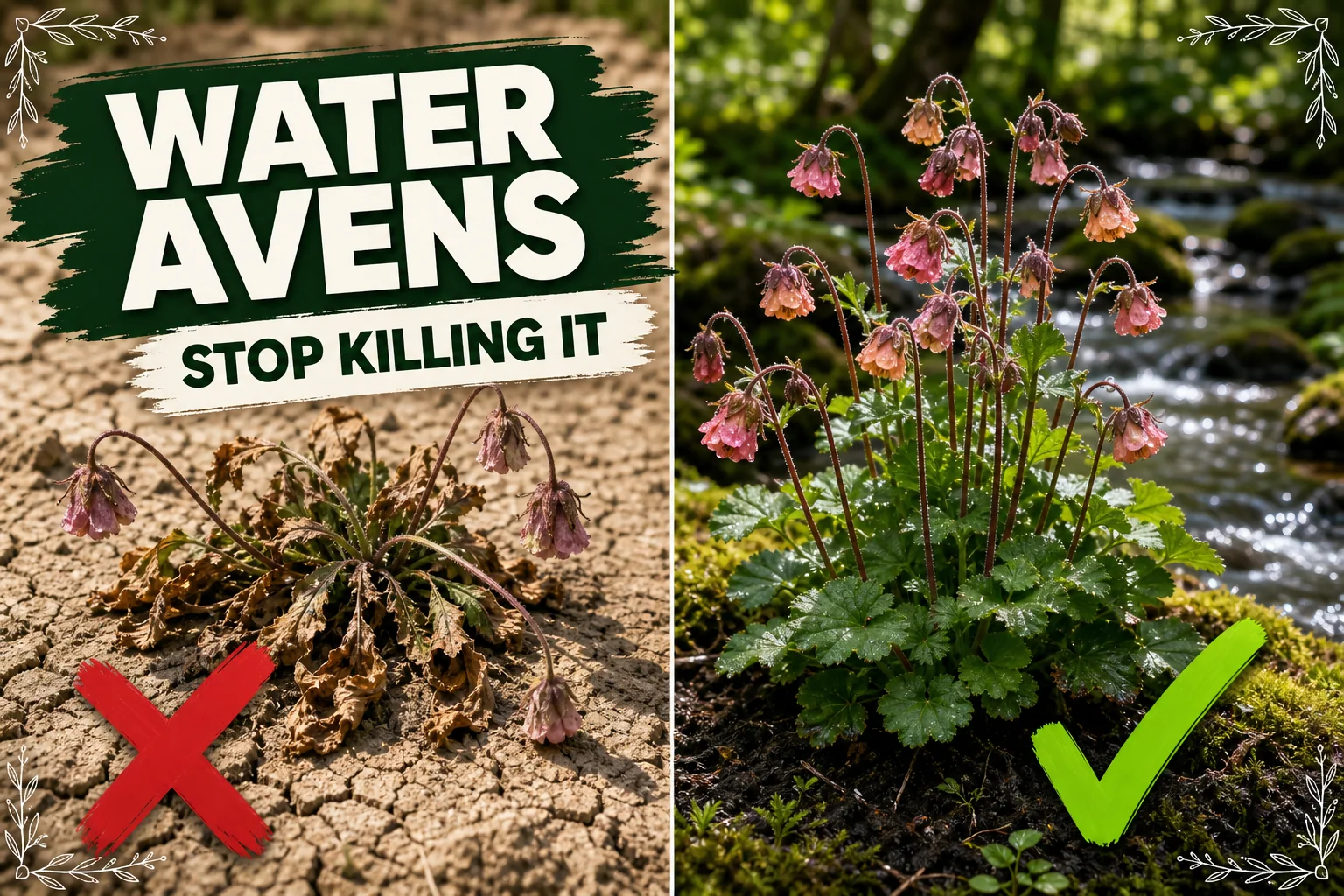
- Full hot sun (6+ hours direct, especially afternoon sun in zones 6-7) scorches the leaf edges within weeks and dries the shallow roots faster than the plant can replace the moisture. Plants in full sun without irrigation rarely survive their second summer.
- Deep shade (less than 2 hours direct light) reduces flowering — leaves stay healthy but stems become weak and bloom counts drop sharply.
- Part shade — about 3-4 hours of gentle morning sun followed by afternoon shade — is ideal. Dappled light through deciduous trees works equally well.
Two practical exceptions:
- Cool maritime climates (UK, Pacific Northwest, coastal Maine): water avens tolerates considerably more direct sun if the soil stays reliably moist.
- Hot, humid summers (USDA zones 7+ in continental climates): push toward more shade. Afternoon shade is non-negotiable.
Soil and moisture
Geum rivale evolved on streamsides, wet meadows, and the boggy edges of fens. Reproduce that drainage profile and the plant practically takes care of itself.
Target conditions:
- pH 6.0 to 7.5 — slightly acidic to slightly alkaline. Water avens grows wild on chalk streams and acidic peat bogs alike.
- Humus-rich — fork well-rotted compost, leaf mould, or aged bark fines into the planting hole at a depth of 20-25 cm (8-10 in).
- Reliably moist year-round — the soil should feel cool and damp 5 cm (2 in) below the surface in any season except deep frost.
Water avens tolerates occasional short waterlogging better than most border perennials, but it does not want to sit in stagnant water indefinitely. A pond margin where the crown is 5-15 cm (2-6 in) above standing water is perfect. Heavy clay sites benefit from raised beds 20-30 cm (8-12 in) above grade. Sandy or chalky soils need extra organic matter mixed in to hold moisture between waterings.
When planting, set the crown so the topmost growing point sits level with the soil surface — never below, never proud. Burying it encourages crown rot in heavy soil; planting too high accelerates frost lifting in winter.
Watering through the year
Consistent moisture is the single most important husbandry skill for water avens.
- Water deeply when the top 2-3 cm (1 in) of soil starts to feel dry to the touch.
- In a typical garden bed in summer, that translates to roughly 2.5-3.5 cm (1-1.4 in) of water per week from rainfall plus irrigation combined.
- Container-grown plants dry out very fast — check daily in summer. If you must use pots, choose deep ones at least 30 cm (12 in) wide.
- Reduce watering by late autumn so the crown enters winter on the slightly drier side; soggy frozen soil is the worst combination for crown rot.
Mulching matters more here than for almost any other border perennial. A 5 cm (2 in) layer of pine bark, composted leaves, or shredded hardwood mulch around the crown (but not over it) keeps the root zone evenly moist and slowly enriches the humus content of the soil as it decomposes. Pull the mulch back from the crown itself in autumn so the woody base can dry slightly between rains.
Feeding
Water avens is a moderate feeder. Heavy fertilizer is counterproductive — it forces fast soft growth, weakens the crown, and fades flower colour.
- Spring: top-dress with a 2-3 cm (1 in) layer of well-rotted compost or aged manure around the crown as new growth emerges.
- Container plants: a single application of a balanced slow-release perennial fertilizer in early spring at half the label rate.
- Avoid high-nitrogen lawn fertilizers, fresh manure, or anything labelled “tomato food” — these push leggy growth and burn the shallow root system.
Deadheading and cutting back
Water avens responds well to regular deadheading. Removing faded blooms at the base of each stem extends the flowering window from late spring well into midsummer.
- Snip individual spent flowers with sharp narrow scissors at the next leaf joint down the stem.
- Once the main flush is over, cut all flower stems back to the basal rosette to encourage a second smaller flush in late summer.
- Leave the final autumn flowers to set seed if you want gentle self-sown seedlings around the parent — water avens self-seeds politely, never aggressively.
In autumn, after the first few hard frosts, cut the basal rosette back to about 5 cm (2 in) if the foliage is brown and tatty. In milder zones the rosette stays mostly evergreen.
Common problems and how to fix them
| Symptom | Likely cause | Fix |
|---|---|---|
| Leaves crisping at the edges | Too much sun, soil too dry | Move to part shade; deep-water; mulch 5 cm (2 in) |
| Black, mushy stems at soil level | Crown rot from waterlogged frozen soil | Lift, slice off black tissue, replant in raised bed with grit |
| Few or no flowers | Too much shade, or overfeeding | Increase morning sun to 3-4 hrs; stop high-nitrogen feeds |
| Yellow lower leaves in spring | Normal — old leaves shedding | Pull off by hand; check for crown heaving |
| Crown lifted out of soil after winter | Frost heaving in zones 3-5 | Press back firmly; mulch in autumn |
| Holes chewed in leaves | Slugs, snails, or vine weevils | Apply nematodes; hand-pick at night |
| Plant declining after 4-5 years | Woody centre, no division | Lift and divide in early spring |
In USDA zones 3-5 the freeze-thaw cycle gradually lifts the woody crown out of the soil over winter — a 5 cm (2 in) autumn mulch around (not over) the crown is the simplest prevention. This is the same problem that affects coral bells (Heuchera). Damp shade also favours slug activity, especially on young divisions; treat with parasitic nematodes in early spring. Crown rot after a wet winter is almost always caused by waterlogged clay soil or planting the crown too deep — lift, slice off rotten material, and replant in a raised bed with grit.
Best cultivars to plant
The wild species is beautiful in its own right, but a handful of named selections offer cleaner colour or stronger habit.
| Cultivar | Flower colour | Height | Notes |
|---|---|---|---|
| ’Leonard’s Variety’ | Old-rose pink with copper undertones | 45 cm (18 in) | The most widely grown selection; vigorous, long bloom |
| ’Album’ | Creamy white | 30 cm (12 in) | A graceful pale alternative for woodland borders |
| ’Lionel Cox’ | Soft apricot-yellow | 30 cm (12 in) | Compact, good for damp rock gardens |
| ’Bell Bank’ | Double rosy-pink | 40 cm (16 in) | Doubled flowers; richer colour, holds well in cooler zones |
Pair two contrasting selections — for example ‘Leonard’s Variety’ with ‘Album’ — in a drift along a damp border and the bed reads as a permanent low tapestry through late spring.
Dividing water avens
Every 3-4 years the central crown becomes woody, the middle dies back, and the lower stems start to lift. That’s the cue to divide.
- Lift the entire clump in early spring or early autumn, when soil is moist and temperatures mild.
- Wash or shake the soil off the crown so you can see the structure clearly.
- Use a sharp knife or pruners to slice the crown into sections, each with healthy white roots and 3-5 leaf rosettes.
- Discard the dead woody centre — it never re-roots well.
- Replant each division in a refreshed hole with added compost. Set the topmost growing point level with the soil surface, never buried, never proud.
- Water in well, then mulch 5 cm (2 in) deep around (not over) the crown.
A mature clump usually yields 3-5 healthy divisions, the cheapest way to fill a long damp border.
Water avens vs common avens (Geum urbanum)
The single most common identification confusion in the genus — one plant is a refined garden perennial, the other a stubborn weed.
| Feature | Water avens (Geum rivale) | Common avens (Geum urbanum) |
|---|---|---|
| Flower colour | Nodding pink, salmon, or peach bells | Small upright bright yellow stars |
| Flower posture | Drooping, bell-shaped | Upright, flat-faced |
| Native habitat | Streamsides, wet meadows, bogs | Dry woodland edges, hedgerows |
| Height | 30-60 cm (12-24 in) | 20-50 cm (8-20 in) |
| Habit | Slowly expanding clumps | Aggressive self-seeder |
| Garden value | Refined ornamental | Weedy; dig out when seen |
A yellow-flowered avens turning up in dry corners is almost certainly common avens — pull it before it sets the hooked seeds that cling to fur, fabric, and shoes.
Companion planting
Water avens shines in moist part-shade borders. Strong neighbours reinforce the same conditions and bloom in overlapping windows.
- Coral bells (Heuchera) — jewel-toned foliage in lime, plum, peach, and silver pairs beautifully with the soft pink bells of water avens.
- Columbine (Aquilegia) — blooms slightly earlier in the same dappled-shade niche; its airy nodding flowers echo the silhouette of water avens.
- Peonies — for the slightly drier higher edge of the same border, peonies bring sturdy structure that contrasts with the airy water avens stems.
- Astilbe, ferns, hostas, primulas, and rodgersia all share the moist part-shade niche and combine into a classic bog-garden palette.
A note on conditions
Every garden is different. Local rainfall, summer humidity, winter freeze-thaw cycles, and the trees overhead all change how water avens performs in your specific spot. Use the numbers above as a starting point and watch how the foliage responds in the first full season — a clump that crisps in one corner often thrives under a different tree two metres away.
Track your water avens division schedule, autumn mulch reminders, and spring frost-heave check with the free Tazart plant care app.
Related reading
- Coral bells (Heuchera) care — the foliage perennial that pairs perfectly with water avens in moist part-shade borders.
- Columbine flower care — another dappled-shade perennial that blooms in the same window as Geum rivale.
- Peony plant care — the structural anchor for the slightly drier higher edge of a water-avens border.
Highly recommended
The supplies that make this guide work

Tazart is an Amazon Associate — we earn from qualifying purchases at no extra cost to you. Thank you for helping us keep these guides free.
Frequently asked questions
Is water avens a perennial?
Yes — water avens (Geum rivale) is a hardy herbaceous perennial that lives for many years in USDA zones 3-7. The clump expands slowly from a woody crown each season, dies back to ground level over winter in cold zones, and re-emerges from the same crown in early spring. Divide every 3-4 years to keep the centre vigorous.
Does water avens like sun or shade?
Part shade is ideal — about 3-4 hours of gentle morning sun followed by afternoon shade. Full hot sun scorches the leaves and dries the shallow roots faster than the plant can keep up, especially in USDA zones 6-7. In cool, cloudy climates like the UK or Pacific Northwest, water avens can tolerate more sun if the soil stays reliably moist.
How wet does water avens soil need to be?
Reliably moist — never bone dry, but not permanently waterlogged either. In its native habitat Geum rivale grows along streamsides, wet meadows, and the edges of bogs where the soil holds moisture year-round. Aim for soil that feels cool and damp 5 cm (2 in) below the surface. Heavy mulching and pond-edge planting both work well.
When should I divide water avens?
Every 3-4 years in early spring or early autumn, when the centre of the clump becomes woody and the lower stems start to lift. Lift the whole crown, slice it into sections each with healthy roots and 3-5 leaf rosettes, and replant deeper than before with the crown level with the soil surface.
How is water avens different from common avens?
Water avens (Geum rivale) has nodding bell-shaped pink-to-orange flowers and grows along streams and in wet meadows, reaching 30-60 cm (12-24 in). Common avens (Geum urbanum, also called wood avens or herb bennet) has small upright bright-yellow flowers and prefers drier woodland edges. Common avens is also notably weedier and self-seeds aggressively into garden beds.
Is Geum rivale invasive?
No — water avens is a well-behaved native perennial in most of Europe and northern Asia. It can self-seed gently along damp ground, but it forms slowly expanding clumps rather than runners or aggressive rhizomes. It is not listed as invasive in any US state. Common avens (Geum urbanum), by contrast, is the species that earns avens a weedy reputation.
Are water avens deer resistant?
Water avens is rated moderately deer resistant. The slightly hairy leaves and bitter-tasting tissues make it unappealing to deer in most years, though hungry deer in late winter will browse almost anything. Plant it among more strongly resistant perennials like ferns, hellebores, and astilbe to lower the overall risk in deer-pressured gardens.