Houseplants
Purple Passion Plant Care (Gynura aurantiaca)
Keep your purple passion plant's velvety purple leaves vibrant with the right light, base watering, and regular pruning. Complete Gynura aurantiaca care guide.
On this page
- Quick answer
- Table of contents
- Why it loses its purple
- Light
- Watering — base only, never overhead
- Why you must never mist it
- Humidity and temperature
- Soil and potting
- Pruning to keep it bushy
- Propagation — stem cuttings every 1–2 years
- The smell when it flowers — pinch them off
- Common mistakes
- Troubleshooting
- Watch: purple passion plant care guide
- Related reading
- A note on conditions
Watch the visual walkthrough
How To Propagate A Purple Passion Plant ( Tutorial - Results )
I show you how I propagated my purple passion plant in order to multiply them and have more plants. This is a pretty simple and ...
The purple passion plant is one of the most visually striking houseplants you can own — when it’s happy. Gynura aurantiaca produces leaves covered in thousands of fine purple hairs called trichomes, and when light hits them at the right angle, the whole plant shimmers with an almost iridescent velvet glow. No dye, no filter — just biology doing something remarkable.
The catch is that this plant is short-lived and surprisingly particular. Most growers lose the purple within the first year, then watch the whole plant go leggy and bare within two. This guide explains exactly why that happens and how to prevent it — including the one care rule almost everyone gets wrong.
Quick answer
Purple passion plant care: bright indirect light (the closer to a south or east window the better), water at the base when the top 2 cm (0.75 in) of soil is dry, well-draining peat-based mix, 18–26°C (64–79°F) / 65–80°F, 40–60% humidity — but NEVER mist. Plan to propagate new plants from cuttings every 1 to 2 years, as the plant naturally declines after that period.
Table of contents
- Why it loses its purple — the secret is light
- Light requirements
- Watering — base only, never overhead
- Why you must never mist it
- Humidity and temperature
- Soil and potting
- Pruning to keep it bushy
- Propagation — stem cuttings every 1–2 years
- The smell when it flowers — pinch them off
- Common mistakes
- Troubleshooting
- Watch: purple passion plant care guide
- Related reading
- A note on conditions
Why it loses its purple
The vivid purple colour in Gynura aurantiaca leaves comes from anthocyanin pigments packed into tiny surface hairs called trichomes. The plant only produces these pigments in significant quantities when it receives strong, consistent light.
Put the plant in a dim corner, push it back from the window, or leave it under a single weak bulb, and the anthocyanin production drops off. The hairs are still there — you can still feel the fuzz — but the leaves fade to a dull green with faint purple shading. Move it back into strong bright light and the new growth will come in vividly purple again within a few weeks.
Low light is the single biggest reason purple passion plants disappoint their owners. Everything else matters too, but fixing the light fixes the plant.
Light
Purple passion plants need bright indirect light for most of the day — ideally 4 to 6 hours of strong indirect sun, or 2 to 3 hours of gentle direct morning sun.
Best positions indoors:
- South-facing window — the brightest spot in most homes; keep the plant directly on or within 30 cm (12 in) of the glass, diffused by a sheer curtain if summer sun is intense
- East-facing window — gentle morning sun, good colour, lower scorch risk
- West-facing window — afternoon sun works, but watch for leaf curl in hot summers
What to avoid:
- North-facing windows — not enough light; leaves go green within weeks
- Dark corners or shelves more than 1 metre from a window
- Artificial light alone (unless you’re using a dedicated grow light 30–40 cm (12–16 in) above the canopy for 12–14 hours per day)
Rotate the pot a quarter turn every week so every side of the plant gets even light exposure and the stems grow upright rather than leaning hard in one direction.
Watering — base only, never overhead
Water your purple passion plant when the top 2 cm (0.75 in) of soil feels dry to the touch. Probe with your finger — if there is still moisture in the top layer, wait another day or two.
When you do water:
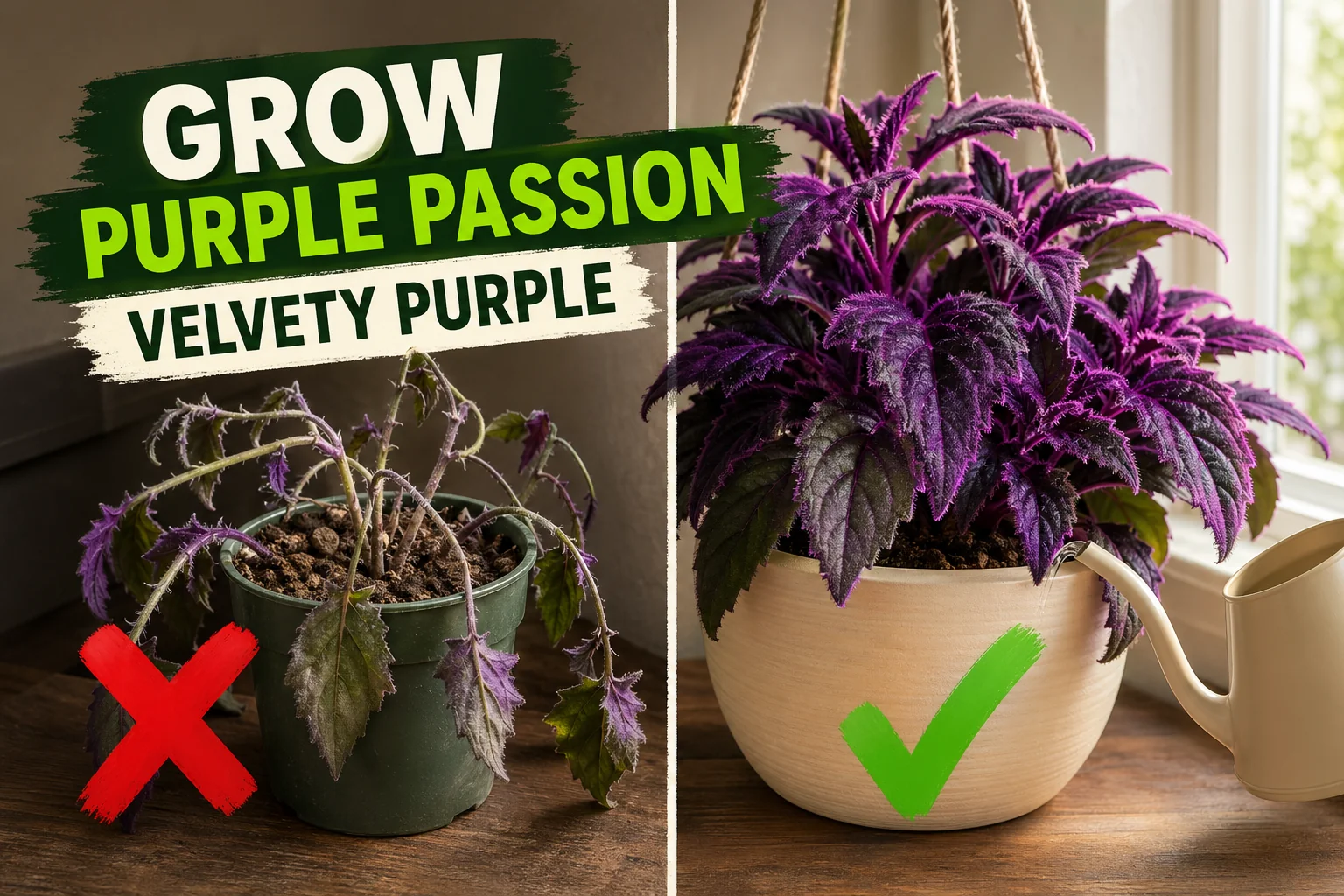
- Pour slowly at the base of the plant, aiming at the soil, not the leaves
- Water until it drains freely from the bottom holes
- Empty the saucer after 30 minutes — never let the pot sit in standing water
- Wait until the top 2 cm (0.75 in) dries again before the next watering
Typical watering frequency: every 5 to 10 days indoors during the growing season, longer in autumn and winter when growth slows.
The fuzzy trichomes on the leaves hold onto water. If you water overhead, droplets sit in the fuzz, promote fungal issues, and leave permanent brown marks on the velvet surface. Once those brown spots appear, they don’t heal.
Why you must never mist it
Misting is generally recommended for tropical houseplants that need humidity. Gynura aurantiaca is a tropical plant — but misting it is one of the worst things you can do to it.
The reason is the trichomes. Those fine surface hairs that create the velvet texture are excellent at trapping and holding moisture. When you mist, water sits on the leaf surface rather than evaporating quickly. The result:
- Brown water spots on the velvet — permanent, and they spread
- Fungal rot on the leaf surface, which can work its way into the stem
- Loss of the velvet texture where the trichomes are damaged
Raise humidity the right way instead:
- Place the pot on a pebble tray half-filled with water (pot sits above the water line, not in it)
- Group the plant with other houseplants — they naturally raise local humidity around each other
- Use a small humidifier in the room during dry seasons
- Keep the plant away from radiators, heating vents, and air-conditioning units
Humidity and temperature
Ideal humidity: 40–60%. Purple passion plants are comfortable in most normal home environments, but they suffer in air that drops below 30% — common near radiators in winter. Above 70% humidity with poor airflow can also lead to fungal issues on the dense fuzzy foliage.
Ideal temperature: 18–26°C (64–79°F) / 65–80°F. Consistent warmth keeps growth active. Avoid:
- Temperatures below 10°C (50°F) / 50°F — the plant goes dormant and can suffer damage
- Cold draughts from open windows in winter
- Sudden temperature swings of more than 5°C (41°F) overnight
- Placement directly above a heating vent, which desiccates the foliage
Purple passion plants are not frost-tolerant. Outdoors in summer is fine in warm climates, but bring them inside before temperatures drop below 15°C (59°F) / 59°F.
Soil and potting
Use a well-draining peat-based potting mix — standard houseplant compost amended with 20–30% perlite works well. The goal is a mix that holds just enough moisture to stay damp after watering but drains freely and never stays sodden.
Avoid:
- Dense garden soil or unamended heavy compost — it holds too much water and compacts around roots
- Purely sandy mixes — they drain too fast and the plant dries out within a day
Pot choice: terracotta pots are ideal because the porous walls allow excess moisture to escape, reducing overwatering risk. Plastic pots work fine if you’re careful with watering frequency. Always use a pot with drainage holes.
Repotting: every 1 to 2 years in spring, moving up one pot size only. Purple passion plants actually prefer being slightly root-bound — they grow faster and the stress encourages more compact, colourful foliage. Very large pots hold too much soil moisture and increase root rot risk.
Pruning to keep it bushy
Pruning is not optional for this plant — it is essential maintenance.
Without regular pruning, Gynura aurantiaca naturally stretches its stems, loses the lower leaves, and becomes a sparse, leggy vine within a few months. Regular cutting forces the stems to branch at every node, building a dense, bushy plant.
How to prune:
- Pinch or cut just above a leaf node (the point where a leaf meets the stem)
- Do this every 3 to 4 weeks during spring and summer
- You can remove up to one-third of the stem length in a single session without stressing the plant
- Save every cutting — they root easily (see Propagation below)
Pruning is also the best time to remove any stems that have gone completely bare at the base. These won’t produce new leaves, and removing them redirects the plant’s energy to actively growing stems.
In autumn and winter, you can slow or stop pruning as growth naturally decelerates.
Propagation — stem cuttings every 1–2 years
Gynura aurantiaca is a short-lived perennial. After 1 to 2 years, the plant starts looking its worst: lower stems become woody and bare, the upper canopy gets sparse, and the velvet colour fades even with good care. This is natural — not a failure.
The right response is not to try nursing the old plant back. Take cuttings and start fresh.
How to propagate by stem cutting:
- Cut a healthy stem 10–15 cm (4–6 in) long, cutting just below a leaf node
- Remove the lower leaves, leaving 2 to 3 leaves at the top
- Place the cut end in a glass of water, or directly into moist perlite or a light seed-raising mix
- Keep in bright indirect light, out of direct sun
- Roots appear in 10 to 21 days in water, slightly longer in perlite
- Once roots are 2–3 cm (0.75–1 in) long, pot up into the regular peat mix
Cuttings taken during active growth (spring and summer) root fastest. One plant can supply dozens of cuttings, making this one of the easiest houseplants to multiply.
The app Tazart can remind you when it’s time to take your next round of cuttings — just set a recurring care note on your plant’s profile.
The smell when it flowers — pinch them off
Purple passion plants will eventually produce flowers — small, fluffy, orange-yellow daisy-like blooms in the Asteraceae family. They look cheerful. They do not smell cheerful.
The flowers emit a strong, unpleasant odour often described as musty, sour, or reminiscent of dirty laundry. It is a natural pollination mechanism and completely normal, but most people find it intolerable indoors.
More importantly: flowering is a signal that the plant is entering the final stage of its life cycle. After flowering, the plant’s vigour typically drops off sharply, the stems become woody, and regrowth slows.
What to do: pinch off any flower buds as soon as you spot them. This delays the decline, keeps energy in the foliage, and spares you the smell. Flower buds are small, orange-tipped clusters that appear at the growing tips — they’re easy to distinguish from new leaf buds once you know to look.
Common mistakes
-
Not enough light. The most common reason for fading purple. The plant needs to be as close to a bright window as possible — not in a dim corner.
-
Misting the leaves. Water spots on velvet leaves are permanent. Raise humidity with a pebble tray or humidifier, never by misting directly.
-
Watering overhead. Even when watering, direct the flow to the soil, not the foliage. The trichomes hold moisture and rot follows.
-
Ignoring the need to prune. Without regular tip pruning every 3 to 4 weeks, the plant becomes leggy and bare within months.
-
Letting the plant flower without pinching. The flowers smell terrible and accelerate the plant’s decline. Remove the buds early.
-
Expecting a single plant to last many years. Purple passion plants naturally decline after 1 to 2 years. Propagate regularly with stem cuttings — that’s how experienced growers always have a fresh, vibrant plant.
Troubleshooting
| Symptom | Likely cause | Fix |
|---|---|---|
| Leaves fading from purple to green | Insufficient light | Move to brightest indirect light spot, within 30 cm (12 in) of a south or east window |
| Brown water spots on leaves | Misting or overhead watering | Always water at base only; never mist; damaged spots will not heal |
| Soft rotting stems at the base | Overwatering or sitting in water | Allow soil to dry; check drainage holes are clear; repot if roots are rotted |
| Leggy bare stems with few leaves | Not pruned regularly | Cut back hard to the last healthy node; prune every 3–4 weeks going forward |
| Leaves yellowing and dropping | Overwatering or root rot | Reduce watering frequency; check for soggy roots; repot into fresh dry mix |
| Strong unpleasant smell from the plant | Plant is flowering | Pinch off all orange-yellow flower buds immediately |
Watch: purple passion plant care guide
A short visual walkthrough is useful for seeing exactly what a correctly pruned, well-lit purple passion plant looks like compared to a neglected one. Search for Gynura aurantiaca care or purple passion plant care on YouTube — look for channels that show real before-and-after results and demonstrate the base-watering technique.
Watch the guide, then come back to this article for the exact timing and thresholds above. The written guide provides the specific numbers (soil dryness, temperature ranges, pruning intervals) that videos often skip.
Related reading
- How to care for a pothos plant — another trailing tropical that rewards bright light and careful watering, with similar “let it dry slightly” watering rules.
- How to take care of a spider plant — if you want a low-maintenance companion that genuinely thrives in lower light.
- How to propagate a rubber plant — goes deeper on stem cutting techniques that apply directly to purple passion propagation.
- Use the free Tazart plant care app to set watering reminders, pruning schedules, and propagation alerts for your purple passion plant — and ask Dr. Afrao., the in-app AI plant assistant, if you’re seeing symptoms not covered here.
A note on conditions
Every home is different. The light reaching your windowsill, the humidity in your rooms, your pot size, your soil mix, the season, and your local climate all affect how your purple passion plant grows and how quickly it needs water. Use the numbers in this guide as a starting point — then adjust based on what your specific plant shows you in the first two to three weeks. That’s how every experienced grower calibrates their care.
Highly recommended
The supplies that make this guide work

Tazart is an Amazon Associate — we earn from qualifying purchases at no extra cost to you. Thank you for helping us keep these guides free.
Frequently asked questions
Why is my purple passion plant turning green?
Not enough light. Gynura aurantiaca produces its velvety purple colour through anthocyanin pigments in the leaf trichomes (fine surface hairs), and the plant only synthesises those pigments under strong, bright light. Move it to the brightest indirect light you have — ideally right next to a south- or east-facing window — and the new growth will come in purple within a few weeks.
Can I mist my purple passion plant?
No. Never mist a purple passion plant. The fine fuzzy hairs on the leaves trap moisture, which leads to brown water spots, fungal rot, and permanent damage to the velvet texture. Raise humidity instead by placing the pot on a pebble tray with water, grouping it with other plants, or using a small room humidifier nearby.
Why do purple passion plant flowers smell bad?
Gynura aurantiaca produces small orange-yellow flowers that emit a noticeably unpleasant odour — often described as musty or like dirty socks. The smell is a natural pollination mechanism. Pinch off any flower buds as soon as you see them. Letting the plant flower also signals the end of its vigorous growth phase, so removing buds keeps energy focused on the foliage.
How often should I water a purple passion plant?
Water when the top 2 cm (0.75 in) of soil feels dry to the touch — typically every 5 to 10 days indoors depending on pot size, light, and season. Always water at the base of the plant, never overhead, and never let it sit in standing water. The fuzzy leaves hold moisture, making overwatering and overhead watering the two most common causes of rot.
How do I keep my purple passion plant bushy?
Pinch or prune the growing tips regularly — every 3 to 4 weeks during spring and summer. Cutting just above a leaf node forces the plant to branch rather than stretch. Without pruning, the stems become long and bare very quickly. Those pruned tips can be rooted immediately as cuttings in water or moist perlite.
How long does a purple passion plant live?
Gynura aurantiaca is a short-lived perennial. Plants look their best in the first one to two years, then the lower stems become woody and bare, the foliage gets sparse, and the velvet colour fades. Rather than trying to rescue an old plant, take stem cuttings and start fresh — the cuttings root easily and you'll have a vigorous new plant within a few weeks.