Care
Lavender Plant Care: The Complete Guide (Lavandula)
Master lavender plant care — full sun, gritty soil, deep watering, twice-yearly pruning, and winter prep for English, French, and Spanish lavender varieties.
On this page
- Quick answer
- Table of contents
- Light requirements
- Soil — the single most important factor
- Watering — less is always more
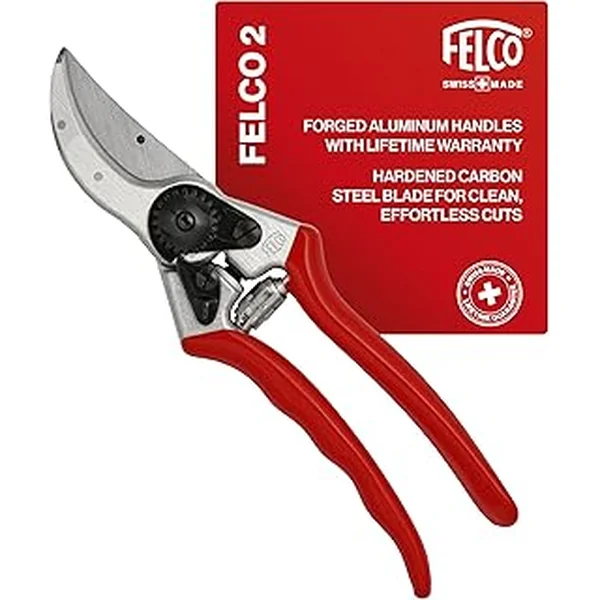
- Pruning — the twice-yearly routine
- Fertilizing
- Lavender in containers
- Variety guide: English vs French vs Spanish lavender
- Pollinator value
- Winter care
- Common problems and solutions
- Watch: Lavender care video guide
- Lavender care at a glance — quick-reference checklist
- Related reading
Watch the visual walkthrough
Plant Profile: Lavender :: How to Prune, Plant & Grow Beautiful Lavender!
Welcome Gardeners! Lavender is not only one of the most beautiful and best smelling plants in the garden, but it's also fuss free!
Lavender (Lavandula angustifolia) is one of the most rewarding plants you can grow — but also one of the most commonly killed by well-meaning overcare. Too much water, too little sun, the wrong soil, and a single ill-timed pruning cut into woody stems can undo years of growth in a single season.
Get the fundamentals right, and lavender asks almost nothing of you. It tolerates drought, feeds every bee in the neighbourhood, fills the air with fragrance from late spring through summer, and can live for over a decade. This guide covers everything: light, soil, watering, pruning, the key variety differences, winter prep, and exactly how to avoid the most common mistakes.
Quick answer
Grow lavender in full sun (6–8+ hours daily) in fast-draining, slightly alkaline soil (pH 6.5–7.5). Water deeply but infrequently — established plants are drought tolerant and need almost no supplemental watering. Prune twice yearly: a light spring shaping and a post-bloom summer cut, always into green growth, never into bare wood. English lavender (L. angustifolia) is hardy in USDA zones 5–8; French and Spanish lavender are tender (zones 7–10).
Table of contents
- Light requirements
- Soil — the single most important factor
- Watering — less is always more
- Pruning — the twice-yearly routine
- Fertilizing
- Lavender in containers
- Variety guide: English vs French vs Spanish
- Pollinator value
- Winter care
- Common problems and solutions
- FAQs
Light requirements
Lavender is a full-sun plant. No exceptions.
A minimum of 6 hours of direct sunlight per day is the baseline for flowering. Eight hours or more produces the most compact growth, the most flower spikes, and the strongest fragrance. In hot climates above 35°C (95°F), a brief period of afternoon shade is tolerable — but anything below 6 total hours of sun leads to poor bloom, leggy weak stems, and significantly higher risk of fungal disease.
South-facing or west-facing aspects work best in the Northern Hemisphere. If your garden only offers a 4-hour-sun spot, choose a different plant — lavender will slowly decline regardless of how perfect everything else is.
Light checklist:
- At least 6 hours direct sun — 8+ is better
- South or west-facing placement in the Northern Hemisphere
- Avoid placing near walls or fences that cast long shadows
- Avoid overhanging trees — shade and drip both harm lavender
Soil — the single most important factor
If there is one thing to get right with lavender, it is the soil. Lavender dies far more often from root rot in waterlogged soil than from any other cause.
What lavender needs:
- Fast-draining — water must pass through within minutes, not sit for hours
- Lean and gritty — average to poor fertility; rich soil causes floppy, disease-prone growth
- Slightly alkaline — pH 6.5–7.5 is optimal; acidic soils below pH 6.0 reduce bloom quality
In heavy clay soil: dig in generous amounts of horticultural grit or coarse sharp sand — at least 30–50% by volume — before planting. Alternatively, build a raised bed at least 30 cm (12 in) high filled with a gritty loam mix.
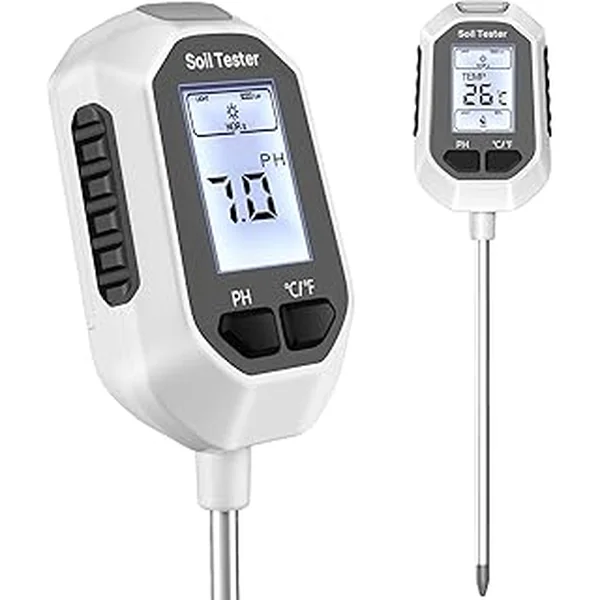
Lime amendment: In naturally acidic soils (pH below 6.0), apply garden lime in early spring. A rate of approximately 100–200 g per m² (3–6 oz per 10 sq ft) raises pH by roughly 0.5–1.0 units. Test your soil first before amending.
Planting depth: Plant at the same depth the lavender was in its nursery pot — never deeper. Burying the crown encourages rot.
Soil mix for containers:
- 50% peat-free potting compost
- 50% horticultural grit or perlite
This mix drains fast and stays aerated even after repeated watering.
Watering — less is always more
Lavender’s Mediterranean origin means it evolved in dry summers with winter rain. Replicating this rhythm is the key to long-lived plants.
In the first growing season
New transplants need help establishing roots. Water deeply — enough to wet the soil to 15–20 cm (6–8 in) depth — every 7–10 days during dry periods in the first year. Always allow the soil to dry completely at the surface before watering again.
Established plants (year two onward)
Once established, lavender in the ground rarely needs supplemental watering in temperate climates. Rainfall is usually sufficient. Only water during extended dry spells lasting 3–4 weeks or more. When you do water, water deeply — a long slow soak rather than a light sprinkle — then leave the plant alone again.
Container lavender
Pots dry out faster than garden beds. Check every 3–5 days in summer; water when the top 2.5 cm (1 in) of soil is completely dry. In winter, barely water container lavender — once every 3–4 weeks is usually enough.
Watering rules to live by
- Never use a dripper or soaker system set to water daily — this is the fastest way to kill lavender
- Never let water sit in a pot saucer under lavender — tip it out after watering
- Morning watering is better than evening — foliage dries faster, reducing disease risk
- Rainwater is fine; tap water is fine — lavender is not picky about water source
Pruning — the twice-yearly routine
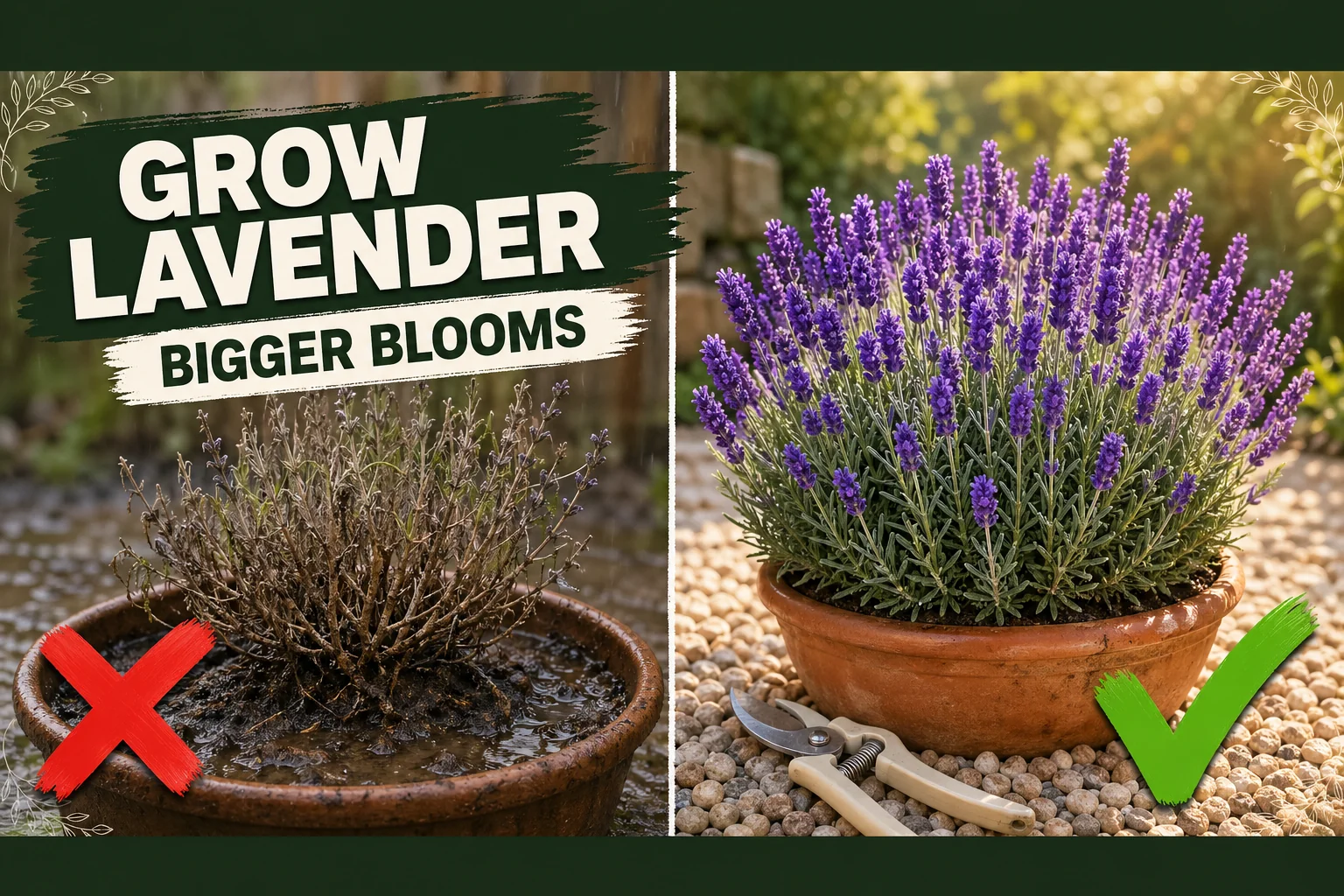
Pruning is the single most misunderstood aspect of lavender care. Done correctly, it extends the plant’s life and keeps it compact. Done incorrectly — especially cutting into old woody stems — it can kill the plant.
The golden rule
Never cut into bare, brown, woody stems. Lavender will not regenerate from old wood the way roses or buddleja do. Only prune into green leafy growth. This is non-negotiable.
Prune 1: Early spring shaping
When: As soon as you see new growth emerging at the base, typically March–April in USDA zones 5–7.
What to do:
- Remove any stems that are winter-damaged, dead, or snapped
- Cut the overall plant shape back by roughly one-third — aim for a compact mound
- Work from the outside in, maintaining a rounded dome shape
- Do not cut below the lowest green leaves on any stem
Why: This removes winter die-back, encourages bushy compact growth, and sets the plant up for a strong bloom.
Prune 2: Post-bloom summer cut
When: Immediately after the main flower flush fades — usually July to August in USDA zones 5–7. Do not leave spent flowers on the plant for weeks; deadhead promptly.
What to do:
- Cut all spent flower stalks back to the foliage
- Trim an additional 2.5–5 cm (1–2 in) of leafy growth to maintain shape
- Again, stay in the green growth — do not go below the lowest leaves
Why: Removing spent flowers prevents the plant from putting energy into seed production. The post-bloom trim stimulates a second, smaller flush of flowers in late summer in many English lavender varieties. It also keeps the plant compact so it doesn’t sprawl and split.
What happens if you skip pruning
Without annual pruning, lavender quickly becomes leggy, with a hollow woody centre and flowers only at the tips of long bare stems. After 3–4 years of no pruning, the plant can no longer be saved by cutting back — it becomes a candidate for replacement.
Fertilizing
Lavender thrives on lean soil and actively dislikes heavy feeding. Rich soil promotes soft, floppy growth that is prone to disease and produces fewer flowers.
What to do:
- Apply a light dressing of a low-nitrogen, high-potassium granular fertilizer once in early spring — a tomato fertilizer (high-K) works well
- Alternatively, work in a small amount of garden lime and a handful of bone meal at planting
- Do not feed after midsummer — late feeding pushes soft growth that won’t harden before winter
- Do not use high-nitrogen fertilizers (lawn feeds, general-purpose) — these produce excessive leafy growth at the expense of flowers
In containers, a half-strength liquid feed of a high-potassium fertilizer once in spring and once in early summer is sufficient.
Lavender in containers
Lavender adapts well to containers when drainage is handled properly. It is one of the best-draining-required plants for patios and balconies.
Container requirements:
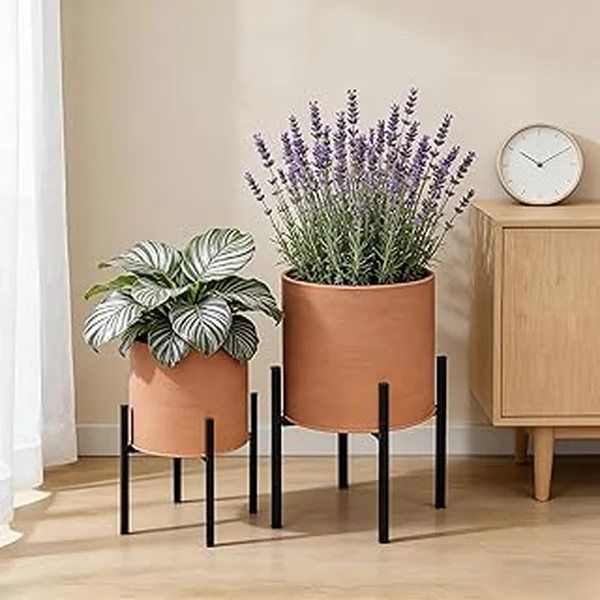
- Terracotta pots are ideal — they are porous and wick excess moisture away from roots. Plastic pots hold too much moisture.
- Minimum size: 30 cm (12 in) wide and 30 cm (12 in) deep for a single plant; larger for dwarf cultivars
- Drainage hole: mandatory — no exceptions
- Pot feet or stands: raise the pot so the drainage hole cannot become blocked
Compact varieties best for containers:
- ‘Hidcote’ — dense, deep purple, 45–60 cm (18–24 in)
- ‘Munstead’ — early blooming, compact, 30–45 cm (12–18 in)
- ‘Little Lottie’ — dwarf, pale pink flowers, 20–30 cm (8–12 in)
Container lavender needs repotting every 2–3 years as roots fill the pot. Go up one pot size — don’t jump to a massive pot, which holds too much moisture.
Variety guide: English vs French vs Spanish lavender
The three lavender types look similar in a nursery but have very different care needs and cold hardiness.
| English (L. angustifolia) | French (L. dentata) | Spanish (L. stoechas) | |
|---|---|---|---|
| Hardy to | USDA zones 5–8 | USDA zones 7–10 | USDA zones 7–10 |
| Flower shape | Classic slender spikes | Soft, fringed spikes | Compact head with ‘rabbit ear’ petals |
| Fragrance | Strongest — classic lavender | Moderate | Mild, slightly resinous |
| Bloom time | June–July, possible second flush | Almost year-round in mild climates | April–June, earlier than English |
| Leaf shape | Narrow, grey-green | Toothed, grey-green | Narrow, slightly downy |
| Longevity | 10–15 years with good care | 5–10 years | 5–8 years |
| Best for | Cold climates, cooking, essential oil | Mild coastal gardens | Mediterranean gardens, cut flowers |
English lavender popular cultivars:
- ‘Hidcote’ — compact, deep violet, one of the best for cold climates
- ‘Munstead’ — one of the oldest and most reliable; pale purple; early bloomer
- ‘Alba’ — white-flowered form; slightly less cold-hardy
- ‘Vera’ — large, grey-green leaves; grown commercially for essential oil
French lavender (L. dentata): Recognizable by its serrated (dentate) leaves. Blooms for a very long season in mild climates — almost year-round in zones 8–9. Not frost hardy; bring inside or protect below 0°C (32°F).
Spanish lavender (L. stoechas): The ‘rabbit ears’ (sterile bracts on top of the flower head) make it instantly identifiable. Very early bloomer — often flowering in April. Popular for containers and cutting gardens in mild climates.
Pollinator value
Lavender is one of the most important pollinator plants in temperate gardens.
If you want another strongly scented, insect-repelling plant to combine with lavender in a sensory garden or near a seating area, the citronella plant care guide covers a grass with overlapping site requirements and a complementary lemon-citrus fragrance. Bumblebees, honeybees, solitary bees, and hoverflies visit constantly throughout the bloom period — the long tubular flowers are perfectly shaped for bees to access nectar.
For another long-season pollinator perennial that pairs beautifully with lavender at the front of a hot, dry border, russian sage care covers a plant with nearly identical site requirements and a complementary blue-violet flower tower.
Research has shown lavender to be among the top 10 garden plants for bee forage in UK and European studies. A single established lavender plant in full bloom can see dozens of bees working it simultaneously on a warm day.
Butterflies — including skippers, small tortoiseshells, painted ladies, and red admirals — are also regular visitors, particularly during the main mid-summer bloom.
Practical tips for pollinators:
- Plant in groups of 3–5 plants rather than singly — larger drifts attract more insects and are more visible to passing pollinators
- Leave the second flush of flowers on the plant as long as possible in late summer
- Avoid spraying any pesticide on or near lavender in flower
Winter care
English lavender (zones 5–8)
English lavender is the most cold-hardy species and will survive most temperate winters without intervention, provided drainage is excellent. Wet, waterlogged winter soil is far more lethal to lavender than frost alone.
What to do before winter:
- After the summer prune, leave the plant alone — do not feed or prune again in autumn
- In zones 5–6, apply a light 2.5–5 cm (1–2 in) layer of coarse gravel or horticultural grit around the crown — this reflects light, improves drainage, and provides a microclimate of warmth
- Do not use bark mulch — it holds moisture right at the crown where rot starts
- In exposed or particularly cold gardens, a breathable horticultural fleece over the plant on the coldest nights (below −15°C / 5°F) provides additional protection
What to avoid:
- Do not cut back hard in autumn — leave the structure for winter protection
- Do not mound bark or soil up around the stems
French and Spanish lavender (zones 7–10)
These are tender and will not survive frost below about −5°C (23°F). Options:
- Move container plants to an unheated greenhouse, cold frame, or sheltered porch
- In the ground, protect with horticultural fleece during any frost event
- In colder zones (below zone 7), treat as an annual or lift and overwinter indoors
Spring recovery
After a hard winter, some stems will look dead and grey. Wait until new basal growth appears (usually March–April) before deciding what to prune. Plants that look completely dead at the tips are often still alive at the crown — patience is the right approach.
Common problems and solutions
| Problem | Likely cause | Fix |
|---|---|---|
| Grey, mushy stems at base | Root rot from overwatering or poor drainage | Improve drainage immediately; reduce watering; remove affected stems; if crown is gone, replace plant |
| Leggy, woody plant with few flowers | Lack of pruning over multiple years | If some green remains, prune into green growth; if all woody, plant is likely beyond saving |
| Yellowing leaves | Overwatering, waterlogged soil, or over-fertilizing with nitrogen | Reduce water; improve drainage; switch to high-K low-N feed |
| Few or no flowers | Insufficient sun, over-fertilizing, or not pruning | Move to a sunnier spot; reduce feeding; prune post-bloom |
| Leaves turning brown and crispy | Root rot (paradoxically), severe drought in containers, or frost damage | Check roots; water container plants more frequently; assess frost damage in spring |
| Plant splitting open in centre | Not pruned for several years; natural ageing | Prune back into green; tie stems loosely to close gap temporarily; replace if beyond recovery |
| Silvery white powder on leaves | Powdery mildew — usually from poor air circulation or excess humidity | Improve spacing; trim surrounding plants; avoid wetting foliage; apply a dilute neem oil solution |
Watch: Lavender care video guide
A visual walkthrough is especially helpful for the pruning technique — seeing exactly where to cut makes the “stay in green growth” rule much clearer.
The YouTube resolver will populate this section with a verified video on lavender care. The embed and VideoObject schema will be added after running python3 scripts/resolve_youtube_videos.py lavender-plant-care.
Lavender care at a glance — quick-reference checklist
Planting:
- Full sun location — 6–8+ hours
- Fast-draining, lean soil amended with grit if needed
- Slightly alkaline pH 6.5–7.5; add lime if soil is acidic
- Plant at nursery pot depth — do not bury the crown
Watering:
- Deep, infrequent watering in first year (every 7–10 days)
- Established plants: water only during prolonged drought
- Container plants: check every 3–5 days; water when top 2.5 cm (1 in) is dry
Pruning:
- Spring shape — into green growth only, remove dead stems
- Post-bloom summer trim — cut spent stalks plus 2.5–5 cm (1–2 in) of foliage
- Never cut into bare woody stems
Feeding:
- Light high-K, low-N feed once in spring only
- Nothing after midsummer
Winter:
- Gravel/grit mulch at crown (zones 5–6)
- No autumn hard prune
- Tender varieties (French/Spanish): protect from frost or move inside
Related reading
- How to care for rosemary — another drought-tolerant Mediterranean herb with similar sun and soil requirements
- Catmint plant care (Nepeta) — the best lavender companion plant for pollinators; identical pruning rhythm
- Borage plant care — another excellent pollinator plant that pairs well with lavender borders
Highly recommended
The supplies that make this guide work
Tazart is an Amazon Associate — we earn from qualifying purchases at no extra cost to you. Thank you for helping us keep these guides free.
Frequently asked questions
How much sun does lavender need?
Lavender needs a minimum of 6 hours of direct sun per day, and it performs best with 8 hours or more. In hot climates, light afternoon shade is acceptable, but anything shadier than 6 hours results in poor flowering, leggy growth, and increased susceptibility to fungal disease. Full sun is non-negotiable for strong blooms.
How often should you water lavender?
Once established — after roughly one full growing season — lavender is highly drought tolerant and rarely needs supplemental watering in temperate climates. In the first season, water deeply every 7–10 days during dry spells, allowing the soil to dry completely between sessions. Established plants in the ground may only need watering during prolonged drought of 3–4 weeks or more. Container lavender dries out faster and typically needs watering every 5–7 days in summer.
When and how do you prune lavender?
Prune lavender twice a year: once in early to mid spring (when new growth appears at the base) to shape the plant and remove winter-damaged stems, and again immediately after the main bloom flush ends in summer. In both cases, cut back into the green foliage — never cut into bare, woody stems, which rarely regenerate. Remove roughly one-third of the plant's height in spring and cut the spent flower stalks plus about 2.5–5 cm (1–2 in) of foliage after the summer bloom.
Does lavender come back every year?
English lavender (Lavandula angustifolia) is a hardy perennial that reliably returns each year in USDA zones 5–8 (down to −20°C / −4°F with good drainage). French lavender (L. dentata) and Spanish lavender (L. stoechas) are tender perennials or shrubs, generally hardy only in zones 7–10. With correct drainage and pruning, English lavender can live 10–15 years.
What is the difference between English, French, and Spanish lavender?
English lavender (Lavandula angustifolia) has thin, grey-green leaves, classic slender purple flower spikes, the strongest fragrance, and the best cold hardiness (zones 5–8). French lavender (L. dentata) has toothed leaves, longer bloom season, and is cold-tender (zones 7–10). Spanish lavender (L. stoechas) is recognizable by its distinctive 'rabbit ear' petals atop the flower head, blooms very early, and is also cold-tender (zones 7–10).
Can lavender grow in containers?
Yes, but drainage is critical. Use a terracotta pot with at least one drainage hole — at least 30 cm (12 in) wide and deep — and a gritty mix of 50% potting compost and 50% perlite or horticultural grit. Container lavender dries out faster than in-ground plants, so check the soil every few days in summer. Feed lightly with a low-nitrogen, high-potassium fertilizer once in spring. Repot every 2–3 years as roots fill the container.
How do you prepare lavender for winter?
In autumn, cut back any remaining spent flower stems but avoid the heavy structural prune — save that for spring. In zones 5–6 where temperatures drop below −12°C (10°F), mulch around the base with coarse gravel or horticultural grit (not bark, which holds moisture). Improve drainage before the wet season if the soil is heavy. Pot-grown lavender can be moved to a sheltered, frost-free spot such as an unheated greenhouse or cold frame. Do not feed after late summer.
Why is my lavender dying?
The most common cause is overwatering or poor drainage leading to root rot — the plant will show grey, mushy stems at the base. Other causes include: insufficient sun (fewer than 6 hours), heavy clay soil that stays wet, cutting into woody stems during pruning, or planting too deep. Check the crown and roots: if the base is firm and green, the plant can usually recover with improved drainage and reduced watering. If the base is mushy and black, root rot has set in and recovery is unlikely.