Houseplants
How to Propagate String of Turtles (Peperomia prostrata)
Propagate string of turtles from stem cuttings in water, sphagnum moss, or soil. Roots take 4–6 weeks — here is what actually works and what kills cuttings.
On this page
Watch the visual walkthrough
How to Propagate Trailing Succulent Plants | String of Turtles, Banana & Teardrops
I would like to share how I did my propagation of trailing succulent plants like string of turtles, bananas and teardrops and some ...
String of turtles (Peperomia prostrata) is one of the most rewarding trailing houseplants to propagate — but it tests your patience. This is a genuinely slow-growing peperomia, and the cuttings reflect that. Roots take 4 to 6 weeks to appear, and a full trailing plant takes months to build. The good news: the actual propagation steps are simple, and the failure modes are predictable and avoidable.
This guide covers stem cuttings (the fastest and most reliable method), single-leaf propagation, all three rooting media, and the common mistakes that kill cuttings before they ever root.
Quick answer
Take a 5–8 cm (2–3 in) stem cutting with 3 to 5 pairs of leaves, strip the bottom pair, and place it in damp sphagnum moss, room-temperature water, or moist perlite/coir mix. Keep in bright indirect light at 20–24°C (68–75°F) with moderate to high humidity. Expect roots in 4 to 6 weeks. String of turtles is a slow grower — do not disturb the cutting before the 4-week mark.
About the plant
Peperomia prostrata — called string of turtles for the dark-veined, circular patterned leaves that resemble turtle shells — is a creeping, trailing member of the Piperaceae (pepper) family. It is native to tropical rainforests in South America where it grows as an epiphyte on forest-floor debris, meaning its roots prefer excellent aeration and never want to sit in standing water for long.
That epiphytic origin matters for propagation. The plant roots best when the medium is:
- Airy (not compacted)
- Moist (not wet or bone dry)
- Warm (20–24°C / 68–75°F consistently)
It is also a genuinely slow grower. Unlike pothos or spider plants, which can root in under two weeks, string of turtles follows its own unhurried schedule. Expecting faster results leads to the #1 mistake: pulling the cutting out to check, damaging the tiny emerging roots, and starting over.
Stem cutting method (recommended)
Stem cuttings with multiple leaves are the most reliable way to propagate string of turtles. A multi-leaf cutting has more stored energy (in its leaves) to sustain itself through the long 4 to 6 week rooting period than a single leaf does.
What you need
- One healthy, actively trailing string of turtles with strands at least 10–15 cm (4–6 in) long
- Clean, sharp scissors or micro-tip snips (sterilize with isopropyl alcohol)
- Your rooting medium: propagation glass, damp sphagnum moss, or moist perlite/coir mix
- A spot with bright indirect light and temperatures of 20–24°C (68–75°F)
- Optional: rooting hormone powder
Step by step
1. Choose a healthy stem. Pick a strand with at least 3 to 5 pairs of full-size, patterned leaves. Avoid any strand that is yellowing, limp, or has soft spots on the stem — those cuttings rarely recover.
2. Cut just below a leaf node. Using your sterilised scissors, cut the strand to give you a section 5–8 cm (2–3 in) long with 3 to 5 pairs of leaves. Cut just below (within 0.5 cm / 0.25 in of) a leaf node — the small bump where the leaf joins the stem. This is where roots will emerge.
3. Strip the bottom pair of leaves. Remove the lowest pair of leaves carefully by snapping them downward against the stem. You want 1–2 cm (0.4–0.75 in) of bare stem that will sit inside the medium. Leave the rest of the leaves intact.
4. Let it callous (sphagnum or soil only). If you are propagating in sphagnum or soil, let the cut end dry and callous for 30 to 60 minutes before placing it in the medium. This is not necessary for water propagation.
5. Place in your medium. See the Water vs sphagnum vs soil section below for specific setup. The bare stem goes into the medium; the upper leaves stay above.
6. Provide warmth, light, and humidity. Bright indirect light, 20–24°C (68–75°F), and 60 to 70% humidity are the ideal conditions. A clear plastic bag tented loosely over the pot raises humidity without cutting off airflow.
7. Wait 4 to 6 weeks without disturbing the cutting. This is the hardest part. Do not pull the cutting out to check. Instead, look for tiny white root tips visible through a glass jar (water method) or wait for gentle tug-resistance (sphagnum/soil). New leaf growth is also a reliable signal that roots have formed.
Single-leaf method
Individual leaves of Peperomia prostrata can produce new plantlets, but the process is slower and less guaranteed than stem cuttings. It is worth knowing when you have a plant with very few long strands but plenty of spare leaves.
How to do it:
- Snap off a healthy, fully mature leaf. The leaf must come off with its petiole — the short stalk connecting the leaf to the stem — intact. Without the petiole, the leaf will not root.
- Let the cut petiole tip callous for 30 to 60 minutes.
- Push the petiole gently into barely moist sphagnum moss or perlite at a shallow angle — just deep enough to hold the leaf upright without burying the leaf blade itself.
- Cover loosely with a humidity dome or clear bag.
- Place in bright indirect light at 20–24°C (68–75°F).
A tiny new plantlet will emerge at the base of the petiole. This takes 8 to 12 weeks — longer than stem cuttings — and not every leaf will succeed. Once the plantlet has 2 to 3 of its own leaves, it can be carefully separated and potted up.
Single-leaf propagation is slower but lets you multiply a plant from leaves that would otherwise be discarded during pruning.
Water vs sphagnum moss vs moist soil
All three methods work. The differences come down to visibility, rot risk, and the transfer step.
| Medium | Pros | Cons | Best for |
|---|---|---|---|
| Water | Easy to monitor; no disturbance needed; free | Roots formed are fragile; needs transfer to soil; requires weekly water changes | Beginners who want to watch roots form |
| Sphagnum moss | Excellent aeration; retains moisture evenly; low rot risk; roots transfer easily | Needs to be kept damp (not wet); harder to see roots | Most reliable results; best overall medium |
| Moist perlite/coir | No transfer stress; roots develop as soil roots from day one | Can dry out fast; harder to see progress | Propagators who want to skip the transfer step |
Water propagation setup
- Fill a small glass or propagation tube with room-temperature water.
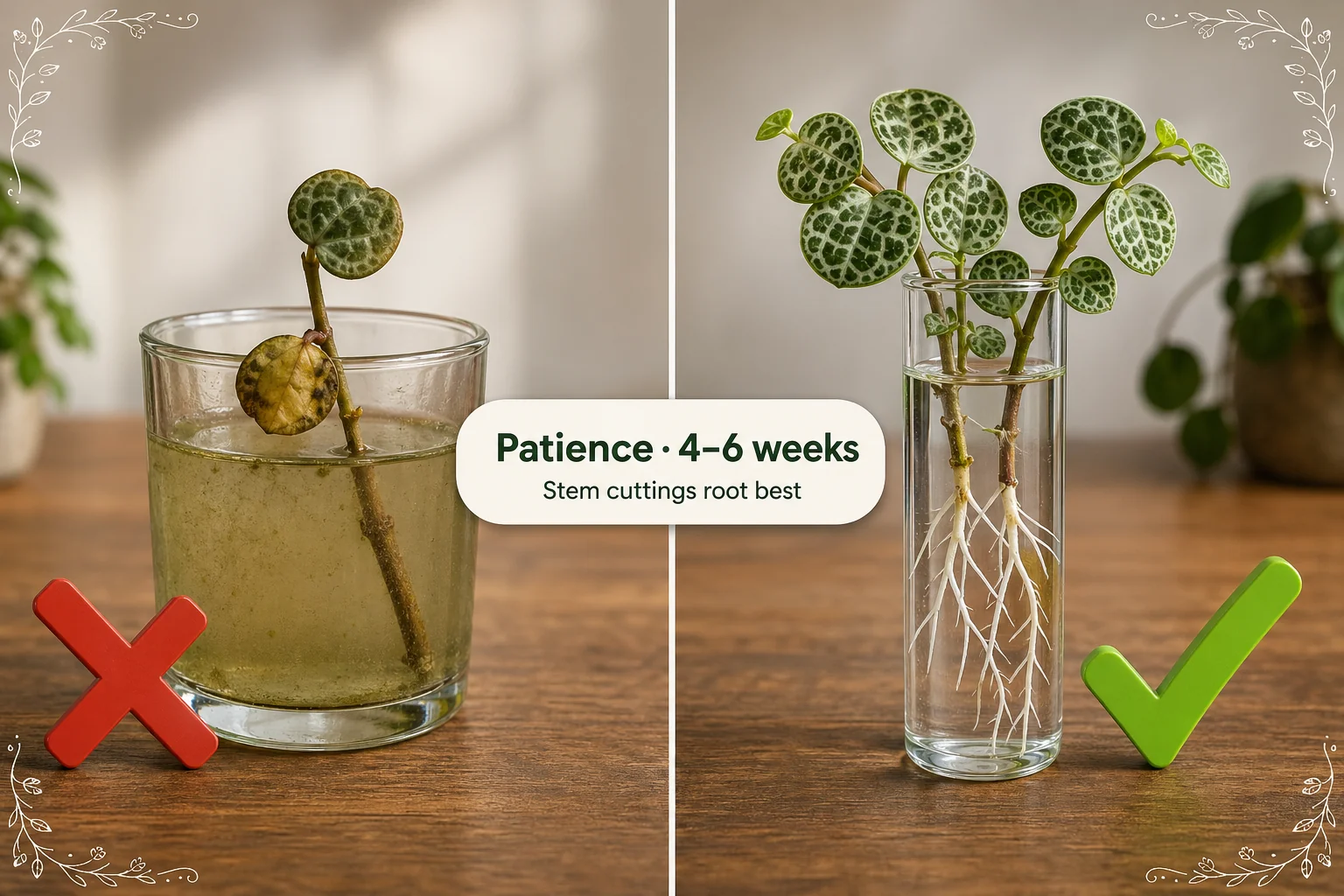
- Submerge only the bare stem. No leaves should touch the water — submerged leaves rot within days.
- Change the water every 5 to 7 days. Stagnant water becomes anaerobic and kills the stem.
- Keep the jar in bright indirect light, not direct sun (which heats the water and encourages algae).
- Pot up when roots are 2–4 cm (0.75–1.5 in) long.
Sphagnum moss setup
- Use long-fiber sphagnum moss. Rinse it, squeeze it thoroughly, and work it into a small pot or tray.
- It should feel like a damp sponge — moist when squeezed, not dripping. Too wet is worse than too dry.
- Push the bare stem 1–2 cm (0.4–0.75 in) into the moss. Do not pack the moss tight around the stem.
- Mist the surface every 2 to 3 days and tent with a clear bag.
- The cutting has rooted when it resists a very gentle tug.
Moist perlite/coir setup
- Mix 50% perlite with 50% coco coir.
- Moisten with water until barely damp — squeeze a handful and only a few drops should fall.
- Push the bare stem 1–2 cm (0.4–0.75 in) into the mix.
- Water very sparingly — less than you think. The mix should dry slightly between mistings.
- New leaf growth after 5 to 6 weeks signals successful rooting.
Patience: string of turtles is a slow grower
It cannot be overstated: Peperomia prostrata propagates on a slow schedule by nature. This is not a pothos. Here is the realistic timeline you should expect:
| Milestone | Timeframe |
|---|---|
| First white root tips visible | 4 to 6 weeks |
| Roots long enough to pot up | 5 to 7 weeks |
| First new leaf on rooted cutting | 6 to 10 weeks |
| Cutting starts to trail noticeably | 3 to 5 months |
| A full, lush cascading plant | 6 to 12 months |
The biggest propagation mistake people make with this plant is checking too early, disturbing the fragile nascent roots, and declaring it a failure. A cutting that looks identical at week 3 compared to day 1 is not dead — it is still rooting. Leave it alone.
A plant care tracker like Tazart can hold a reminder for week 5 so you know exactly when to check without the temptation to peek too early.
Light and humidity for new starts
String of turtles cuttings need more support than the established parent plant during propagation:
Light: Bright indirect light is essential. A spot 30–60 cm (12–24 in) from an east-facing window or set back from a south- or west-facing window works well. Low light is one of the most common reasons cuttings fail — they simply do not have enough energy to power root growth in the dark.
Do not put cuttings in direct sun. The small leaves are thin and vulnerable, and direct sun will scorch or wilt them before any roots form.
Humidity: Aim for 60 to 70% during the rooting period. A humidity dome, a clear plastic bag tented over the cutting with a few small holes poked for airflow, or a spot near a humidifier all work. Once the cutting has rooted and is showing new leaf growth, you can gradually remove the humidity aid over 1 to 2 weeks to acclimatise it to normal household humidity (40–50%).
Temperature: 20–24°C (68–75°F) is the sweet spot. Below 18°C (65°F) rooting slows dramatically. Keep cuttings away from cold windowsills and air-conditioning drafts.
Common failures and how to avoid them
Stem rot before rooting The most common failure. Caused by: too much water in the medium, submerged leaves in water propagation, or an unsterilised cutting tool introducing bacteria. Fix: squeeze out sphagnum thoroughly before use, change propagation water every 5 to 7 days, and always sterilize your scissors before taking cuttings.
No roots after 8+ weeks Usually means the temperature is too cold, the light is too dim, or the cutting was taken from an unhealthy or dormant section of the plant. Take a fresh cutting from a healthy, actively growing strand in spring or summer — this is when Peperomia prostrata propagates most reliably.
Cutting collapses and shrivels The tiny leaves are losing moisture faster than the stem can uptake it. This happens in very dry air (under 40% humidity) or direct sun. Move to a shadier, more humid spot and tent with a clear bag for the first two weeks.
Single leaf produces nothing Not all leaves have viable petioles, and some leaves detach from the petiole during removal. Check that the petiole stub (the tiny stalk) is still attached to the leaf. If the leaf came off cleanly at the leaf blade with no petiole stub, it will not root — discard it and try again with a fresh leaf snapped (not cut) from the stem.
Roots form but die after potting up Water roots are particularly fragile. If you waited too long and the roots are 6 cm (2.5 in) or longer, they were optimised for a water environment and the sudden switch to soil is stressful. Pot up at 2–4 cm (0.75–1.5 in), keep the soil barely moist (not wet) for the first two weeks after transfer, and tent the pot loosely with a clear bag to hold humidity during the adjustment period.
Related reading
- Baby rubber plant care (Peperomia obtusifolia) — the closest Peperomia relative in this family; similar slow-growing, low-water care requirements.
- How to propagate pothos — a faster comparison: pothos roots in water in 7 to 14 days versus the 4 to 6 weeks of string of turtles.
- How to propagate jade plant — jade also propagates from leaves and stem cuttings with a callousing step, making it a useful parallel.
- Track your cuttings’ 4-week rooting window with a free reminder in the Tazart plant care app — Dr. Afrao., the in-app AI, can also help troubleshoot if your cuttings stall.
A note on conditions
Every home is different. Room temperature, light levels, water hardness, and the time of year all affect how quickly your string of turtles cuttings root. Spring and early summer — when the plant’s growth hormones are naturally elevated — consistently produce faster, stronger roots than autumn or winter cuttings. The timelines in this guide (4 to 6 weeks to first roots, 3 to 5 months to trailing growth) are reliable averages; your cuttings may be faster or slower depending on your specific conditions.
Highly recommended
The supplies that make this guide work



Tazart is an Amazon Associate — we earn from qualifying purchases at no extra cost to you. Thank you for helping us keep these guides free.
Frequently asked questions
How long does string of turtles take to root?
Expect the first white roots to appear in 4 to 6 weeks regardless of medium — water, sphagnum moss, or moist soil. String of turtles (Peperomia prostrata) is a naturally slow grower; rooting is not faster just because it is warm. Once rooted, the cutting will need another 2 to 3 months of growth before it starts trailing noticeably. Be patient — rushing by disturbing the cutting early is the most common way to fail.
Can you propagate string of turtles from a single leaf?
Yes, but it is slower and less reliable than stem cuttings. Snap off a healthy leaf with its petiole (the tiny stalk that connects leaf to stem) intact, let the cut end callous for 30 to 60 minutes, then push the petiole into barely moist sphagnum or perlite. A tiny new plantlet will eventually emerge at the base of the petiole — but this can take 8 to 12 weeks, and not every leaf succeeds. Multi-leaf stem cuttings (3 to 5 leaves, 5–8 cm / 2–3 in long) root faster and produce a stronger plant.
Should I propagate string of turtles in water or soil?
All three media — water, sphagnum moss, and moist soil — work, but sphagnum moss produces the strongest roots with the least rot risk. Water propagation is easier to monitor but the roots formed are fragile and sometimes struggle when transferred to soil. Moist perlite or a perlite/coir mix is the closest to direct-soil propagation and skips the transfer step entirely. Water is the most forgiving option for beginners provided the water is changed every 5 to 7 days.
Why are my string of turtles cuttings not rooting?
The four most common reasons: (1) the cutting has no leaves — leaves must be present to photosynthesize and power rooting; (2) the medium is too wet and the stem has rotted before it could root; (3) the room is too cold — below 18°C (65°F) slows rooting dramatically; (4) the cutting is in too little light. String of turtles needs bright indirect light to propagate, not a dim corner. Also check that the cutting is fresh — wilted or yellowing stems rarely recover.
How many leaves should a string of turtles cutting have?
Aim for a stem section with at least 3 to 5 pairs of leaves and a total length of 5–8 cm (2–3 in). Remove the bottom pair of leaves so bare stem sits in the medium, leaving the upper leaves in the air. A single pair of leaves is the minimum that will root, but three or more gives the cutting enough stored energy to push through the 4 to 6 week wait. Longer cuttings with 6 to 8 leaves fill out into a lusher plant faster after potting.
When should I pot up string of turtles water cuttings?
Pot up once the roots are 2–4 cm (0.75–1.5 in) long. String of turtles roots are thinner and more delicate than pothos roots — do not wait until they are tangled. Transfer into a peat-free mix cut with 30 to 50% perlite, water sparingly, and keep at 20–24°C (68–75°F) with bright indirect light for the first four weeks while the water roots adapt to soil.
Does string of turtles need humidity to propagate?
Higher humidity (60–80%) speeds rooting and reduces the chance of the tiny leaves shrivelling before roots form. A clear plastic bag loosely tented over the cutting, a propagation tray with a humidity dome, or a spot near a humidifier all work. Avoid fully sealing the bag — some airflow prevents mould on the sphagnum or soil surface. Regular household humidity of 40–50% is usable but rooting will be on the slower end of the 4 to 6 week window.