Houseplants
How to Propagate a Rubber Plant (Stem and Air-Layering Methods)
Two reliable ways to propagate a Ficus elastica at home — stem cuttings in water and air-layering for tall leggy plants. Latex safety, timing, and step-by-step guide.
On this page
- Quick answer
- Safety: rubber plant latex sap
- What you’ll need
- Method 1: Stem cutting in water
- Method 2: Air-layering (best for legginess)
- Method 3: Soil cutting (when water isn’t an option)
- Care after roots form
- When to pot up
- Common mistakes to avoid
- Troubleshooting
- Watch: propagating rubber plant
- Related reading
- A note on conditions
Watch the visual walkthrough
How to Propagate Rubber Plant | Soil and Water Propagation
A short visual walkthrough that pairs with the steps above.
Rubber plants (Ficus elastica) are one of the most rewarding houseplants to multiply. A healthy mother plant gives you years of free cuttings, and the two reliable methods — stem cuttings in water and air-layering — both work for a complete beginner with the right setup.
Before you start, one quick warning: rubber plants ooze a milky white latex sap when cut. It’s a skin and eye irritant for humans and is toxic to cats and dogs if chewed. Wear gloves, keep the cutting away from your face, and put trimmings somewhere pets can’t reach.
Quick answer
Stem cutting in water: take a 10–15 cm (4–6 in) tip cutting with 2–4 leaves, blot the white latex from the cut end with a paper towel, optionally dip it in rooting hormone, and place it in a glass of room-temperature water (21–26°C (70–79°F)) in bright indirect light. Change the water weekly. Roots appear in 4 to 8 weeks.
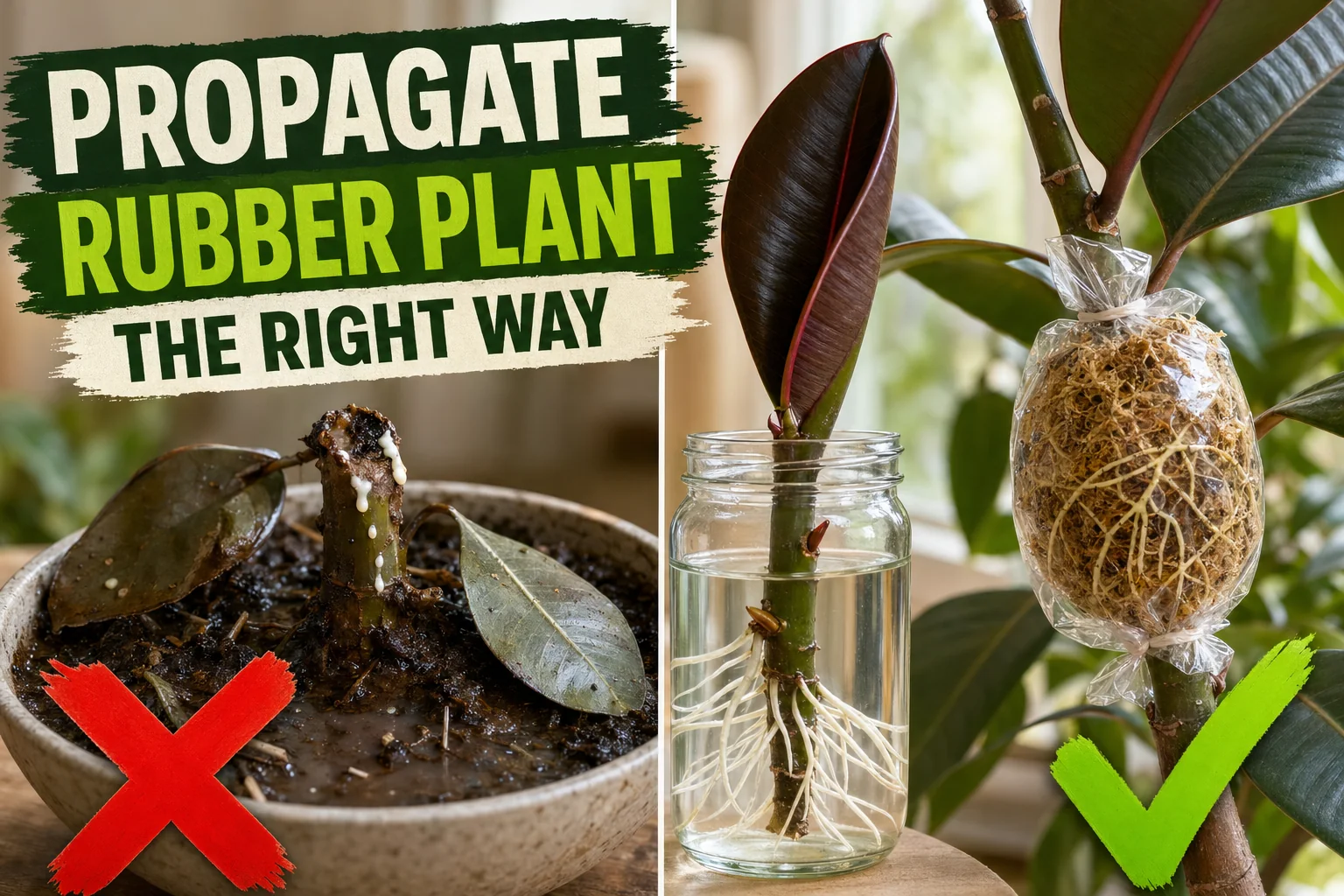
Air-layering (best for tall leggy plants): wound a 30–60 cm (12–24 in)-tall stem, dust the wound with rooting hormone, wrap a baseball-sized handful of damp sphagnum moss around it, cover with clear plastic taped at both ends, and mist weekly. Sever the stem just below the moss when roots fill the bundle — usually 6 to 10 weeks.
Safety: rubber plant latex sap
Every cut you make on a rubber plant releases a sticky white latex. Take it seriously:
- Wear gloves — nitrile or rubber kitchen gloves are fine.
- Don’t touch your eyes while working with cuttings.
- Keep cuttings, leaves, and the knife away from pets. Cats and dogs can be poisoned by chewing rubber plant material.
- Blot the latex from each cut end with a paper towel for 30 seconds before going further. Water cuttings root much better when the cut isn’t still oozing sap.
- Wash tools with warm soapy water after — dried latex is a pain to remove.
If sap touches your skin, wash with soap and water. If it touches your eye, rinse with cool water for several minutes and call a doctor.
What you’ll need
- A healthy mother rubber plant with semi-woody stems
- Sharp, clean pruning shears or a craft knife (wipe with rubbing alcohol)
- Nitrile gloves and paper towels
- For water cuttings: a clear glass jar of room-temperature filtered or tap water
- For air-layering: a handful of damp sphagnum moss, clear plastic wrap, twist ties or plant tape
- Rooting hormone powder (optional but recommended)
- Bright indirect light — a few feet back from a north-, east-, or filtered south-facing window
Method 1: Stem cutting in water
This is the easiest method and works on any rubber plant with at least one tip you can spare.
1. Choose a healthy stem
Pick a semi-woody stem with 2 to 4 healthy leaves. The stem should bend slightly without snapping — fully green soft growth roots slowly, fully woody old stems struggle to push roots.
2. Cut just below a node
A node is the small bump on the stem where a leaf meets it. Roots grow from nodes, not from random points along a smooth stem. Cut just below a node at a slight angle so the cutting has more surface area to root from.
Aim for a finished cutting 10 to 15 cm (6 in) long. If your tip has very large leaves, you can roll one or two into a loose cone and tape gently — this reduces water loss while it roots.
3. Blot the latex
Press a paper towel firmly against the cut end. Hold it for 20–30 seconds, then swap to a fresh corner and repeat until the white sap stops oozing. A still-bleeding cut won’t root well in water.
4. Optional: dip in rooting hormone
Dip the bottom 1 cm (0.5 in) of the cut into rooting hormone powder, tap off the excess. Skip this if you don’t have any — it just speeds things up; it’s not required.
5. Place in water
Fill a clear jar with room-temperature water (21–26°C (70–79°F) is the sweet spot). Drop the cutting in so the node sits below the water line and the leaves stay above it. Set the jar in bright indirect light — never direct sun on a glass of water, which cooks the cutting.
6. Change the water weekly
Every 7 days, tip out the old water and refill with fresh room-temperature water. Cloudy water = bacteria = rotted stem. Don’t skip this.
7. Wait 4–8 weeks
Roots show up first as little white bumps at the node, then grow into thick white strands. Wait until the longest root is about 5 cm (2 in) before potting up — shorter roots transition badly to soil.
Method 2: Air-layering (best for legginess)
Air-layering is the right answer when your rubber plant has gotten tall and bare on the bottom. Instead of cutting first and hoping it roots, you root the stem while it’s still attached to the mother plant — so the new plant is already a robust, leafy specimen the day you sever it.
1. Pick the spot
Find a stem 30 to 60 cm (24 in) above the pot, ideally just below a healthy leafy section. The stem should be at least pencil-thick.
2. Wound the stem
Using a sharp clean blade, scrape away a 2–3 cm (0.75–1 in) long strip of bark on one side of the stem, going down to the green tissue underneath. Don’t cut all the way through — you want the wound, not amputation. The plant will push roots from this wound.
3. Dust with rooting hormone
Dab the wound with a damp finger or wet brush, then dust generously with rooting hormone powder. This step matters more here than for water cuttings — air-layering is slower, and the hormone meaningfully improves success rates.
4. Wrap with damp sphagnum
Soak a baseball-sized handful of sphagnum moss in water, then squeeze it out so it’s damp, not dripping. Press it firmly around the wounded section so the moss makes full contact with the wound.
5. Seal with plastic
Wrap clear plastic wrap around the moss bundle and tape both ends so no moss is exposed. The bundle should look like a transparent egg around the stem. Keeping it clear lets you see roots when they appear.
6. Maintain and watch
Mist the bundle through the plastic once a week, or unwrap one end and trickle a little water in if the moss looks dry. The moss should always feel damp like a wrung-out sponge.
After 6 to 10 weeks, you’ll see white roots spreading through the moss against the plastic. Once roots fill most of the bundle, you’re ready to pot up.
7. Sever and pot
Cut the stem just below the moss bundle. Gently unwrap the plastic but leave the moss in place — disturbing the new roots is the easiest way to kill an air-layered plant. Pot the whole thing, moss and all, into a pot of chunky aroid mix.
Method 3: Soil cutting (when water isn’t an option)
If you don’t want to deal with a glass of water on your shelf, you can root rubber plant cuttings directly in soil:
- Take the cutting exactly as in Method 1 (10–15 cm (4–6 in), semi-woody, blot latex).
- Dip in rooting hormone (recommended for soil propagation).
- Push the cut end 3–5 cm (1–2 in) into a small pot of pre-moistened chunky mix (perlite, coco coir, a little bark).
- Cover the whole pot with a clear plastic bag to hold humidity, with one corner left open for airflow.
- Place in bright indirect light. Mist inside the bag if it dries out.
- Tug gently after 6–8 weeks. Resistance = roots.
Soil cuttings root a little slower than water cuttings, but the transition shock at potting-up time is zero.
Care after roots form
Once your cutting has roots roughly 5 cm (2 in) long, it’s ready for soil.
- Soil: chunky aroid mix — about 50% potting soil, 30% perlite or pumice, 20% orchid bark. Avoid heavy peat-only mixes that stay wet.
- Pot: a small pot just 2–3 cm (0.75–1 in) wider than the root ball, with drainage holes. Bigger is worse — extra unused soil stays wet and rots roots.
- Transition: for water cuttings, the first 2 weeks in soil are the riskiest period. Keep the soil consistently damp (not soggy) so the water-grown roots can adapt to soil.
- Light: bright indirect light. Direct hot sun bleaches new leaves; deep shade stalls growth.
- Watering: wait until the top 3–4 cm (1–1.5 in) of soil is dry, then water deeply until it drains.
- Fertilizer: wait at least a month after potting up before fertilizing. Then a balanced liquid feed at half strength every 4–6 weeks during spring and summer.
A free plant care app like Tazart can hold the watering schedule for your new rubber plant, factor in your local weather, and remind you when it’s time — useful when you’re rooting several cuttings at once and each pot dries down at a different rate.
When to pot up
The clearest signal is root length. Wait until the longest root on a water cutting is roughly 5 cm (2 in) — long enough to anchor in soil but not so long the roots tangle and snap.
For air-layering, pot up when roots have spread visibly through most of the moss bundle. If roots are barely poking through, give it another 2–3 weeks of damp moss.
Don’t pot up during a heatwave or in a chilly room (under 18°C (64°F)). Stable warm temperatures help the cutting establish.
Common mistakes to avoid
- Not letting the latex stop oozing. A wet, leaking cut end rots in water and won’t take rooting hormone properly.
- No rooting hormone on stubborn semi-woody stems. Younger soft growth roots fine without it; thicker semi-woody stems often stall without a boost.
- Dim light. A cutting in a dark corner will sit for months without roots. Bright indirect light is non-negotiable.
- Cold water. Water below 18°C (64°F) dramatically slows rooting and invites rot. Use room-temperature water.
- Taking cuttings in winter dormancy. Late spring to early summer is the right season; winter cuttings often just sit and rot.
- Disturbing roots when potting up. Once water roots hit ~5 cm (2 in), pot gently and don’t wash off the moss on air-layered cuttings.
Troubleshooting
| Symptom | Likely cause | Fix |
|---|---|---|
| Cutting rotted in water | Old stagnant water or unblotted latex | Recut above the rotted section, blot latex thoroughly, fresh water, change weekly |
| No roots after 8 weeks in water | Too cold, too dim, or fully woody stem | Move to a warmer (21–26°C (70–79°F)) brighter spot; try a fresh semi-woody cutting with rooting hormone |
| Leaves yellowing on water cutting | Stagnant water or roots not forming fast enough | Change water immediately; trim one yellow leaf to reduce demand on the cutting |
| Mushy stem at the node | Bacteria from dirty water or contaminated tools | Bin the cutting; sterilise the jar and shears; start over with a clean cut |
| Mother plant looks stressed after cutting | Lost too many leaves at once | Don’t take more than ~30% of foliage at a time; resume normal watering, hold off on fertiliser |
| Air-layering moss going dry | Plastic wrap leaks at the seams | Re-tape both ends; trickle 1–2 tablespoons of water into the bundle and reseal |
Watch: propagating rubber plant
A short visual walkthrough pairs well with the steps above. If you’re a visual learner, watch a quick tutorial like How to Propagate a Rubber Plant on YouTube and then come back to follow the timing in this guide.
Related reading
- How to propagate a jade plant — the easiest succulent to multiply, with leaf or stem cuttings.
- How to propagate a spider plant — using the plantlets it sends out on long stems.
- How to propagate a ZZ plant — the slow but rewarding rhizome and leaf method.
- Snap a photo of the next mystery cutting with the free Tazart plant identifier and let it set the watering schedule for you.
A note on conditions
Every home is different. Light, ambient humidity, water temperature, season, and how vigorous your mother plant is all change how fast a rubber plant cutting roots and whether air-layering takes. Use the timings above as a starting point and adjust based on what you actually see in week three — that’s how every good propagator learns.
Highly recommended
The supplies that make this guide work
Tazart is an Amazon Associate — we earn from qualifying purchases at no extra cost to you. Thank you for helping us keep these guides free.
Frequently asked questions
Can you propagate a rubber plant in water?
Yes. A 10–15 cm (4–6 in) tip cutting with 2–4 leaves roots reliably in a glass of room-temperature water. Blot the milky latex from the cut end, optionally dip it in rooting hormone, and place the jar in bright indirect light. Change the water weekly. You'll see white roots in 4 to 8 weeks.
How long does a rubber plant cutting take to root?
Stem cuttings in water typically root in 4 to 8 weeks at 21–26°C (70–79°F) with bright indirect light. Air-layering is slower but more reliable on thick stems — it takes 6 to 10 weeks for the moss bundle to fill with roots before you can sever it from the mother plant.
Is rubber plant sap toxic?
The white latex that oozes from a cut rubber plant is a skin and eye irritant for humans and is toxic to cats and dogs if chewed. Wear gloves when taking cuttings, avoid touching your eyes, and keep all cuttings, sap-stained tools, and trimmings away from pets.
Can you propagate a rubber plant from a leaf?
A single leaf with no node will sometimes root, but it almost never grows into a new plant — it just sits there as a rooted leaf forever. For a real new plant, take a stem cutting that includes at least one node (the bump where a leaf meets the stem).
When is the best time to propagate a rubber plant?
Late spring through early summer is ideal — warm temperatures and longer days speed up rooting. Avoid taking cuttings in winter when the plant is dormant; rooting is much slower and rot risk goes up.
Do rubber plant cuttings need rooting hormone?
Not strictly required for water propagation, but rooting hormone noticeably speeds things up on semi-woody stems and improves success on stubborn cuttings. For air-layering, dusting the wound with rooting hormone is strongly recommended.