Houseplants
How to Propagate Purple Heart Plant (Roots in 5-10 Days)
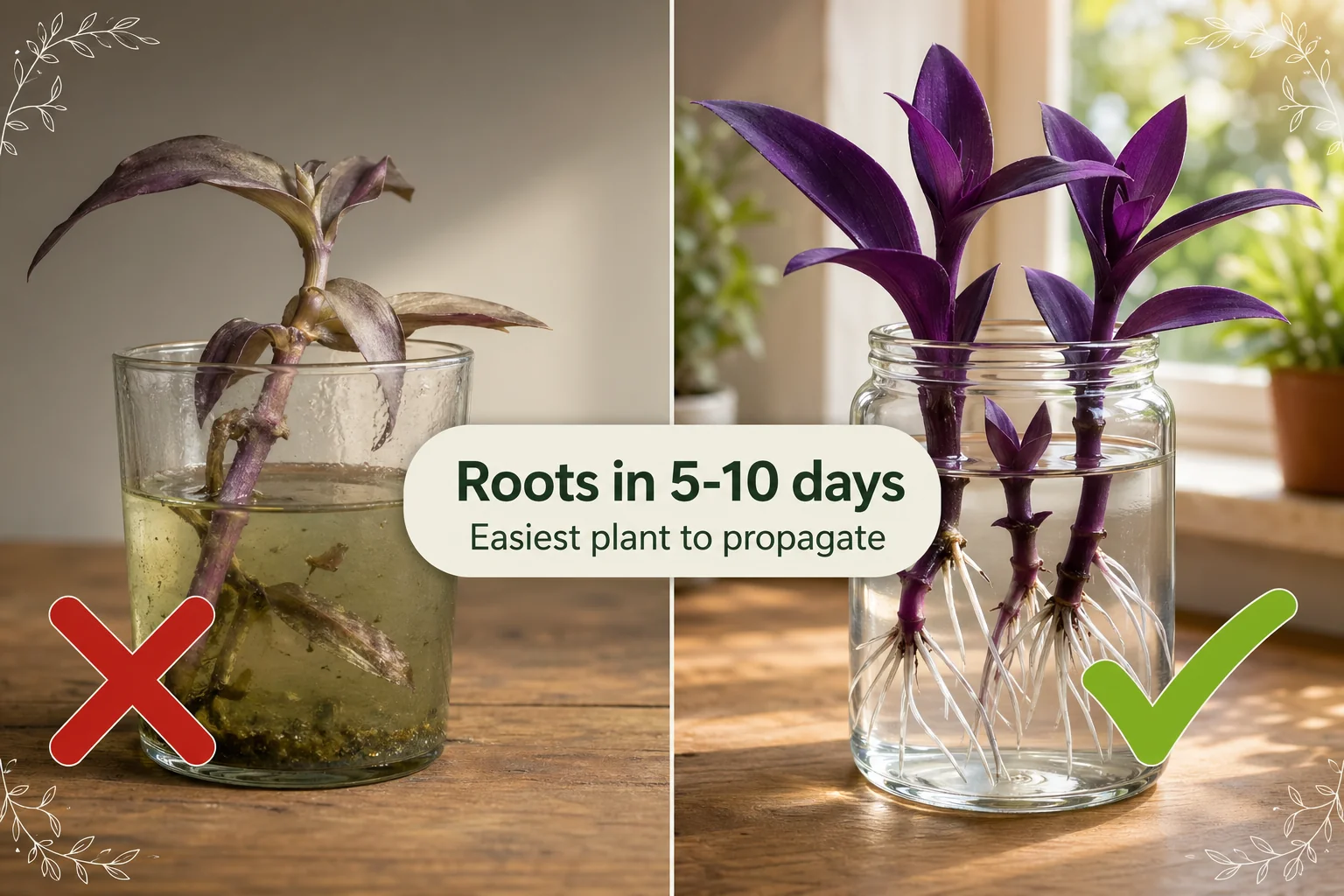
Propagate purple heart (Tradescantia pallida) from 3-4 inch stem cuttings in water or soil. Roots appear in 5-10 days — one of the easiest plants to propagate.
On this page
- Quick answer
- About purple heart (Tradescantia pallida)
- When to take cuttings
- Stem selection — what to look for
- Water rooting vs soil rooting — which is better?
- Step-by-step: water propagation
- Step-by-step: soil propagation
- Light and warmth for new starts
- Transplant timing
- Outdoor vs indoor propagation differences
- Why purple heart cuttings sometimes fail
- Related reading
- A note on conditions
Watch the visual walkthrough
The Ultimate Hellstrip Garden Makeover! How To Propagate Purple Heart Plant, Tradescantia pallida
In this video I'll show you how to start a hellstrip garden in Houston featuring, Purple Heart Plant, tradescantia pallida! FOLLOW ...
Purple heart (Tradescantia pallida, formerly Setcreasea pallida) is one of the easiest plants on Earth to propagate. A single 8–10 cm (3–4 in) stem cutting dropped in a glass of clean water can grow a full set of white roots in as little as five days — no rooting hormone, no humidity dome, no special equipment.
This guide walks you through exactly how to take a cutting, root it in water or soil, when to pot it up, and what to do when it stalls.
Quick answer
Cut an 8–10 cm (3–4 in) section of purple heart stem just below a leaf node, strip the lower leaves, and place it in a glass of clean room-temperature water with the node submerged. Set in bright indirect light at 21–26°C (70–79°F). White roots appear in 5 to 10 days. Pot up in well-draining potting mix once the roots are 3–5 cm (1–2 in) long.
About purple heart (Tradescantia pallida)
Purple heart is a fast-growing trailing perennial in the Commelinaceae family, native to northeast Mexico. It’s grown primarily for its striking deep violet-purple stems and leaves — colour produced by anthocyanin pigments that intensify in bright light. The more sun, the deeper the purple.
It’s closely related to wandering dude (Tradescantia zebrina) and shares the same legendary ease of propagation. In fact, across the whole Tradescantia genus, the question isn’t really whether a cutting will root — it’s just a matter of how many days.
Outdoors in warm climates (USDA zones 7–11) it’s often considered invasive because dropped stems root themselves wherever they touch soil. Indoors, that same willingness to root wherever is exactly what makes it such a satisfying plant to propagate.
When to take cuttings
Spring and early summer are the fastest seasons. The combination of warmth and long days pushes root development quickly — most cuttings in this window show roots in 5 to 7 days.
Autumn and winter cuttings still work perfectly well indoors near a warm, bright window, but can take 14 to 21 days instead of 5 to 10.
Avoid taking cuttings from a plant that is:
- Actively blooming — flowering diverts the plant’s energy away from root production
- Recently repotted and still adjusting
- Showing signs of pests or disease
- Sitting in a room below 18°C (65°F) — cold slows rooting dramatically
The best signal that a plant is ready to give: new, vigorous growth at the tips with rich deep purple colour.
Stem selection — what to look for
Not all stems propagate equally well. Pick stems that are:
- Deep purple, not washed out — pale greenish-purple stems indicate low light stress and root more slowly
- Firm, not limp — limpness signals under-watering or disease; a healthy cutting feels turgid when pinched
- Non-flowering, or tip-pinched — if the stem has an open bloom, snip the flower off before taking the cutting, or choose a different stem
- 8–10 cm (3–4 in) long — short enough to fit a propagation jar, long enough to have a proper node and 2–4 leaves above the waterline
One long trailing stem can usually give you 3 to 6 individual cuttings. Cut from the tips first, working back toward the crown if you need more.
Water rooting vs soil rooting — which is better?
Both methods work reliably with purple heart. The right choice depends on what you want to see and how much time you want to spend.
| Water rooting | Soil rooting | |
|---|---|---|
| Time to first roots | 5–10 days | 10–21 days |
| Visible progress | Yes — watch roots grow | No — must infer from new leaves |
| Transplant step needed | Yes — water to soil | No |
| Risk of rot | Low if water changed regularly | Low in well-draining mix |
| Best for | Beginners, impatient propagators | Direct potting, filling a planter |
Water rooting is the most popular method because you can watch every root emerge. It’s also more forgiving — if the cutting starts to rot, you see it immediately and can re-cut.
Soil rooting skips the transplant shock step entirely. The roots form in the medium they’ll live in permanently, which means the plant never needs to “switch” from water roots to soil roots. It requires more faith — you won’t see the roots — but it produces a sturdier plant once established.
Step-by-step: water propagation
1. Prepare the cutting
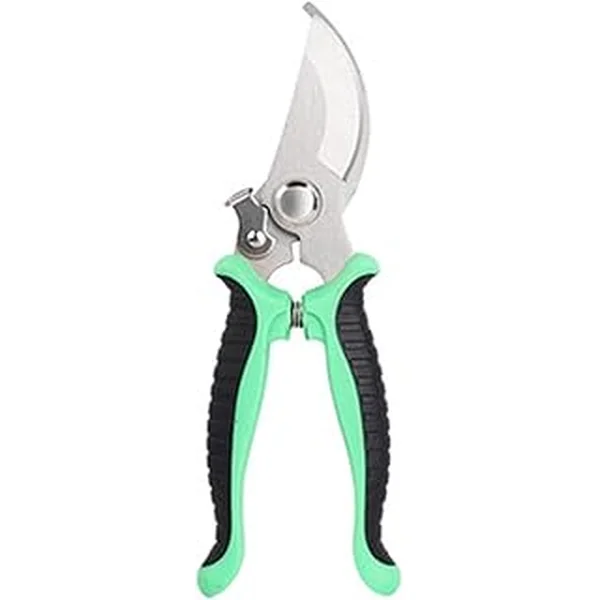
Use clean scissors or bypass pruning shears sterilised with isopropyl alcohol. Cut 0.5 cm (0.25 in) below a leaf node at a slight angle. Strip every leaf from the bottom 3–4 cm (1–1.5 in) of the stem — any leaf that would sit at or below the waterline must come off.
2. Set up the jar
Use a clear glass jar — a propagation station, a small vase, or a clean jam jar all work. Fill with room-temperature filtered or dechlorinated tap water. Cold water from the tap shocks the cutting and slows rooting; let it sit for 30 minutes first if your tap water is very cold.
3. Submerge the node
Place the cutting so the stripped node is submerged at least 2 cm (0.75 in) below the surface, with the healthy leaves above the waterline. A propagation station holds cuttings at the right depth naturally; in a jar, lean the cutting against the rim.
4. Position in bright indirect light
Set the jar in a spot that receives bright indirect light for most of the day — an east-facing windowsill is perfect. Avoid direct hot midday sun, which heats the water, promotes algae, and can bleach the purple colour. Aim for room temperature between 21 and 26°C (70 and 79°F).
5. Change the water every 5–7 days
This is the step most people skip and the #1 reason cuttings rot. Pour out the old water, rinse the jar, refill with fresh room-temperature water. Stagnant water loses oxygen and grows anaerobic bacteria within days.
6. Pot up once roots are 3–5 cm (1–2 in) long
White root nubs typically appear in 5 to 10 days. Wait until they’re 3–5 cm (1–2 in) long with a few side branches before potting — that usually happens between day 10 and day 14. Don’t wait until the roots tangle; roots over 8–10 cm (3–4 in) struggle to adapt to soil.
Step-by-step: soil propagation
- Take the same 8–10 cm (3–4 in) cutting with the lower leaves stripped.
- Optional: dip the cut end in rooting hormone powder, tap off the excess.
- Make a hole 3–4 cm (1–1.5 in) deep in moist peat-free potting mix (a pencil works well for this).
- Insert the cutting, gently firm the soil around it.
- Water lightly — the mix should be damp but not soggy.
- Set in bright indirect light at 21–26°C (70–79°F).
- Keep the soil evenly moist for the first two weeks. Don’t let it dry out completely, but don’t let it sit wet either.
- New leaf growth at the tip means the cutting has rooted — usually 10 to 21 days in.
Light and warmth for new starts
Whether rooting in water or soil, light and warmth are the two biggest drivers of rooting speed.
Light: Bright indirect light for at least 4 to 6 hours per day. Purple heart is more light-hungry than most Tradescantia species — it actually needs decent light even during propagation to maintain its purple pigment and drive root development. A north-facing shelf in a dim room will produce pale, slow-rooting cuttings.
Temperature: 21–26°C (70–79°F) is the sweet spot. Below 18°C (65°F) rooting slows to a crawl. Above 30°C (86°F) and the water heats up, oxygen depletes faster, and bacterial growth accelerates — change the water more frequently if your home is very warm.
If you don’t have a bright window, a full-spectrum LED grow light placed 25–30 cm (10–12 in) above the cuttings for 12 to 14 hours per day will deliver the same result year-round.
Transplant timing
The exact moment to move water-rooted cuttings into soil matters more than most people realise.
- Too early (roots under 2 cm / 0.75 in): the roots are too fragile to anchor in soil; the cutting wilts and may not recover
- Ideal window (roots 3–5 cm / 1–2 in, with side branches): roots are robust enough to adapt but still supple enough to lay naturally in the potting mix
- Too late (roots over 8–10 cm / 3–4 in): long water roots are structurally different from soil roots; they often struggle to switch, causing a week or two of post-transplant stall
When you pot up:
- Choose a pot 8–12 cm (3–5 in) wide with drainage holes.
- Use peat-free indoor potting mix — lightweight and airy, never dense garden soil.
- Group 3 to 5 cuttings per pot for a lush, full look from day one (a single cutting takes months to fill a pot).
- Water until it drains from the bottom, then let the top 2 cm (0.75 in) dry slightly before the next watering.
- Keep it in bright indirect light for the first two weeks — don’t move it around.
Outdoor vs indoor propagation differences
Purple heart is a common garden plant in warm climates. Propagation outdoors behaves slightly differently from indoors.
Outdoors (zones 7–11, warm seasons):
- Cuttings stuck directly into garden soil root within 7 to 14 days when temperatures are above 20°C (68°F)
- Rooting success rates are extremely high — almost every cutting takes
- Fallen stems touching the soil often root themselves with no intervention
- Water propagation outdoors is not recommended — direct sunlight overheats the water
Indoors (year-round):
- Water propagation works best because the environment is controlled
- Maintain 21–26°C (70–79°F) — don’t place near an air conditioning vent
- A grow light compensates for low winter light in northern latitudes
- Purple heart can lose some of its purple depth indoors; ensure bright indirect light to maintain colour in newly rooted plants
Why purple heart cuttings sometimes fail
Even the easiest plant has failure modes. Here are the most common ones and how to fix them:
| Symptom | Likely cause | Fix |
|---|---|---|
| No roots after 14+ days | Room too cold (below 18°C / 65°F) or no node included | Move to a warmer spot; re-cut just below a visible leaf node |
| Stem turns mushy below the waterline | Stagnant water, submerged leaf rotting | Snip above the rot, refresh water, remove every submerged leaf |
| Water turns cloudy within 2 days | Bacteria from a decomposing leaf or dirty jar | Wash the jar with soap, refill with fresh water, strip all leaves below the waterline |
| Cutting goes limp and collapses | Too much direct sun heating the water, or cutting has no node | Move to indirect light; re-cut below a node |
| Roots formed but plant wilts after potting | Roots were too long (over 8–10 cm / 3–4 in) at transplant | Tent loosely with a clear bag for 7 days to hold humidity while it adapts |
| Purple colour fades on new growth after rooting | Insufficient light after potting | Move to a brighter window or add a grow light; new leaves will come in deep purple |
| Roots form but new leaf growth stalls | Cool room, or plant needs fertilizer | Raise room temperature above 21°C (70°F); begin half-strength balanced feed after 4 weeks |
Related reading
- Wandering dude plant care (Tradescantia zebrina) — the closest relative of purple heart, with very similar propagation rules but its own striping and light requirements.
- How to propagate pothos — pothos uses nodes too, but root timeline is 7 to 14 days; a useful comparison for water-rooting technique.
- How to propagate a spider plant — spider plants make pups instead of needing a node cut; a different propagation method worth knowing.
- Track your cuttings’ root progress, set water-change reminders, and get watering schedules for newly potted plants in the free Tazart plant care app.
A note on conditions
Every home is different. Room temperature, water hardness, light levels, and the time of year all affect how quickly purple heart cuttings root. Use the 5-to-10-day window as a benchmark, not a hard deadline — healthy cuttings in good conditions consistently hit it, but a cool dim room may take three weeks. Watch the cutting, not the calendar, and adjust from there.
Highly recommended
The supplies that make this guide work


Tazart is an Amazon Associate — we earn from qualifying purchases at no extra cost to you. Thank you for helping us keep these guides free.
Frequently asked questions
How long does purple heart take to root in water?
Most purple heart (Tradescantia pallida) cuttings show first white roots in 5 to 10 days in water. By day 14 the roots are typically 3–5 cm (1–2 in) long with side branches — at that point they're ready to pot into soil. Warmer rooms at 21–26°C (70–79°F) with bright indirect light speed rooting up; rooms below 18°C (65°F) can stretch it to 2–3 weeks.
Can you propagate purple heart directly in soil?
Yes, and many growers prefer it because the roots adapt to soil from day one. Push the stripped cutting 3–4 cm (1–1.5 in) into moist, well-draining potting mix, keep the soil consistently damp (not soggy) for the first two weeks, and place in bright indirect light. Roots form in 10 to 21 days. New leaf growth at the tip confirms the cutting has taken.
How do you take a cutting from a purple heart plant?
Use clean, sharp scissors or pruning shears to cut a healthy 8–10 cm (3–4 in) section of stem just below a leaf node. Each cutting should have 2–4 healthy leaves at the top. Strip all leaves from the bottom 3–4 cm (1–1.5 in) so no foliage sits below the waterline or soil surface — submerged leaves rot and kill the cutting.
Why are my purple heart cuttings not rooting?
The four most common causes: (1) the room is too cold (below 18°C / 65°F), which slows rooting dramatically; (2) the water was never changed and became stagnant — change it every 5–7 days; (3) no node is included in the cutting — the cutting must include the point where a leaf joins the stem; (4) the cutting is sitting in low light — bright indirect light is essential for rooting speed.
Does purple heart need rooting hormone?
No — Tradescantia pallida roots so easily in plain water that rooting hormone is rarely necessary. If you're propagating directly into soil, a quick dip of the cut end in rooting hormone powder can speed things up by 5 to 7 days. For water propagation, skip it entirely.
When should I transplant purple heart cuttings to soil?
Transplant water-rooted cuttings once the white roots are 3–5 cm (1–2 in) long with a few visible side branches. Don't wait until the roots tangle or exceed 8–10 cm (3–4 in) — very long water roots struggle to adapt to soil and the plant often stalls for a week or two after potting.
Can purple heart cuttings root in any season?
Spring and early summer are the fastest seasons because warmth and long daylight hours maximize rooting speed. Cuttings taken in autumn or winter still root indoors near a warm bright window, but may take twice as long. Avoid propagating when the parent plant is stressed, blooming heavily, or showing signs of pest damage.
Is purple heart (Tradescantia pallida) toxic to pets?
Tradescantia pallida is considered mildly toxic to cats and dogs. The sap can cause skin irritation and mild stomach upset if ingested. It is not life-threatening, but keep cuttings and rooted plants out of reach of pets and wash your hands after handling the stems.