Edible
How to Propagate Mint from Cuttings (Roots in 7–14 Days)
Propagate mint from cuttings in water or soil and get rooted plants in 7–14 days. 4–6 inch stems, strip lower leaves, and mint practically roots itself.
On this page
- Quick answer
- When to take mint cuttings
- Selecting a healthy stem
- Water propagation vs direct soil rooting
- Step-by-step: how to propagate mint from cuttings in water
- Direct soil rooting method
- Division of established clumps
- Lighting for new starts
- Transplant timing
- Containing mint’s spreading habit
- Common mistakes to avoid
- Troubleshooting
- Related reading
- A note on conditions
Watch the visual walkthrough
5 Tips How to Grow a Ton of Mint in one Container or Garden Bed
If you would like to know how to get a massive harvest of mint from the one container then this is the video to watch! I give my 5 top ...
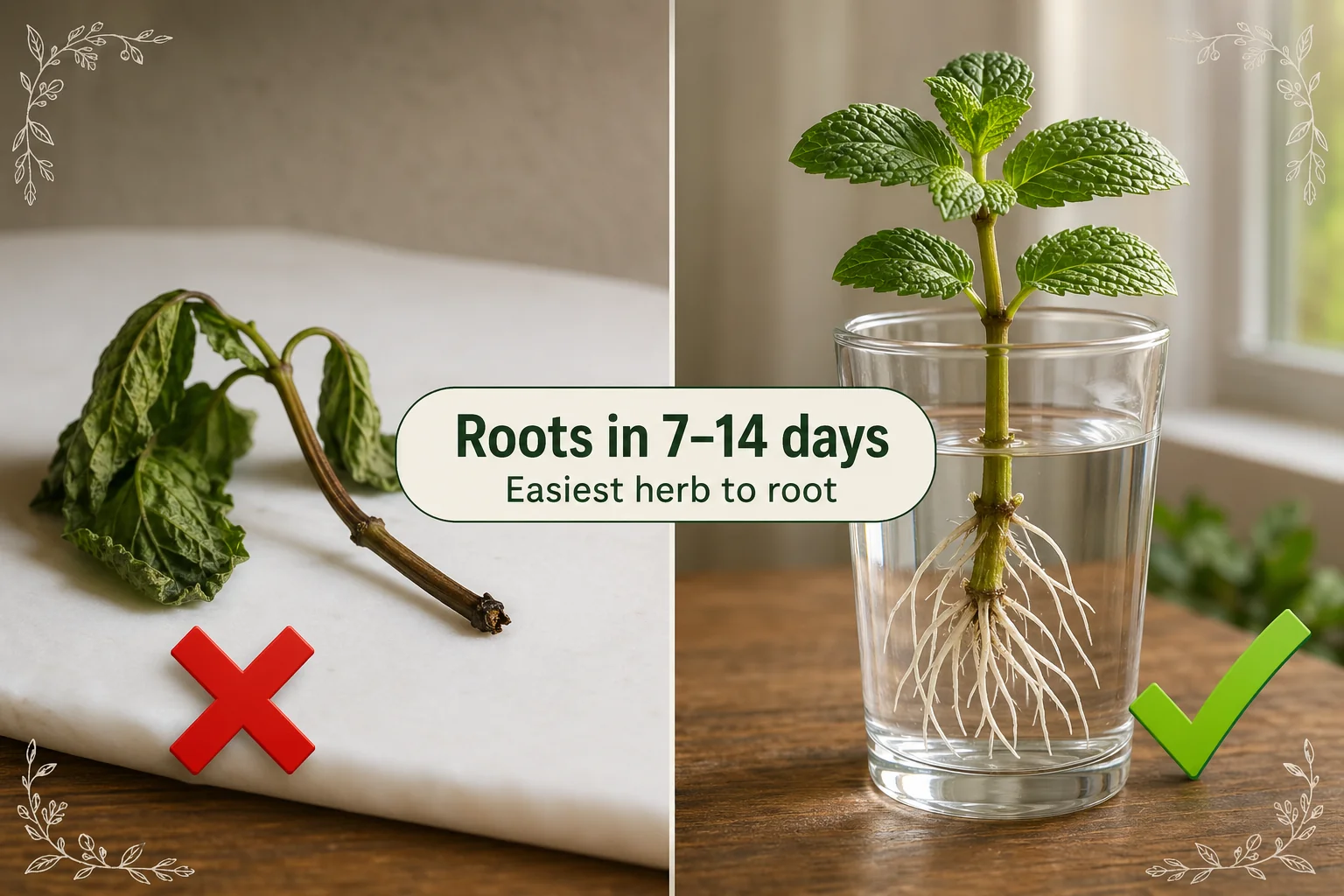
Mint is one of the easiest herbs to propagate. Take a 10–15 cm (4–6 in) cutting, strip the lower leaves, stand it in a glass of clean water, and roots appear in 7–14 days with almost no effort. One healthy mint plant can produce dozens of free rooted cuttings in a single afternoon.
This guide covers water propagation, direct soil rooting, clump division, the best timing, and how to contain the spreading habit of every plant you produce.
Quick answer
Take a 10–15 cm (4–6 in) mint stem cutting just below a node, strip the lower two-thirds of leaves, and stand it in 3–4 cm (1–1.5 in) of clean room-temperature water. Place in bright indirect light at 18–24°C (65–75°F). White roots appear at the node in 7–10 days. Pot up once roots reach 3–5 cm (1–2 in), around 14 days. Always plant rooted cuttings in a pot on a hard surface — never directly in the ground.
When to take mint cuttings
Spring through early summer is the best window. Mint is pushing out long vigorous new shoots in this period, and the ambient warmth accelerates rooting.
The sweet spot is late spring — when the plant is growing hard but has not yet sent up flower spikes. Cuttings taken just before bolting root the fastest of all.
Autumn is workable but slower; root development can take 3–4 weeks instead of 1–2. Avoid taking cuttings from a plant that is actively flowering — those stems are in reproductive mode and root reluctantly.
Selecting a healthy stem
Not every stem on a mint plant is a good cutting candidate. Look for:
- Active vegetative growth — long, new shoots with small fresh leaves at the tip
- No flower buds — even tiny, unopen buds signal the stem has shifted from leaf to seed production
- Deep green colour — avoid pale, yellowish, or rust-spotted stems
- Firm texture — limp or hollow stems rot before they root
A single well-established mint plant in a 30 cm (12 in) pot can yield 10–15 good cuttings in one session without harming the parent plant, as long as you leave at least half of each stem on the plant.
Water propagation vs direct soil rooting
Both methods work reliably. The difference is convenience and rooting speed.
| Water propagation | Direct soil rooting | |
|---|---|---|
| Setup | Instant — just a jar and water | Needs moist potting mix + optional bag |
| Root visibility | Full visibility from day one | Invisible until new leaves appear |
| Time to roots | 7–14 days | 10–21 days |
| Transplant adjustment | 1–2 week transition as water roots adapt to soil | None — roots already soil-adapted |
| Best for | Beginners, monitoring progress | Hands-off growers, multiple cuttings at once |
Water propagation is the most popular choice because you can watch every root form, which makes it easy to catch problems early. Direct soil rooting produces roots already adapted to the growing medium, which can give a stronger start after potting.
Step-by-step: how to propagate mint from cuttings in water
1. Select a healthy non-flowering stem
Choose a stem with at least 4–6 leaf pairs and visible nodes — the slight swellings where each leaf joins the stem. These nodes are the only places roots can emerge.
2. Cut 10–15 cm (4–6 in) just below a node
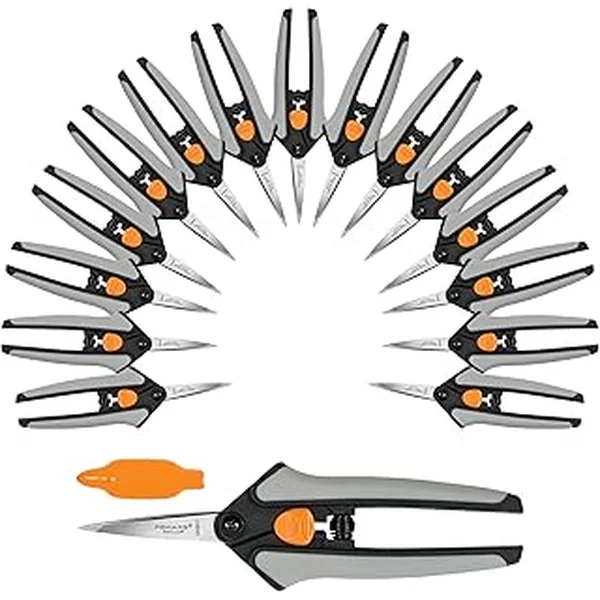
With clean, sharp scissors or bypass pruning shears, cut 0.5 cm (0.25 in) below a node at a slight angle. The node must stay on the cutting, not the parent plant.
A single 30 cm (12 in) shoot typically gives you 2–3 cuttings.
3. Strip the lower two-thirds of leaves
Pinch off every leaf that would sit at or below the waterline. Submerged leaves begin to rot within 48 hours, cloud the water with bacteria, and can kill the cutting before roots form.
Keep 3–4 healthy leaves at the top of each cutting for photosynthesis.
4. Place in clean water with the node submerged
Use a clear glass or jar — clear glass lets you monitor root development. Fill with enough room-temperature water to cover the bare node by at least 2 cm (0.75 in) but keep all remaining leaves above the waterline.
5. Place in bright indirect light
Set the jar near a window that gets bright light all day but no direct afternoon sun. A south- or east-facing windowsill works well. Aim for room temperature of 18–24°C (65–75°F) — anything under 15°C (60°F) slows rooting dramatically.
6. Change the water every 4–5 days
Pour out the old water, rinse the jar, and refill with fresh room-temperature water. This is the single most important maintenance step. Stagnant water loses dissolved oxygen and allows anaerobic bacteria to grow — the number-one reason mint cuttings rot before they root.
7. Watch for roots
White root nubs appear at the node within 7–10 days. By 14 days the roots are typically 3–5 cm (1–2 in) long with 2–3 visible side branches. That is your signal to pot up.
Direct soil rooting method
Skip water entirely and root straight in moist potting mix:
- Take the same 10–15 cm (4–6 in) node-bearing cutting and strip the lower two-thirds of leaves.
- Optionally dip the cut end briefly in rooting hormone powder and tap off the excess — it is not required for mint but can reduce rooting time by a few days.
- Push the bare stem 3–4 cm (1.5 in) into a pot of moist, light peat-free potting mix so the bottom node is buried.
- Water lightly and place in bright indirect light at 18–24°C (65–75°F).
- Cover loosely with a clear plastic bag for the first 7 days to hold humidity — do not let the bag touch the leaves.
- Keep the soil consistently damp but not soggy. Roots typically form in 10–21 days.
New leaf growth is the signal that roots have formed. Tug gently — if the cutting resists, it has rooted.
Division of established clumps
If you already have an established mint plant that has been in the same pot for 2–3 years, division is the fastest way to create new plants with a full root system.
- In early spring, before the plant pushes much new growth, tip the pot out and remove the root ball.
- Use a sharp knife or spade to slice the root ball into 2–4 sections. Each section needs a healthy tuft of roots and at least 2–3 shoots.
- Pot each division into its own pot with fresh potting mix.
- Water thoroughly and place in a sheltered spot for 7–10 days while it establishes.
Division is faster than cuttings — the new plants are already established and will be producing full harvests within 4–6 weeks.
Lighting for new starts
Bright indirect light is the single most important environmental factor for rooting mint cuttings. A dark shelf will stall rooting for weeks.
Outdoors: A sheltered spot in dappled shade or morning sun with afternoon shade is ideal. Avoid full direct midday sun — it wilts cuttings before roots can form.
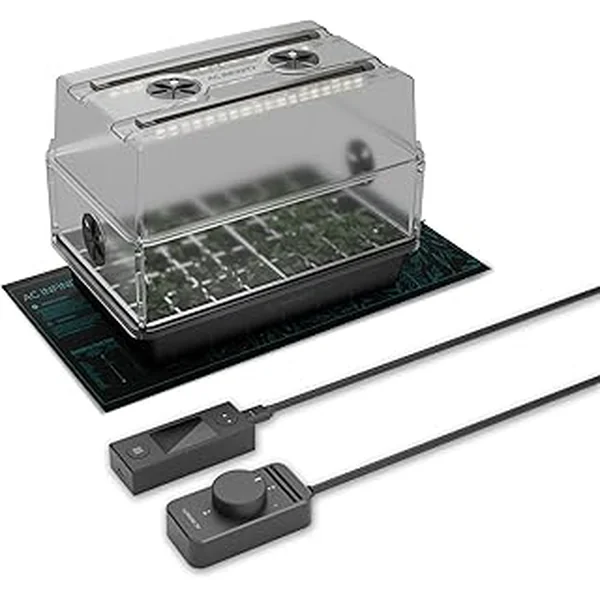
Indoors: A south- or east-facing windowsill gives good results year-round. If natural light is limited (especially in winter), a compact full-spectrum LED grow light bar positioned 20–25 cm (8–10 in) above the cuttings on a 12-hour timer replicates ideal conditions reliably.
Once roots form and the cutting is potted, move it to a spot with 4–6 hours of direct or bright indirect light per day.
Transplant timing
Pot water-rooted cuttings up once roots reach 3–5 cm (1–2 in) with visible side branches — around 14 days. Do not wait until roots are tangled or over 10 cm (4 in) long; water-adapted roots struggle to transition to soil and the plant can stall for 2–3 weeks.
Use a 10–15 cm (4–6 in) pot with drainage holes and light peat-free potting mix. Make a wide hole, lower the roots in without cramping or spiralling them, backfill gently, and water until it drips from the drainage holes.
Keep the soil slightly more moist than you usually would for the first 2 weeks while the roots adapt.
A plant care app like Tazart can track the watering schedule for each new cutting and remind you when the transition window opens — useful if you are rooting a batch of multiple cuttings at once.
Containing mint’s spreading habit
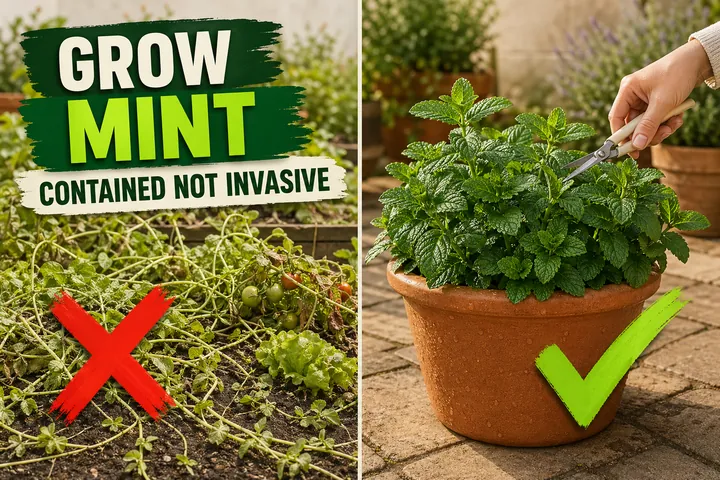
Every mint plant you propagate carries the same invasive spreading habit as the parent. Mint spreads two ways:
- Above ground: long stems that root wherever a leaf node touches damp soil.
- Below ground: white underground rhizomes (stolons) that travel 60–90 cm (24–36 in) per season.
Three rules prevent escape:
- Always pot in a container — never in open ground. A 30 cm (12 in) wide, 30 cm (12 in) deep terracotta or plastic pot with drainage holes is the standard.
- Sit the pot on a hard surface. A paving stone, tile, or decking board stops roots from escaping through the drainage holes into the soil below.
- Check the rim every 2–3 weeks. Stems sprawling over the rim will root on contact with soil or neighbouring pots. Pinch them back.
Every autumn, lift the plant out and slice the root ball in half with a sharp spade. Replant the healthier half in fresh potting mix. This resets vigour and stops rhizomes circling the pot.
Common mistakes to avoid
- Leaving leaves underwater. They rot within 48 hours, cloud the water, and kill the cutting. Strip every leaf that would sit at or below the waterline.
- Never changing the water. Stagnant water loses oxygen and grows bacteria. Change every 4–5 days.
- Taking cuttings from flowering stems. Flowering stems root poorly and slowly. Always pick vegetative shoots.
- Potting up too early. Roots under 3 cm (1 in) are too fragile to survive soil transplant. Wait for 3–5 cm (1–2 in) with side branches.
- Planting rooted cuttings directly in the ground. Within one season the mint will escape and spread. Always use a pot on a hard surface.
- Using cold water. Cold water below 15°C (60°F) shocks the cutting and slows rooting dramatically. Always use room-temperature water.
Troubleshooting
| Symptom | Likely cause | Fix |
|---|---|---|
| No roots after 3 weeks | No node on the cutting, or room too cold (under 15°C / 60°F) | Re-cut just below a visible node; move to a warmer spot at 18–24°C (65–75°F) |
| Stem mushy below the waterline | Stagnant water, or a leaf was submerged | Snip off the rotted section, strip any remaining submerged leaves, replace the water |
| Water turns cloudy within 2 days | Submerged leaf or unclean jar | Strip every leaf below the waterline, wash the jar, refill with fresh water |
| Cutting wilts after potting | Roots too long (over 10 cm / 4 in) at pot-up | Tent with a clear bag for 7–10 days to raise humidity while it adapts to soil |
| Roots form but new leaves stall | Too little light after potting | Move to a brighter spot or add a grow light — at least 4–6 hours of good light per day |
| Mint spreading outside the pot | Runners escaped through drainage holes or over the rim | Lift the pot, cut all escaping rhizomes back to the pot, sit on a hard surface |
Related reading
- How to grow mint (without it taking over) — the full care guide once your cuttings are rooted and growing.
- How to grow basil indoors — basil is another herb that benefits from the same cutting technique, though it roots faster and prefers warmer temperatures.
- How to grow oregano — woody-stemmed herbs like oregano use a similar cutting method but require a longer callous period before rooting.
- Track every cutting’s water change and pot-up timing in the free Tazart plant care app — it sends a reminder straight to your phone so nothing sits forgotten in stale water.
A note on conditions
Every cutting roots at its own pace. Light, room temperature, water quality, the age of the stem, and the time of year all influence how quickly mint roots. Use the timelines above as a starting point and adjust based on what you see in week one. The mint will tell you — slow root formation usually means one of the four fixable factors: no node, stale water, cold room, or too little light. Fix the one that applies and most cuttings recover within days.
Highly recommended
The supplies that make this guide work

Tazart is an Amazon Associate — we earn from qualifying purchases at no extra cost to you. Thank you for helping us keep these guides free.
Frequently asked questions
How long does mint take to root in water?
Most mint cuttings show their first white roots at the node within 7 to 10 days at room temperature (18–24°C / 65–75°F). By 14 days the roots are usually 3–5 cm (1–2 in) long with side branches — long enough to pot up. Warmer rooms root faster; anything under 15°C (60°F) can stretch to 3–4 weeks. Change the water every 4–5 days to keep it oxygenated and clear.
Can you propagate mint directly in soil?
Yes — mint roots reliably in moist soil without water propagation first. Take a 10–15 cm (4–6 in) cutting, strip the lower two-thirds of leaves, and push the bare stem 3–4 cm (1.5 in) into a pot of moist peat-free potting mix. Cover loosely with a clear bag for the first week to hold humidity. New leaf growth in 10–14 days signals roots have formed. Direct soil propagation avoids the water-to-soil transition shock.
When is the best time to take mint cuttings?
Spring through early summer is ideal — mint is putting out long, vigorous new shoots and the warm soil temperature speeds rooting. Late spring cuttings taken just before the plant tries to flower root fastest of all. Autumn is a distant second; cuttings still root but more slowly. Avoid taking cuttings mid-summer if mint is already flowering, as flowering stems redirect energy to seeds and root slowly.
How do I know when mint cuttings are ready to pot up?
Pot up once the roots are at least 3–5 cm (1–2 in) long with 2 or 3 visible side branches. Shorter roots get lost in the soil and can dry out; roots over 10 cm (4 in) have a harder time transitioning. In practice, this is around 14 days for water-rooted cuttings at a warm room temperature. Gently tug the cutting — if it resists, soil-propagated cuttings have rooted.
Does mint root better in water or soil?
Both work well, and mint is forgiving enough that either method is reliable. Water propagation is faster to start (nothing to prepare) and lets you watch the roots form — it is the most popular choice for beginners. Direct soil propagation skips the transfer step and produces roots already adapted to soil, which means less transplant shock later. If you have the cuttings and time to watch them, start in water; if you need a quick hands-off method, go straight to moist soil.
How do I stop propagated mint from spreading?
Always pot rooted mint cuttings in a container with drainage holes — never directly in an open garden bed. Mint spreads by underground rhizomes that can travel 60–90 cm (24–36 in) per season. Sit the container on a paving stone or hard surface so roots cannot escape through the drainage holes into the soil below. Check the rim every few weeks for runners trying to escape over the top and pinch them off.
Can I propagate mint from a grocery store bunch?
Often yes, if the bunch is fresh. Remove any rubber bands, strip the bottom third of leaves, and stand the stems in 3–4 cm (1–1.5 in) of clean water. Place in bright indirect light and change the water every 4 days. Grocery store mint is typically spearmint or peppermint — both root readily if the stems are not too old or wilted. Expect roots in 10–14 days. Not every stem will root, so start with 4–6 stems and keep the best.
Why are my mint cuttings not rooting?
The four most common reasons: (1) the cutting has no node — you need a stem section with at least one node (the slight swelling where a leaf meets the stem); (2) the water is stagnant and low in oxygen — change it every 4–5 days; (3) the room is too cold (under 15°C / 60°F) — move somewhere warmer; (4) too little light — bright indirect light is essential, a dark shelf will stall rooting for weeks. Fix whichever applies and most cuttings recover within a week.