Houseplants
How to Propagate Goldfish Plant (Stem Cuttings That Root)
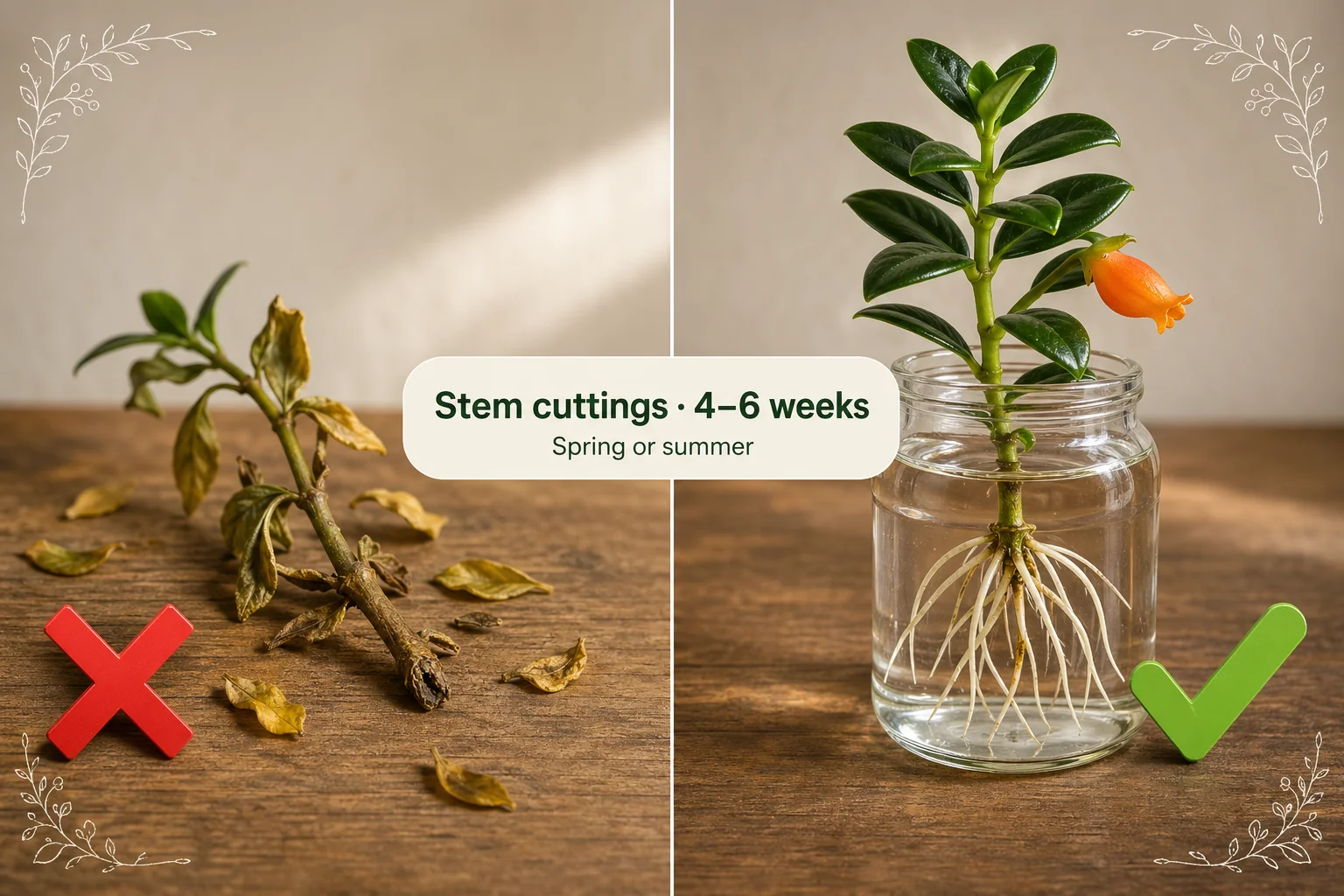
Propagate goldfish plant from 8–10 cm (3–4 in) stem cuttings in water or moist soil. Roots form in 4–6 weeks. Step-by-step guide for Nematanthus gregarius.
On this page
- Quick answer
- About the goldfish plant
- When to take cuttings
- Choosing the right stem
- Step-by-step: rooting in water
- Step-by-step: rooting in soil
- Why humidity matters more for goldfish plant than most cuttings
- Transplanting: timing and technique
- Encouraging blooms after propagation
- Common propagation failures — and how to fix them
- Care summary after potting
- Related reading
- A note on conditions
Watch the visual walkthrough
How to Propagate Goldfish Plant Tutorial
Hi guys! I'm back with a tutorial on how to propagate and root goldfish plant from cuttings follow me on ig @myorangejungle ...
Goldfish plant (Nematanthus gregarius, sometimes listed under Columnea) is one of those trailing houseplants that looks like it should be difficult to propagate — waxy, succulent-like leaves, specific humidity needs, and those improbable orange blooms that actually look like tiny leaping goldfish. In practice, it propagates reliably from stem cuttings and roots in 4 to 6 weeks with the right conditions.
This guide shows you which stems to pick, how to root them in water or soil, why humidity is the critical variable, and how to get the orange flowers back after propagation.
Quick answer
Take an 8–10 cm (3–4 in) tip cutting from a non-flowering stem in spring or summer. Strip all leaves from the bottom 3–4 cm (1–1.5 in). Stand the bare stem in a glass of room-temperature water or insert it 2–3 cm (1 in) into a moist 50/50 perlite and peat-free mix. Cover loosely with a humidity tent, place in bright indirect light at 21–24°C (70–75°F), and expect white roots in 3 to 4 weeks. Pot up after 4 to 6 weeks once roots reach 3–5 cm (1–2 in).
About the goldfish plant
Nematanthus gregarius is a trailing epiphyte from the rainforests of Brazil. In the wild it grows on tree branches and rock faces, which is why its roots demand air and fast drainage — not the dense wet soil of most garden pots. Indoors, it’s grown as a trailing or hanging houseplant prized for its dark, waxy, almost succulent-looking leaves and the clusters of tubular orange flowers that bloom in spring and summer.
The “goldfish” name comes from the flower shape: a puffy, rounded tube pinched at the front that mimics an open-mouthed goldfish mid-swim. Get the propagation right and those blooms return reliably each spring.
Closely related species and hybrids sold as goldfish plant or column plant include Columnea spp. and various Nematanthus hybrids — all propagate identically.
When to take cuttings
Spring is the ideal window. The plant exits its cool-season rest, produces fast new growth, and has the highest rooting hormone concentration in its stems. Early summer works nearly as well.
Avoid late autumn and winter cuttings. Short days and cool indoor temperatures slow root initiation dramatically and make the cutting vulnerable to rot before it establishes.
If you need to propagate outside the ideal window — for example to rescue a leggy plant — raise ambient temperature to 24°C (75°F), use a heat mat under the pot, and expect rooting to take 8 weeks instead of 4 to 6.
Choosing the right stem
Not all stems root equally well:
- Tip growth (soft new stems): roots fastest — first choice. Look for stems with the smallest newest leaves at the tip. Cut 8–10 cm (3–4 in) below that soft tip.
- Semi-hardwood mid-stem: roots reliably but more slowly. A backup if the plant has no new tip growth.
- Flowering stems: skip these entirely. Stems that are putting energy into flowers root poorly and often abort before producing roots. Wait until the flower finishes or choose a different stem.
Each cutting should have:
- A length of 8–10 cm (3–4 in)
- At least 3 pairs of healthy leaves on the upper half
- No yellowing, no soft spots, no visible pests
A mature goldfish plant can give you 4 to 8 cuttings in a single session without harming the parent — cut from different trailing stems to keep it looking balanced.
Step-by-step: rooting in water
Water propagation lets you watch root development day by day and is the easiest method for beginners.
- Fill a clear glass jar with room-temperature water — filtered or tap water left to sit overnight to off-gas chlorine.
- Strip all leaves from the bottom 3–4 cm (1–1.5 in) of the cutting. Any leaf touching the water will rot within days.
- Stand the bare stem in the jar so the stripped section is submerged and the remaining leaves sit above the waterline.
- Place in bright indirect light at 21–24°C (70–75°F). A north- or east-facing windowsill is ideal — no direct afternoon sun.
- Cover the jar and cutting loosely with a clear plastic bag to hold humidity. Don’t let the bag touch the leaves.
- Change the water every 5 to 7 days. Stagnant water loses oxygen and grows bacteria — the most common reason cuttings rot before rooting.
- Look for tiny white root nubs at the stripped node in 2 to 3 weeks. Full roots of 3–5 cm (1–2 in) appear by 4 to 6 weeks.
Step-by-step: rooting in soil
Soil propagation skips the water-to-soil transition shock and produces roots already adapted to growing medium — useful if you plan to pot the plant into a hanging basket immediately after.
- Mix equal parts perlite and peat-free potting mix. Fill a small 8 cm (3 in) pot and moisten it thoroughly — squeeze a handful; it should hold shape but release no drips.
- Optional but recommended: dip the cut end 1 cm (0.5 in) into rooting hormone powder, tap off the excess.
- Make a hole in the mix with a pencil, insert the cutting 2–3 cm (1 in) deep, and firm gently so the stem makes contact with the mix.
- Water lightly, cover with a humidity dome or clear plastic bag, and place in bright indirect light.
- Keep the mix evenly moist — not wet. Check daily; goldfish plant likes consistent moisture but hates soggy roots.
- Roots form in 4 to 6 weeks. New leaf growth at the tip is your confirmation — tug gently and if the cutting resists, it has rooted.
Why humidity matters more for goldfish plant than most cuttings
Goldfish plant has small, dense, waxy leaves that slow water loss — but an unrooted cutting with no roots has no way to replace any moisture it does lose. In a typical home at 40% humidity, an unrooted goldfish plant cutting will wilt and abort root formation within 5 to 7 days.
Raising humidity to 60–70% around the cutting:
- Slows transpiration so the cutting stays turgid while roots form
- Keeps the soil or water evenly moist without waterlogging
- Mimics the rainforest floor conditions that Nematanthus evolved in
The simplest humidity fix is a clear plastic bag loosely tented over the cutting and pot. A propagator tray with a lid or a small desktop humidifier nearby also works. Remove the cover for 30 minutes each day to prevent mould, then replace it.
Once you see 2 to 3 cm (1 in) of white roots on a water-rooted cutting or new leaf growth on a soil-rooted cutting, gradually reduce the humidity tent over 5 to 7 days rather than removing it all at once.
Transplanting: timing and technique
Pot up water-rooted cuttings once roots are 3–5 cm (1–2 in) long with visible side branches. Roots shorter than this get lost in the soil; roots longer than 8 cm (3 in) have adapted to water and struggle to switch — they often wilt after transplanting even with good care.
Pot and mix:
- A 8–10 cm (3–4 in) pot with drainage holes
- 50% peat-free indoor potting mix + 30% perlite + 20% orchid bark — light and airy, drains in seconds
- Never use dense garden soil or peat-heavy composts that hold water too long around epiphytic roots
Transplant steps:
- Fill the pot loosely with your mix.
- Make a hole, lower the cutting in so the roots sit naturally — do not ram or coil long roots.
- Backfill, firm gently, water until it drains from the bottom.
- Keep the soil slightly more moist than usual for the first 2 weeks. The roots need time to adapt from water to soil.
- Replace the humidity tent for 3 to 5 more days after transplanting, then gradually remove it.
Encouraging blooms after propagation
New cuttings rarely bloom in their first season — they are busy building root mass. Once established for 3 to 4 months, this is what triggers flowers:
- Bright indirect light: 6 or more hours per day year-round. Too little light is the most common reason a goldfish plant never blooms.
- Autumn cool-dry rest: from October to December, reduce watering slightly and allow nighttime temperatures to drop to 16–18°C (60–65°F). This mimics the dry season that cues bud formation.
- Spring reward: as days lengthen and you resume normal watering, buds set in winter open as the characteristic orange goldfish-shaped flowers.
- Fertilize in spring and summer only: a balanced liquid fertilizer at half strength every 3 to 4 weeks. Stop feeding entirely from October to February.
A free plant care app like Tazart can track the seasonal watering schedule and alert you when to reduce watering in autumn — useful for plants with this kind of rest-then-bloom cycle.
Common propagation failures — and how to fix them
Stem turns mushy below the waterline: Lower leaves were left on the cutting or the water was not changed. Snip the rotted section above the rot line to fresh green tissue, strip any remaining submerged leaves, and start with fresh water. Change water every 4 days going forward.
Cutting wilts and collapses within a few days: Humidity is too low. The cutting is losing moisture faster than it can replace without roots. Add a humidity tent immediately and move away from heating vents or AC.
No roots after 6 weeks: Room temperature is likely below 18°C (65°F), or the cutting was taken from a stem without an active node. Move to a warmer spot — aim for 21–24°C (70–75°F) — and check that the stem section you cut has a visible leaf node.
Soil-rooted cutting shows new leaves but then wilts when the bag is removed: The transition from high humidity to room air was too abrupt. Replace the tent, then remove it for increasing periods — 1 hour on day 1, 2 hours on day 2 — over a 7 to 10 day hardening period.
Rooted cutting drops leaves after transplanting: Transplant shock from roots that were too long or roots that were bent during potting. Keep the soil lightly moist, tent for 5 more days, and avoid moving the plant during the adjustment period.
Care summary after potting
| Task | Timing |
|---|---|
| Water | When the top 2–3 cm (1 in) of soil is dry — roughly every 5 to 7 days in bright warm conditions |
| Light | Bright indirect, 6+ hours per day; east or north window ideal |
| Temperature | 18–27°C (65–80°F); minimum 13°C (55°F) |
| Humidity | 50–70%; pebble tray or humidifier in dry rooms |
| Fertilize | Half-strength balanced liquid feed every 3 to 4 weeks in spring and summer only |
| Autumn rest | Reduce watering, allow cool nights 16–18°C (60–65°F) from October to December to trigger buds |
Related reading
- Peace lily care: drooping, watering, and blooms — another humidity-loving tropical that shares the goldfish plant’s preference for indirect light and evenly moist soil.
- How to propagate pothos — the same stem-cutting-in-water method, slightly faster rooting — good for building your propagation confidence before tackling goldfish plant.
- Anthurium care — tropical epiphyte with similar humidity and light requirements; good companion plant for your goldfish plant shelf.
- Track the 4 to 6 week rooting window and the autumn cool-dry rest automatically with the free Tazart plant care app.
A note on conditions
Every home is different. Light level, room temperature, humidity, water quality, and the specific cultivar of goldfish plant you’re growing all affect how fast cuttings root. Use the timelines in this guide as a starting baseline — if your cutting is healthy, in the right humidity, and in a warm room, it will root. Adjust based on what you observe in the first two weeks, and the goldfish-shaped orange flowers will follow.
Highly recommended
The supplies that make this guide work

Tazart is an Amazon Associate — we earn from qualifying purchases at no extra cost to you. Thank you for helping us keep these guides free.
Frequently asked questions
How long does goldfish plant take to root from cuttings?
Most goldfish plant cuttings show first white roots in 3 to 4 weeks and are ready to pot up after 4 to 6 weeks. Warm temperatures of 21–24°C (70–75°F), high humidity of 60–70%, and bright indirect light all speed rooting. Cool rooms below 18°C (65°F) or low humidity can stretch the timeline to 8 weeks.
Can you propagate goldfish plant in water?
Yes. Place a 8–10 cm (3–4 in) stem cutting with the lower leaves stripped into a glass jar with enough room-temperature water to cover the bottom 2–3 cm (1 in) of bare stem. Change the water every 5 to 7 days. White roots usually appear within 3 to 4 weeks. Pot up once roots reach 3–5 cm (1–2 in) with visible side branches.
When is the best time to take goldfish plant cuttings?
Spring and early summer are the best times — the plant is actively growing, roots form fastest, and cuttings have the whole growing season ahead to establish before winter. You can take cuttings in late summer or autumn, but rooting is slower and new plants are smaller heading into the short-day season.
Why is my goldfish plant cutting not rooting?
The four most common reasons: (1) the cutting has no tip growth node and is just bare stem, (2) the room is too cool below 18°C (65°F), (3) humidity is too low causing the cutting to wilt and abort root formation, or (4) the stem end has rotted from sitting in stagnant water or waterlogged soil. Strip the rotted end, re-cut to fresh green tissue, refresh the water or soil, add a humidity tent, and move to a warmer spot.
How do I get my goldfish plant to bloom after propagation?
Goldfish plants need to be established for at least 3 to 4 months before they reliably bloom. For orange goldfish-shaped flowers, give the plant bright indirect light for 6 or more hours per day, slightly cooler nights of 16–18°C (60–65°F) in autumn, and reduce watering slightly in winter for 6 to 8 weeks. This cool-dry rest period triggers the flower buds that open in spring.
What soil mix is best for rooting goldfish plant cuttings?
Use a light, fast-draining mix — 50% peat-free potting mix and 50% perlite, or an orchid bark and coco coir blend. Goldfish plant is an epiphyte in the wild, so its roots need air as much as moisture. Dense, heavy potting compost holds too much water and rots the delicate new roots before they establish.
How many leaves should I leave on a goldfish plant cutting?
Leave 3 to 5 leaves on the tip half of the cutting and strip all leaves from the bottom 3–4 cm (1–1.5 in) that will be in water or soil. Fewer leaves means less moisture loss through transpiration while the cutting has no roots to replace it — but at least 2 or 3 healthy leaves are needed to photosynthesize and drive root formation.