Flowers
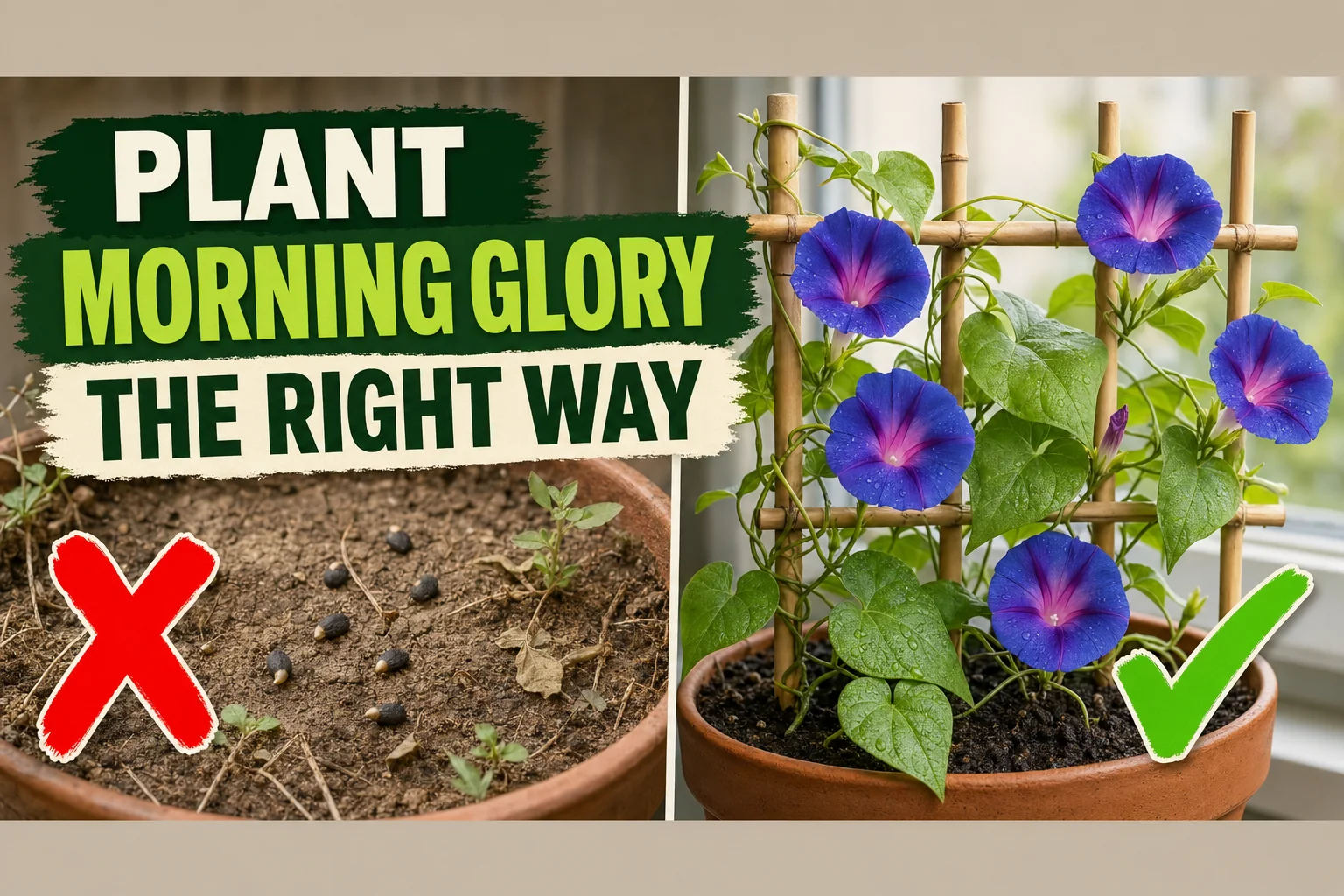
How to Plant Morning Glory Seeds (Step-by-Step Guide)
Learn how to plant morning glory seeds the right way — scarify, soak, sow, and get vibrant trumpet flowers climbing your trellis in 6 to 10 weeks.
On this page
Watch the visual walkthrough
Easiest Way to Grow Seeds | How to Germinate Morning Glory Seeds | How to Grow Seeds
A short visual walkthrough that pairs with the steps above.
Morning glories are one of the most rewarding annuals you can grow from seed — fast-climbing vines that throw out trumpet-shaped blooms in deep blues, purples, pinks, and whites from midsummer through frost. The catch: their seed coat is famously stubborn, so a few minutes of prep makes the difference between a bare trellis and a wall of flowers.
This guide walks you through the whole process: choosing seeds, scarifying and soaking, sowing depth, support, watering, and exactly when to expect the first bloom.
Quick answer
Nick each seed with a nail file, soak in lukewarm water for 24 hours, then sow 1 cm (0.5 in) (½ inch) deep and 15 cm (6 inches) apart in warm soil at the base of a trellis. Water in, keep evenly moist, and place in 6+ hours of full sun. Sprouts appear in 5–7 days and the first trumpet flowers open 6 to 10 weeks after sowing.
Why grow morning glories from seed
Morning glories (Ipomoea purpurea and Ipomoea tricolor) are cheap, fast, and dramatic. A single packet of 25 seeds costs less than a coffee and can cover a 2-meter trellis in a single summer.
A few things make them stand out from other climbing annuals:
- They flower in 6 to 10 weeks from sowing — faster than almost any other vine
- Each vine produces dozens of blooms across the season, opening fresh every morning
- They self-seed gently, so you usually get volunteers next year for free
- Heat and humidity make them happier, not weaker
The one thing they ask for is a sunny spot and something to climb. Get those right and the seeds practically grow themselves.
What you’ll need
- One packet of morning glory seeds (15–25 seeds is plenty for a 2 m trellis)
- A nail file, fine sandpaper, or small knife (for scarification)
- A small bowl of lukewarm water
- A trellis, fence panel, bamboo teepee, or netting at least 1.8 m (6 ft) tall
- Loose, well-draining soil — garden bed or large pot of potting mix
- A pot at least 30 cm (12 inches) wide and deep if container-growing
- Watering can with a fine rose
That’s the full list. No fertilizer needed at sowing — rich soil actually produces lots of leaves and few flowers.
Step-by-step: planting morning glory seeds
1. Scarify the seed coat
Hold each seed against a nail file or fine sandpaper and rub gently 5 to 10 times until you see a faint pale spot — that’s the seed coat thinning. Don’t grind all the way through to the white interior; you only need to break the waterproof layer.
If you’d rather not file each seed, an alternative is to nick them once with a sharp knife on the rounded side, away from the small dimple (the hilum). The goal is the same: let water in.
2. Soak overnight
Drop the scarified seeds into a small bowl of lukewarm water and leave them for 24 hours at room temperature. Within a few hours, viable seeds will swell to roughly 1.5× their original size and feel softer.
Discard any seeds that look the same after 24 hours — they didn’t take up water and won’t germinate. Plant only the swollen ones.
3. Wait for warm soil
Morning glories germinate best when soil is 18–24°C (64–75°F). Sowing into cold soil is the most common reason seeds rot.
Outdoors, that usually means 1 to 2 weeks after your last frost date. If you want a head start, sow indoors 4 to 6 weeks before last frost in biodegradable peat or coir pots — morning glories hate root disturbance, so transplant the whole pot directly into the garden.
4. Sow shallow at the base of a support
Loosen the soil to a depth of 15 cm (6 in) and rake it smooth. Make small holes 1 cm (0.5 in) (½ inch) deep and 15 cm (6 inches) apart along the base of your trellis or fence.
Drop one seed per hole, cover with soil, and pat lightly. Sowing too deep is the second most common reason morning glory seeds fail — anything past 2 cm (0.75 in) and the shoot runs out of energy before reaching the surface.
5. Water in gently
Water with a fine rose or a slow stream so you don’t wash the seeds out of place. Soak the soil to about 5 cm (2 in) deep, then stop. The goal is evenly moist soil, not waterlogged.
After this first watering, check daily and water whenever the top 1 cm (0.5 in) of soil feels dry. Consistent moisture during the 5–7 day germination window is non-negotiable — a single dry day at this stage usually kills the seed.
6. Provide a climbing support immediately
Don’t wait for the vines to flop before adding a trellis — morning glories twine quickly and won’t transplant well once they grab on. Bamboo canes, cattle panel, jute netting, and chain-link fences all work. The vine reaches up to 3 m (10 ft), so make the support at least 1.8 m tall to get a real flower display.
For container growing, push three 1.8 m bamboo canes into the pot at sowing time and tie them at the top to make a teepee.
Care after planting
Once the vines are 15 cm (6 in) tall, morning glories ask very little. Keep these three things on track:
| Task | When |
|---|---|
| Water | Deeply once or twice a week — more in heat. Soil should never bake hard. |
| Fertilize | Skip it, or use a low-nitrogen bloom feed once a month after the vines reach 60 cm (24 in) |
| Train the vine | Gently wrap young tips around the trellis the first few times — they’ll take it from there |
A free plant care app like Tazart can hold the watering schedule for you, adjust it for your local weather, and ping you on Apple Watch when it’s time — useful once the vines spread across a fence and you can’t tell at a glance how dry the soil is.
Avoid high-nitrogen fertilizer. It produces a giant green wall with almost no flowers, which is the most common disappointment with this plant.
When you’ll see flowers
The first blooms typically open 6 to 10 weeks after sowing, depending on variety, sun hours, and summer warmth. Heavenly Blue and Grandpa Ott’s tend to lean later in that window; smaller-flowered hybrids often hit it sooner.
Each individual flower opens at sunrise and closes by mid-afternoon — the name is literal. New buds open daily through the rest of summer until the first hard frost ends the season.
If you’re past 10 weeks and still no flowers, the cause is almost always one of: too much shade, too much nitrogen, or vines planted too late in the season. Move next year’s planting earlier and into a sunnier spot.
Common mistakes to avoid
- Skipping the scarification and soak. The seed coat is genuinely waterproof — most “dud seed” complaints come from this single missed step.
- Sowing into cold soil. Below 15°C (59°F), seeds rot rather than sprout. Wait for true warm soil.
- Planting too deep. 1 cm (0.5 in) is the right depth. 3 cm (1 in) is too deep.
- Letting the soil dry out during germination. A single dry day in the first week kills the seed.
- Using rich soil or fertilizer at sowing. You’ll get all leaves, no flowers.
- Forgetting the trellis. Vines tangle on themselves and become a sad green ball if you don’t add a support before they’re 30 cm (12 in) tall.
Troubleshooting
| Symptom | Likely cause | Fix |
|---|---|---|
| Seeds never sprouted after 14 days | No scarification, or soil too cold | Re-scarify and soak fresh seeds; sow when soil is 18°C (64°F)+ |
| Sprouts appeared then collapsed at the base | Damping-off fungus from soggy soil | Let the top 1 cm (0.5 in) dry between waterings; thin crowded seedlings |
| Vines are huge but barely flower | Too much nitrogen, or too little sun | Stop fertilizing; ensure 6+ hours direct sun; flowers usually catch up in 2–3 weeks |
| Yellow leaves with green veins | Iron chlorosis from compacted alkaline soil | Loosen soil; mulch; apply a small dose of chelated iron |
| Holes chewed in leaves | Caterpillars or Japanese beetles | Hand-pick at dawn; spray with a mild insecticidal soap if heavy |
| Buds form but never open | Drought stress or daily heat over 35°C (95°F) | Water deeply; mulch the base 5 cm (2 in) thick to cool the roots |
Watch: planting morning glory seeds
A short visual walkthrough pairs well with the steps above. If you’re a visual learner, watch a quick tutorial like How to Plant Morning Glory Seeds on YouTube — seeing the scarify-and-soak step in real time makes it click — then come back to follow the timing in this guide.
Related reading
- How to plant peony bulbs the right way — if you want a long-lived perennial bloomer alongside your annual morning glories.
- How to plant a sprouted onion — the same warm-soil and “don’t bury too deep” rules apply to most direct-sown crops.
- How to water a Monstera the right way — the dry-between-waterings principle that keeps morning glories alive in pots.
- How to grow cosmos flowers — pollinator-friendly daisies that fill the gaps below your morning glory trellis with non-stop summer color.
- Snap a photo of any seedling with the free Tazart plant identifier and let it set the watering and feeding schedule for you.
A note on conditions
Every garden is different. Latitude, last-frost date, soil type, container size, summer humidity, and how many hours of direct sun your spot actually gets all change how morning glories behave. Use the numbers above as a tested starting point, watch how your vines respond in week two, and adjust water and support from there — that’s how every good gardener learns this plant.
Highly recommended
The supplies that make this guide work


Tazart is an Amazon Associate — we earn from qualifying purchases at no extra cost to you. Thank you for helping us keep these guides free.
Frequently asked questions
Do you need to soak morning glory seeds before planting?
Strongly recommended. Morning glory seeds have a thick, water-resistant coat that slows germination from 14 days to as little as 4 to 6 days when softened. Nick each seed lightly with a nail file or sandpaper, then soak in lukewarm water for 24 hours before sowing. Discard any seeds that don't swell — they're duds.
How long does it take morning glory seeds to germinate?
With scarification and soaking, expect sprouts in 5 to 7 days at soil temperatures of 18–24°C (64–75°F). Without that prep, germination is patchy and can take 2 to 3 weeks. Cooler soil below 15°C (59°F) often causes seeds to rot before they sprout.
When should I plant morning glory seeds?
Direct sow outdoors after your last frost date when soil has warmed to at least 18°C (64°F). For a head start, sow indoors 4 to 6 weeks before last frost in biodegradable pots — morning glories resent root disturbance, so transplant the whole pot.
How deep do you plant morning glory seeds?
Sow 1 cm (0.5 in) (about ½ inch) deep, no deeper. Space seeds 15 cm (6 inches) apart along the base of a trellis or fence. Cover lightly with soil, water gently, and keep evenly moist until germination.
Do morning glories need full sun?
Yes — at least 6 to 8 hours of direct sun per day is required for heavy flowering. In partial shade, the vines still climb and produce healthy leaves, but you'll get far fewer blooms. South- or west-facing fences and walls work best.
Why aren't my morning glory seeds sprouting?
Three usual culprits: seeds weren't scarified or soaked (the seed coat blocked water), soil is too cold (under 15°C (59°F) / 60°F), or the soil dried out mid-germination. Re-soak any unsprouted seeds for 24 hours, sow again 1 cm (0.5 in) deep, and keep the soil consistently moist — not soggy — until shoots appear.