Edible
How to Plant Corn: Block Spacing, Timing, and Varieties Explained
Learn exactly how to plant corn — when to sow, why single rows fail, block spacing rules, variety types, succession planting, and harvest timing. 1,800-word guide.
On this page
- Quick answer
- When to plant corn
- The block planting rule (single rows almost always fail)
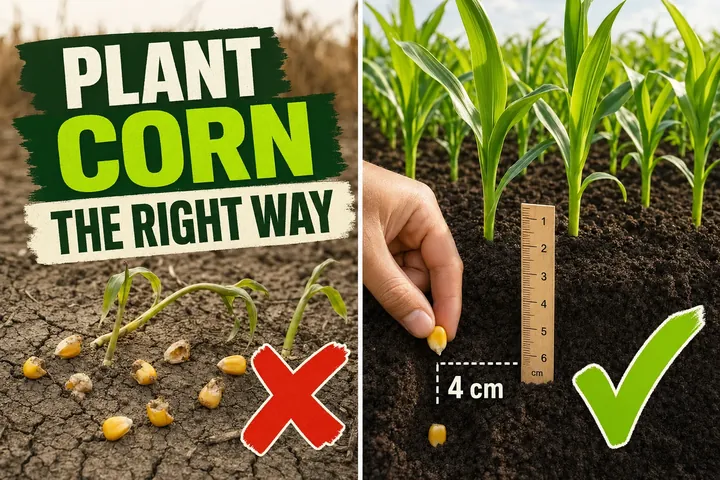
- Seed depth
- Spacing
- Sweet corn vs popcorn vs flour corn: choose your type first
- Succession planting for extended harvest
- Fertilising corn (a heavy nitrogen feeder)
- Thinning
- Common pests
- Watch: How to plant corn (video guide)
- Harvest timing
- Common mistakes checklist
- Troubleshooting table
- Related guides
Watch the visual walkthrough
5 Tips How to Grow a Ton of Sweetcorn in One Raised Garden Bed or Container
If you would like to know how to grow a big harvest of sweet corn watch this video for my five top tips on sweetcorn growing!
Corn is one of the most satisfying crops to grow — if you plant it right. Get the timing, layout, and feeding wrong, and you’ll end up with tall green plants and empty cobs. This guide covers every decision that matters: when to sow, why single rows always disappoint, which variety to choose, how to feed a crop that eats nitrogen faster than almost anything else in the garden, and exactly when to run out and pick.
Quick answer
Wait until soil temperature reaches 15°C (60°F) at 5 cm (2 in) depth, then sow seeds 2.5–5 cm (1–2 in) deep, 30 cm (12 in) apart, in a block of at least 4 rows by 4 plants. Single rows fail because corn is wind-pollinated — pollen blows past a single row and misses the silks. Feed with nitrogen at knee-high and again at tasseling. Harvest when silks brown and kernels release milky juice, usually 60–90 days from sowing depending on variety.
When to plant corn
Corn is a warm-season crop that detests cold soil. The hard rule: soil temperature must be at least 15°C (60°F) at 5 cm (2 in) depth before you sow a single kernel. Cold soil doesn’t slow germination — it stops it, and sitting kernels rot within a week.
How to check: push a soil thermometer 5 cm (2 in) into the bed at 9 a.m. on three consecutive mornings. If readings stay at or above 15°C (60°F), you are safe to sow.
Air temperature is not a reliable guide. Soil warms more slowly than air in spring. Your last frost date gives a rough starting point, but a soil thermometer is the only honest check.
Typical sowing windows by region:
| Region | Safe outdoor sowing |
|---|---|
| Southern US (zones 8–10) | Late March – April |
| Mid-Atlantic / Pacific Northwest | Late April – May |
| Northern US / most of UK | Late May – early June |
| Canada (short season) | Early June |
For an earlier start, sow into deep module trays indoors 3–4 weeks before your last frost date, then transplant once soil warms. Corn tolerates transplanting at seedling stage but develops a deep tap root fast — transplant before seedlings exceed 10 cm (4 in) or roots will be damaged.
The block planting rule (single rows almost always fail)
This is the single most important piece of advice in this guide.
Corn (Zea mays) is wind-pollinated. Pollen is produced at the tassel — the branching structure at the top of each plant. It falls with the breeze and must land on the silks growing from each developing ear. Every silk strand is connected to exactly one kernel. No pollen on a silk = no kernel = a gap in the cob.
In a single long row, most pollen drifts sideways into open air and never reaches a silk. Growers report 30–70% of kernels missing on single-row corn — not because of disease, not because of bad seed, but because of physics.
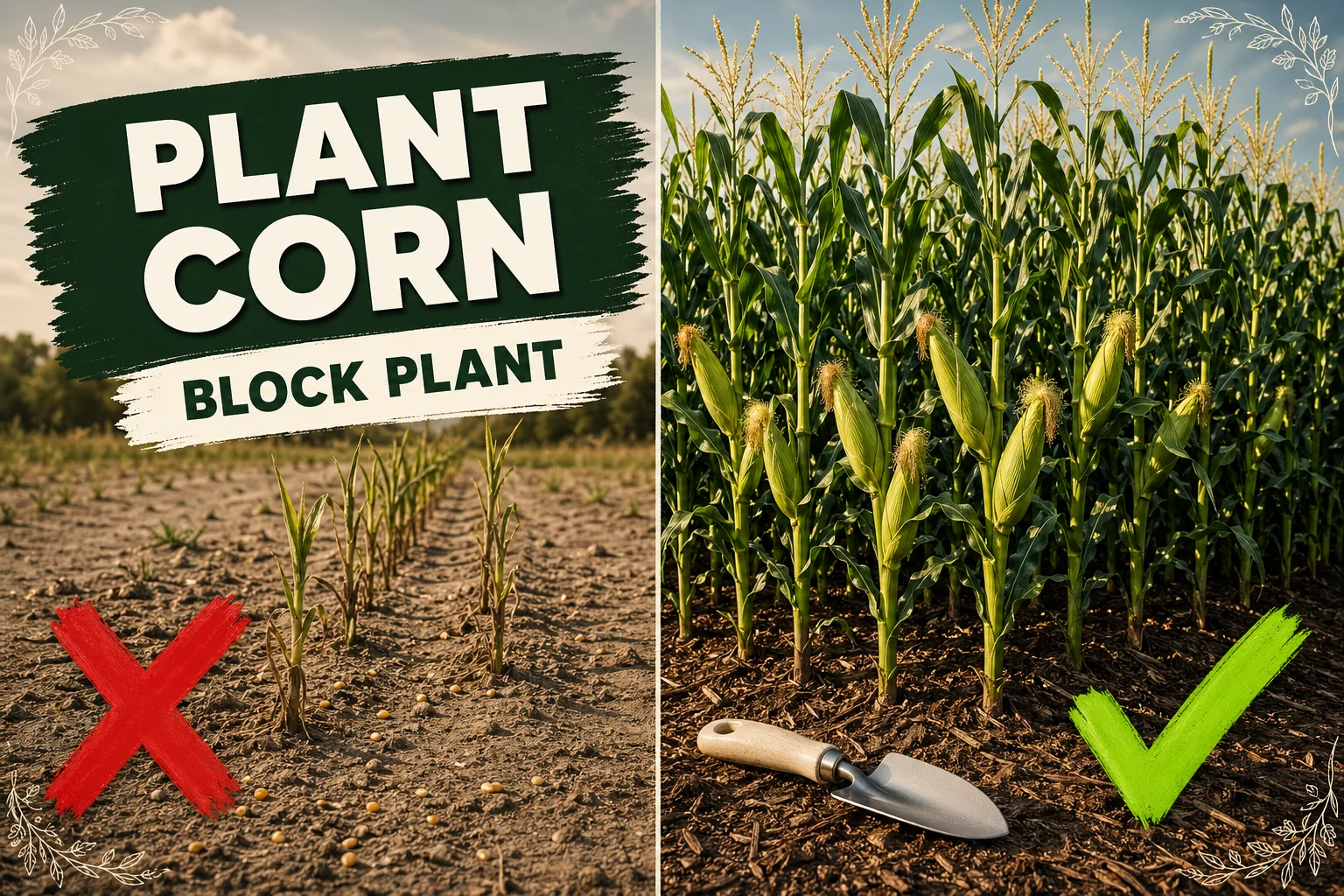
The fix: plant in a compact square block of at least 4 rows by 4 plants (16 plants minimum). In a block, every plant is surrounded by tassels in multiple directions. Pollen has nowhere to go except onto nearby silks. Cobs fill out fully.
Bigger blocks always pollinate better. A 6×6 or 8×8 block is excellent if you have space.
If your garden is narrow, plant 6 short rows rather than 2 long ones — 6 rows, even if each row only has 4 plants, pollinate far better than 2 long rows with 20 plants each.
Seed depth
Plant corn seeds 2.5–5 cm (1–2 in) deep. The right depth within that range depends on soil conditions at sowing time:
- Cool, moist soil (early sowing): 2.5 cm (1 in). Shallow sowing gets the kernel into the warm zone near the surface faster.
- Warm, dry soil (later sowing): 4–5 cm (1.5–2 in). The top centimetre or two dries out fast in heat. Deeper sowing reaches consistent moisture and prevents the kernel from desiccating before it germinates.
If in doubt: push your finger 5 cm (2 in) into the soil. If it feels damp and cool, plant at 2.5 cm (1 in). If it feels dry and warm, plant at 4–5 cm (1.5–2 in).
For more depth detail — including germination troubleshooting by soil type — see our dedicated guide: How deep to plant corn.
Spacing
Within-row spacing: 30 cm (12 in) between plants.
Row spacing (traditional rows): 75–90 cm (30–36 in) between rows.
Block spacing (recommended): if planting in an all-directions block rather than defined rows, space plants 30–38 cm (12–15 in) in every direction.
Sow 2 seeds per hole as insurance against poor germination. Once seedlings reach 10–15 cm (4–6 in) tall, thin to the strongest plant per hole by cutting the weaker seedling at soil level with scissors — pulling it out disturbs the roots of the survivor.
Minimum block for reliable pollination: 4 rows × 4 plants = 16 plants, covering roughly 1.2 m × 1.2 m (4 ft × 4 ft).
Corn and pole beans are a classic companion planting pair — if you’re growing both in the same season, the pole bean planting guide covers timing and trellis setup so beans don’t compete with corn for pollination.
Sweet corn vs popcorn vs flour corn: choose your type first
Never mix corn types in the same growing space in the same season — they cross-pollinate and the results ruin both crops.
Sweet corn
Harvested immature when kernels are swollen and milky. Eaten fresh, frozen, or canned. The sweet sugar converts to starch within 24–48 hours of picking — taste peaks minutes after harvest.
- Days to maturity: 60–90 days depending on variety
- Varieties: ‘Earlibird’ (60 days), ‘Incredible’ (85 days), ‘Honey and Pearl’ bicolour (78 days)
- Isolation: keep 400 m (440 yd) from popcorn or field corn, or time sowings so they tassel at least 10 days apart
Popcorn
Left fully on the stalk until husks are dry and papery. Kernels are then dried further indoors for 3–4 weeks before popping. The hard endosperm structure is what makes kernels explode when heated.
- Days to maturity: 90–110 days (harvest when husks are dry, then cure)
- Varieties: ‘Tom Thumb’ (compact, 90 days), ‘Strawberry’ (decorative, 100 days)
- Isolation: critical — cross-pollination with sweet corn ruins sweetness; cross with field corn affects popping quality
Flour corn (dent/field corn for grinding)
Kernels allowed to fully dry and harden on the stalk. Ground into cornmeal, masa, or polenta. Dent corn is the large-scale US agricultural type; open-pollinated heirloom varieties like ‘Bloody Butcher’ and ‘Oaxacan Green’ are popular for home milling.
- Days to maturity: 90–110 days
- Varieties: ‘Bloody Butcher’ (100 days), ‘Glass Gem’ (decorative and edible, 110 days)
Succession planting for extended harvest
Sweet corn has a very short harvest window — about 3–6 days per block at the milky stage. If you want to eat fresh corn for 6–8 weeks instead of scrambling to use 16 cobs in 4 days, succession plant.
Method: sow a new block every 2–3 weeks from your safe sowing date until midsummer. Each block will tassel and set ears roughly 2–3 weeks after the previous one, staggering your harvest across the whole season.
Practical limit: stop sowing when the latest planting won’t mature before your first autumn frost. Count days to maturity from your seed packet backward from your average first frost date.
Example for a UK garden with average first frost 15 October:
- Block 1: sown 25 May (ready ~24 August, 90-day variety)
- Block 2: sown 10 June (ready ~8 September)
- Block 3: sown 25 June (ready ~23 September)
- Block 4: sown 5 July (ready ~2 October — tight, use a 70-day variety)
Isolation between blocks: if different blocks are of the same variety, cross-pollination between them is not a problem. If you plant different varieties for succession, separate them by at least 7–10 tassel days or 400 m (440 yd) to avoid off-type kernels.
Fertilising corn (a heavy nitrogen feeder)
Corn strips nitrogen from the soil faster than almost any common garden vegetable. Underfeeding results in pale yellow-green plants, thin stalks, and poor ear development.
Three-stage nitrogen programme:
-
At planting: work a balanced granular fertiliser (e.g. 10-10-10) or a 5 cm (2 in) layer of well-aged compost into the top 20 cm (8 in) of soil. This feeds early root and leaf growth.
-
Knee-high side-dress: when plants reach 30 cm (12 in) — roughly knee-high — broadcast a nitrogen-rich fertiliser (ammonium nitrate, blood meal, or a balanced liquid) along each row, 15 cm (6 in) away from the stems. Work it lightly into the soil surface and water in. This is the most important feeding — it drives the rapid stalk extension and tassel development phase.
-
At tasseling: when the first tassels emerge at the top of the plants, apply a second side-dress at the same rate. This feeds the ear-fill phase when most grain weight is accumulated. Do not apply more nitrogen after this point — it pushes leaf growth at the expense of the ear.
Phosphorus and potassium: phosphorus is critical at planting for root development — if your soil test shows deficiency, add bone meal or superphosphate before sowing. Potassium supports stalk strength and drought tolerance; wood ash or potassium sulphate corrects deficiency.
Rule of thumb: if leaves are yellow-green rather than deep green, corn needs nitrogen. If stalks are thin and floppy, it also needs potassium.
Thinning
Sow 2 seeds per hole. When seedlings reach 10–15 cm (4–6 in), cut the weaker seedling at soil level with scissors. Do not pull — you’ll disturb the root of the one you want to keep.
Leave only the single strongest seedling per planting station. Crowded corn does not produce more cobs — it produces two weak plants competing for nitrogen, water, and root space, with neither able to develop a full ear.
Common pests
Corn earworm (Helicoverpa zea)
The most common corn pest in North America. The moth lays eggs on fresh silks; caterpillars hatch and burrow down into the tip of the ear, eating kernels from the top down. By harvest you find the damage at the tip — brown frass, chewed kernels, sometimes a fat caterpillar.
Prevention: apply a few drops of mineral oil or a solution of Bacillus thuringiensis (Bt) directly into the silk channel of each ear 3–5 days after silks first emerge. Repeat once if wet weather washes it out. Treat all ears in the block — earworm pressure is rarely limited to one plant.
Raccoons
Raccoons are the most destructive mammal pest on home corn patches, and they are precise — they wait until the cobs are exactly ripe, pull the plants over, and strip cobs overnight.
Most effective deterrent: a two-strand electric fence strung at 15 cm (6 in) and 30 cm (12 in) above ground. Raccoons investigate by touching with their nose — one contact is usually enough to train them off a patch for the season.
Physical barriers, motion-activated lights, and noise devices work temporarily but raccoons habituate to them within days.
Watch: How to plant corn (video guide)
This video gives a practical visual walkthrough of block planting setup, spacing, and pollination mechanics that pairs well with the steps above.
Harvest timing
Sweet corn waits for no one. The milky stage — the window when kernels are at peak sweetness — lasts only 3–6 days on the plant before sugars convert to starch and quality drops sharply.
Two checks to confirm readiness:
-
Silks: the silks (the threads coming from the top of the husk) should be fully brown and dried. Green or pale-gold silks mean the ear is not ready.
-
Kernel test: peel back a small section of husk at the top of the cob and pierce a kernel with your fingernail. The juice should be milky white. Clear juice = not ready. Starchy, paste-like = past peak.
-
Feel: a ready cob feels firm and fully filled when you squeeze it gently through the husk. Soft patches at the tip mean the ear hasn’t filled out completely.
Once you confirm readiness, pick and eat within hours for maximum sweetness. Refrigerate immediately if you can’t eat the same day — cold temperature slows sugar conversion.
Harvest by gripping the cob firmly and twisting downward sharply. It snaps off the stalk cleanly without tools.
Popcorn and flour corn are not harvested at the milky stage. Leave them on the stalk until husks are completely brown, papery, and dry. Then bring indoors and hang in a well-ventilated dry space for a further 3–4 weeks before shelling.
Common mistakes checklist
- Planting in soil below 15°C (60°F) — kernels rot before germinating
- Planting in a single row — wind pollination fails, cobs come out empty
- Mixing sweet corn and popcorn in the same block — cross-pollination ruins sweetness
- Skipping nitrogen side-dress at knee-high — plants yellow and ears stay small
- Harvesting too early (clear kernel juice) or too late (starchy, floury kernels)
- Not checking daily once silks brown — the 3–6 day window closes fast
- Leaving two seedlings per hole after thinning — both plants underperform
- Failing to protect from raccoons until after the first raid — they return every night
Troubleshooting table
| Symptom | Likely cause | Fix |
|---|---|---|
| Kernels missing from cob | Poor pollination / single row | Always plant 4×4 block minimum |
| Yellow-green leaves, thin stalks | Nitrogen deficiency | Side-dress with nitrogen fertiliser immediately |
| Seeds didn’t germinate | Soil too cold (below 15°C/60°F) | Check soil temp before next sowing |
| Cob tips eaten from inside | Corn earworm | Apply mineral oil or Bt to silk channels next season |
| Plants flattened overnight, cobs stripped | Raccoons | Install two-strand electric fence before silks emerge |
| Short, stunted plants | Waterlogged or compacted soil | Improve drainage; raised bed next time |
| Pale, papery cobs with no kernels | Extreme heat during pollination | Shade cloth during heat waves; water heavily during tasseling |
Related guides
- How deep to plant corn — exact depth by soil type, germination troubleshooting
- How to grow radishes — fast-maturing crop to use succession planting space between corn blocks
- How to grow spinach — cool-season crop to plant before your corn goes in
Sources: University of Minnesota Extension, Royal Horticultural Society, Penn State Extension, Cornell Cooperative Extension. Always check your local last-frost date and first-frost date before planning corn sowings.
Highly recommended
The supplies that make this guide work
Tazart is an Amazon Associate — we earn from qualifying purchases at no extra cost to you. Thank you for helping us keep these guides free.
Frequently asked questions
When is the right time to plant corn?
Plant corn after your last frost date, once soil temperature at 5 cm (2 in) depth has reached at least 15°C (60°F). Corn sown in cold soil rots before it germinates. In most of the UK and northern US that means late May to early June; in warmer regions (USDA zones 7+) late April is usually safe.
Why does corn have to be planted in a block?
Corn is wind-pollinated. Pollen falls from the tassels at the top and must land on the silks of nearby ears — each silk feeds one kernel. In a single row, most pollen blows sideways and is lost, leaving cobs empty or half-filled. A block of 4 rows by 4 plants minimum gives every tassel multiple targets upwind, downwind, and to each side.
How far apart should corn be planted?
Space corn seeds 30 cm (12 in) apart within each row. If you're planting in traditional rows, keep rows 75–90 cm (30–36 in) apart. If you're planting in a square block, space plants 30–38 cm (12–15 in) in all directions. Either way, plant a minimum block of 4 rows by 4 plants.
What is the difference between sweet corn, popcorn, and flour corn?
Sweet corn is harvested immature when kernels are milky and eaten fresh or frozen — it goes starchy within days of harvest. Popcorn is left to fully dry on the stalk; its hard starch explodes when heated. Flour corn has a soft starch used for grinding into cornmeal and masa. Never plant sweet corn next to popcorn in the same season — cross-pollination ruins the sweetness of the sweet corn.
How do I do succession planting with corn?
Sow a new block every 2–3 weeks from your safe sowing date until midsummer. Each block matures about 2–3 weeks after the previous one, stretching your harvest window from a single 2-week rush into 6–8 weeks of fresh cobs. Use fast-maturing varieties (60–70 days) for later sowings to beat the first autumn frost.
What fertilizer does corn need and when?
Corn is a heavy nitrogen feeder. At planting, work in a balanced granular fertilizer or compost. Side-dress with a nitrogen-rich fertilizer when plants are 30 cm (12 in) tall (knee-high) and again when tassels first appear. Phosphorus is important at planting for root development; potassium helps stalk strength. Avoid excess nitrogen after tasseling — it pushes leaf growth at the expense of ears.
When is corn ready to harvest?
Check two things: the silks should have turned brown and dried, and the kernels should release milky juice (not clear, not starchy-dry) when pierced with a fingernail. This milky stage lasts only 3–6 days on the plant, so check daily once silks start to brown. The cob should feel full and firm when you squeeze it through the husk.
How do I protect corn from earworms and raccoons?
For corn earworms, apply a few drops of mineral oil or Bacillus thuringiensis (Bt) directly into each ear's silk channel 3–5 days after silks first emerge. For raccoons, the most reliable method is a two-strand electric fence set at 15 cm (6 in) and 30 cm (12 in) above ground — raccoons learn quickly and stay away. Physical barriers and row covers help but are harder to manage at scale.