Edible
How to Grow Tomatoes in Pots (Container Guide)
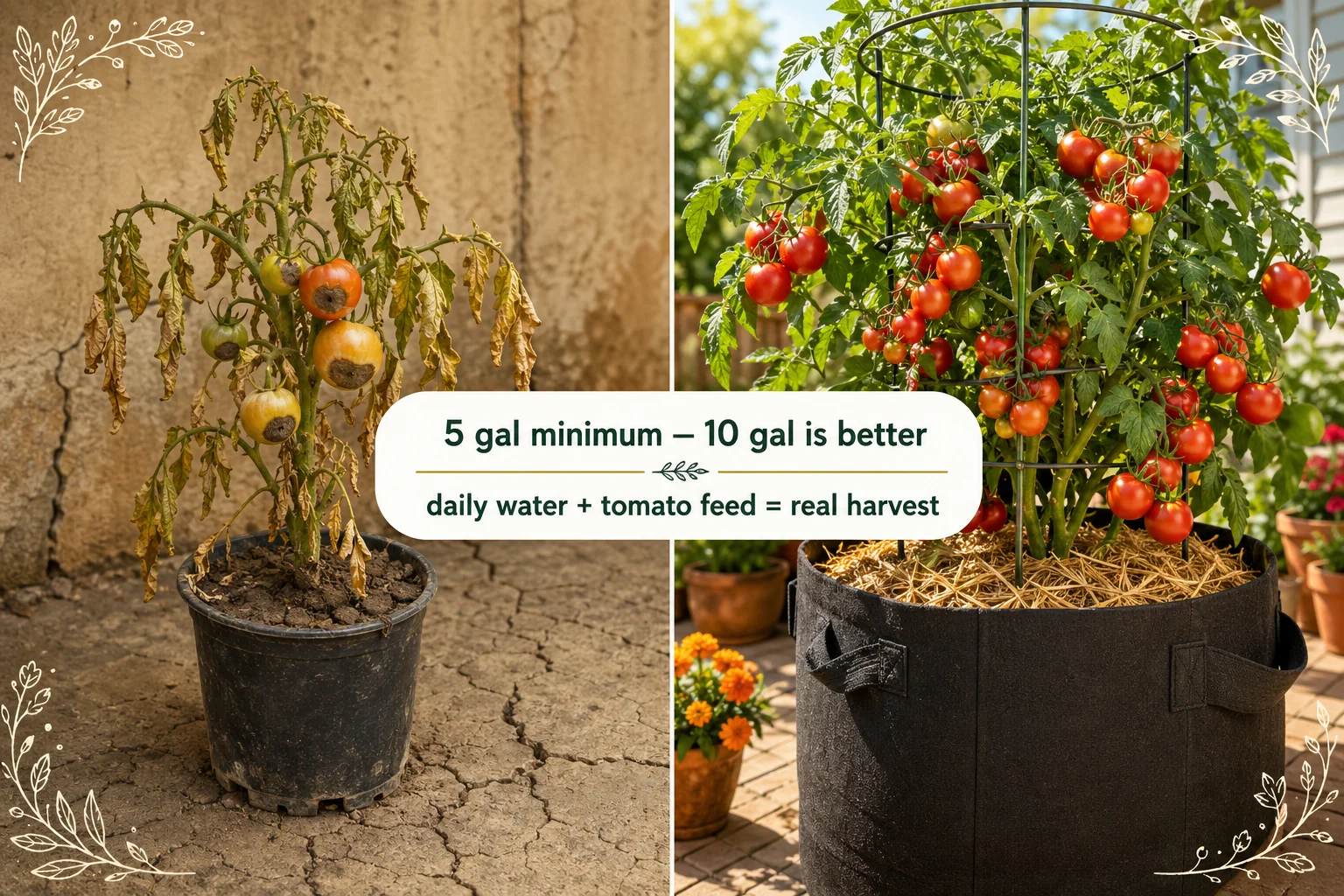
Grow tomatoes in pots with a 5-gallon minimum, the right variety, deep planting, daily summer watering, and a fertilizing schedule that prevents blossom end rot.
On this page
Watch the visual walkthrough
How to Grow Tomatoes in Containers, Pots or Buckets. Container Gardening.
In this video Brian is planting tomatoes in a five gallon bucket, or any container. A few tips you need to know to have success ...
Yes — you can grow tomatoes in pots, and with the right container size, variety, and watering routine you will get a harvest that rivals a small garden bed. The catch is that containers are unforgiving: wrong pot size, inconsistent water, or no fertilizing schedule and the plant stalls in August just when fruit should be coming in.
This guide covers everything that matters: choosing the right pot, picking the right variety, planting deep, building a watering routine, staying on a fertilizing schedule, and diagnosing the most common container problem — blossom end rot.
Quick answer
Use a 5-gallon minimum for compact determinate varieties, 10 gallons or more for most others. Fill with a well-draining potting mix, plant the stem deep, add a heavy cage at planting time, water daily in summer, and switch to a low-nitrogen tomato fertilizer every 7–14 days once flowers appear. Inconsistent watering is the cause of blossom end rot — fix the water, fix the fruit.
Choose the right pot size
Container size is the variable that determines everything else — watering frequency, root volume, drought tolerance, and fruit load. The most common container tomato mistake is starting too small.
| Container size | Root volume | Best for |
|---|---|---|
| 5 gallon | Tight — adequate for small plants | Compact determinates (Patio, Tiny Tim), cherry types in cool climates |
| 10 gallon | Good — enough for most varieties | Bush Early Girl, Sungold, Sweet 100, Roma, most determinate slicers |
| 15–20 gallon | Generous — best results | Full-size slicers, beefsteaks, large indeterminates in hot climates |
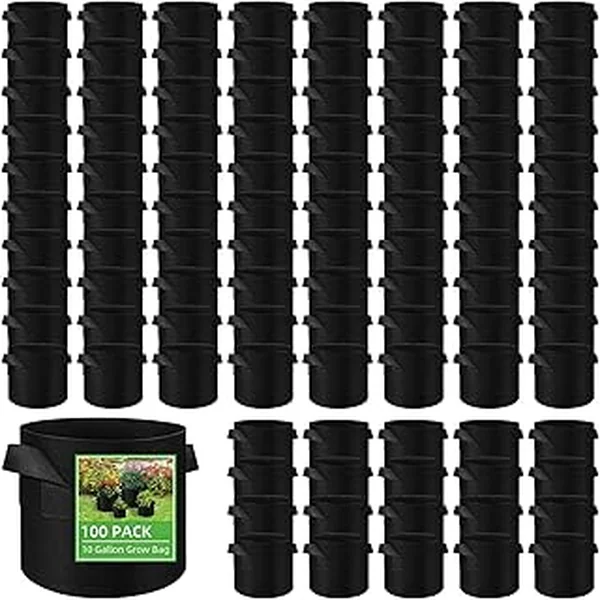
Fabric grow bags vs. plastic pots. Fabric bags breathe through the sides, which means faster drainage and air-pruning of roots (roots that hit air stop circling and produce more fibrous lateral roots instead). They also stay cooler in hot weather. A 10-gallon fabric bag typically outperforms a 10-gallon plastic pot for tomatoes by a meaningful margin. The trade-off is that fabric bags dry out faster — which reinforces the case for daily watering checks in summer.
Whatever container you choose, confirm it has multiple drainage holes in the base. A pot without drainage kills container tomatoes with root rot in one wet week.
Determinate vs indeterminate for containers
Choosing between determinate and indeterminate growth habit is the second most important container decision, right after pot size.
Determinate varieties grow to a defined height — usually 0.9–1.2 m (3–4 ft) — set most of their fruit in a 2–3 week window, and stop. They are self-supporting enough to manage with a small stake and require almost no pruning. They are the practical choice for 5–10 gallon containers, small balconies, and growers who want a concentrated harvest for sauce or canning.
Indeterminate varieties vine continuously all season, can reach 1.5–2 m (5–6 ft) or taller in a container, and produce fruit from midsummer until frost. They need a heavy cage and regular pruning (removing suckers) to stay manageable. The payoff is a longer harvest season and often better fresh-eating flavor. Use 10–20 gallon containers for indeterminates.
Semi-determinate varieties — a middle category that includes Bush Early Girl and Celebrity — behave like compact indeterminates: they keep growing past the main fruit set but stay shorter than a full indeterminate. These are arguably the best all-around choice for 10-gallon containers.
Best container varieties
Not all tomatoes sold at a garden center are suited to containers. These are the varieties with a documented track record in pots:
| Variety | Type | Container minimum | Days to harvest | Notes |
|---|---|---|---|---|
| Patio | Determinate | 5 gal | 65 | Purpose-bred for containers, stays 60 cm (2 ft) |
| Bush Early Girl | Semi-determinate | 10 gal | 62 | Reliable in cool climates, big for its habit |
| Roma | Determinate | 5 gal | 75 | Paste type — great flavor, easy canning |
| Sungold | Indeterminate | 10 gal | 57 | The best-tasting cherry tomato in most growers’ opinion |
| Sweet 100 | Indeterminate | 10 gal | 65 | Prolific cherry — a single plant fills a 10-gal bag |
| Celebrity | Semi-determinate | 10 gal | 70 | Disease-resistant — good for humid climates |
| Marglobe | Determinate | 10 gal | 73 | Classic slicer, dependable in poor weather |
Avoid giant beefsteak varieties (Mortgage Lifter, Brandywine) unless you can give them a 15–20 gallon container and are prepared to water twice a day in July. They are not impossible in containers — they just require the most maintenance.
Soil mix for container tomatoes
Never use garden soil in a pot. In a container it compacts, drains slowly, and creates the oxygen-deprived, wet conditions that kill tomato roots. Use a bagged potting mix designed for containers, and improve it further:
- Base: peat-free potting mix
- Drainage amendment: 20–30% perlite or coarse grit stirred in
- Pre-charge: a slow-release balanced granular fertilizer worked into the mix before planting, per label rate
Some growers also add 10–15% worm castings for biological activity and slow-release nutrition. This is optional but worthwhile.
Fill the pot 2/3 full before planting so there is room to plant deep.
Planting deep
Tomatoes are one of the few vegetables that actively benefit from deep planting. The stem develops adventitious roots along any section that is buried — so the deeper you plant, the larger and more stable the root system.
Before planting:
- Remove the bottom 2–3 sets of leaves from the transplant.
- Dig or push aside the potting mix to create a pocket deep enough to bury the stem up to just below the remaining lowest leaves.
- In a tall 10-gallon bag, this usually means only 15–20 cm (6–8 in) of plant is above the soil surface.
- Fill in around the stem and firm gently.
- Water immediately.
The buried stem roots within 1–2 weeks and dramatically increases the plant’s ability to absorb water and nutrients during the hottest part of summer — exactly when container tomatoes are under the most stress.
Daily watering routine
Consistent watering is the single most important management task for container tomatoes in summer, and the most commonly neglected one.
The basic rule: check the soil every morning. Stick a finger 3–5 cm (1–2 in) into the soil. If it’s dry, water. If it’s still slightly moist, check again in the afternoon. In temperatures above 27°C (80°F), most 10-gallon containers need water every day. A fabric grow bag may need water twice a day during a heatwave.
How to water properly: water slowly at the soil surface — not on the foliage — until water flows freely from the drainage holes. This ensures the entire root zone gets wet, not just the top layer. Watering fast and stopping early leaves the bottom third of the container dry, which is where roots pull most of their calcium.
Mulch the surface: a 3–5 cm (1–2 in) layer of straw or wood chip mulch on top of the soil cuts evaporation dramatically and slows the wet-dry cycle that triggers blossom end rot. This matters more in fabric bags, which dry out faster than plastic.
A drip irrigation kit on a timer is worth installing if you can’t reliably check pots every morning. Missing a single day in peak summer can crack tomatoes and trigger the calcium-uptake disruption that causes blossom end rot.
Fertilizing schedule
Container tomatoes are heavy feeders, and every watering leaches soluble nutrients out of the pot. Unlike in-ground plants that can mine soil a meter deep, container plants depend entirely on what you add.
| Stage | Fertilizer type | Frequency |
|---|---|---|
| Transplant to first flowers | Balanced (10-10-10 or similar) | Every 2 weeks |
| First flowers to fruit set | Tomato feed (low N, higher P+K) | Every 7–14 days |
| Fruit ripening | Tomato feed, same | Every 14 days |
| Last 2 weeks before final harvest | Stop feeding | — |
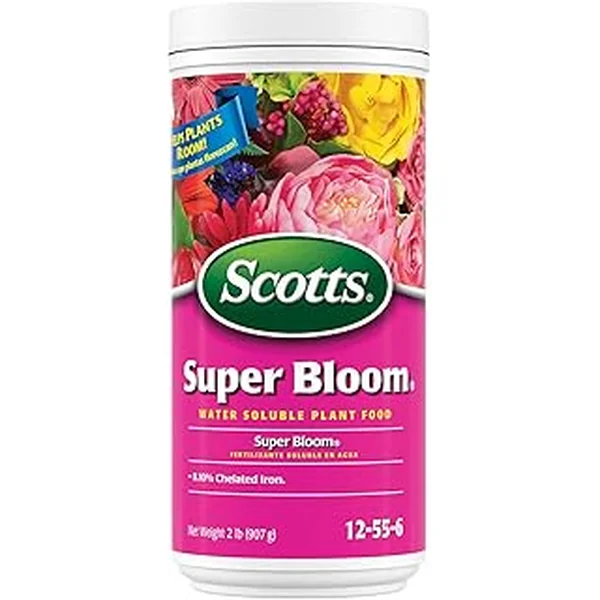
The switch from a balanced fertilizer to a tomato-specific feed at flowering is important. High-nitrogen fertilizer after flowering encourages leaf growth at the expense of fruit. Tomato fertilizers are formulated with the nitrogen-to-phosphorus-to-potassium ratios that support fruit development rather than vegetative growth.
Signs of under-fertilizing in a container: pale yellow-green leaves starting on the bottom of the plant, poor fruit set, small fruit size.
Support and pruning
Install support at planting time. Pushing a cage or stake into a pot once a tomato plant is 60 cm (2 ft) tall tears the roots that have already spread into the outer edges of the container. Do it on day one.
For determinates: a single heavy stake or a short 0.9 m (3 ft) cage is usually enough. As stems grow, tie loosely with soft garden twine — never wire.
For indeterminates: use a three-ring or spiral cage at least 1.2 m (4 ft) tall, or a heavy bamboo teepee anchored to the pot rim. As the plant grows, weave the stems through the cage rings and remove suckers (the side shoots that grow in the V between a main stem and a leaf) when they are 3–5 cm (1–2 in) long. Pruning suckers is optional on determinates; it is strongly recommended on indeterminates grown in containers, because an unpruned indeterminate in a 10-gallon pot becomes so leafy and top-heavy that it is nearly impossible to water without blowing over.
Common container problems
Blossom end rot
The bottom of the fruit turns dark brown or black and collapses inward. This is the most common container tomato problem and the one growers most often misdiagnose.
Cause: inconsistent watering. When the soil dries out significantly and is then flooded, the plant cannot absorb calcium efficiently from the soil solution, even if calcium is present. The developing fruit — which has no way to move calcium once it is deposited — suffers the deficiency at the blossom end, where new cells are expanding fastest.
Fix: steady, consistent watering. The moment you see blossom end rot, your watering schedule is not consistent enough. Set a daily alarm, install a drip timer, or add mulch to slow drying. Calcium foliar sprays are widely sold as a remedy but have limited effectiveness — the calcium cannot move from leaves to fruit in meaningful amounts.
Prevent it: mulch, consistent watering schedule, and planting deep so the root system is large enough to buffer the dry-wet swings of a hot day.
Cracked fruit
Radial (splits from stem outward) or concentric (rings around the shoulders) cracks appear as fruit ripens. Cause: heavy rainfall or heavy watering after a dry period causes the fruit to expand faster than the skin can stretch. Fix: consistent watering and harvesting at first color break, letting tomatoes finish ripening indoors.
Yellowing lower leaves in midsummer
Lower leaves yellow and drop while upper growth stays green. On a well-fertilized container plant, this is usually natural — the plant sheds older leaves to redirect energy upward. If yellowing progresses up the plant, fertilize and check for spider mites (fine webbing on leaf undersides is the giveaway in hot dry conditions).
Wilting at midday even after watering
On very hot days, tomatoes wilt at midday even with moist soil — this is normal thermoregulation. If the plant is wilted first thing in the morning and the soil is dry, that is a watering problem. If soil is moist but the plant is wilted at 9 AM, check for root rot (overwatering) or root-bound conditions (roots circling at the base of the pot with no room left).
A free plant care app like Tazart tracks your watering and feeding schedule, adjusts reminders for local weather, and sends you a nudge on Apple Watch on the dry hot days when a container pot goes from moist to bone-dry in six hours.
Related reading
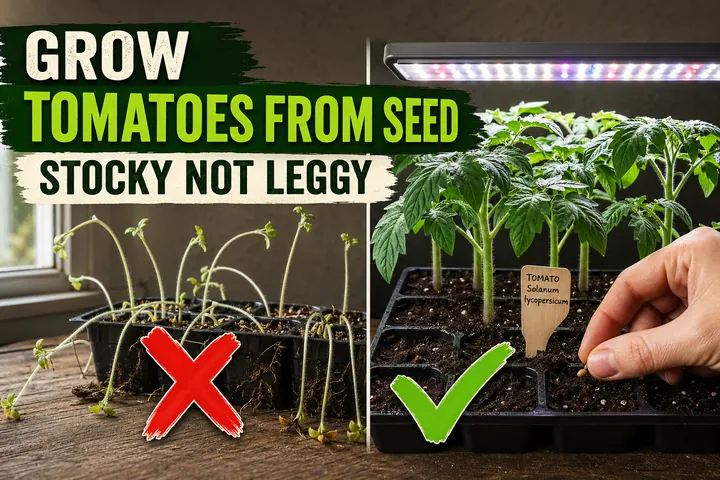
- How to grow tomatoes from seed (indoor start to harvest) — if you want to start your container tomatoes from seed rather than transplants, this guide covers germination, grow lights, potting up, and hardening off.
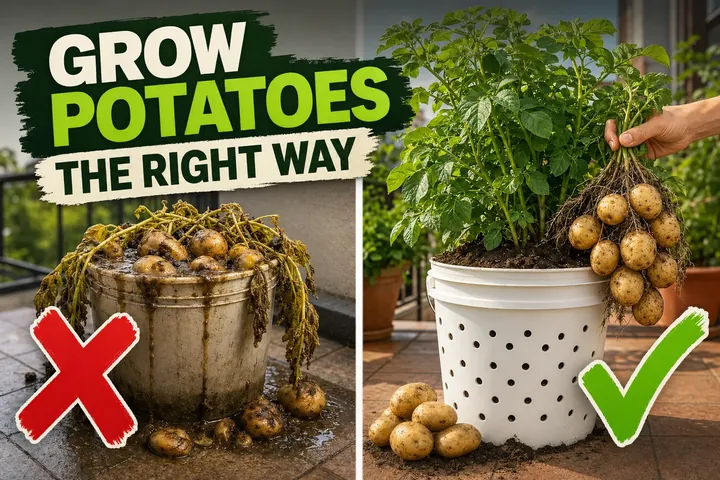
- How to plant potatoes in a bucket (5-gallon step-by-step) — the same container-grow principles applied to potatoes: drainage, soil mix, and consistent watering in a single bucket.
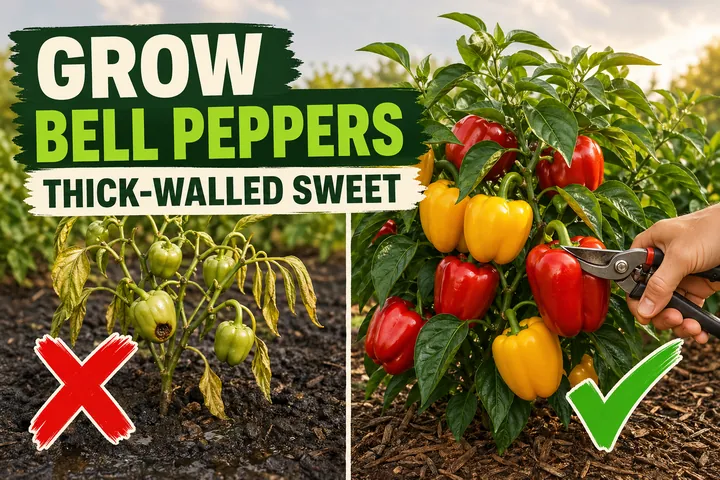
- How to grow bell peppers (thick-walled sweet peppers) — peppers share the same pot-size requirements, fertilizing schedule, and blossom-drop issues as container tomatoes — a natural companion crop.
- How far apart to plant tomatoes — bed-spacing chart for indeterminate vs determinate types, Florida weave and cordon options.
- How far apart to plant cherry tomatoes — vining cherries grow as large as full-size beefsteaks; spacing rules apply.
- Track every watering, feeding date, and harvest note for each container with the free Tazart plant care app — set the schedule once and let it remind you.
A note on conditions
Container tomato growing varies enormously by climate. In a cool coastal climate, a 5-gallon pot may never need daily watering; in the Arizona desert in July, a 10-gallon fabric bag can dry out in under six hours. The guidelines above are calibrated for a temperate summer (20–30°C / 68–86°F). Adjust watering frequency and shade based on what your plant actually shows you in the first two weeks — that’s how every good container grower calibrates their system.
Highly recommended
The supplies that make this guide work
Tazart is an Amazon Associate — we earn from qualifying purchases at no extra cost to you. Thank you for helping us keep these guides free.
Frequently asked questions
What size pot do I need to grow tomatoes?
A 5-gallon pot is the practical minimum for compact determinate varieties and cherry tomatoes. For most indeterminate slicers and beefsteaks, use 10 gallons or more. A larger pot holds more moisture, resists heat stress, and gives roots the volume they need to support heavy fruit loads. Anything under 5 gallons produces stunted plants and very low yields.
Which tomato varieties grow best in containers?
Determinate and semi-determinate varieties are the easiest choice — Bush Early Girl, Patio, Roma, and Marglobe stay compact and don't need constant pruning. Among indeterminates, cherry types like Sungold and Sweet 100 do well in 10-gallon bags. Avoid full-size beefsteaks in anything under 15 gallons; the plants get large enough but the root volume can't support reliable fruit set.
How often do you water tomatoes in pots?
In summer heat, container tomatoes often need watering once a day, sometimes twice when temperatures are above 32°C (90°F). Check the top 3–5 cm (1–2 in) of soil each morning. If it's dry, water deeply until you see runoff from the drainage holes. Inconsistent watering — letting the pot dry out, then flooding it — is the primary cause of blossom end rot.
What causes blossom end rot in container tomatoes?
Blossom end rot is a calcium deficiency in the developing fruit caused by irregular water uptake, not a lack of calcium in the soil. When a pot dries out and is then flooded, the plant can't absorb calcium efficiently, and the bottom of the fruit turns black and leathery. The fix is steady, consistent watering — not calcium spray, which is mostly ineffective once the problem appears.
Do container tomatoes need a cage or stake?
Yes — even determinate varieties benefit from a stake or a small cage to keep the fruit-laden stems off the pot rim. Indeterminates grown in containers absolutely need a heavy-gauge tomato cage at least 1.2 m (4 ft) tall, anchored firmly in the grow bag. Install the support at planting time; adding it later disturbs roots.
How deep should I plant a tomato in a pot?
Plant as deep as possible, burying the stem up to just below the lowest set of healthy leaves. Tomatoes develop roots all along the buried stem, creating a deeper, more drought-tolerant root system. In a 10-gallon bag this typically means removing the bottom 2–3 sets of leaves and planting so only the top 15–20 cm (6–8 in) of the plant is above the soil.
What soil mix is best for container tomatoes?
Use a high-quality peat-free potting mix (not garden soil) blended with about 20–30% perlite or coarse grit for drainage. Add a slow-release balanced fertilizer to the mix at planting. Garden soil compacts in containers, roots waterlogged, and blocks drainage — it will kill a container tomato before summer peaks.
When should I start fertilizing container tomatoes?
Start with a balanced fertilizer (10-10-10 or similar) every 2 weeks from transplant until the first flowers open. Once flowers appear, switch to a low-nitrogen, higher-phosphorus-and-potassium tomato feed applied every 7–14 days. Container tomatoes exhaust nutrients in weeks because watering leaches salts from the soil; consistent feeding is not optional.