Flowers
How to Grow Sweet Peas (Fragrant Climbing Annuals)
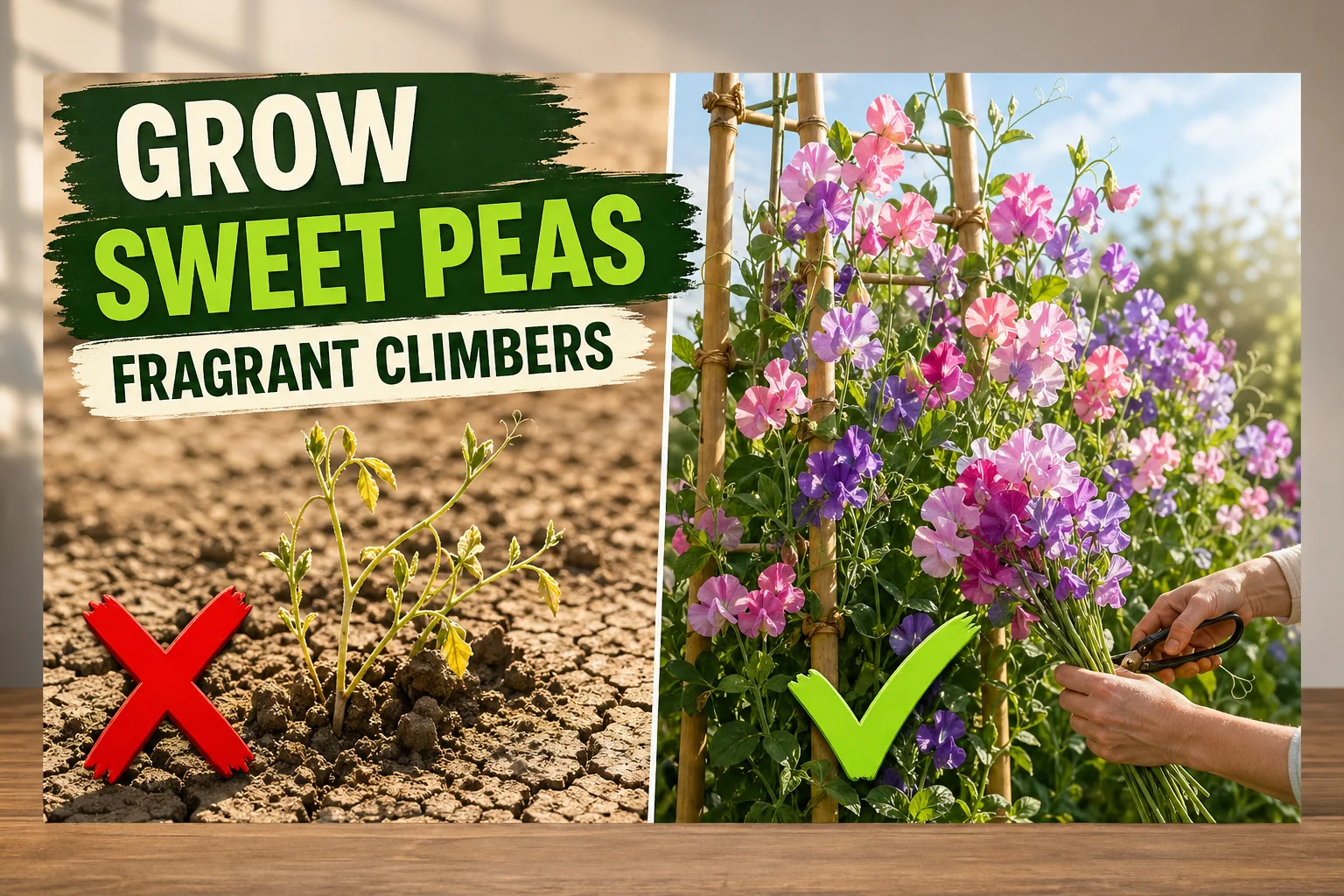
Grow sweet peas the right way — soak the seeds, sow cool, give them a tall trellis, and deadhead for months of intensely fragrant pastel blooms.
On this page
Watch the visual walkthrough
How to Grow Sweet Peas
A short visual walkthrough that pairs with the steps above.
Sweet peas are one of the most beloved climbing annuals in the cottage garden — soft pastel flowers in pink, lavender, cream, and deep purple, all carrying a fragrance that no breeder has ever managed to replicate in another flower. The catch is they hate heat. Get the timing right and they bloom for months; get it wrong and they fizzle out before they ever reach the trellis.
This guide walks you through the whole season: choosing seeds, soaking, sowing depth, support, watering, feeding, and exactly how to deadhead for the longest possible bloom.
Quick answer
Soak sweet pea seeds in lukewarm water for 12–24 hours, sow 2 cm (¾ in) deep and 5 cm (2 in) apart in cool moist soil at the base of a tall trellis at least 1.8 m (6 ft) tall, and place in 6+ hours of sun with cool roots. First fragrant blooms open 10 to 14 weeks after sowing, and cutting stems daily keeps the vines flowering for 8 to 12 weeks straight.
Why grow sweet peas
Sweet peas (Lathyrus odoratus) are the rare flower that earns its space three times over: the scent fills a whole room from a single small vase, the pastel color range looks like nothing else in the border, and they are one of the few cut flowers that bloom more the more you cut them.
A few details set them apart from other climbing annuals:
- The fragrance is unique — heavy, sweet, almost honeyed — and only the annual Lathyrus odoratus has it
- They thrive in cool weather most flowers can’t handle, including light spring frosts
- A single 1.5 m (5 ft) row can produce 200+ stems for the vase across the season
- They self-support on tendrils once they reach the trellis, so they need almost no tying-in
The two non-negotiable conditions are cool soil at sowing and a tall support set up before you plant. Get those right and the seeds practically grow themselves.
What you’ll need
- One packet of sweet pea seeds (15–25 seeds is plenty for a 1.5 m / 5 ft row)
- A small bowl of lukewarm water for soaking
- A trellis, netting panel, bamboo teepee, or fence at least 1.8 m (6 ft) tall
- Loose, well-draining soil enriched with compost — sweet peas are heavy feeders
- A garden bed in full sun, or a deep pot at least 30 cm (12 in) wide and 30 cm (12 in) deep
- Watering can with a fine rose
- A pair of bypass pruning shears for daily harvesting
That’s the full list. No nitrogen-heavy fertilizer at sowing — too rich a soil pushes leafy growth over flowers.
Step-by-step: growing sweet peas from seed
1. Soak the seeds
Drop the seeds into a small bowl of lukewarm water and leave them at room temperature for 12 to 24 hours. Viable seeds will swell to roughly 1.5× their original size and feel softer.
Discard any seeds that look the same after 24 hours — those have a hard coat that didn’t break and they’ll just rot in the soil. Plant only the swollen ones, and plant them the same day.
If you’d rather not soak, you can lightly nick the seed coat with a nail file on the side opposite the small “eye” (the hilum). The goal is the same: let water reach the embryo.
2. Time the sowing to your climate
Sweet peas need cool soil and cool air to do their best work. Match the sowing date to your zone:
- Mild winters (USDA zones 7+): sow outdoors in late autumn, October to November, for an over-wintered crop that flowers 4 to 6 weeks earlier the following spring on sturdier vines.
- Cold winters (zones 3–6): sow indoors in deep root-trainer cells 4 to 6 weeks before your last frost, then transplant out as soon as the soil can be worked — sweet peas tolerate light frost down to −2°C (28°F).
- Direct sow: in any zone, you can also direct sow once the soil reaches 10–18°C (50–65°F) and is workable.
The single biggest mistake is sowing too late. Once daytime temperatures pass 24°C (75°F), bloom production crashes and the vines mildew quickly.
3. Set up the trellis first
Sweet peas climb by curling tendrils around anything thinner than a pencil — wire, twine, netting, slim bamboo. Set the support before you sow so you don’t disturb the seedling roots later.
Good options:
- A bamboo teepee tied at the top, 1.8–2.4 m (6–8 ft) tall, with 6 to 8 canes
- Pea netting or sheep wire stretched between two posts
- A wooden A-frame or obelisk with crossed bamboo
- A trellis panel against a fence or wall (the wall must let air through — solid masonry traps heat and triggers mildew)
Avoid thick wooden trellises — sweet pea tendrils can’t grip pieces wider than about 1.5 cm (½ in), and the vines will slide off in wind.
4. Sow at the right depth and spacing
Push each soaked seed into loose, compost-amended soil at the base of the trellis:
- Depth: 2 cm (¾ in) deep
- Spacing: 5 cm (2 in) apart along the row, or 6 to 8 seeds evenly spaced around a teepee
- Row spacing: if you want a second row, set it 60–90 cm (24–36 in) away to keep airflow open
Cover with soil, tap gently to settle, and water in. Keep the seedbed evenly moist — never soggy — until shoots break the surface in 7 to 14 days.
5. Pinch the seedlings
When seedlings reach 10 cm (4 in) tall and have 3 to 4 sets of leaves, pinch out the very top growing tip with your fingers. It feels brutal but it’s the single highest-impact step in the whole guide.
Pinching forces the plant to send up multiple side shoots from the base instead of one tall, thin, easily-broken main stem. The result is a bushier vine with two to four times more flowering stems by midseason.
6. Train onto the trellis
Once the side shoots reach 20 cm (8 in), guide the lowest tendrils onto the support by hand. After that the plant takes over — every new leaf produces a tendril that reaches for the closest vertical line.
If a vine flops sideways instead of climbing, loop a length of soft garden twine loosely around the stem and the trellis to redirect it. Don’t tie tightly; the hollow stems crush easily.
Care after planting
Once sweet peas are climbing, they only ask for three things:
| Task | When |
|---|---|
| Water | Deeply once or twice a week — aim for 2.5 cm (1 in) of water reaching the roots, not the leaves |
| Feed | A balanced liquid feed every 2 weeks once buds appear; avoid high-nitrogen lawn fertilizer |
| Mulch roots | A 5 cm (2 in) layer of straw or compost mulch keeps roots cool and extends bloom by weeks in summer |
A free plant care app like Tazart can hold the watering schedule for you, adjust it for your local weather, and ping you on Apple Watch when it’s time — useful if you have several climbers running at once.
How and when to deadhead (the secret to a long bloom)
Sweet peas live to make seed. The instant a flower fades and starts forming a green pea pod, the whole plant gets the chemical signal that the season is over and slows new bloom production within days.
The fix is simple: cut every flower stem at least every other day, whether you take them indoors or compost them. Snip the stem deep down at the next leaf node with bypass pruners so a new flowering shoot can break from there.
Done consistently, this turns a 4-week display into 8 to 12 weeks of fragrant cut flowers. A single vine can produce 30 to 50 stems across the season.
Common mistakes to avoid
- Sowing too late. Sweet peas need to flower before summer heat. Sow as early as your zone allows.
- Skipping the trellis. Vines on the ground rot at the base and produce a fraction of the flowers.
- Overfeeding with nitrogen. Lush leaves and few blooms = too much nitrogen. Switch to a balanced or potash-leaning feed.
- Letting seed pods form. Even one missed pod can shut down the rest of the vine. Cut every flower.
- Hot dry roots. Mulch heavily and water deeply. Heat-stressed sweet peas mildew within a week.
- Cramming the row. 5 cm (2 in) apart is dense enough — closer than that and airflow drops, which invites powdery mildew.
Troubleshooting
| Symptom | Likely cause | Fix |
|---|---|---|
| Yellowing lower leaves, leggy stems | Not enough light or too warm | Move pots to a cooler spot with 6+ hours of morning sun; mulch the roots |
| Seeds didn’t germinate | Hard seed coat, soil too dry, or soil too cold | Re-soak unsprouted seeds for 24 hours and resow at 2 cm (¾ in) into evenly moist soil |
| Lots of leaves, no flowers | Too much nitrogen, or pinching skipped | Switch to a low-nitrogen feed; pinch seedlings next year at 10 cm (4 in) |
| Flowers slowed down after a few weeks | Seed pods forming | Cut every flower at least every other day; remove any visible green pods |
| White powdery coating on leaves | Powdery mildew from heat and poor airflow | Thin the row, water at the base only, and mulch — affected leaves can be removed |
| Vines flopping off the support | Support too thick or no early training | Use thinner canes / netting; loop soft twine to redirect floppy stems |
| Tiny green insects on new growth | Aphids | Spray off with water; repeat every 2–3 days for a week |
Watch: growing sweet peas from seed
A short visual walkthrough pairs well with the steps above. If you’re a visual learner, watch a quick tutorial like How to Grow Sweet Peas From Seed on YouTube and then come back to follow the timing in this guide.
Related reading
- How to plant morning glory seeds — another fast-climbing annual with similar trellis needs but a very different, heat-loving temperament.
- How to plant nasturtium seeds — a cottage-garden companion that thrives in the same cool conditions and looks beautiful planted at the base of sweet peas.
- How to grow cosmos flowers — pair with sweet peas in the cutting garden for a steady supply of stems from spring through frost.
- Scan the next plant you bring home with the free Tazart plant identifier and let it set up the watering schedule for you.
A note on conditions
Every garden is different. Day length, soil mix, rainfall, summer heat, and how often you cut all change how long a sweet pea stays in flower. Use the steps above as a starting point and adjust based on what your vines actually do in week three — that’s how every good cut flower grower learns the rhythm.
Highly recommended
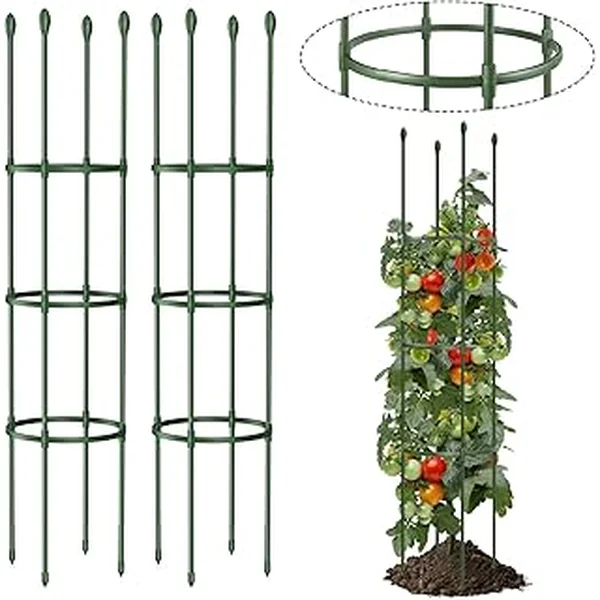
The supplies that make this guide work



Tazart is an Amazon Associate — we earn from qualifying purchases at no extra cost to you. Thank you for helping us keep these guides free.
Frequently asked questions
When should I plant sweet peas?
Sow sweet peas as soon as the soil can be worked — late winter to early spring in mild climates, or in autumn for an over-wintered crop in zones 7 and warmer. They are a cool-season annual and germinate best at soil temperatures of 10–18°C (50–65°F). Heat above 24°C (75°F) shuts down flowering, so the goal is to get them blooming before midsummer.
Do sweet peas need a trellis?
Yes — sweet peas are climbing vines that reach 1.5–2.4 m (5–8 ft) and grab on with curling tendrils. Without a trellis, netting, bamboo teepee, or fence panel at least 1.8 m (6 ft) tall, the vines flop, rot at the base, and produce far fewer flowers. Set the support in place before sowing so you don't disturb the roots later.
How long do sweet peas take to bloom?
From sowing to first flower takes about 10 to 14 weeks. Spring-sown seeds typically bloom from late spring through midsummer, while autumn-sown seeds in mild climates flower 4 to 6 weeks earlier the following spring on much sturdier vines.
Should I soak sweet pea seeds before planting?
Soaking is helpful but optional. Sweet pea seeds have a hard coat — soaking in lukewarm water for 12 to 24 hours speeds germination from 14 days down to 7 to 10 days. Discard any seeds that don't swell, and sow the swollen ones immediately 2 cm (¾ in) deep.
Why are my sweet peas not flowering?
The three most common reasons are heat (above 24°C / 75°F shuts down bloom), too much nitrogen (rich lawn-style fertilizer pushes leaves over flowers), and not deadheading. Cut every flower the moment it opens — once a sweet pea sets seed pods, the whole vine signals that the season is over and stops producing new blooms.
Are sweet peas annuals or perennials?
The fragrant garden sweet pea (Lathyrus odoratus) is a true annual — it lives one season, sets seed, and dies. The unrelated 'perennial sweet pea' (Lathyrus latifolius) is a hardy perennial vine but has almost no fragrance, so for the legendary scent you have to replant the annual variety every year.