Edible
How to Grow Strawberries from Seed (For Patient Gardeners)
Grow strawberries from seed: cold stratify 4 weeks, surface-sow on fine mix, raise seedlings under a grow light, harvest year-1 berries from alpine varieties.
On this page
Watch the visual walkthrough
How To! Growing Strawberries From Seeds (2019)
A short visual walkthrough that pairs with the steps above.
Yes — you can grow strawberries from seed at home, but it is not a fast project. Strawberry seed is finicky: it wants cold, light, and patience. Plan on 5 to 6 months from sowing to the first alpine berry, and a full 10 to 14 months for a regular garden strawberry.
The reward is varieties you can’t buy as plants — small-fruited alpine types, white pineberries, day-neutral heirlooms — for the cost of a single seed packet. This guide walks you through it step by step: cold stratification, sowing depth, light, potting up, and exactly when to transplant outdoors.
Quick answer
Cold stratify strawberry seeds in the fridge at 2–5°C (35–41°F) for 3–4 weeks. Surface-sow on fine seed starting mix at 18–24°C (65–75°F) — do NOT bury, the seed needs light. Cover with a humidity dome and wait 14–28 days for germination. Move under a full-spectrum LED grow light held 7–10 cm (3–4 in) above the leaves for 14–16 hours a day. Pot up to 10 cm (4 in) pots at the first true leaves, harden off over 7–10 days, then transplant outdoors after night temperatures stay above 10°C (50°F).
Pick the right strawberry type
Not every strawberry is a good fit for seed-starting. The species you choose decides whether you’re harvesting in 6 months or 14.
| Type | Latin name | Year-1 fruit from seed? | Best uses |
|---|---|---|---|
| Alpine strawberry | Fragaria vesca | Yes — usually July of year 1 | Containers, edges, shade-tolerant |
| Day-neutral garden strawberry | Fragaria × ananassa (day-neutral) | Sometimes a small crop | Beds, raised beds, balcony pots |
| June-bearing garden strawberry | Fragaria × ananassa (June-bearing) | No — wait until year 2 | Big in-ground harvests |
| Pineberry / white strawberry | Fragaria × ananassa (white-fruited) | No — wait until year 2 | Specialty, gift-worthy fruit |
For a first-time seed-starter, alpine strawberries (look for ‘Alexandria’, ‘Mignonette’, ‘Reine des Vallées’, or ‘White Soul’) are by far the easiest. They’re day-neutral, fruit reliably in year one, stay tidy in pots, and don’t need to be netted from birds because the berries are small and hidden under the leaves.
If you want runners and big slicing berries, accept that you’re committing to a year before the first real harvest.
Why grow strawberries from seed at all?
Most home growers buy strawberry plants as bare-root crowns or runners — and that’s the right call if you want fruit fast. So why bother with seed?
- Variety access. Specialty alpines, white-fruited pineberries, and many heirlooms are only sold as seed.
- Disease-free start. Seed-grown plants don’t carry the viruses that build up in propagated runner stock.
- Dozens of plants per packet. A $4 packet of alpine seed gives 50–100 viable seedlings — enough to edge a whole bed.
- The challenge itself. Strawberry seed is the kind of project that teaches you patience and finicky germination. If you can grow strawberries from seed, you can grow almost anything.
What you’ll need
- A packet of named strawberry seed (alpine F. vesca recommended for year-1 fruit)
- A small zip-top bag and a damp paper towel for cold stratification
- Cell trays or small pots, plus a waterproof tray underneath
- Fine peat-free seed starting mix — not garden soil, not regular potting mix
- A clear humidity dome (a salad-clamshell from the supermarket works)
- A full-spectrum LED grow light bar
- A warm spot — ideally a seedling heat mat at 18–24°C (65–75°F)
- A spray bottle for misting
- Tweezers (the seeds are 0.5–1 mm — a teaspoon is the wrong tool)
Step-by-step: starting strawberries from seed
1. Cold stratify the seed for 3–4 weeks
Strawberry seed evolved to fall on the ground in late summer, get rained on, and sit through a cold winter before germinating. Skipping this signal is why so many seed packets seem to fail.
Lay the seeds on a damp (not soaking) paper towel, fold once, and seal in a zip-top bag. Label with the date and variety, then store in the back of the fridge at 2–5°C (35–41°F) for 3 to 4 weeks.
You can skip this step only if your seed packet is explicitly labeled “pre-stratified.”
2. Prep the cells and mix
Fill cell trays or small pots with peat-free seed starting mix to about 5 mm (¼ in) below the rim. Mist heavily with a spray bottle until the mix is uniformly damp but not waterlogged — strawberry seed will rot in standing water before it sprouts.
Tap the trays once on the table to settle the mix. Don’t pack it down. The seed needs surface contact with a fluffy, breathable layer.
3. Surface-sow the seeds — do NOT bury them
This is the single most important step. Strawberry seed needs light to germinate.
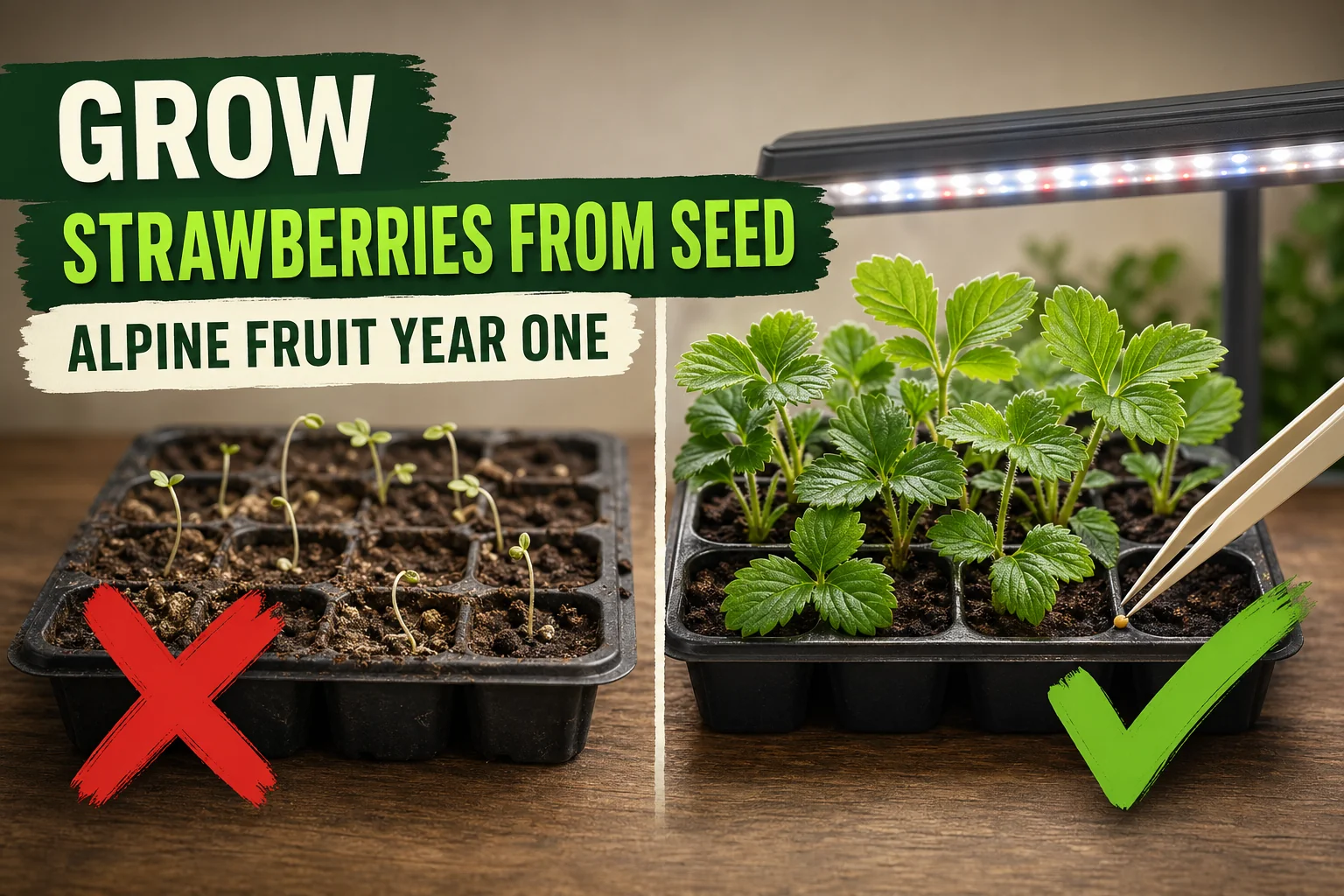
Use tweezers to place 2–3 seeds on the surface of each cell. Press very gently with a fingertip or the back of a spoon to ensure soil contact. Do not cover with mix. Mist the surface lightly so the seeds adhere.
If you cover strawberry seed with even 2–3 mm (⅛ in) of soil, germination drops to almost zero. This is the #1 reason home growers say their seed was bad.
4. Dome and warm
Cover the trays with a clear humidity dome to lock in moisture. Place on a seedling heat mat set to 18–24°C (65–75°F). Higher than 27°C (80°F) actively suppresses strawberry germination — warmer is not better here.
Mist the surface daily so the seeds never dry out. Surface-sown seed is unforgiving — a single dry afternoon will end it.
5. Wait 14–28 days for germination
Strawberry seed is slow. The first sprouts usually appear at day 14–21, and stragglers can show up as late as day 35. Don’t toss a tray that looks empty after two weeks. Mist, keep warm, keep covered.
Expected germination rate is 60–80% on fresh seed. Anything above 50% is a success.
6. Move under a grow light at germination
The instant you see the first cotyledons, get the tray under a full-spectrum LED grow light bar held 7–10 cm (3–4 in) above the leaves for 14–16 hours a day. Lift the dome partly to allow airflow, then fully a few days later.
A south-facing window is not enough. Strawberry seedlings stretching for a far-off light source go leggy in 5–7 days, and leggy strawberry seedlings rarely thicken back up. The whole game at this stage is light intensity.
7. Thin to one seedling per cell
Once the strongest seedling has its first true leaf (the one with the classic serrated strawberry-leaf shape, not the rounded cotyledons), snip the others at soil level with small scissors. Don’t pull — you’ll uproot the keeper.
8. Pot up at the second true leaf
When the seedlings have 2–3 true leaves, transplant into individual 7–10 cm (3–4 in) pots. Hold by a leaf, not the stem — strawberry stems are fragile. Water in gently and return them under the grow light.
This is also when you can start a half-strength balanced liquid fertilizer every 10–14 days.
9. Harden off over 7–10 days
About 6–8 weeks after germination, your seedlings should be 8–15 cm (3–6 in) tall with multiple true leaves. Before they go outside, harden them off:
- Day 1: 1 hour in shade
- Day 3: 3 hours in dappled light
- Day 6: 6 hours of morning sun
- Day 8 onward: full day outside, brought in if nights drop below 10°C (50°F)
Skipping this step sunburns the leaves brown in a single afternoon.
10. Transplant outdoors
Once nights stay above 10°C (50°F), transplant into the garden, raised bed, or final container.
- Spacing: 25–30 cm (10–12 in) apart for alpines, 30–45 cm (12–18 in) for garden types
- Depth: plant so the crown (the point where the leaves emerge) sits exactly at soil level — too deep rots the crown, too shallow exposes the roots
- Soil: rich, well-drained, slightly acidic (pH 5.5–6.8)
- Light: 6+ hours of direct sun for F. × ananassa; alpines tolerate part shade
A free plant care app like Tazart can hold the watering, fertilizing, and runner-pinching schedule for each plant and adjust it for your local weather — useful when you’ve just transplanted 30 alpines.
Care after transplant
| Task | When |
|---|---|
| Water | When the top 2–3 cm (1 in) of soil is dry — usually every 2–3 days in summer |
| Fertilize | Balanced organic fertilizer every 4 weeks during the growing season |
| Mulch | Straw or pine needles around the crown to keep berries clean and soil cool |
| Pinch flowers (year 1 garden type) | Yes — first 6 weeks, to build the crown |
| Pinch flowers (year 1 alpine type) | No — let alpines flower and fruit |
| Net against birds (garden type) | When fruit starts coloring |
Common mistakes to avoid
- Burying the seed. Strawberry seed needs light. Surface-sow only.
- Skipping cold stratification. Drops germination to single digits on most varieties.
- Letting the surface dry out. Surface-sown seed needs misting daily until sprouts emerge.
- Trying to grow on a windowsill. Strawberry seedlings stretch toward distant light and never recover. Use a grow light.
- Sowing in regular potting mix. Coarse mix won’t keep moisture at a 0.5 mm seed. Use fine seed starting mix.
- Expecting tomato-speed. Strawberry seed is 14–28 days to germinate, not 5–7. Don’t toss a tray too early.
- Planting the crown too deep. Crown rot kills more new strawberry transplants than any pest.
Troubleshooting
| Symptom | Likely cause | Fix |
|---|---|---|
| No germination after 28 days | Seed buried, no cold stratification, or soil too cold | Re-sow on the surface, cold stratify the next batch, hold at 18–24°C (65–75°F) |
| Seeds sprout then die in days | Damping off — fungal pathogen in damp, still air | Remove dome partly for airflow, mist less, run a small fan 2–3 hours daily |
| Seedlings pale and leggy | Light too far away or too few hours | Lower the LED bar to 7 cm (3 in) above the leaves, run 14–16 hours a day |
| Tiny black flying insects in the soil | Fungus gnats from staying too wet | Let the surface dry between mistings, top with 1 cm (0.5 in) of dry sand |
| Leaves yellow with green veins | Iron deficiency or alkaline soil | Check soil pH, target 5.5–6.8; feed with a balanced liquid fertilizer |
| Crown collapsed, plant wilted at base | Crown rot from being planted too deep | Replant with the crown exactly at soil level, water less often |
| Seedlings stall at 2 true leaves for weeks | Pot-bound or under-fed | Pot up to 10 cm (4 in) pots, start half-strength fertilizer |
Watch: starting strawberries from seed
A short visual walkthrough pairs well with the steps above. If you’re a visual learner, watch a quick tutorial like How to Start Strawberry Seeds Indoors on YouTube and then come back to follow the timing in this guide.
Related reading
- How long does a strawberry plant take to produce fruit? — once your seedlings are in the ground, this guide covers exactly when to expect the first berry.
- How to plant strawberries — the crown-depth and bare-root planting techniques that make every transplant a success.
- How to grow strawberries — full lifecycle from seedling to harvest, with year-by-year care.
- How to plant blueberry bushes the right way — strawberries and blueberries share the same acidic-soil sweet spot; pair them in the same bed.
- How to grow tomatoes from seed — same indoor seedling setup (heat mat + grow light + harden off), just six weeks faster.
- Track every sowing date and watering window with the free Tazart plant identifier and let it set up the seedling care schedule for you.
A note on conditions
Every home is different. Light, pot size, soil mix, season, humidity, your fridge temperature during stratification, and your local last-frost date all change how fast strawberry seed sprouts and how strong the seedlings grow. Use the steps above as a starting point and adjust based on what your seedlings actually do in week three — that’s how every good strawberry grower learns.
Highly recommended
The supplies that make this guide work
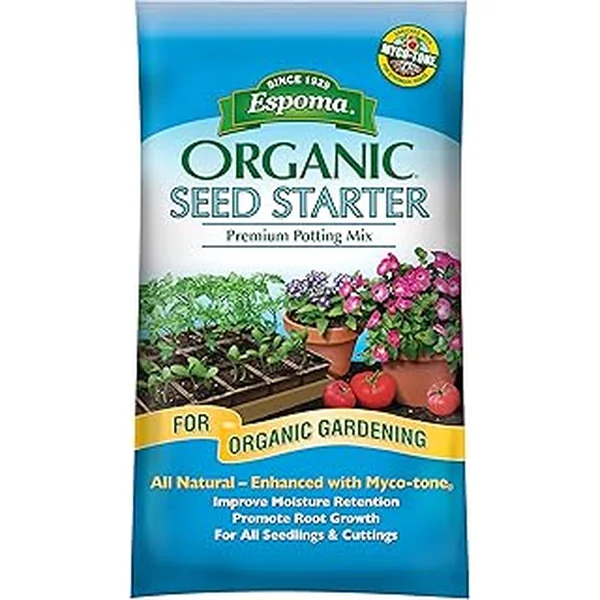
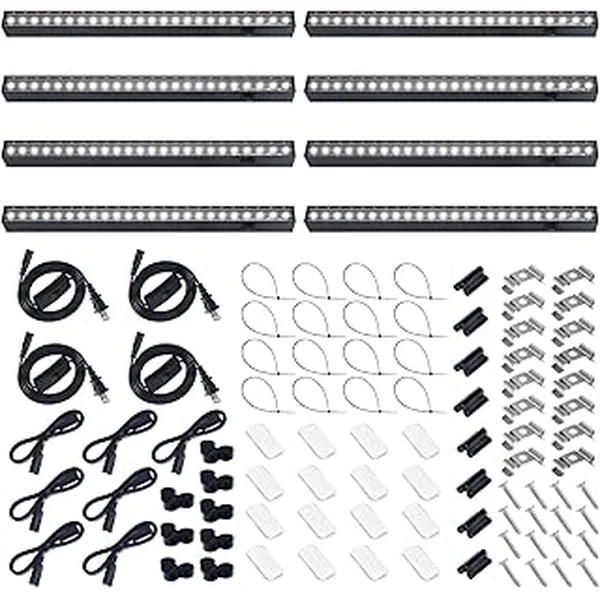
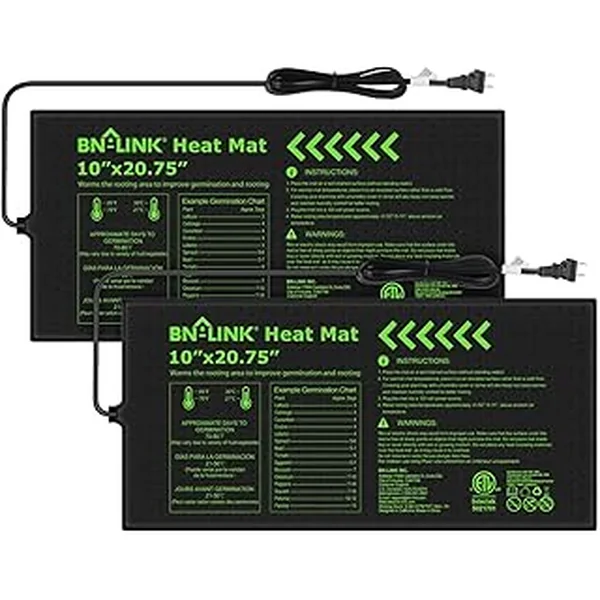

Tazart is an Amazon Associate — we earn from qualifying purchases at no extra cost to you. Thank you for helping us keep these guides free.
Frequently asked questions
How long does it take to grow strawberries from seed?
From sown seed to first ripe berry is roughly 5 to 6 months for alpine types (Fragaria vesca) and 10 to 14 months for most garden strawberries (Fragaria × ananassa). Germination alone takes 14 to 28 days at 18–24°C (65–75°F), and only 60–80% of seed will sprout. Patience is the whole game — strawberry seed is far slower than tomato or pepper seed.
Do strawberry seeds need cold stratification?
Yes for nearly every variety. Place the seed packet in a sealed bag with a damp paper towel and refrigerate at 2–5°C (35–41°F) for 3 to 4 weeks before sowing. Cold stratification mimics winter and breaks dormancy — skipping it can drop germination from 70% down to under 10%. A few alpine cultivars sold as 'pre-stratified' do not need this step.
Can you grow strawberries from store-bought strawberry seeds?
You can sow the tiny seeds embedded on a supermarket strawberry, but most commercial berries are F1 hybrids — the seedlings won't grow true to the parent and are usually weaker. Buy a named variety like Fragaria vesca 'Alexandria', 'Mignonette', or a day-neutral cultivar from a seed company instead. The germination rate alone (70%+ versus 5–15%) makes packaged seed worth it.
When should I start strawberry seeds indoors?
Start strawberry seeds indoors 10 to 12 weeks before your average last frost date — far earlier than tomatoes. After the 3–4 week cold stratification, the 2–4 week germination, and the 6–8 week seedling stage, you'll have transplant-ready plants exactly when nights stabilize above 10°C (50°F). For most US zones that means starting in late January to early February.
Do strawberry seeds need light to germinate?
Yes — strawberry seeds need light to germinate. Surface-sow them on top of moist seed starting mix and press gently for contact, but do NOT cover with soil. Cover the tray with a clear humidity dome instead. Buried strawberry seeds almost never sprout, which is the most common reason gardeners think their seed was bad.
Will strawberries fruit in the first year from seed?
Alpine strawberries (Fragaria vesca) sown in January or February will reliably fruit in their first summer, usually starting in July. Garden strawberries (Fragaria × ananassa) almost never fruit in year one from seed — pinch any flowers off in year one to direct energy into runners and a strong crown, and harvest a full crop in year two.