Flowers
How to Grow Petunias (Hanging-Basket Bloom Machine)
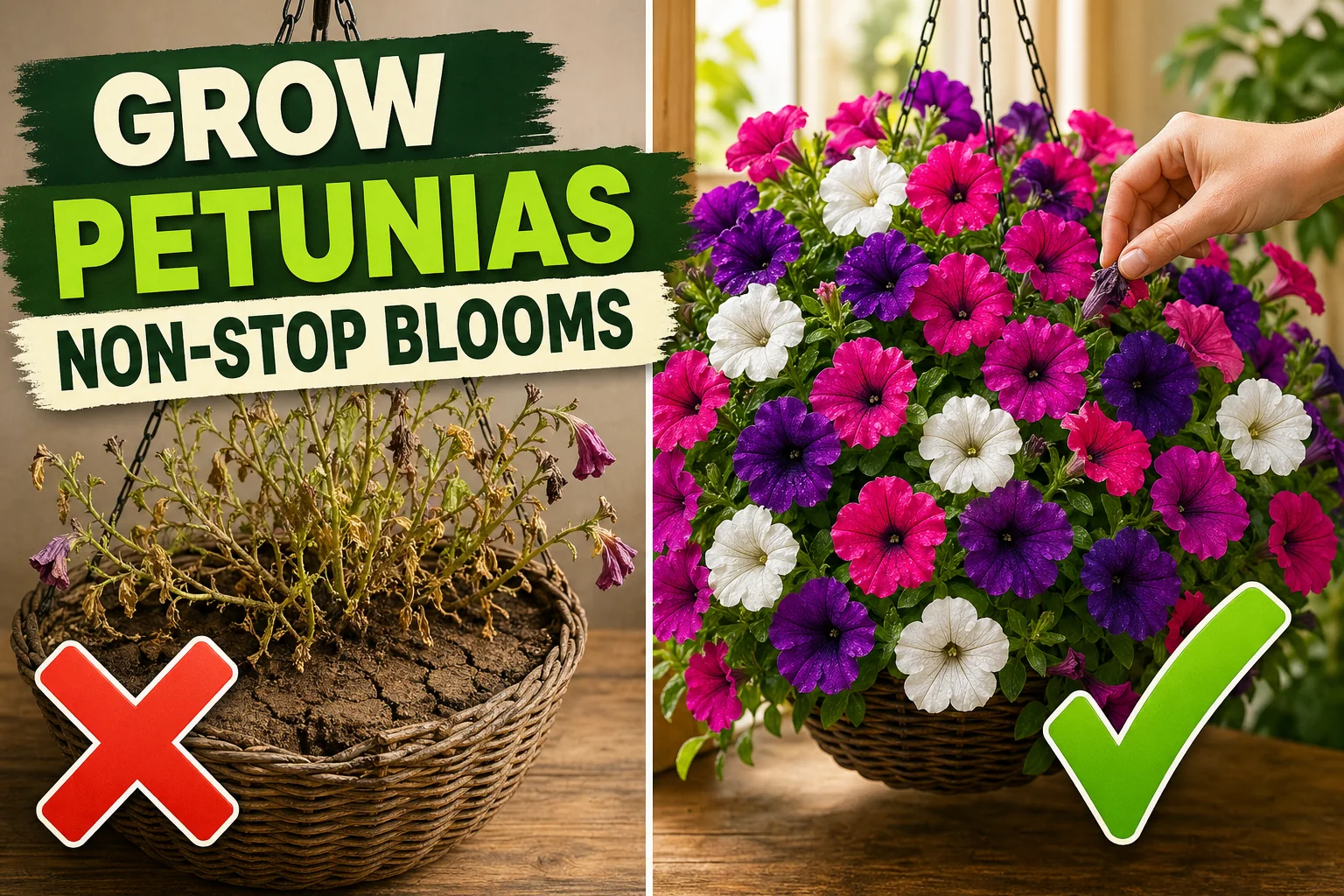
Grow petunias that spill out of hanging baskets and bloom non-stop until frost. Sun, soil, watering, deadheading, and feeding — the full guide for huge color all summer.
On this page
- Quick answer
- Meet the petunia (and pick the right variety)
- What you’ll need
- Step-by-step: planting petunias
- Care after planting
- Deadheading: the secret to non-stop blooms
- How to fix a leggy petunia mid-summer
- Common mistakes to avoid
- Troubleshooting
- Watch: growing petunias in hanging baskets
- Related reading
- A note on conditions
Watch the visual walkthrough
How to Grow Petunias from Seed (A Step by Step Guide for Novices and Experienced Growers) #76
A short visual walkthrough that pairs with the steps above.
Petunias are the reliable workhorse of the summer flower garden — give them sun, food, water, and a weekly pinch, and they’ll spill out of a hanging basket in pink, purple, white, and magenta until the first frost.
This guide walks through everything: picking the right variety, planting depth and spacing, watering and fertilizing, deadheading, and how to revive a tired basket mid-season.
Quick answer
Plant petunias in full sun (6+ hours) in a peat-free potting mix with drainage, spaced 25–30 cm (10–12 in) apart. Water when the top 2 cm (0.75 in) of soil is dry, feed weekly with a balanced flower fertilizer, and pinch off spent flowers and any leggy stems. You’ll get non-stop blooms from late spring through the first hard frost.
Meet the petunia (and pick the right variety)
Petunias (Petunia × hybrida) are tender perennials grown as annuals across most of the US and Europe. They come in four loose styles, and choosing the right one matters more than any other care decision:
- Grandiflora — biggest flowers (10–13 cm / 4–5 in), but flop in rain. Best in covered patios.
- Multiflora — smaller flowers, many more of them. Tougher in wet weather, great for beds.
- Wave / Easy Wave / Supertunia — vigorous trailing types bred to spread up to 90 cm (3 ft) and self-clean their spent flowers. The hands-down winner for hanging baskets.
- Milliflora — tiny 2.5 cm (1 in) flowers on compact plants. Edge of pots and small containers.
If you want a non-stop hanging-basket “bloom machine,” buy a Wave or Supertunia. They cost a couple of dollars more per plant and save you hours of deadheading.
What you’ll need
- 3–5 healthy petunia starts (look for stocky plants with buds, no yellow leaves)
- A hanging basket at least 30 cm (12 in) wide with drainage holes — or a 25 cm (10 in) wide pot per plant
- Peat-free outdoor potting mix (the lighter the better — heavy garden soil rots roots)
- A water-soluble flower fertilizer with phosphorus (10-10-10, 15-30-15, or similar)
- Watering can or hose with a soft shower head
- Sharp scissors or pinch fingers for deadheading
You don’t need rooting hormone, grow lights, or a greenhouse. Petunias are bedding plants — they’re built to be planted and left to bloom.
Step-by-step: planting petunias
1. Wait for warm soil
Petunias are frost-tender. Don’t plant outside until your last frost date has passed and overnight lows are reliably above 10°C (50°F). Cold soil stalls them for weeks even if they don’t visibly damage.
In the US that’s roughly mid-April in zones 8–9, mid-May in zones 5–7, and early June in zones 3–4.
2. Prep the basket or pot
Fill your basket with peat-free outdoor potting mix to about 3 cm (1 in) below the rim. Tap it once on a hard surface to settle — don’t pack it down. Roots need air pockets.
For hanging baskets, mix a slow-release flower fertilizer granule into the top 5 cm (2 in) of soil before planting. It feeds the plant for 6–8 weeks, taking the pressure off you.
3. Space the plants right
For a 30 cm (12 in) basket: 3 plants. For a 35–40 cm (14–16 in) basket: 4–5 plants. In the ground, space petunias 25–30 cm (10–12 in) apart in every direction.
It looks sparse on day one. By week three you won’t see the soil anymore.
4. Plant at the same depth they came in
Pop each start out of its cell, gently tease the bottom roots if they’re circling the pot, and set it in a hole at the same depth it grew in the nursery pot. Burying the stem deeper leads to rot.
Place trailing varieties at the rim of the basket so they can spill over the edge. Put any upright varieties in the center.
5. Water them in
Water slowly until you see drips from the drainage holes. This first watering closes air gaps and tells the roots it’s safe to spread.
After this, let the top 2 cm (0.75 in) of soil dry between waterings. In a sunny basket that usually means once a day in summer; sometimes twice on a 32°C (90°F) heatwave day. For a deeper look at petunia-specific watering cues across seasons, see our guide on how frequently petunias need water.
6. Hang it in full sun
Petunias bloom hardest in 6+ hours of direct sun. Morning sun + afternoon sun is best. They’ll tolerate a half-day of sun, but you’ll get fewer flowers and longer leggy stems.
If your only spot gets 2–4 hours of sun, switch to impatiens or begonias instead — they’re built for shade.
Care after planting
Once they’re rooted (about 10–14 days after planting), petunias settle into a simple weekly rhythm:
| Task | When |
|---|---|
| Water | When the top 2 cm (0.75 in) of soil is dry — usually daily for hanging baskets in summer |
| Feed | Half-strength water-soluble flower fertilizer once a week, or full strength every 2 weeks |
| Deadhead | Pinch off spent flowers and any seed pods every 2–3 days |
| Pinch back | Trim any stem longer than 30 cm (12 in) by one third in mid-summer |
A free plant care app like Tazart can hold the watering schedule and fertilizer reminders for you, adjust them for your local heatwave forecast, and ping you on Apple Watch — handy when you’ve got more than two baskets going.
Deadheading: the secret to non-stop blooms
A petunia’s only goal is to make seed. Once a flower fades and starts forming a green seed pod, the plant slows new flower production. Pinch the spent bloom plus the little green pod behind it between your fingers and pop it off.
Two minutes per basket, every two or three days, doubles the bloom count over the season. With self-cleaning Wave and Supertunia varieties, you can skip the deadhead and just pinch off the seed pods every 7–10 days — they handle the rest.
How to fix a leggy petunia mid-summer
By July most petunias look like they’ve quit — long bare stems, few flowers, color only at the very tips. This is normal. The fix is dramatic but works every time:
- Cut the entire plant back by one third with scissors. Yes, the flowering tips too.
- Water deeply.
- Feed once with a half-strength balanced fertilizer.
- Wait 10–14 days.
You’ll get a fresh flush of leaves first, then a wave of flowers that lasts another month. Repeat in late August if needed.
Common mistakes to avoid
- Planting in shade. Petunias in less than 4 hours of sun will bloom poorly and stretch. Pick the variety to match your light, not the other way around.
- Skipping fertilizer. Petunias are heavy feeders. Without weekly food, they slow down by July and don’t recover.
- Watering on a fixed schedule. Hanging baskets in full sun in July might need water twice a day; the same basket in May needs it every other day. Always check the soil first.
- Not deadheading. Spent flowers and seed pods tell the plant to stop blooming. Pinch them off.
- Heavy garden soil in containers. Petunias rot in dense soil. Use a peat-free outdoor potting mix.
- Planting too early. Cold soil below 10°C (50°F) stalls them for weeks even without a frost.
Troubleshooting
| Symptom | Likely cause | Fix |
|---|---|---|
| Long bare stems with flowers only at the tips | No pinching, leggy mid-summer growth | Cut back by one third, water, feed once |
| Yellow leaves all over | Iron deficiency or overwatering | Feed with iron-fortified fertilizer; let soil dry between waterings |
| Few flowers, lots of green leaves | Too much nitrogen or not enough sun | Switch to a phosphorus-heavy bloom fertilizer (15-30-15); move to brighter spot |
| Sticky leaves and curling new growth | Aphids | Spray off with a strong jet of water, repeat in 3 days; insecticidal soap if persistent |
| Brown mushy stems near soil | Crown rot from wet soil | Cut out infected stems; let soil dry; reduce watering frequency |
| Tiny green caterpillars chewing buds | Tobacco budworm | Hand-pick at dusk; spray Bt (Bacillus thuringiensis) every 7 days |
| Flowers shut after rain or hose | Normal — just water-damaged petals | Snip off; new buds open within 24–48 hours |
Watch: growing petunias in hanging baskets
A short visual walkthrough pairs well with the steps above. If you’re a visual learner, watch a tutorial like How to Grow Petunias in Hanging Baskets on YouTube and then come back to follow the timing in this guide.
Related reading
- How to grow zinnias from seed for cutting bouquets — the same “feed weekly + deadhead” rule turns zinnias into a cut-and-come-again machine.
- Impatiens plant care for shade pots and beds — the right pick if your spot only gets a few hours of sun a day.
- How to plant nasturtium seeds for trailing summer color — another full-sun trailing flower that mixes well with petunias.
- Track watering, fertilizer, and deadhead reminders for every basket with the free Tazart plant care app.
A note on conditions
Every garden is different. Light, basket size, soil mix, season, humidity, and your local weather all change how fast a petunia grows and how often it needs water and food. Use the steps above as a starting point and adjust based on what your plants actually do in week two — that’s how every good gardener learns.
Highly recommended
The supplies that make this guide work

Tazart is an Amazon Associate — we earn from qualifying purchases at no extra cost to you. Thank you for helping us keep these guides free.
Frequently asked questions
How do you grow petunias?
Plant petunias in full sun (6+ hours), in a peat-free potting mix with drainage, spaced 25–30 cm (10–12 in) apart. Water when the top 2 cm (0.75 in) of soil is dry, feed weekly with a balanced flower fertilizer once they're rooted, and pinch off spent flowers every few days. They'll bloom from late spring until the first hard frost.
Do petunias need full sun?
Yes. Petunias bloom heaviest with 6+ hours of direct sun per day. They'll tolerate a half-day of sun, but with less light you'll get long leggy stems and few flowers. South- and west-facing balconies or beds are ideal.
How often should I water petunias?
Hanging baskets in full sun usually need water once a day in summer, sometimes twice in heatwaves above 32°C (90°F). Garden-bed petunias get watered every 2–4 days. Always check the top 2 cm (0.75 in) of soil first — water when it's dry, not on a fixed schedule.
Do I need to deadhead petunias?
Most older varieties yes, modern self-cleaning ones (Wave, Supertunia, Easy Wave) no. Even with self-cleaners, a quick weekly pinch of spent flowers and any seed pods keeps the plant pumping out new blooms instead of redirecting energy into seed production.
Why are my petunias leggy?
Three usual causes: not enough sun, no fertilizer, or no pinching. By midsummer, even healthy petunias get long bare stems. Cut everything back by one third with scissors, water well, feed once, and you'll have a fresh flush of flowers in 10–14 days.
What is the best fertilizer for petunias?
Petunias are heavy feeders. Use a balanced or bloom-boosting water-soluble flower fertilizer (something like 10-10-10 or 15-30-15) at half strength once a week, or a slow-release granular at planting plus liquid feed every 2 weeks. Iron-rich formulas help yellowing leaves.
Are petunias annuals or perennials?
In most US and European climates, petunias are grown as annuals — they're killed by the first hard frost. Technically they are tender perennials hardy in USDA zones 10–11, so in frost-free climates a single plant can bloom for years if cut back.