Edible
How to Grow Passion Fruit at Home (Full Guide)
Learn how to grow passion fruit at home — zones, variety types, seeds vs cuttings, trellis setup, hand pollination, and when to harvest. First fruit in 12–18 months.

On this page
- Quick answer
- Which variety should you grow?
- Can you grow passion fruit in Zone 8 or colder?
- Seeds vs cuttings: which is faster?
- Container vs in-ground growing
- Building the right trellis
- Soil, sun, and position
- Watering passion fruit
- Feeding your passion fruit vine
- Hand pollination: why and how
- Pruning and training
- Harvesting passion fruit
- Watch: growing passion fruit at home
- Common problems and fixes
- How long before the first harvest?
- Related reading
- A note on conditions
Watch the visual walkthrough
5 Tips How To Grow a Ton of Passionfruit From ONE Passion Fruit!
In this video, I give you my 5 top tips on how to grow a ton of passionfruit all from just one passion fruit! Order my book here: ...
Passion fruit (Passiflora edulis) is one of the most rewarding fruiting vines you can grow at home — fragrant flowers, fast growth, and exotic fruit that costs a fortune in supermarkets. The trade-off is patience: expect 12 to 18 months from seed to your first harvest, and a trellis tall enough to take a vine that can easily reach 6 m (20 ft) in a single season.
Done right, one vine fills a pergola and fruits for years. This guide covers everything from choosing the right variety to hand-pollinating flowers and knowing the exact moment to harvest.
Quick answer
Grow passion fruit in USDA Zones 9–11 outdoors, or in a large container (40–50 L / 10–13 gal) elsewhere. Start seeds or cuttings in well-drained soil in full sun. Build a sturdy trellis before you plant — vines reach 6 m (20 ft) in year one. Water deeply and feed with a high-potassium fertiliser every 6–8 weeks during the growing season. Hand-pollinate if bees are scarce. Harvest when fruit drops or skin wrinkles — not before. First fruit arrives 12–18 months from seed.
Which variety should you grow?
There are three varieties commonly grown at home, and the right choice depends on your climate and how you intend to use the fruit.
| Variety | Latin name | Hardiness | Pollination | Fruit notes |
|---|---|---|---|---|
| Purple passion fruit | Passiflora edulis | Zones 9–11; light frost tolerance to −2°C (28°F) | Largely self-fertile | Sweet, aromatic, most popular for home growing |
| Yellow passion fruit | P. edulis f. flavicarpa | Zones 10–12; strictly tropical | Needs cross-pollination | Larger fruit, sharper flavour, higher juice yield |
| Sweet granadilla | Passiflora ligularis | High-altitude tropics (mild, not hot) | Needs cross-pollination | Mild, jelly-like pulp, orange skin when ripe |
For most home growers outside the tropics, purple passion fruit is the right pick. It is the most cold-tolerant, largely self-fertile, and tastes excellent fresh or juiced. Yellow passion fruit thrives in Florida, Hawaii, and tropical Asia but sulks in anything below Zone 10.
If you live below Zone 9, grow purple passion fruit in a container that spends summer on a sunny patio and overwinters in a bright indoor space above 7°C (45°F).
Can you grow passion fruit in Zone 8 or colder?
Zone 8 is marginal. Purple passion fruit can survive there if roots are mulched 15 cm (6 in) deep, the vine grows against a south-facing masonry wall, and fleece covers it on nights below −1°C (30°F). The vine may die back to the ground and re-sprout from roots in spring. Below Zone 8, containers and indoor overwintering are the only reliable route.
Seeds vs cuttings: which is faster?
Starting from seed
Seed-grown vines take 12 to 18 months to fruit but seed is cheap.
If you’re planning a tropical fruit corner alongside passion fruit, the banana tree planting guide covers a companion plant that thrives in the same warm, sheltered, frost-free microclimate and creates natural windbreak for the passion fruit vine.
- Scoop pulp and seed from a ripe passion fruit. Rinse and dry for 24 hours.
- Sow 6 mm (¼ in) deep in moist seed-starting mix at 20–25°C (68–77°F) under a humidity dome.
- Germination takes 2 to 4 weeks — sometimes up to 8 weeks. Do not discard the tray early.
- Pot up into 10 cm (4 in) pots at 3–4 true leaves.
- Transplant when the vine reaches 30 cm (12 in) and nights stay above 10°C (50°F).
Use fresh seed from a fruit you just opened — old or dried seed germinates poorly.
Starting from cuttings
Cuttings root faster and generally fruit 6 to 12 months after planting — half the wait of seed.
- Take a 20–30 cm (8–12 in) semi-hardwood cutting with 2–3 nodes in late spring or early summer.
- Remove lower leaves, leaving 2–3 leaves at the tip.
- Dip the cut end in rooting hormone powder.
- Insert into a 50:50 mix of coarse perlite and peat-free potting mix.
- Cover loosely with a clear plastic bag to hold humidity.
- Roots develop in 3 to 5 weeks at 22–26°C (72–79°F).
- Pot up once roots are 3–5 cm (1–2 in) long and visible through the drainage holes.
Cuttings also preserve the genetics of a productive parent vine — useful if you have a neighbour with a heavy-fruiting plant.
Container vs in-ground growing
In the ground (Zones 9–11)
In-ground passion fruit grows fastest and fruits most heavily. Plant in spring after the last frost, in a spot with at least 6–8 hours of direct sun.
- Dig a hole twice the width of the root ball and the same depth
- Mix in a generous amount of compost or aged manure
- Space multiple vines at least 3 m (10 ft) apart — they spread wide
- Stake or tie immediately so the young vine finds its support
In a container (colder climates)
Container growing works well but requires a large pot. The minimum for a fruiting vine is 40–50 L (10–13 gal). Smaller pots restrict roots and the vine grows vigorously without ever setting fruit — a very common frustration.
Use a well-draining mix:
- 60% quality potting mix
- 25% coarse perlite or horticultural grit
- 15% compost
Repot every 2 years as the vine becomes root-bound. In winter, move the container to a bright frost-free space — a conservatory, heated greenhouse, or south-facing porch is ideal.
Building the right trellis
This step is non-negotiable. A passion fruit vine without a robust trellis becomes a tangled, unproductive mess.
Minimum spec:
- Height: at least 1.8 m (6 ft); 2.4 m (8 ft) is better
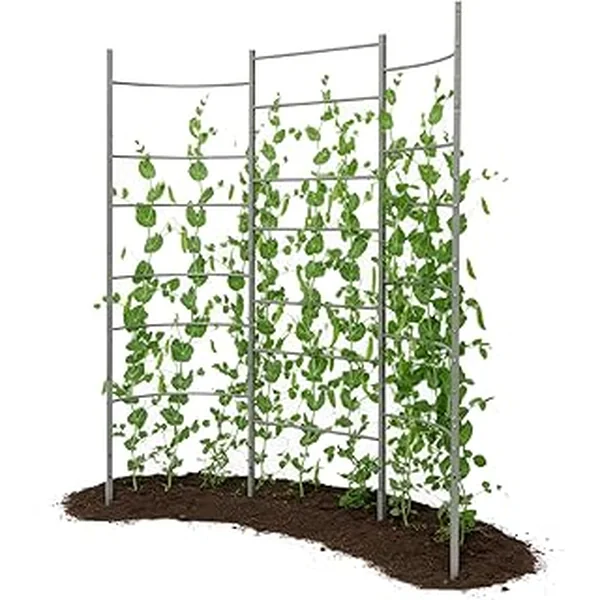
- Horizontal wires or mesh spaced 30 cm (12 in) apart — the vine climbs by tendrils that need horizontal wires to grip
- Post anchoring: timber or metal posts set at least 60 cm (24 in) in the ground, or bolted into a wall
- Load capacity: a mature vine in full fruit weighs more than you expect — build stronger than you think you need
Common trellis styles: a post-and-wire fence (two or three stout posts, four to five horizontal wires), a pergola or archway (the vine covers it completely and fruits hang dramatically), or a wall trellis fan-trained against a sunny masonry wall in marginal climates.
Install the trellis before you plant. Retrofitting a trellis around an established vine damages tendrils and stems.
Soil, sun, and position
Sun: Passion fruit demands full sun — at least 6 hours of direct sunlight per day. A shaded vine will grow but flower sparingly and fruit poorly. South or west-facing walls and fences are ideal.
Soil: Well-drained is essential. Passion fruit tolerates a range of soils — sandy loam, clay-loam — but will not survive waterlogged roots. Aim for pH 6.0–6.5. If your soil drains poorly, raise the planting bed by 20–30 cm (8–12 in) or grow in a container.
Shelter: Strong wind strips flowers before they are pollinated. A sheltered south-facing wall or fence provides ideal conditions.
Watering passion fruit
Passion fruit is thirsty during growth and flowering but hates wet soil.
- Newly planted: water deeply every 2–3 days for the first 4 weeks
- Spring–summer: water when the top 5 cm (2 in) of soil is dry — roughly every 3–5 days
- Winter: reduce significantly; cold wet soil causes root rot
- Container: check daily; pots dry faster than ground
Deep, infrequent watering beats daily shallow splashing.
Feeding your passion fruit vine
A well-fed vine flowers and fruits far more heavily than a neglected one.
| Growth stage | Feed | Frequency |
|---|---|---|
| First 8 weeks after planting | Balanced NPK (e.g. 10-10-10) | Every 4 weeks |
| Actively growing vine | High-nitrogen liquid feed | Every 4 weeks |
| Pre-flowering and fruiting | High-potassium granules or liquid | Every 6–8 weeks |
| Winter / dormancy | None | — |
Once the vine is established, too much nitrogen pushes leafy growth at the expense of flowers. Switch to a high-potassium feed when flower buds appear. For containers, liquid feeds applied to damp (not dry) soil are easier to control than granules.
Hand pollination: why and how
In a garden busy with bees, passion fruit pollinates itself naturally. In urban gardens, indoor settings, or early in the season before bee numbers build, hand pollination dramatically improves fruit set.
The flowers open for one day only. In humid or cool conditions the style may not curl far enough to bring pollen into contact with the stigma — that’s where you step in.
How to hand-pollinate:
- Check flowers mid-morning to midday when pollen is most available
- Use a soft paintbrush or cotton swab to collect yellow pollen from the anthers
- Dab it onto the three stigma tips of the same or a different flower
- Repeat across several flowers
The base of a pollinated flower swells into a round green fruit within 3 to 5 days. Unpollinated flowers drop within 24 hours.
For yellow passion fruit you must have two plants — or borrow a flowering stem from a neighbour — to enable cross-pollination.
Pruning and training
Train the main stem up the trellis in year one and encourage side shoots to fan out along horizontal wires. After the first fruiting season, cut back spent fruiting stems by one-third — passion fruit fruits on new growth, so this pruning triggers the fresh stems that carry next year’s crop. Remove dead or crossing stems any time. Container vines can be cut back to 60–90 cm (24–36 in) of framework to keep them manageable.
Harvesting passion fruit
Patience pays off at harvest. The single most common mistake is picking passion fruit too early.
Purple passion fruit: skin turns deep purple or dark burgundy, fruit drops or pulls away with no effort.
Yellow passion fruit: skin is fully yellow with no green patches, fruit pulls off without resistance.
Pick up fallen fruit daily — it is not spoiled. Skin wrinkles within 3 to 5 days after harvest, concentrating sweetness and aroma. Store at room temperature for 5 days or refrigerate for up to 2 weeks.
Watch: growing passion fruit at home
Search YouTube for “5 Tips How To Grow a Ton of Passionfruit From ONE Passion Fruit” for a visual walkthrough of vine training, hand pollination, and harvest that pairs well with this guide.
Common problems and fixes
| Symptom | Likely cause | Fix |
|---|---|---|
| Vine grows fast but no flowers | Too much nitrogen; insufficient sun; pot too small | Switch to high-K feed, move to full sun, repot into 40–50 L (10–13 gal) pot |
| Flowers drop before setting fruit | Poor pollination; temperature above 38°C (100°F); drought stress | Hand-pollinate daily; shade briefly in extreme heat; water consistently |
| Yellow leaves overall | Nitrogen deficiency or waterlogged roots | Feed with balanced NPK; check drainage; reduce watering if soil stays soggy |
| Yellow patches between veins | Iron deficiency in alkaline soil | Check soil pH; adjust to 6.0–6.5 with acidifying fertiliser |
| Small brown spots on leaves | Alternaria or Phytophthora leaf spot | Improve airflow; avoid wetting foliage; remove infected leaves; apply copper-based fungicide if severe |
| Fruit turns yellow early (purple variety) | Fruit fly damage or premature ripening from heat stress | Use fruit fly traps; harvest promptly as fruit begins to colour |
| Vine dies back suddenly | Hard frost; Phytophthora root rot in wet soil | For frost, mulch and hope for root regrowth; for root rot, improve drainage and reduce watering |
How long before the first harvest?
| Starting method | Time to first fruit |
|---|---|
| Seed (direct-sown at home) | 12–18 months |
| Cutting (semi-hardwood) | 6–12 months |
| Grafted or nursery plant | 6–12 months |
These timelines assume full sun, consistent feeding, and a proper trellis. Shade, a small pot, or poor drainage can each add months. Once fruiting begins, expect 2 to 4 flushes per year, heaviest in late summer to autumn.
Related reading
- How to plant grape vines the right way — same post-and-wire trellis system and annual pruning strategy applies.
- How to grow blueberries in pots — pairs well with a container passion fruit on the same sunny terrace.
- How to grow ginger indoors — another tropical edible that thrives indoors with the right pot and feeding routine.
- Track watering and feeding automatically with the free Tazart plant care app — set a hand-pollination reminder and a watering alert for your local conditions.
A note on conditions
Every garden is different. Sunlight hours, local frost risk, container size, soil drainage, your summer temperatures, and the bee population in your area all affect how quickly your passion fruit vine fruits and how heavy the harvest is. Use this guide as a framework, then adapt based on what your vine actually does in its first summer. The best passion fruit growers watch their vines closely and adjust feeding and watering as the season changes.
Highly recommended
The supplies that make this guide work
Tazart is an Amazon Associate — we earn from qualifying purchases at no extra cost to you. Thank you for helping us keep these guides free.
Frequently asked questions
How long does passion fruit take to produce fruit?
Expect your first harvest 12 to 18 months after planting from seed, or 6 to 12 months from a cutting or grafted plant. Vines started from seed take longer because they spend their first season building a root system before diverting energy into flowers and fruit. Once a vine begins fruiting it will produce for 5 to 7 years before productivity declines.
Can you grow passion fruit in a pot indoors?
Yes, but the pot must be large — at least 40–50 L (10–13 gal) — and placed in a south or west-facing window with as much direct sun as possible. Outdoors on a warm balcony works far better. Indoors, low light causes vines to grow vigorously without ever flowering. If your climate is below Zone 9, grow in a container that moves outside in summer and overwinters under glass.
Do passion fruit vines need hand pollination?
It depends on your variety. Purple passion fruit (Passiflora edulis) is largely self-fertile but benefits from cross-pollination. Yellow passion fruit (P. edulis f. flavicarpa) requires a second plant for cross-pollination to set fruit reliably. In gardens with few bees, hand-pollinate by using a soft paintbrush or cotton swab to transfer pollen from the anthers of one flower to the stigma of another — do this at midday when flowers are fully open.
What trellis is best for passion fruit?
A sturdy horizontal wire system or rigid wooden trellis panel at least 1.8 m (6 ft) tall is ideal. Passion fruit clings with tendrils, so the support needs horizontal wires or mesh for the tendrils to wrap around. Space horizontal wires 30 cm (12 in) apart. The structure must be strong enough to hold the weight of a mature vine plus fruit in wind — a bamboo cane pushed into a pot is not adequate.
How do you know when passion fruit is ready to harvest?
Purple passion fruit is ready when the skin changes from green to deep purple or burgundy, and the fruit falls or pulls off easily from the vine — or simply drops to the ground. Yellow passion fruit turns bright yellow when ripe. Ripe fruit wrinkles slightly within 3 to 5 days of falling; that wrinkling is normal and actually concentrates the flavour. Never pick passion fruit green — it will not ripen off the vine.
What is the difference between purple and yellow passion fruit?
Purple passion fruit (Passiflora edulis) is the most widely grown home variety — it tolerates cooler conditions, is largely self-fertile, and has sweet, aromatic pulp. Yellow passion fruit (P. edulis f. flavicarpa) grows vigorously in hot, humid tropical conditions, produces a larger fruit, has sharper flavour, and needs cross-pollination. Sweet granadilla (Passiflora ligularis) is a third type grown in high-altitude tropics — mild, sweet, and orange-skinned.
Does passion fruit grow in cold climates?
Passion fruit is truly cold-sensitive. Purple varieties are hardiest, surviving light frost down to about -2°C (28°F) for short periods if the roots are mulched heavily. Zone 8 gardeners can try purple passion fruit with heavy mulching and wall protection. Below Zone 8, grow in a container that spends summer outdoors and overwinters in a bright conservatory or greenhouse. Yellow passion fruit is strictly tropical and does not survive frost at all.