Edible
How to Grow Lemongrass Indoors (Complete Guide)
Grow lemongrass indoors from grocery store stalks in a wide pot. Covers rooting, soil, light, warmth, watering, fertilizing, harvest, and winter care.
On this page
- Quick answer
- Why grow lemongrass indoors?
- Table of contents
- Starting from grocery store stalks
- Choosing the right pot
- Soil mix
- Light requirements
- Temperature and warmth
- Watering
- Fertilizing
- How to harvest lemongrass
- Winter care
- Common mistakes
- Troubleshooting
- Watch: how to grow lemongrass indoors
- Practical checklist
- Related reading
- A note on conditions
Watch the visual walkthrough
5 Tips How to Grow a Ton of Lemongrass at Home
In this video, I give you my 5 top tips on how to grow lemongrass at home. But not just "some" lemongrass a LOT, in fact, a TON of ...
Lemongrass (Cymbopogon citratus) is one of the easiest tropical herbs to start from scratch — because you can pull the starter plants straight off the grocery store shelf. Fresh stalks sold for cooking will root in a glass of water in under three weeks, and a single bundle of lemongrass from the supermarket can start four to eight thriving plants for free.
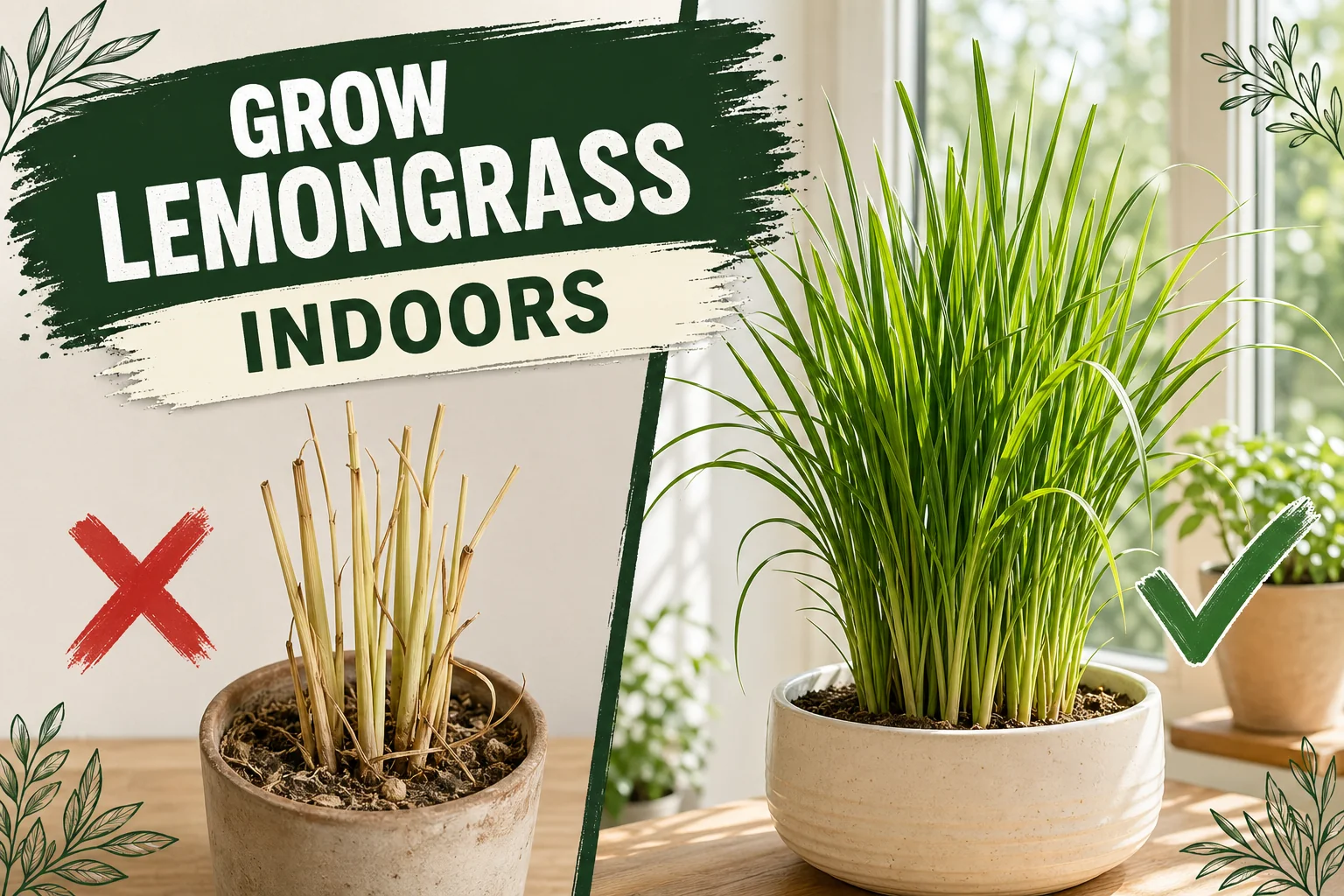
Indoors, lemongrass grows into a wide spreading clump of thick, aromatic stalks that you can harvest throughout the year. The main requirements are simple: a wide pot, a hot bright window, and consistent warmth. Get those three right and the plant essentially looks after itself.
Quick answer
Root fresh grocery store lemongrass stalks in water for 1–3 weeks, then pot them up in a wide 20–25 cm (8–10 in) container filled with a mix of potting soil and perlite. Place it in your sunniest window with 6+ hours of direct sun, keep the room at 24–29°C (75–85°F), water when the top 3 cm (1 in) of soil is dry, and harvest outer stalks at the base once they are 1 cm (0.5 in) thick.
Why grow lemongrass indoors?
Lemongrass is a staple in Thai, Vietnamese, and Indonesian cooking, and it is notoriously expensive and limp by the time it reaches most supermarkets. Growing your own indoors gives you stalks that are fresher, thicker, and far more aromatic than anything that ships across the country in a plastic clamshell.
It is also an aggressive grower that rewards minimal care. Once a clump establishes itself in a wide container, it pushes out new stalks from the center continuously — you can harvest, and it fills back in within weeks.
Table of contents
- Starting from grocery store stalks
- Choosing the right pot
- Soil mix
- Light requirements
- Temperature and warmth
- Watering
- Fertilizing
- How to harvest lemongrass
- Winter care
- Common mistakes
- Troubleshooting
- FAQs
Starting from grocery store stalks
The cheapest and most reliable way to start lemongrass indoors is from fresh stalks bought at an Asian grocery store, a farmers market, or the herb section of most large supermarkets. Avoid pre-trimmed stumps — you need the pale bulb base intact for rooting to work.
What to look for:
- Firm stalks with a pale green-to-white base
- No signs of mold or mush at the cut end
- At least 5–8 cm (2–3 in) of bulb base visible
Rooting steps:
- Strip off any dry papery outer leaves from the lower 10 cm (4 in) of each stalk.
- Trim the tops down to about 30 cm (12 in) to reduce the amount of leaf the stalk needs to support while rooting.
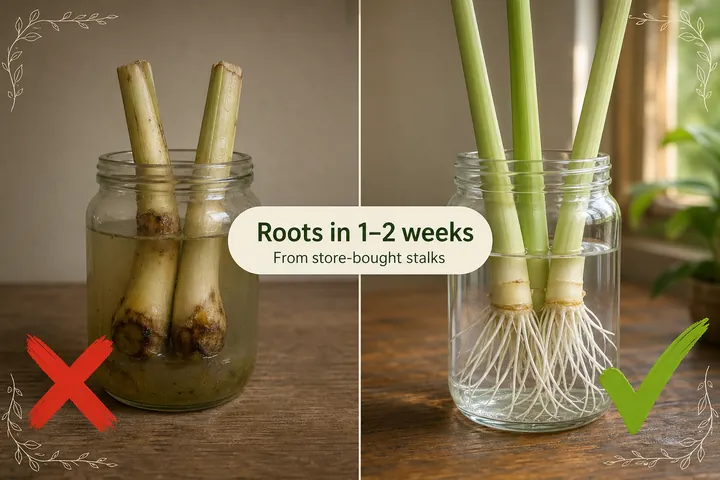
- Stand 4–6 stalks in a clean glass or jar. Add enough water to submerge the base 5–8 cm (2–3 in) — keep the green part above water.
- Place in a warm spot — 24–29°C (75–85°F) — with good bright light. A windowsill is ideal.
- Change the water every 2 days so it stays fresh and well-oxygenated.
- Check the base after 7 days. Tiny white roots usually appear within 1–3 weeks.
Once roots are 2–4 cm (0.75–1.5 in) long, the stalks are ready to pot up. Do not wait for long tangled roots — shorter roots settle into soil faster.
One bundle of 6–8 grocery store stalks typically produces 4–8 rooted plants. Pot them up in pairs or clusters of 3 — lemongrass clumps naturally and the grouping looks fuller faster.
Choosing the right pot
Pot size matters more for lemongrass than for most herbs. The plant spreads outward as the clump grows, and a pot that is too narrow forces the roots to circle, slows growth, and means you will need to water every day in summer.
Recommended sizes:
- Starting out: 20–25 cm (8–10 in) wide for a cluster of 3–4 rooted stalks
- Established clump: 30–40 cm (12–16 in) wide once the plant fills in after 4–6 months
Width is more important than depth — lemongrass roots spread shallow and wide rather than deep.
Best pot materials:
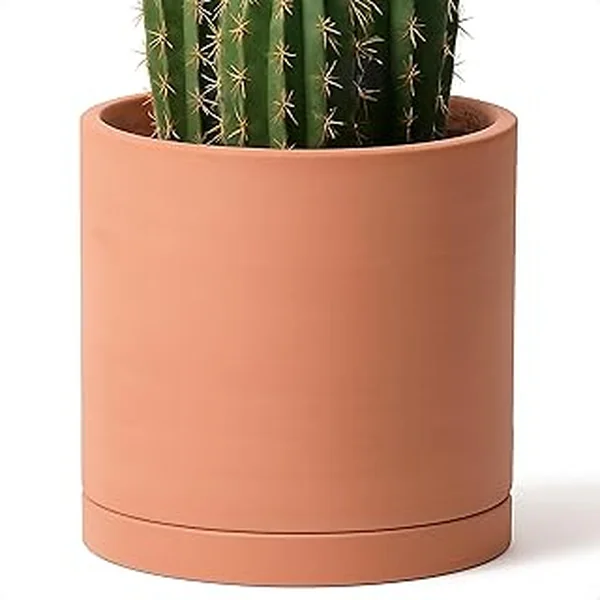
- Terracotta: breathes well, reduces overwatering risk, heavy enough to prevent toppling
- Glazed ceramic: retains moisture a little longer, looks clean on a windowsill — fine if you are careful with watering
- Plastic: light and cheap, but lemongrass can get top-heavy and tip over
Drainage holes are non-negotiable. Lemongrass sitting in waterlogged soil will rot at the base within weeks.
Soil mix
Lemongrass wants a mix that drains quickly while still holding enough moisture to support its active growth. The two-part formula below works well in most indoor conditions:
- 2 parts all-purpose potting mix (peat-free preferred)
- 1 part coarse horticultural perlite
The perlite prevents compaction and keeps the root zone well-aerated even when watered frequently. Skip garden soil — it compacts in containers and creates drainage problems.
If you have it, a small amount of slow-release granular fertilizer worked into the bottom third of the mix at potting time gives new plants an easy start without needing liquid feed for the first 6–8 weeks.
Light requirements
Lemongrass is a full-sun tropical grass. This is not a plant that tolerates dim corners or shaded shelves. Indoors, it needs a minimum of 6 hours of direct sun per day — ideally 8 hours.
Best window positions:
- South-facing window in the northern hemisphere (best option)
- West-facing window (good afternoon sun)
- East-facing window (morning sun only — may be marginal in winter)
When natural light is not enough:
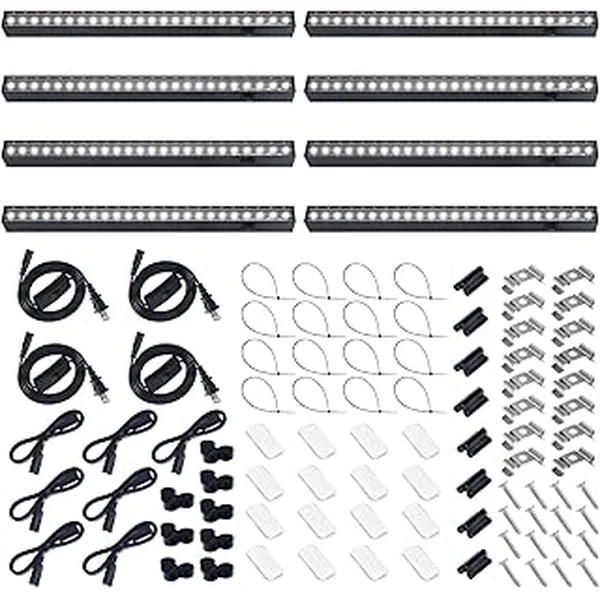
In winter, or in rooms that do not have a south- or west-facing window, natural light alone will not keep lemongrass productive. The stalks will stay thin, pale, and weak. The fix is a full-spectrum LED grow light bar:
- Position the bar 25–30 cm (10–12 in) above the tops of the plant
- Run on a 12-hour timer (e.g. 7 a.m. to 7 p.m.)
- Raise it as the plant grows to maintain the same distance
Under a good grow light, lemongrass produces stalks that are nearly indistinguishable from outdoor summer growth — thick, fragrant, and deeply colored at the base.
Temperature and warmth
Lemongrass is native to tropical Asia and is built for heat. Indoors, the sweet spot is 24–29°C (75–85°F). It grows actively within this range and slows noticeably below 18°C (65°F).
Key temperature rules:
- Below 10°C (50°F): the plant dies back rapidly — never expose it to cold drafts or unheated rooms in winter
- 10–18°C (50–65°F): near-dormant, very slow growth, reduce watering significantly
- 18–24°C (65–75°F): steady moderate growth
- 24–29°C (75–85°F): full active growth, fastest stalk production
Keep the pot away from cold windowpanes in winter — the glass surface can be significantly colder than the room air temperature and will chill the roots if the pot sits directly against it. Move the pot a few centimeters (an inch or two) back from the glass on cold nights, or use a cork mat or saucer as insulation underneath.
Watering
Lemongrass is not drought-tolerant, but it will rot fast in soggy soil. The right approach is to water deeply and then wait until the soil has partially dried out before watering again.
How to water:
Press a finger 3 cm (1 in) into the soil. If it feels dry, water slowly until water drips freely from the drainage holes. If it still feels cool and damp, wait another day and check again.
Approximate frequency (use as a starting point — adjust to your conditions):
| Season | Typical frequency |
|---|---|
| Spring–summer (active growth) | Every 4–6 days |
| Fall (slowing down) | Every 7–9 days |
| Winter (near-dormant indoors) | Every 10–14 days |
Warning signs:
- Leaf tips browning and curling: often underwatering or very dry indoor air — water more frequently and consider a humidity tray
- Base of stalks turning soft or brown: overwatering or poor drainage — let the soil dry out fully, check drainage holes are clear
- Pale yellowing from the base up: often sitting in water — check the saucer is not holding standing water
Fertilizing
Lemongrass is a heavy feeder compared to most herbs. Without regular nutrients, a container-grown plant exhausts the potting mix within a few months and the stalks become thin and pale.
Feeding schedule:
- Spring–summer (active growth): feed every 4–6 weeks with a balanced slow-release granular fertilizer, or every 3–4 weeks with a half-strength balanced liquid fertilizer
- Autumn: feed once in early autumn, then stop
- Winter: no feeding — the plant is not actively growing and unused fertilizer builds up as salt in the soil
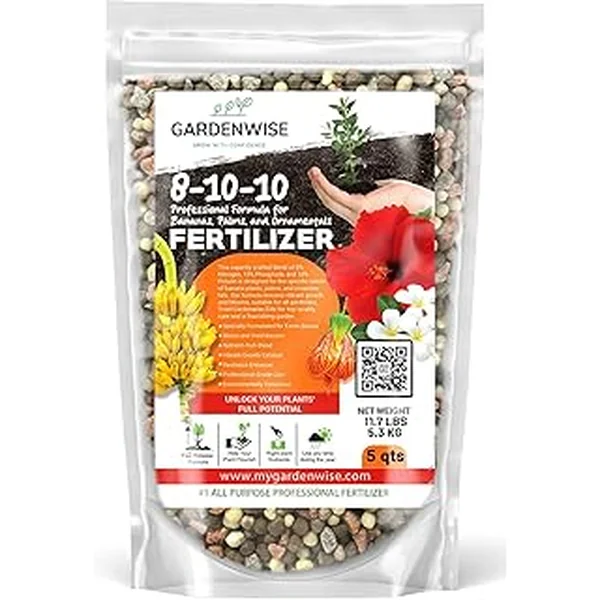
A balanced NPK fertilizer (such as 10-10-10 or similar) is appropriate — lemongrass is not particularly nitrogen-hungry compared to leafy greens, so avoid heavily nitrogen-biased formulas that push leafy growth at the expense of thick, well-formed stalks.
Work slow-release granules lightly into the top 2–3 cm (0.75–1 in) of soil rather than digging them in deep, where they can contact and burn roots.
How to harvest lemongrass
The harvest method determines whether your plant keeps producing or slowly declines. Done correctly, harvesting actually stimulates the clump to push out more new stalks from the center.
When to harvest:
- Outer stalks are at least 1 cm (0.5 in) thick at the base
- Stalk height is 30 cm (12 in) or more
- The center of the clump has plenty of young shoots still growing
How to harvest:
- Identify the outer stalks of the clump — these are the oldest and thickest.
- Grip the stalk firmly at the base and twist-snap it off at soil level, or cut it as close to the base as possible with a sharp knife or scissors.
- Remove no more than one-third of the total stalks per harvest — this keeps the clump healthy and productive.
- Leave all inner and center stalks alone — these are the new growth that will become your next harvest.
What to use each part for:
- Lower 8–15 cm (3–6 in) of the stalk (the pale, firm base): the part used for cooking — slice thin or bruise and use whole in soups and curries
- Upper green stalks: too fibrous to eat but excellent for lemongrass tea — steep in hot water for 5 minutes
Within 3–6 weeks of a harvest, the clump will have pushed new stalks to harvestable size again, especially in warm conditions with good light.
Winter care
Lemongrass grown indoors handles winter well as long as you make a few adjustments.
If you want another strongly scented, mosquito-deterring plant to pair with lemongrass on a patio or balcony, the citronella plant care guide covers a closely related grass that handles outdoor summers just as well. The goal in winter is to keep the plant alive and healthy at low energy cost, then let it ramp back up when warmth and light return in spring.
Winter checklist:
- Bring in before temperatures drop below 10°C (50°F) — lemongrass outdoors in summer must come in before the first cold snap
- Reduce watering — check the soil less frequently and let it dry out more between waterings; in a cool room the soil can stay damp for 2 weeks
- Cut back dead or brown stalks — trim any dry or yellowed outer stalks to the base to tidy the plant and direct energy to healthy growth
- Add a grow light if your window is north-facing — even in winter, a few hours of grow light per day will keep some green growth ticking over
- Do not fertilize from November through February
- Keep it away from cold drafts — especially near sliding doors or old windows with gaps
In spring, as days lengthen and temperatures rise above 21°C (70°F) consistently, resume normal watering and feeding and the clump will bounce back quickly.
Common mistakes
- Using a pot that is too narrow. Lemongrass clumps spread outward. A tall narrow pot restricts growth and dries out too fast.
- Not enough light. Thin pale stalks are almost always a light problem. Move to the sunniest window you have or add a grow light.
- Watering on a fixed schedule. Indoor conditions change week to week. Always use the finger test rather than a calendar.
- Harvesting from the center. The center is where new stalks emerge. Always take outer stalks only.
- Leaving it outdoors too long in autumn. One cold night below 5°C (41°F) can badly damage or kill a lemongrass clump. Bring it in early.
- Skipping fertilizer in summer. In a container, nutrients are depleted fast. Without regular feeding, stalks stay thin even in good light.
- Using stalks without the base intact from the grocery store. Pre-trimmed lemongrass has no bulb base and will not root. You need the intact base for propagation.
Troubleshooting
| Symptom | Likely cause | Fix |
|---|---|---|
| Thin, pale, floppy stalks | Not enough light | Move to sunniest window; add full-spectrum grow light on 12-hour timer |
| Brown tips on stalks | Low humidity or underwatering | Mist the clump, place on a pebble humidity tray, water more often |
| Soft or mushy base | Overwatering or root rot | Let soil dry; check drainage; remove rotted stalks; repot in fresh well-draining mix |
| Slow or no new growth | Cold temperatures or low light | Ensure room stays above 21°C (70°F); supplement with grow light |
| Yellowing from base upward | Waterlogged soil | Empty the drip saucer; improve drainage; reduce watering frequency |
| Stalks remain thin after months | Nutrient depletion | Feed with balanced fertilizer every 4 weeks; consider repotting into fresh mix |
| Roots poking out of drainage holes | Pot is too small | Move up to the next pot size (at least 5–8 cm / 2–3 in wider) |
Watch: how to grow lemongrass indoors
A visual walkthrough pairs well with the steps above. Search YouTube for how to grow lemongrass indoors from grocery store stalks for practical video guides that show the rooting and potting stages clearly. The written steps in this guide give you exact timings and measurements to follow alongside any video you watch.
Practical checklist
- Fresh lemongrass stalks with bulb base intact
- Wide pot 20–25 cm (8–10 in) minimum — 30–40 cm (12–16 in) for established clumps
- Potting mix and coarse perlite (2:1 ratio)
- South- or west-facing window with 6+ hours of direct sun
- Full-spectrum LED grow light (if window is insufficient)
- Watering by finger test — not on a schedule
- Balanced fertilizer on hand for spring/summer feeding
- Plan to harvest outer stalks only, no more than one-third at a time
- Brought indoors before 10°C (50°F) nights if grown outdoors in summer
Related reading
- How to propagate lemongrass — divide an established indoor clump to make new plants for free, or share with friends.
- How to grow mint — another fast-growing aromatic herb that thrives in containers indoors, with different light and water needs.
- How to grow chives — the easiest herb to keep on a sunny kitchen windowsill alongside lemongrass.
- Track your lemongrass watering schedule, fertilizing reminders, and winter care alerts with the free Tazart plant care app.
A note on conditions
Every home is different. Light levels, pot size, soil mix, indoor temperature, humidity, and the season all affect how fast your lemongrass grows and how often it needs water. The timings in this guide are starting points — watch what your plant does in the first two weeks and adjust from there.
Highly recommended
The supplies that make this guide work
Tazart is an Amazon Associate — we earn from qualifying purchases at no extra cost to you. Thank you for helping us keep these guides free.
Frequently asked questions
Can you grow lemongrass indoors year round?
Yes. Lemongrass is a tropical grass that grows actively in warm conditions, so keeping it indoors at 24–29°C (75–85°F) near a bright south- or west-facing window — or under a grow light — lets it grow all year. It slows noticeably in winter when light drops, but it won't die if you keep it above 10°C (50°F) and reduce watering. Many growers treat indoor lemongrass as a permanent kitchen herb pot rather than a seasonal annual.
How do you root lemongrass from grocery store stalks?
Select fresh stalks with their bulb base intact — not trimmed stumps. Strip off the outer dry leaves, trim the top to about 30 cm (12 in) to reduce water loss, and stand the stalks in a glass of water with 5–8 cm (2–3 in) submerged. Place in a warm bright spot. Change the water every 2 days. Roots appear in 1–3 weeks. Once roots are 2–4 cm (0.75–1.5 in) long, pot them up in moist potting mix. This is the cheapest way to start lemongrass — one grocery bunch can give you 4–8 rooted plants.
What size pot does lemongrass need?
Start in a 20–25 cm (8–10 in) wide pot and move up to 30–40 cm (12–16 in) once the clump fills in. Width matters more than depth — lemongrass spreads outward as the clump multiplies. A pot that is too small forces roots to circle, slows growth, and means you need to water daily. A wide, heavy ceramic or terracotta pot also prevents the tall plant from toppling. One established clump can eventually fill a 40 cm (16 in) wide container.
How much light does indoor lemongrass need?
Lemongrass needs at least 6 hours of direct sun per day, and it does best with 8 hours. A south- or west-facing windowsill that gets direct sun is the minimum. In winter or in north-facing rooms, supplement with a full-spectrum LED grow light bar positioned 25–30 cm (10–12 in) above the tops and run on a 12-hour timer. Without enough light, the stalks grow thin, pale, and floppy rather than the thick, firm stalks you can actually cook with.
How do you harvest lemongrass without killing the plant?
Cut or snap off outer stalks at the base, as close to the soil as possible. Never cut from the middle or top of a stalk — lemongrass growth comes from the base and the center of the clump is where new shoots emerge. Leave the inner stalks untouched. Harvest no more than one-third of the stalks at one time so the plant recovers quickly. Within 3–6 weeks, the clump will have pushed out new growth from the center and the outer stalks will be back to harvestable size.
Does lemongrass survive winter indoors?
Yes, with a few adjustments. Bring it in before temperatures drop below 10°C (50°F) — lemongrass dies back fast in cold. Indoors in winter, reduce watering significantly because growth slows and the plant uses far less water. Cut back any dry brown stalks to tidy the plant and focus energy on the healthy center growth. If your home drops below 18°C (65°F) in winter, the plant will mostly go dormant but will survive and bounce back strongly in spring when heat and light return.
Can lemongrass grow indoors without direct sun?
Not well on natural light alone. Lemongrass is a full-sun tropical grass and genuinely struggles in indirect or low-light conditions — stalks stay thin, pale, and weak rather than thick and harvestable. If you do not have a south- or west-facing window with several hours of direct sun, a full-spectrum LED grow light is not optional, it is the only way to grow productive lemongrass indoors. Run it for 10–12 hours a day positioned close enough that you can feel mild warmth near the tops of the plant.