Edible
How to Grow Blueberries in Pots (Complete Container Guide)
Grow sweet blueberries in any garden using containers. Covers acidic soil, pot size, top varieties, cross-pollination, watering, and winter protection.
On this page
- Quick answer
- Table of contents
- Why pots work so well for blueberries
- Choosing the right variety
- Pot size: what you need by year
- The soil requirement that cannot be skipped
- Why you need two varieties
- Planting step by step
- Watering: why rainwater matters
- Mulching
- Fertilizing container blueberries
- Winter protection
- When to expect fruit
- Common mistakes
- Troubleshooting
- Watch: container blueberry guide
- Related reading
- A note on conditions
Watch the visual walkthrough
How to Plant Blueberries at Home for AMAZING Results!
Want to grow your own delicious blueberries? In this video, I'll show you everything you need to know to plant blueberries at ...
Growing blueberries in pots is one of the smartest moves a home gardener can make. You control the soil pH exactly, you can move the pots to follow the sun or dodge hard frosts, and you can grow a productive blueberry harvest on a patio, balcony, or courtyard with no digging at all.
The catch is real: blueberries have narrower requirements than almost any other fruit. Get the soil pH wrong by just half a point and the plant starves — not slowly, but noticeably fast. This guide covers every detail you need to succeed, from choosing the right compact variety to watering with rainwater and protecting the roots through winter.
Quick answer
Grow two compact blueberry varieties — such as Top Hat + Sunshine Blue — in 55–60 L (15 gal) containers filled with purpose-made ericaceous compost at pH 4.5–5.5. Place pots together in full sun. Water with rainwater, mulch with pine bark, and feed with an acid-loving fertilizer in spring. Expect your first real harvest in year 2–3.
Table of contents
- Why pots work so well for blueberries
- Choosing the right variety
- Pot size: what you need by year
- The soil requirement that cannot be skipped
- Why you need two varieties
- Planting step by step
- Watering: why rainwater matters
- Mulching
- Fertilizing container blueberries
- Winter protection
- When to expect fruit
- Common mistakes
- Troubleshooting table
- Watch: container blueberry guide
- FAQs
Why pots work so well for blueberries
Most home garden soils are too alkaline for blueberries. The national average garden soil pH sits around 6.0–7.0. Blueberries need 4.5–5.5. That gap is enormous, and acidifying clay or loam to that level takes years of sulphur amendments — if it works at all.
A container bypasses the problem entirely. You fill the pot with ericaceous compost at the correct pH, and the plant goes into the ideal environment from day one.
Other container advantages:
- Move the pot into a sheltered spot for winter — in-ground roots can’t escape frost
- Reposition for optimal sun as the season changes
- Ideal for renters, small gardens, balconies, and courtyards
- Easier to maintain consistent soil moisture
The trade-off is that pots dry out faster and cool down faster in winter, so watering and frost protection become more important than for in-ground plants.
Choosing the right variety
Not all blueberries suit containers. Full-size highbush varieties can reach 1.8–2.4 m (6–8 ft) tall and spread as wide — manageable but demanding in pots. Compact and half-high varieties are a far better starting point.
Recommended container varieties
| Variety | Type | Height | Notes |
|---|---|---|---|
| Top Hat | Dwarf highbush | 45–60 cm (18–24 in) | Classic container choice, high yield for its size, tolerates neglect well |
| Patriot | Highbush | 1.2–1.5 m (4–5 ft) | Exceptionally hardy (USDA zone 3), tolerates wet soil, needs a 60 L (15 gal) pot |
| Sunshine Blue | Southern highbush | 90–120 cm (3–4 ft) | Low chill-hour requirement, semi-evergreen, good for mild-winter climates |
| Pink Lemonade | Hybrid | 90–120 cm (3–4 ft) | Novelty pink berries, later to fruit but visually stunning on a patio |
| Northblue | Half-high | 60–90 cm (24–36 in) | Cold-hardy to USDA zone 3, heavy crops, good all-round container choice |
Rule of thumb: match the variety to your climate zone, then choose based on pot size. Top Hat and Sunshine Blue are the two most recommended by extension services for container growing specifically.
Pot size: what you need by year
Container size is one of the most common places people get this wrong. An undersized pot restricts root growth, dries out in hours, and produces weak crops.
- Year 1: 20 L (5 gal) minimum — a young bare-root or 1-year-old potted plant fits here comfortably while it establishes
- Year 2–3 onward: Move up to a 55–60 L (15 gal) container — this is the permanent size for a mature highbush or half-high plant
- Top Hat (dwarf): 40 L (10 gal) is sufficient long-term given the smaller root system
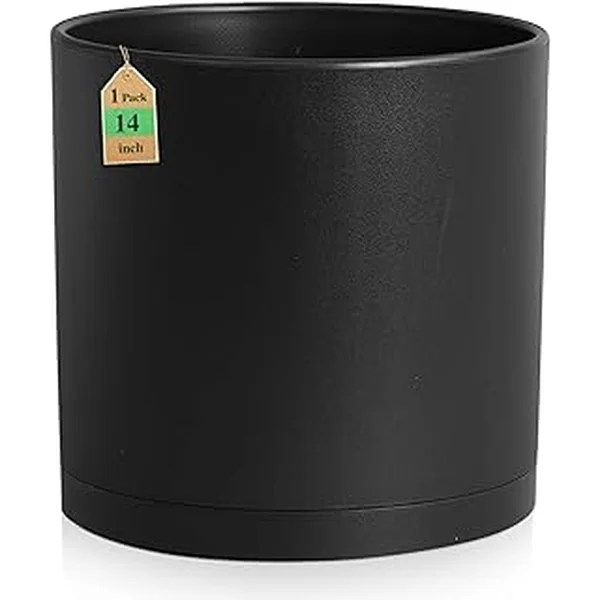
Always choose pots with at least three drainage holes. Blueberries need consistent moisture but will rot quickly if the water sits around the roots. Terracotta pots are beautiful but dry out faster than plastic or glazed ceramic — add a saucer in summer and remove it in autumn to prevent waterlogging.
Repotting: every 3–4 years, repot into the same-size container with fresh ericaceous compost. Root-bound plants drop their yield noticeably.
The soil requirement that cannot be skipped
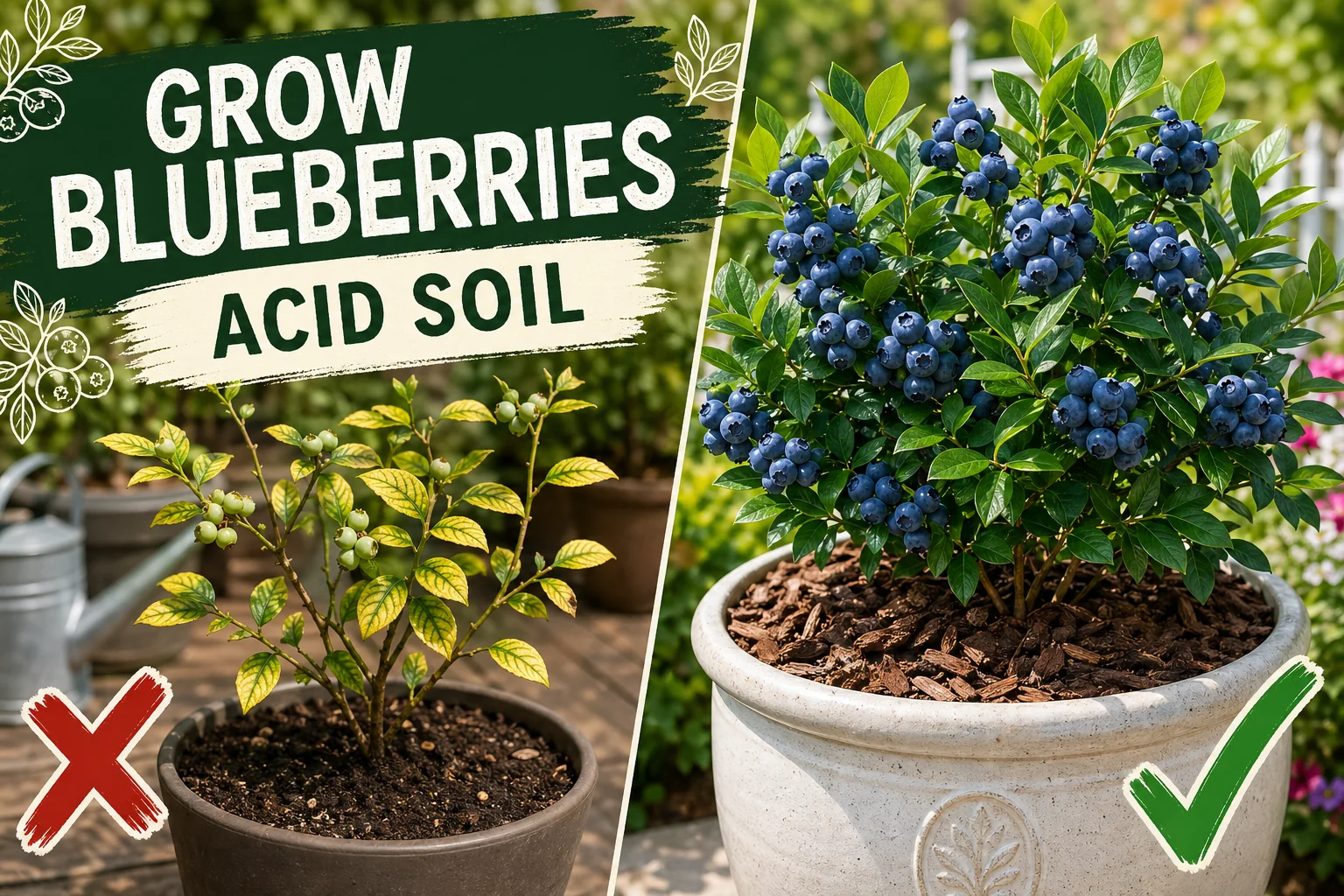
Blueberries are acid-loving plants — technically called ericaceous plants, the same family as rhododendrons and azaleas. Their roots cannot absorb iron, manganese, or several other micronutrients unless the soil pH sits between 4.5 and 5.5.
Above pH 6.0 — which is where most multipurpose potting mixes sit — the leaves turn yellow with green veins (iron chlorosis) within weeks. Above pH 6.5, the plant slowly starves even if you fertilize it.
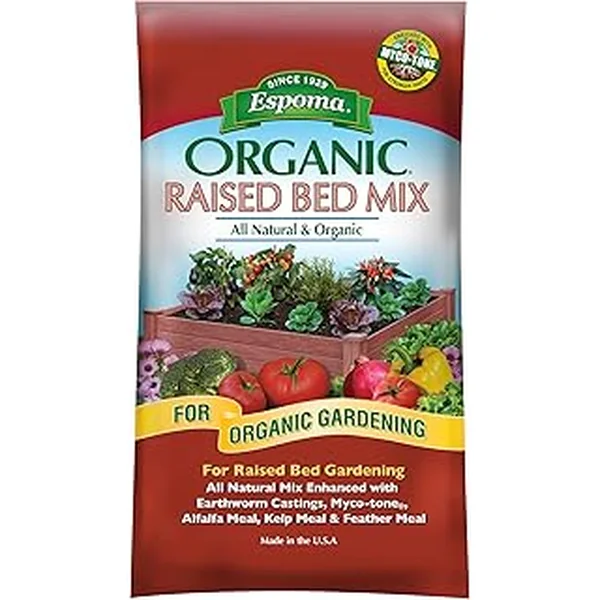
What to use: Buy a bag labelled ericaceous compost, acid compost, or azalea and rhododendron compost. These are pre-mixed to pH 4.5–5.5 and require nothing else from you at potting time.
What to avoid:
- Standard multipurpose compost (typically pH 6.0–6.5)
- Garden topsoil (usually alkaline)
- Homemade compost (varies widely, often pH 6.5–7.0)
- Peat-free composts labelled as general purpose — many of these sit above pH 6.0
Test your mix: A cheap pH test kit or digital soil pH meter gives you a quick check before and after potting. Test the compost fresh from the bag before you use it.
Why you need two varieties
Most blueberry varieties are partially self-fertile — they will set some fruit with their own pollen. But “some” is usually a fraction of what cross-pollination produces.
When bees carry pollen between two different varieties flowering at the same time:
- Berry count increases dramatically — often double or more
- Individual berries grow noticeably larger and sweeter
- The harvest window extends because different varieties ripen slightly differently
For container growing, place two pots within 2–3 m (6–10 ft) of each other on the same patio or balcony. Bees find them easily at that distance.
Good pairings:
- Top Hat + Northblue (both compact, both cold-hardy)
- Sunshine Blue + Pink Lemonade (both suit warm climates, complementary bloom times)
- Patriot + Bluecrop (both highbush, heavy croppers, bloom overlaps well)
Important: Pair within the same type — two highbush, or two half-high, or two southern highbush. Rabbiteye and northern highbush bloom at different times and do not pollinate each other effectively.
Planting step by step
Step 1: Choose your pot
Select a 20 L (5 gal) container for a young plant, or jump straight to a 55–60 L (15 gal) if you are planting a 2-year-old nursery plant. Cover the drainage holes with a piece of broken crock or mesh to stop compost washing out — but never block them with stones, which can trap water.
Step 2: Add ericaceous compost
Fill the pot with ericaceous compost to within 5 cm (2 in) of the rim. Do not mix in any standard potting compost, soil, or fertilizer at this stage.
Step 3: Set the plant at the right depth
Remove the blueberry from its nursery pot and gently tease out any circling roots. Lower it into the container so the top of the root ball sits level with or very slightly above the compost surface — never bury the crown deeper than it sat in the original pot. Burying the crown invites rot.
Step 4: Backfill and firm
Fill around the root ball with more ericaceous compost, pressing it gently to close any air gaps. Leave a 3–5 cm (1–2 in) watering gap between the compost surface and the rim of the pot.
Step 5: Water in deeply
Water slowly and thoroughly until it drains freely from the bottom of the pot. Use rainwater for this first watering if possible — it sets up the soil environment without introducing alkaline minerals.
Step 6: Mulch the surface
Add a 5–7 cm (2–3 in) layer of pine bark mulch across the top of the compost. Keep the mulch a few centimetres clear of the main stems. Mulch keeps the surface cool and moist and as it breaks down it continues to acidify the top layer of the compost.
Watering: why rainwater matters
Container blueberries dry out faster than in-ground plants. In summer, check the compost daily by pushing a finger 2–3 cm (about 1 in) into the surface. Water when it feels dry at that depth.
Rainwater is strongly preferred over tap water, especially in hard-water areas. Hard tap water is high in calcium carbonate — the same minerals that create limescale in kettles. Applied regularly, it gradually raises the compost pH toward neutral, undoing all the acidic conditions you set up at potting.
Practical tips:
- Set up a water butt next to your containers — a 200 L (53 gal) butt holds enough for several weeks of watering
- In winter, water far less — once every 1–2 weeks is usually enough for a dormant plant, just enough to stop the compost drying out completely
- Never let a container blueberry sit in a saucer of standing water — empty saucers within an hour of watering
If you only have hard tap water available, an occasional flush with slightly acidified water (a small splash of distilled white vinegar per 4.5 L / 1 gal) can offset pH creep. Do not do this more than once a month, and always follow with plain water to avoid salt buildup.
Mulching
Pine bark mulch is the ideal surface covering for container blueberries. As it slowly breaks down, it releases mild organic acids that keep the compost surface acidic. Pine needles work well too.
Apply 5–7 cm (2–3 in) of mulch and top it up every spring. In summer this layer reduces evaporation significantly — a mulched pot may need watering only every 2–3 days instead of daily.
Avoid: cocoa-shell mulch (can mould in wet pots), wood chip from treated timber, and heavy peat blocks (compacts and resists rewetting when dry).
Fertilizing container blueberries
Do not fertilize in the first season. Ericaceous compost contains enough slow-release nutrition for the first year. Fertilizing new roots with a concentrated feed risks scorching.
From year two onward:
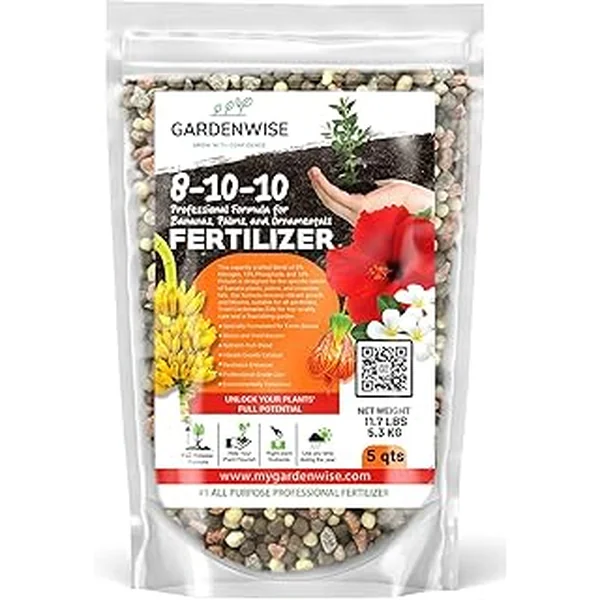
- Early spring (when buds begin to swell): apply an ericaceous / acid-loving plant fertilizer at the label rate — typically a slow-release granule or liquid feed. Products designed for azaleas, rhododendrons, and blueberries are ideal.
- Midsummer: a second application at half rate can support fruit development
- Autumn: stop feeding — you want the plant to harden off before winter, not push soft new growth
Avoid: standard balanced fertilizers (e.g. 10-10-10 granules), liquid tomato feeds, or anything containing lime or chalk. These push pH upward quickly.
A sign of overfeeding is dark, lush leaf growth with poor fruiting — scale back if this happens.
Winter protection
Container roots sit exposed on all sides, with none of the insulating mass that in-ground soil provides.
For another fruiting plant that handles container growing well and benefits from similar overwintering protection, the raspberry plant care guide covers growing canes in large pots with the same wrapped-pot strategy used for blueberries in cold climates. In cold climates, this matters.
Once temperatures regularly drop below −5°C (23°F):
- Move pots against a sheltered south-facing wall, into an unheated greenhouse, or into a garage with some ambient warmth — the goal is to stop the rootball freezing solid
- Wrap the pot itself in bubble wrap, hessian, or horticultural fleece secured with string
- Mulch the compost surface with an extra 5–7 cm (2–3 in) of pine bark
- A leafless dormant plant needs no light but does need occasional watering — check once a fortnight; the compost should be barely moist, not bone dry
Sunshine Blue is semi-evergreen and tolerates mild winters outdoors. Patriot and Northblue are built for cold climates. Top Hat handles USDA zone 4 (−34°C / −30°F) but still benefits from wrapped pots in sustained hard freezes.
In USDA zones 7 and above, winter protection is usually minimal — move pots away from prolonged frost hollows and you are done.
When to expect fruit
Be patient. Container blueberries are a long-term investment.
- Year 1: Pinch off any flowers as soon as they appear. This redirects the plant’s energy from fruit to root establishment. A plant with deep roots will outperform a first-year fruiter for the next decade.
- Year 2: A light first harvest — typically a handful of berries per plant, enough to taste
- Year 3–4: Crops increase noticeably each season as the plant’s root system expands
- Year 5 onward: A well-managed container blueberry can produce 1–2 kg (2–4 lb) of fruit per season depending on the variety
Harvest berries when they are fully blue with no red tinge at the stem end, and when they come away from the bush with the lightest touch. Blueberries do not continue ripening after picking, so wait for full colour.
Common mistakes
- Using multipurpose compost. The single most common cause of container blueberry failure. The pH is too high from day one.
- Starting in a pot that is too small. A 5 L (1.3 gal) pot might look the right size for a small plant — it will root-bind within one season and yield almost nothing.
- Growing only one plant. You will get some fruit, but cross-pollination can double or triple the harvest.
- Watering with hard tap water all summer. Slowly neutralizes the acidic compost; leaves yellow by late summer.
- Feeding in year one. Burns new roots. Skip entirely.
- Allowing pots to freeze solid. The rootball does not insulate itself in a container — roots die at temperatures that an in-ground plant would survive.
- Skipping the mulch. Bare compost dries rapidly and loses its acidic top layer. Mulch is not optional.
- Harvesting too early. Red-shouldered berries are tart. Wait until the berry is entirely blue and falls into your hand.
Troubleshooting
| Symptom | Likely cause | Fix |
|---|---|---|
| Yellow leaves with green veins (chlorosis) | Soil pH too high — iron locked out | Re-test pH; repot with fresh ericaceous compost; apply chelated iron as a short-term leaf spray |
| Pale green leaves, slow growth | Nitrogen deficiency or root-bound | Feed with ericaceous fertilizer; check if it is time to move to a larger pot |
| Few berries despite lots of flowers | Only one variety planted, no pollinators | Add a second variety within 2–3 m (6–10 ft); avoid pesticides during flowering |
| Small, pale, or never-ripe berries | Insufficient sun | Move pot to a spot with at least 6 hours of direct sun per day |
| Wilting despite moist compost | Overwatering / root rot | Check drainage; tip pot slightly to check water runs freely; let compost dry slightly before next watering |
| Berries dropping before ripe | Drought stress or bird activity | Increase watering frequency; net the plant 1 week before berries colour |
| Leaves browning at the tips | Hard water salt buildup or fertilizer excess | Flush pot with rainwater; reduce fertilizer rate |
| Stems dying back from tips in spring | Late frost damage on young growth | Cover with fleece on nights below −2°C (28°F) when buds are open |
Watch: container blueberry guide
A visual walkthrough pairs well with the steps above. Search YouTube for “growing blueberries in pots” or “container blueberry tutorial” to find practical demonstrations — look for videos from university extension channels or established horticultural educators for the most reliable advice.
Related reading
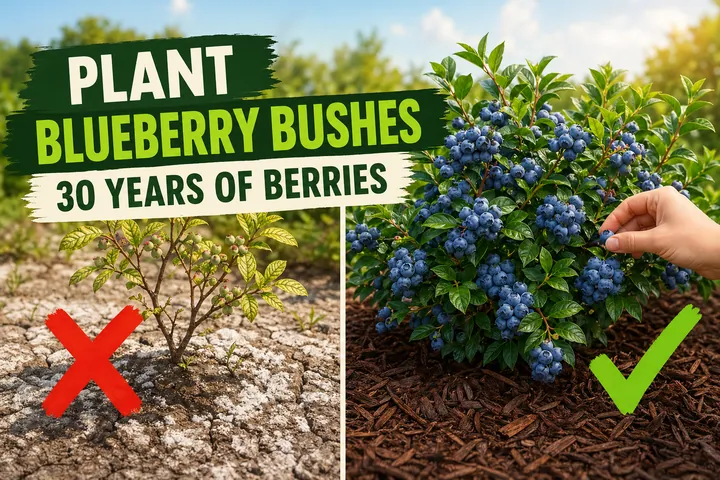
- How to plant blueberry bushes in the ground — if your garden soil is naturally acidic, in-ground planting gives even better long-term yields.
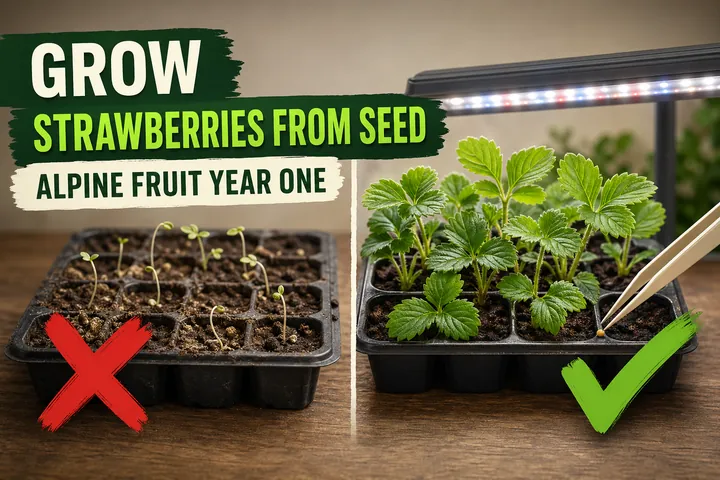
- How to grow strawberries from seed — another acidic-soil-tolerant fruit that pairs beautifully with a patio blueberry collection.
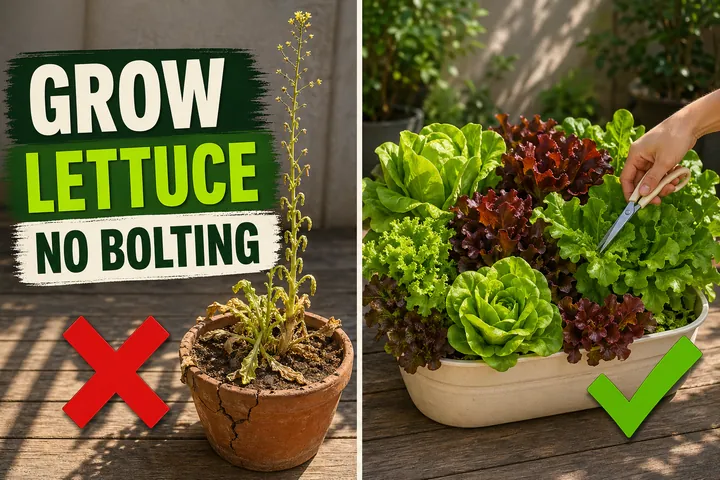
- How to grow lettuce in containers — fast-cropping salad greens to grow alongside your long-term blueberry pots.
- Use the free Tazart plant care app to set up watering reminders for your container blueberries — it can adjust the schedule for your local weather and send you alerts when temperatures are forecast to drop near frost.
A note on conditions
Every patio, balcony, and garden is different. Local water hardness, sun hours, summer heat, and winter cold all affect how a container blueberry performs. Use this guide as a starting point and observe what your plants tell you in their first season — then adjust. That is how every good grower learns.
Highly recommended
The supplies that make this guide work
Tazart is an Amazon Associate — we earn from qualifying purchases at no extra cost to you. Thank you for helping us keep these guides free.
Frequently asked questions
What size pot do blueberries need?
Start a young blueberry in a 20 L (5 gal) pot for its first year. Move it to a 55–60 L (15 gal) container by year two or three — that is the permanent home for a mature plant. Compact varieties like Top Hat can live happily in a 40 L (10 gal) pot long-term. Always choose a pot with generous drainage holes.
What soil pH do blueberries need when grown in pots?
Blueberries need a soil pH of 4.5–5.5 — far more acidic than standard potting mixes, which sit around pH 6.0–6.5. Use a purpose-made ericaceous (acid-loving plant) compost straight from the bag. Never use standard multipurpose compost, topsoil, or garden soil — even one season in alkaline mix can lock out iron and cause the leaves to yellow and the plant to collapse.
Do I need two blueberry plants in pots to get fruit?
Yes — grow two different cultivars of the same type (e.g. two compact highbush varieties) within 2–3 m (6–10 ft) of each other. Most blueberry varieties are only partly self-fertile. Cross-pollination by bees between two different cultivars can double your berry count and noticeably increase fruit size. Place pots side by side on a patio or balcony to make it easy for pollinators.
Can I use tap water to water container blueberries?
In soft-water areas, tap water is fine. In hard-water areas — anywhere calcium and magnesium levels are high — regular tap water gradually raises the soil pH toward neutral, starving the plant of iron. Collect and use rainwater if you can. If rainwater isn't available, use a weak solution of water-soluble sulfur or add a capful of distilled white vinegar per 4.5 L (1 gal) of tap water as an occasional flush.
When do blueberries fruit in pots?
Expect a small first harvest in year 2, with the crop growing each year as the plant matures. Full production typically arrives in years 3–4. Pinching off flowers in year one feels brutal but pushes energy into roots and rewards you with much heavier crops from year two onward. A well-cared-for container blueberry will keep producing for 10–15 years before needing dividing or replacing.
How do I protect potted blueberries in winter?
Container roots are far more exposed to frost than in-ground roots, so winter protection matters. Move pots against a sheltered wall or into an unheated greenhouse or garage once temperatures regularly drop below −5°C (23°F). Wrap the pot in bubble wrap or hessian, and mulch the top of the soil. If the plant is dormant and leafless, it needs no light — just protection from frozen roots.
What is the best blueberry variety for growing in a pot?
Top Hat is the classic dwarf choice — it stays under 60 cm (24 in) and thrives in a 40 L (10 gal) pot. Sunshine Blue (semi-evergreen, low chill-hour requirement) suits warmer climates. Pink Lemonade is a novelty with pink berries. Patriot is a full-size highbush that tolerates wet soil and gives heavy crops but needs a 60 L (15 gal) minimum container. Pair any two for best results.