Flowers
How Often to Water Petunias (Beds, Pots & Hanging Baskets)
Water petunias 1 inch (2.5 cm) per week in beds, daily in containers in summer heat, twice daily in hanging baskets above 30°C (86°F). Full schedule inside.
On this page
- Quick answer
- Table of contents
- Why petunias dry out so fast
- Watering schedule by location
- Hanging baskets: the special case
- Wave vs grandiflora petunia watering
- How to water petunias correctly
- Signs of overwatering
- Signs of underwatering
- Water and fertilizer go together
- Common mistakes
- Troubleshooting
- A quick word on conditions
Watch the visual walkthrough
How to Have Success with Supertunias // Garden Answer
I hope this video helps for those of you growing Supertunias. I've been growing them for years(long before we started Garden ...
Petunias are one of the thirstiest annuals in the garden — and the most-killed by inconsistent watering. The right schedule depends on whether they’re in a bed, a regular pot, or a hanging basket, and shifts dramatically when summer heat arrives.
This guide covers the exact watering schedule by location, the differences between wave and grandiflora petunias, and how to keep mid-summer hanging baskets from crashing.
Quick answer
Water in-ground petunias deeply once or twice a week — about 2.5 cm (1 in) of water per week. Container petunias need water every 1–2 days in spring, daily in summer. Hanging baskets often need watering twice a day in heat above 30°C (86°F). Always check the top 2.5 cm (1 in) of soil first; water when it’s dry.
Table of contents
- Why petunias dry out so fast
- Watering schedule by location
- Hanging baskets: the special case
- Wave vs grandiflora petunia watering
- How to water petunias correctly
- Signs of overwatering
- Signs of underwatering
- Water and fertilizer go together
- Common mistakes
- Troubleshooting
- FAQ
Why petunias dry out so fast
Petunias (Petunia × hybrida) put out an enormous amount of foliage and bloom for their root size. Three traits make them thirsty:
- High flower-to-root ratio — wave and spreading types can spread 90 cm (36 in) or more on a small root system.
- Soft, thin leaves — they transpire faster than waxy-leaved annuals like geraniums.
- Heavy bloomers — every flower the plant produces requires water and energy.
The result is plants that look fine in the morning and limp by mid-afternoon. That’s normal in heat — what matters is whether they recover overnight. If they don’t, you’re behind on watering.
Watering schedule by location
| Location | Spring (15–22°C / 60–72°F) | Summer (24–32°C / 75–90°F) | Heat wave (32°C+ / 90°F+) |
|---|---|---|---|
| In-ground bed | 2.5 cm (1 in) per week | 2.5–4 cm (1–1.5 in) per week | Deep soak every 3–4 days |
| Container 25–30 cm (10–12 in) | Every 2 days | Daily | Daily, morning + check evening |
| Hanging basket 30 cm (12 in) | Daily | Daily, sometimes twice | Twice daily |
| Window box 60 cm (24 in) | Every 1–2 days | Daily | Daily, morning + check evening |
| Self-watering planter | Refill reservoir every 3–5 days | Refill every 2–3 days | Refill every 1–2 days |
These are starting points. Always check the top 2.5 cm (1 in) of soil before watering — petunias in unusually cool, cloudy weather may go an extra day even in summer.
Hanging baskets: the special case
Hanging baskets dry faster than any other type of petunia container for three reasons:
- Air circulation on all sides — wind hits both the top and sides of the soil ball.
- Small soil volume — most baskets hold only 4–8 L (1–2 gal) of soil.
- Coir liners wick moisture out — moss and coir liners breathe but lose water fast.
In a 30 cm (12 in) coir-lined basket on a sunny porch, July temperatures of 32°C (90°F) can pull the soil from saturated to bone dry in 8–10 hours. By 4 PM the plants are wilting hard.
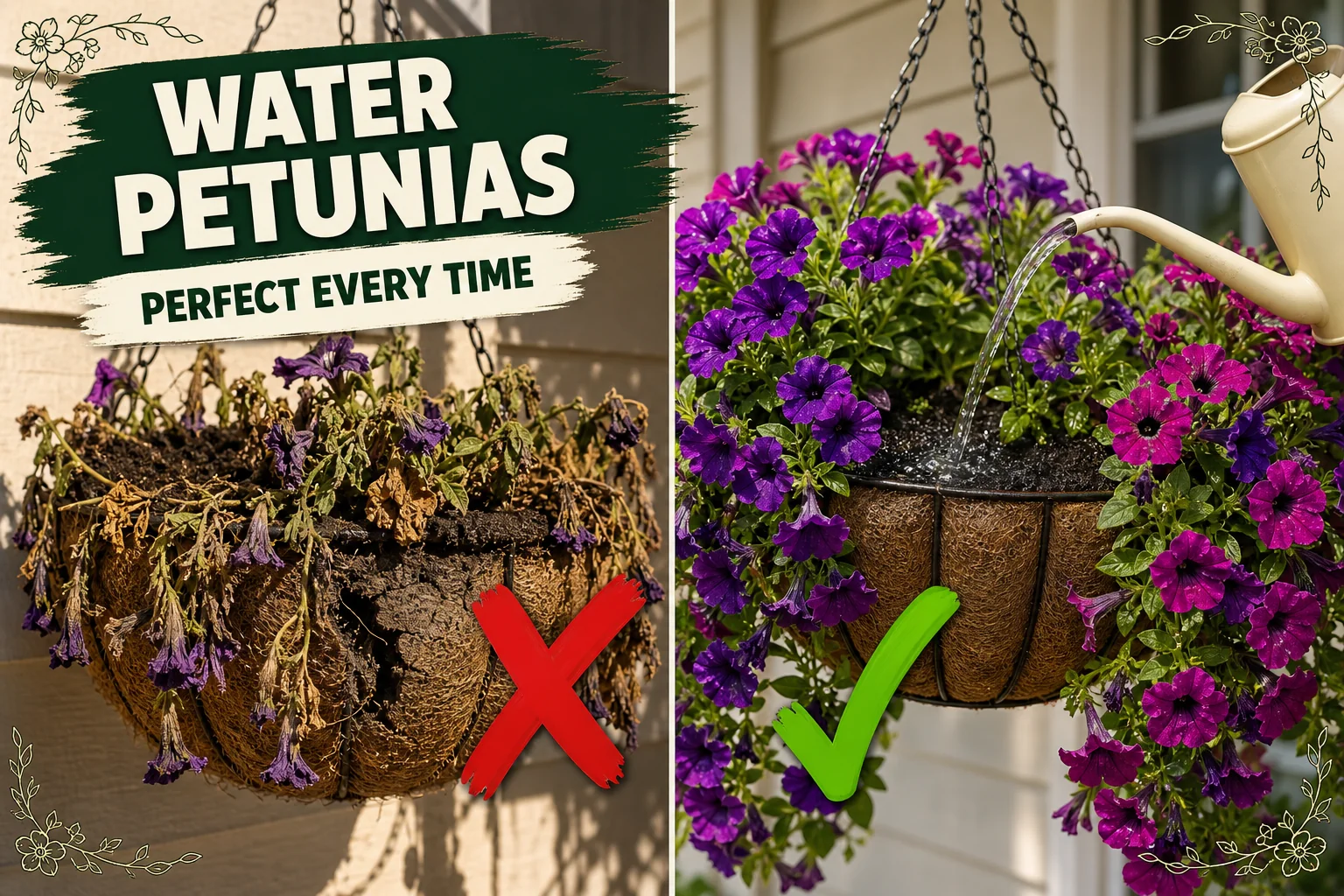
The twice-daily rule. When daytime highs reach 30°C (86°F) and night temperatures stay above 21°C (70°F), water hanging-basket petunias twice a day — once in the morning at 6–8 AM and again at 4–5 PM. Skip the second watering on cool, overcast days.
If you can’t water twice a day, use a self-watering planter or a drip irrigation kit on a timer. A 4 L (1 gal) reservoir keeps a 30 cm (12 in) basket happy for 2–3 days even in heat.
Wave vs grandiflora petunia watering
Not all petunias drink at the same rate.
Wave / spreading petunias (Wave, Easy Wave, Tidal Wave, Supertunia, Surfinia):
- Larger root system, faster growth
- Heavier feeders — fertilize weekly
- Need water daily in pots, often twice daily in mid-summer baskets
- Bloom heaviest, recover fastest from a missed watering — but won’t tolerate two
Grandiflora petunias (Ultra, Storm, Dreams series):
- Largest individual flowers, more upright growth
- Slightly less thirsty than waves
- Daily watering in pots is usually enough even in summer
- Big flowers are damaged by overhead watering — water at soil level
Multiflora and milliflora petunias (Fantasy, Picobella):
- Smaller, more compact plants
- Most drought-tolerant of the petunia types
- In beds, can sometimes go 5–7 days between deep waterings
- Best choice for gardeners who can’t water daily
How to water petunias correctly
The technique matters as much as the frequency.
1. Water the soil, not the leaves. Wet leaves and flowers invite botrytis and powdery mildew. Use a long-spout can or a wand on the hose to deliver water to the soil surface only.
2. Soak deeply, then stop. A light surface sip wets only the top 1 cm (½ in) and trains roots to stay shallow. Water until you see it run out the drainage hole, then stop. For a 30 cm (12 in) basket, that’s typically 1–2 L (½ gal).
3. Water in the morning. 6–9 AM is ideal. Plants drink most during daylight hours, and morning watering lets foliage dry before evening — which prevents fungal disease.
4. Add a second watering only if you need it. Check at 3–4 PM. If the top 2.5 cm (1 in) is dry and the plants are wilting, do a second deep watering. If the soil is still slightly moist, wait until tomorrow morning.
5. Adjust for the pot, not the calendar. A clay pot in full sun might need water twice a day in July; a glazed ceramic pot in dappled shade might go 36 hours. The finger test trumps the schedule.
The same soak-and-drain principle works for watering monstera and other thirsty bloomers — deep infrequent watering trains stronger roots.
Signs of overwatering
Petunias hate soggy roots. The signs come fast:
- Yellowing lower leaves — earliest sign, often with green veins
- Mushy stems at the soil line — crown rot starting
- Stunted bloom — plant is using energy to fight root disease
- Sour, swampy smell from the pot — anaerobic decay
- Wilting that doesn’t recover after watering — counterintuitive but real; rotted roots can’t take up water
If you spot these, stop watering for 3–4 days, move the pot to brighter sun, and check drainage. If roots are visibly black and mushy, follow the root rot recovery protocol.
Signs of underwatering
Petunias telegraph thirst clearly:
- Afternoon wilt that recovers by morning — normal in heat, no action needed
- Persistent wilt that doesn’t recover overnight — soak deeply now
- Crispy brown leaf edges — chronic drought; foliage damage may not recover but new growth will
- Flowers fading and dropping fast — under-watered plants drop blooms to conserve energy
- Soil pulling away from the pot edge — soil is hydrophobic; soak the entire pot in a tray of water for 20 minutes
Underwatered petunias usually bounce back from a single deep soak. The longer fix is moving them to a larger pot or a self-watering setup.
Water and fertilizer go together
Petunias are heavy feeders, and most petunia “watering problems” are actually fertilizer deficits showing up under stress.
- In containers, fertilize weekly with a balanced water-soluble fertilizer at half strength (or use a starter fertilizer at planting and every 4 weeks).
- Wave and Supertunia types may need fertilizing every watering at quarter strength.
- Yellowing leaves on a well-watered plant usually mean nitrogen deficiency, not overwatering.
A starved petunia wilts faster, recovers slower, and stops blooming weeks earlier than a fed one — even with perfect watering.
Common mistakes
- Watering on a fixed daily schedule. Cool, overcast days don’t need a daily soak. Over time, daily watering in cool weather rots roots.
- Light surface sips. Wetting only the top 1 cm (½ in) leaves deep roots dry. Soak fully or skip.
- Overhead watering at night. Wet leaves at sundown invite botrytis and powdery mildew.
- No drainage hole. Petunias in solid-bottom decorative pots are guaranteed to rot. Always use a drainage hole.
- Forgetting the basket has dried out completely. Once peat-based soil is fully dry, it repels water. Set the basket in a tray of water for 20 minutes to rehydrate.
- Watering in midday peak heat. Most water evaporates before reaching roots. Morning is far more efficient.
- Skipping fertilizer because the plant looks “fine.” Petunias need consistent feeding to keep blooming through August.
Troubleshooting
| Symptom | Likely cause | Fix |
|---|---|---|
| Wilting daily, recovers overnight | Normal heat stress | Keep watering schedule; don’t increase |
| Wilting that doesn’t recover by morning | Soil too dry | Soak deeply; consider larger pot or self-watering |
| Yellow lower leaves, soggy soil | Overwatering / poor drainage | Skip 3–4 days; check drainage hole; repot if needed |
| Yellow lower leaves, dry soil | Nitrogen deficiency | Fertilize at half strength weekly |
| Crispy brown leaf edges | Chronic underwatering | Deep soak; new growth will recover |
| Flowers small or sparse | Too little water + fertilizer | Increase both; deadhead spent blooms |
| Soil dry but won’t absorb water | Hydrophobic peat | Submerge pot 20 min; repot in fresh mix at end of season |
| White crust on soil surface | Salt build-up from fertilizer | Flush by watering 3× pot volume; ease off feeding |
| Mushy black stems at soil line | Crown rot from soggy soil | Cut affected stems; repot in dry mix; move to brighter sun |
| Powdery white film on leaves | Powdery mildew from wet foliage | Water only at soil level; improve air flow |
A quick word on conditions
Pot size, soil mix, sun exposure, wind, and humidity all change how fast petunias dry. The intervals above are well-tested averages — but the finger test always wins. Push your finger 2.5 cm (1 in) into the soil before each watering and your petunias will tell you exactly what they need.
For the full planting and care guide, see how to grow petunias. If you want to try a hands-off setup, the self-watering planter guide cuts hanging-basket watering to once every 2–3 days even in heat.
Track watering, fertilizer, and bloom cycles automatically with the free Tazart plant care app — it learns each pot’s rhythm and reminds you only when the soil is actually dry.
Highly recommended
The supplies that make this guide work
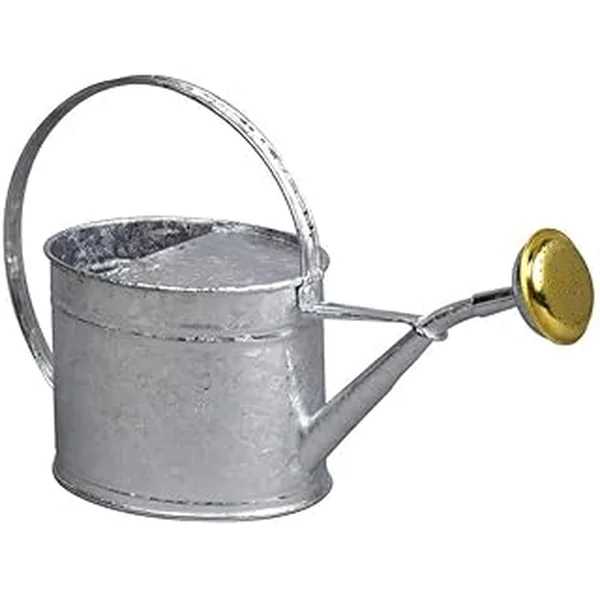
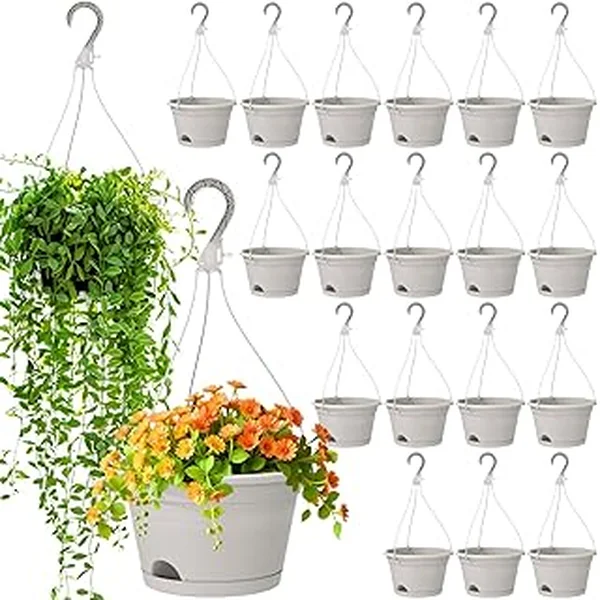
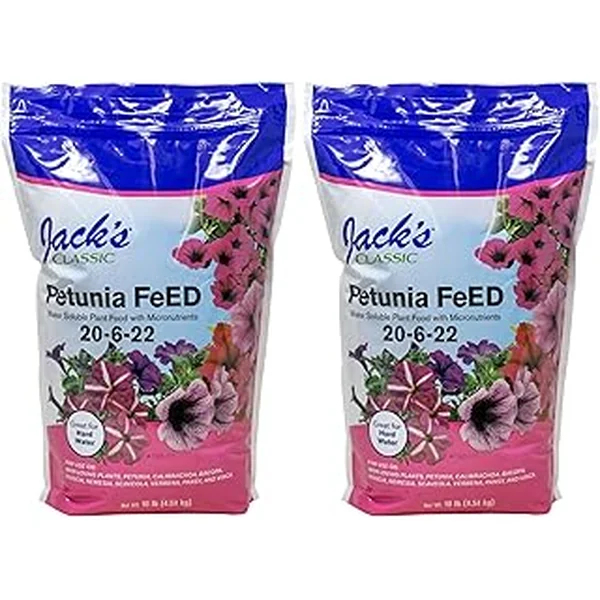
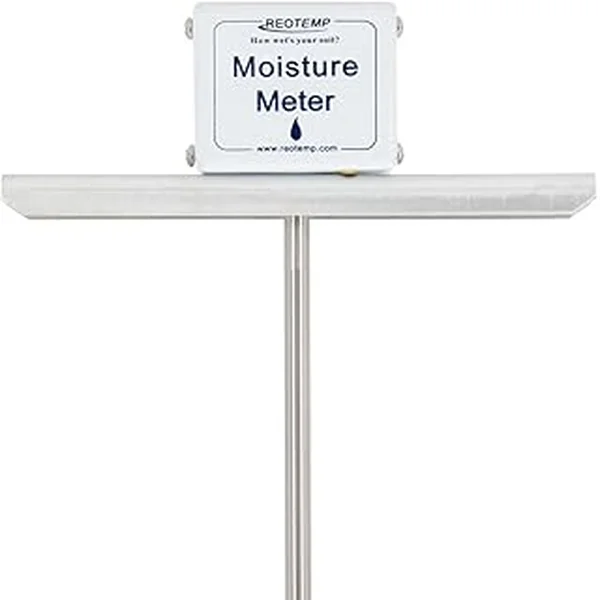
Tazart is an Amazon Associate — we earn from qualifying purchases at no extra cost to you. Thank you for helping us keep these guides free.
Frequently asked questions
How often should I water petunias?
Petunias in garden beds need about 2.5 cm (1 in) of water per week, applied as one or two deep soakings. Container petunias usually need watering every 1–2 days in mild weather and once a day in summer. Hanging baskets often need watering twice a day during heat above 30°C (86°F) because they dry out fastest of any pot type.
Do petunias need water every day?
In-ground petunias generally do not — once or twice a week of deep watering is enough. Petunias in pots, window boxes, and hanging baskets often do need daily watering in summer because the small soil volume dries quickly. The simplest test is to push your finger 2.5 cm (1 in) into the soil — if it feels dry, water deeply until it runs out the drainage hole.
How often should I water petunias in hanging baskets?
In spring and mild weather, once a day is usually enough. From mid-summer onward, when daytime highs cross 30°C (86°F), most hanging baskets need water twice a day — once in the morning and again in late afternoon. Coir-lined baskets dry fastest. Self-watering baskets stretch this to once daily even in heat.
Why are my petunias wilting in the heat?
Heat-stressed petunias wilt to slow water loss even when soil is moist. If your container petunias wilt in the afternoon but recover overnight, you don't need more water — the plant is just transpiring faster than the roots can pull. Persistent wilting that doesn't recover by morning means the soil is too dry; soak deeply until water runs out the drainage hole.
Can you overwater petunias?
Yes. Petunias hate soggy roots and will rot in waterlogged soil. The fastest signs are yellowing lower leaves, mushy stems near the soil line, and a sour smell from the pot. Always use containers with drainage holes and let the top 2.5 cm (1 in) of soil dry between waterings, even in summer.
Should I water petunias in the morning or evening?
Morning is best. Watering at 6–9 AM gives plants a full day of moisture and lets foliage dry before evening, which prevents fungal disease. In extreme heat above 32°C (90°F), a second watering in late afternoon (around 4–5 PM) is fine — just avoid wetting the leaves at night.
What is the difference between watering wave petunias and grandiflora petunias?
Wave and spreading petunias are heavier feeders and faster growers, so they typically need more frequent watering and fertilizer than upright grandiflora types. A 30 cm (12 in) hanging basket of wave petunias may need water twice a day in July, while a grandiflora in the same basket might still go a full day. Both follow the same finger-test rule.