Houseplants
How Often to Water a Jade Plant (Without Killing It)
Jade plants die from overwatering, not neglect. Here's exactly how often to water a jade plant — by season, pot size, and how to read the leaves and soil.
On this page
- Quick answer
- Why jade dies from watering more than from neglect
- How to actually tell when a jade is thirsty
- Watering frequency by season and pot size
- How much water to give
- Bottom watering vs top watering for jade
- Step-by-step: the right way to water a jade plant
- Adjusting for your specific home
- Common mistakes to avoid
- Troubleshooting
- Watch: watering a jade plant
- Related reading
- A note on conditions
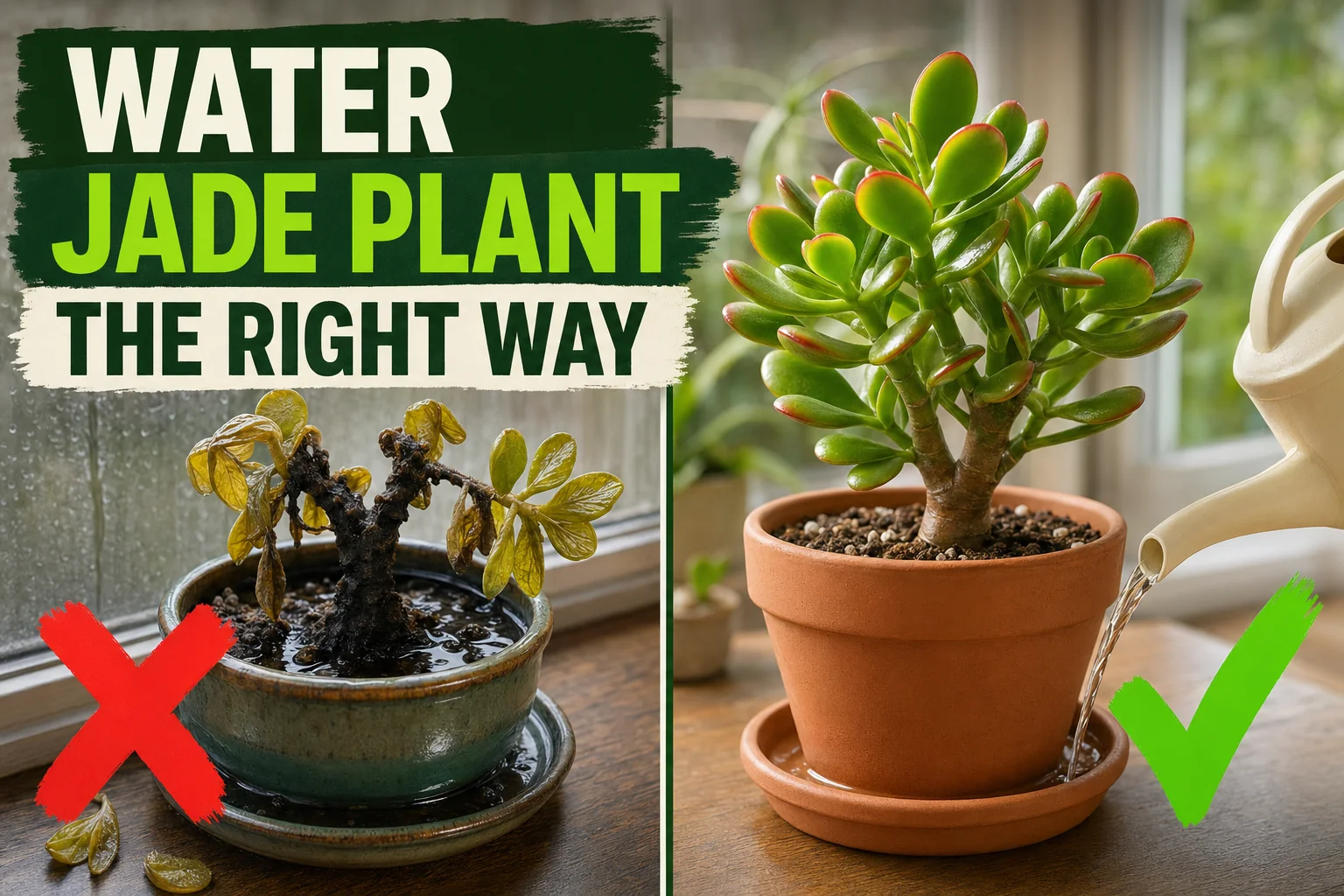
Watch the visual walkthrough
water your jade THE RIGHT WAY
A short visual walkthrough that pairs with the steps above.
Jade plants (Crassula ovata) are desert succulents — they evolved on dry, rocky South African hillsides and store water in their thick leaves the way a camel stores it in its hump. They’re built to survive drought, not soggy soil. Almost every dead jade plant on the internet was killed by too much water, not too little.
The watering rule that keeps a jade alive for decades is simple: deep and infrequent, not small and frequent. This guide gives you the exact cadence by season and pot size, the three reliable ways to tell when your jade is actually thirsty, and the five mistakes that quietly rot the roots before you ever see a yellow leaf.
Quick answer
Water your jade plant deeply only when the soil is bone dry to the bottom of the pot — roughly every 2 to 3 weeks in spring and summer, and every 4 to 6 weeks in autumn and winter. Less in small pots and cool rooms, more in big pots and outdoors. Never water on a fixed schedule.
Why jade dies from watering more than from neglect
A jade plant in dry soil is uncomfortable. A jade plant in wet soil is dying.
Crassula ovata stores its own water reserve inside its leaves and stems. When the soil dries out, the plant simply pulls from that reserve — the leaves go very slightly soft, the stem stays firm, and the plant patiently waits for rain. It can do this for weeks without harm.
When the soil stays wet, however, the roots can’t breathe. Within 3 to 7 days of waterlogged soil they start to die back, and bacteria move in. By the time you see yellow leaves dropping or a black mushy stem, the rot is already deep — and once jade rots at the base, recovery is hard.
This is why “every Sunday” is the worst possible watering schedule for jade. The plant doesn’t drink on a calendar. It drinks when its reserves run out.
How to actually tell when a jade is thirsty
Forget the schedule. Use these three checks instead — together they’re nearly foolproof.
1. Squeeze a lower leaf. A fully hydrated jade leaf is firm and plump, like a small water balloon. A slightly thirsty one feels a touch softer and looks faintly wrinkled along the surface. Slight softness = time to water. Full plumpness = wait.
2. Lift the pot. A jade in dry soil is surprisingly light — you can feel it after picking up the pot once or twice when it’s freshly watered and again a few weeks later. The “light pot” check works better than any moisture meter, especially for a 10 cm (4 in) or smaller pot.
3. Probe to the bottom. Push a long wooden chopstick, bamboo skewer, or your finger straight down into the soil to the very bottom of the pot. Pull it out and look at it. Dry stick with no soil stuck to it = water now. Damp stick with dark soil clinging = wait.
If two of these three say “dry,” water. If even one says “wet,” wait another few days and check again.
Watering frequency by season and pot size
These are starting points for a healthy jade in average household conditions. Adjust upward in hot, dry, sunny spots and downward in cool, dim ones.
| Season + pot size | Indoor — water every | Outdoor — water every |
|---|---|---|
| Spring / Summer — 10 cm (4 in) pot | 2–3 weeks | 1–2 weeks |
| Spring / Summer — 5 cm (2 in) pot | 7–10 days | 5–7 days |
| Autumn / Winter — 10 cm (4 in) pot | 4–6 weeks | 3–4 weeks |
| Autumn / Winter — 5 cm (2 in) pot | 2–3 weeks | 10–14 days |
Big pots hold more water and dry slower than small ones — a 25 cm (10 in) potted jade can easily stretch to a month between waterings even in summer. Always finish with the soil-probe check before pouring.
How much water to give
When you do water, water deeply. A jade plant doesn’t want a sip — it wants a soaking that mimics a desert downpour, then a long dry stretch.
The simple rule: pour slowly around the base until about 20% of the water drains out the bottom, then stop. That’s enough to wet the entire root ball and flush mineral salts that build up over time. For a 10 cm (4 in) pot that’s usually around 100 ml of water; for a 25 cm (10 in) pot it’s closer to 500 ml.
Critically: empty the saucer within 30 minutes. Jade roots tolerate one good soak followed by drying out. They don’t tolerate sitting in standing water for hours — that’s the fastest way to root rot.
Bottom watering vs top watering for jade
Top watering wins for jade plants. Verdict: pour from the top, deeply, and drain the saucer.
Top watering soaks the whole root ball, flushes built-up salts out the drainage holes, and matches how desert rain actually falls on Crassula ovata in the wild. Bottom watering — letting the pot sit in a tray of water — does work, but it leaves salts concentrated at the surface and tends to under-water the deeper roots, which are the ones that actually keep a jade alive in summer.
If you’ve been bottom watering, switch to a deep top-water flush at least every third or fourth time to wash salts through.
Step-by-step: the right way to water a jade plant
1. Probe to the bottom
Push a chopstick, skewer, or finger all the way to the base of the pot. If it comes out completely dry and clean, move on. If it comes out damp or with soil clinging, stop here and check again in 5 to 7 days.
2. Water deeply over the sink
Take the pot to the sink or carry it outside. Pour water slowly around the base of the stem (not on the leaves) until you see roughly 20% of what you poured run out the drainage holes. This flushes salts and saturates every root.
3. Drain the saucer within 30 minutes
Set the pot back down. After 30 minutes, tip the saucer out so no standing water remains. This single habit prevents more jade deaths than any other.
4. Wait until it’s bone dry again
Don’t water again on a fixed day. Re-probe every 7 to 10 days in summer, every 2 to 3 weeks in winter. Only water when all three thirst signs (soft leaf, light pot, dry probe) line up.
5. Never water on autopilot
If you can’t trust yourself to remember to check the soil, let an app remember for you. The free Tazart plant care app lets you scan your jade, sets up a season-aware watering reminder, adjusts it for your local weather, and pings you when the next “check the soil” day arrives — so you’re never watering on a calendar, just on actual conditions.
Adjusting for your specific home
Use the table above as a starting point and tune for your conditions:
- Heating in winter. Forced-air heating dries soil faster than expected — a jade in a heated room may need water every 3 to 4 weeks instead of 5 to 6.
- Humidity. High household humidity (>60%) slows drying. Stretch waterings further apart. Jade does not benefit from extra humidity — skip the mister and the pebble tray.
- Pot material. Terracotta breathes and dries 2x faster than glazed ceramic or plastic. A jade in plastic needs noticeably less frequent watering than the same plant in terracotta.
- Light level. A jade in bright direct light photosynthesizes more and uses water faster than a jade tucked in a corner. Brighter light = water a little more often. Dim light = water far less often, full stop.
Common mistakes to avoid
- Watering on a fixed schedule. “Every Sunday” is the single most common way to kill a jade. The plant doesn’t care what day of the week it is — it cares what the soil is doing.
- Watering when leaves look slightly soft. Slightly soft is the correct signal to water. Watering jade only when the leaves are still fully plump means you’re watering before the plant has used its reserves — and that’s how chronic overwatering starts.
- Using a pot with no drainage hole. A decorative pot without a drainage hole is a swimming pool for roots. Either drill a hole or use it only as a cover-pot with a true draining nursery pot inside.
- Leaving the saucer full of water. Even a perfectly drained pot will rot if it sits in 2 cm (0.75 in) of water for two days. Dump the saucer within 30 minutes, every single time.
- Misting jade. Jade isn’t tropical. Misting raises leaf-surface humidity, which invites fungal spots and mealybugs and does nothing for the plant. Don’t do it.
- Using regular potting mix. Standard houseplant mix holds too much water for jade. Use a cactus / succulent mix, or cut regular potting mix 50/50 with coarse sand or perlite for fast drainage.
Troubleshooting
| Symptom | Likely cause | Fix |
|---|---|---|
| Yellow translucent leaves dropping off | Overwatering / early root rot | Stop watering immediately. Unpot, trim mushy roots, repot in dry cactus mix, wait 7 days to water. |
| Mushy black stem at the soil line | Advanced root rot | Behead the plant above the rot, let the cutting callus 5–7 days, then root in dry cactus mix. |
| Wrinkled, soft, slightly shrunken leaves | Underwatering | Probe to bottom. If bone dry, deep-water once and resume the “bone dry” rule. |
| Brown crispy leaf tips | Salt build-up or fluoride from tap water | Flush deeply with rainwater or filtered water until 30% drains out; repeat monthly. |
| Tiny black flying gnats around the soil | Soil staying too wet — fungus gnats | Let soil dry fully. Top with 1 cm (0.5 in) of dry sand. Reduce watering frequency. |
| No new growth for months in spring | Too dim, too cold, or too dry | Move to a brighter window (6+ hrs light), check temperature is above 15°C (59°F), water when bone dry. |
Watch: watering a jade plant
A short visual demo pairs well with the steps above — seeing the chopstick test and the deep-flush watering once makes the whole rhythm click. If you’re a visual learner, watch a quick tutorial like How to Water a Jade Plant on YouTube and then come back to follow the cadence in this guide.
Related reading
- How to propagate a jade plant from a single leaf or cutting — once you’ve nailed watering, propagating jade is the next easy win.
- How often to water a snake plant (without killing it) — same desert-succulent “bone dry to the bottom” rule applied to Dracaena trifasciata.
- How to care for an aloe vera plant — same desert-succulent watering rules apply to aloe.
- How to water a Monstera the right way — a useful contrast: tropicals like Monstera want frequent water; succulents like jade do not.
- Set up a season-aware watering schedule for your jade in the free Tazart plant care app so you never water on a calendar again.
A note on conditions
Every home is different. Light level, pot size, soil mix, season, humidity, and your local weather all change how fast a jade plant dries out and how often it actually needs water. Use the cadences above as a starting point, then trust the soil probe and the leaf squeeze in week two — that’s how every long-term jade keeper learns to read their plant.
Highly recommended
The supplies that make this guide work
Tazart is an Amazon Associate — we earn from qualifying purchases at no extra cost to you. Thank you for helping us keep these guides free.
Frequently asked questions
How often should I water a jade plant?
Water a jade plant deeply only when the soil is bone dry all the way to the bottom of the pot. Indoors that's roughly every 2 to 3 weeks in spring and summer, and every 4 to 6 weeks in autumn and winter. Smaller pots dry faster than larger ones, and outdoor jades in full sun drink more often than indoor ones. Never water on a calendar — always check the soil first.
Do jade plants like to be misted?
No. Jade is a desert succulent native to dry South African slopes, not a tropical plant. Misting raises humidity around the leaves, which encourages fungal spots, mealybugs, and rot. Skip the mister entirely and let the leaves stay dry.
How do I know if my jade plant needs water?
Three reliable signs: (1) the leaves feel slightly soft and look very faintly wrinkled when squeezed gently — full plump leaves mean the plant still has water stored; (2) the pot feels noticeably light when you lift it; (3) a wooden chopstick or finger pushed all the way to the bottom of the pot comes out completely dry, with no soil clinging to it. If all three are true, water. If even one says wet, wait.
Should I water my jade plant from the top or bottom?
Top watering is best for jade. Pour water slowly around the base of the stem until about 20% drains out the bottom, then empty the saucer within 30 minutes. This flushes salts and mimics a desert downpour. Bottom watering works in a pinch, but it can leave salts at the surface and doesn't drench the deeper roots where jade actually drinks from.
How often do you water a jade plant in winter?
Roughly every 4 to 6 weeks for an indoor jade in a 10 cm (4 in) pot, and even less for jades in cool, low-light rooms. Jade plants slow their growth in winter and use very little water. The #1 cause of dead jades is winter overwatering, so when in doubt, wait another week.
Why are my jade plant leaves wrinkled?
Slightly wrinkled leaves usually mean it's time to water — the plant has used its stored water and is asking for a refill. Deeply shriveled, translucent, or yellow leaves that drop off mean root rot from too much water, not too little. Check the stem at the soil line: firm and woody = thirsty; mushy or black = rotting.