Guide
How Long After Seeding Can I Fertilize My Lawn?
New grass seed and regular fertilizer don't mix. Here's how long to wait, what to use at seeding, and the exact 4–6 week protocol that prevents fertilizer burn.
On this page
- Quick answer
- Why timing matters: roots first, then blades
- The safe waiting window by grass type
- Starter fertilizer vs maintenance fertilizer
- Signs you fertilized too early
- The correct first-fertilization protocol
- Common mistakes to avoid
- Troubleshooting
- Watch: timing your first fertilizer
- Related reading
- A note on conditions
Watch the visual walkthrough
WHEN ARE THE BEST TIMES TO FERTILIZE YOUR LAWN?
lawncare #lawnfertilizer #lawncaretips WHEN ARE THE BEST TIMES TO FERTILIZE YOUR LAWN? Every year lots of people ask ...
If you’ve just seeded a new lawn or overseeded a thin one, the temptation is to feed it straight away to push growth. Don’t. Regular lawn fertilizer applied to fresh seed or young seedlings is the fastest way to burn the lawn before it ever fills in — yellow streaks, dead patches, and a wasted bag of seed.
The right answer is a two-step feeding plan: a starter fertilizer at seeding to support root development, then wait 4–6 weeks before the first regular maintenance feed. This guide walks through the timing, the products, and the warning signs to watch for in the first month.
Quick answer
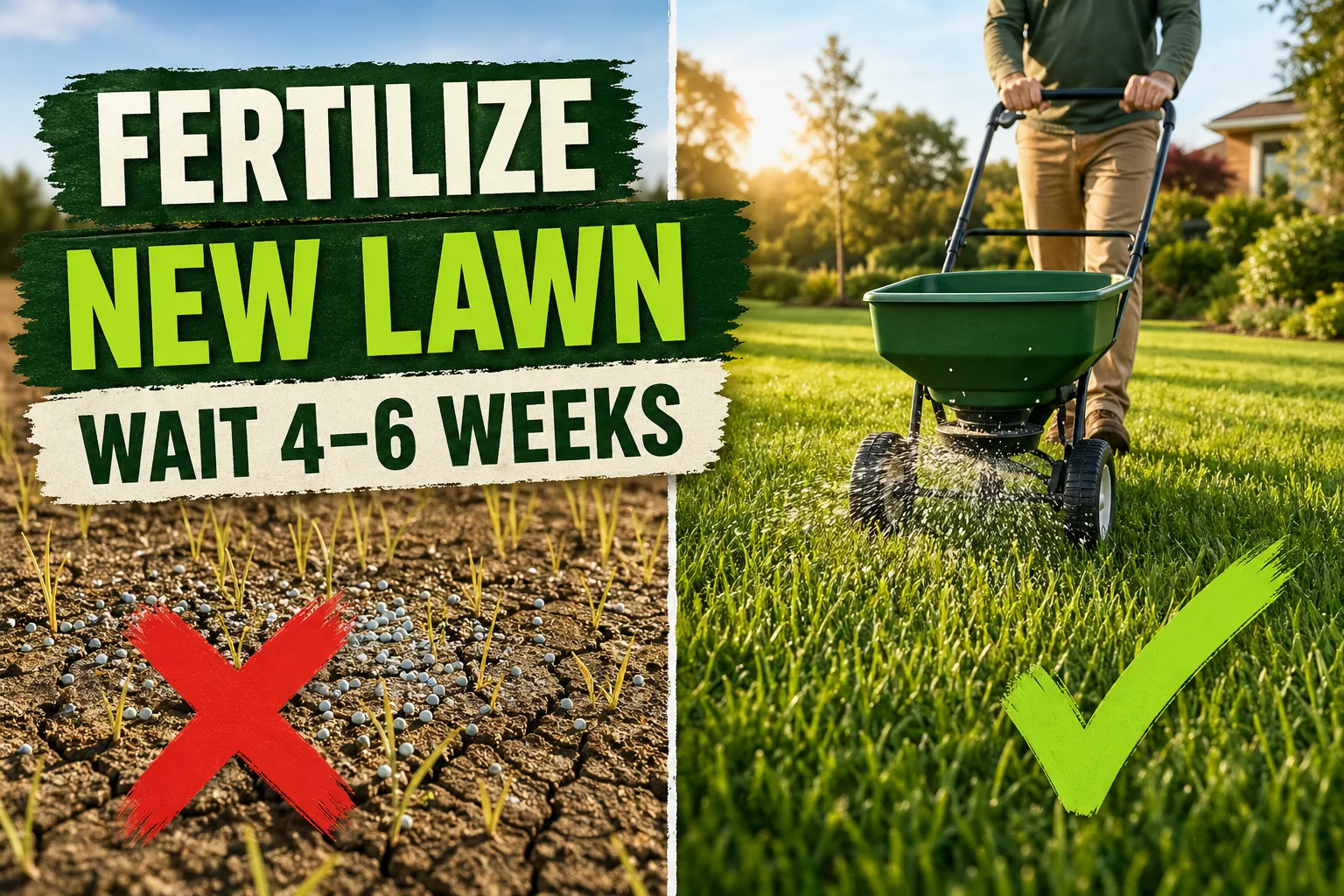
Wait 4–6 weeks after seeding before applying a regular lawn fertilizer. At seeding, you can apply a starter fertilizer (high phosphorus, e.g. 18-24-12) at around 2 kg per 100 m² (4 lb per 1000 sq ft) — never a high-nitrogen turf builder. Apply the second feed 4–6 weeks later, right after the first or second mow, using a balanced fertilizer at the bag rate.
Why timing matters: roots first, then blades
A grass seed germinates in 7–21 days. For the next 3–5 weeks, the seedling pours almost all of its energy into pushing roots downward, not blades upward. The roots at this stage are tiny, shallow (often less than 5 cm (2 in) deep), and extremely sensitive to salt.
Fertilizer is essentially a salt. Apply too much, too soon, and the soluble nitrogen draws water out of the seedling roots faster than they can replace it. The grass dehydrates and dies — what we call fertilizer burn.
Until those roots reach 8–10 cm (3–4 in) deep, which usually takes about 4–6 weeks, the seedlings can’t safely process a regular feed. That’s why the wait isn’t optional.
The safe waiting window by grass type
The 4–6 week rule applies to almost every lawn, but the specifics shift slightly by grass type and season.
Cool-season grasses (tall fescue, perennial ryegrass, Kentucky bluegrass, fine fescues):
- Starter fertilizer: at seeding or within 7 days
- First maintenance feed: 4–6 weeks after seeding, right after the first mow
- Soil temperature should be 13–24°C (55–75°F) when feeding
Warm-season grasses (Bermuda, zoysia, centipede, St. Augustine):
- Starter fertilizer: at seeding or within 7 days
- First maintenance feed: 4–6 weeks after seeding, once daytime temperatures hold above 21°C (70°F)
- Avoid feeding warm-season grasses going into autumn dormancy
The exception worth knowing. Some starter fertilizers labelled “safe at seeding” — typically with controlled-release nitrogen and high phosphorus, around 18-24-12 or 10-20-10 — can be applied directly at seeding, in the same spreader pass. That’s the only product class you should ever consider feeding before week 4.
Starter fertilizer vs maintenance fertilizer
These two products look similar in the bag and on the shelf, but they do completely different jobs. Picking the wrong one is the single biggest cause of failed new lawns.
| Starter fertilizer | Maintenance fertilizer | |
|---|---|---|
| NPK example | 18-24-12, 10-20-10 | 24-0-10, 20-5-10 |
| Phosphorus (middle) | High | Low or zero |
| Nitrogen | Lower, often slow-release | Higher, often fast-release |
| Job | Build roots | Push blades and colour |
| When | At seeding to week 4 | Week 4–6 onwards |
| Application rate | About 2 kg per 100 m² (4 lb per 1000 sq ft) | Per bag rate, usually 1.5–2 kg per 100 m² (3–4 lb per 1000 sq ft) |
Phosphorus (the middle number) drives root development. Nitrogen (the first number) drives top growth. New grass needs roots before it needs blades, so the starter formula is deliberately weighted toward phosphorus.
Note that some regions restrict phosphorus fertilizer use to protect waterways. If your area limits it, look for starter products labelled “low-phosphorus starter” — they substitute with controlled-release nitrogen and still work, just more slowly.
Signs you fertilized too early
If you applied a regular fertilizer too soon, the damage shows up fast — usually within 24–72 hours of the first watering after the application.
- Yellow or brown streaks following the line the spreader walked — a clear visual signature of fertilizer burn
- Wilting and curling of seedlings even when the soil is moist
- Dead patches in the heaviest-applied zones (overlap turns at the end of each pass are classic hotspots)
- Crusted white residue on the soil surface where granules sat undissolved
- Stalled germination — seed that should be sprouting at day 10 stays dormant
- Patchy growth with healthy seedlings next to bare strips, no obvious cause
If you spot these symptoms, water the area deeply — about 2.5 cm (1 in) of water — once a day for two to three days. The deep watering flushes excess salt below the root zone. Don’t apply more fertilizer, and don’t reseed the dead strips until the soil has been flushed for at least a week.
The correct first-fertilization protocol
Once the new lawn has been mowed once or twice and the seedlings stand around 7.5–10 cm (3–4 in) tall, you can move from starter to maintenance fertilizer. Here’s the protocol:
1. Mow first
Make sure the lawn has had at least one mow back to 5 cm (2 in) before you fertilize. Mowing signals to the grass to thicken sideways and tells you the roots are deep enough to support new growth.
2. Wait for dry blades
Apply fertilizer when the grass is dry but the soil underneath is moist. Wet blades hold granules against the leaf, which can scorch even healthy lawns.
3. Use a calibrated spreader
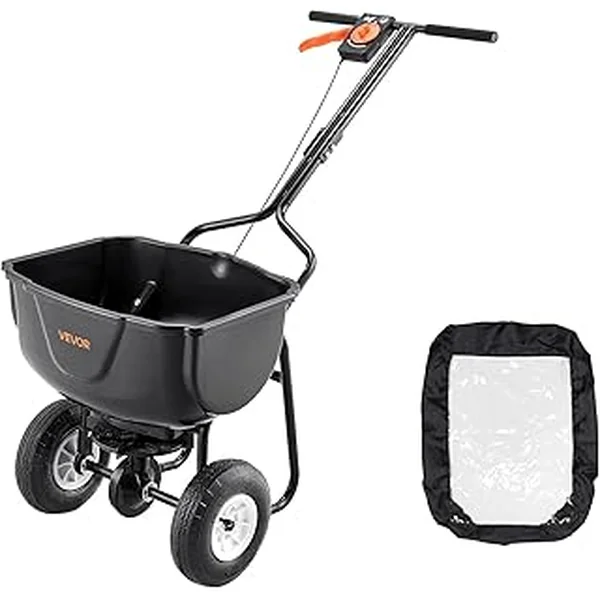
A broadcast (rotary) spreader at the rate marked on the bag. Walk in two perpendicular passes at half-rate each — once north–south, once east–west — for even coverage. Streaky single-direction passes are the #1 cause of post-fertilizer burn.
4. Water in within 24 hours
Apply about 1 cm (0.5 in) of water immediately after spreading. This dissolves the granules into the soil where the roots can take them up and washes any granules off the blades.
5. Track the next feed
For cool-season grasses, the next feed comes 6–8 weeks later. For warm-season grasses, every 4–6 weeks during active growth. A free plant care app like Tazart can hold the fertilizing schedule for you and adjust it for your local weather, soil type, and grass species — useful when the first 90 days of a new lawn are make-or-break.
Common mistakes to avoid
- Using a weed-and-feed at seeding. The pre-emergent herbicide in weed-and-feed kills grass seed too. Never apply it within 4 months of seeding or overseeding.
- Applying lawn winterizer in week 2. Winterizer is high in potassium and slow-release nitrogen — designed for established lawns, not seedlings. Wait until at least week 6.
- Skipping the starter feed entirely. Without phosphorus support, the seedlings root shallowly and the lawn thins out by mid-summer.
- Doubling the rate “to make up for the wait.” More fertilizer doesn’t mean faster growth — it means more burn. Stick to the bag rate.
- Feeding into a heatwave. If air temperature is above 29°C (85°F), wait. Heat plus nitrogen plus shallow roots equals dead grass.
- Not watering in. Granules left dry on the surface either blow away or burn the blades they’re touching. Always water in within 24 hours of any feed.
Troubleshooting
| Symptom | Cause | Fix |
|---|---|---|
| Yellow streaks following spreader path | Fertilizer burn from too-early or uneven application | Flush with 2.5 cm (1 in) of water daily for 3 days; reseed bare strips after 7 days |
| Seedlings stalled, no growth past 5 cm (2 in) | Phosphorus deficiency from no starter feed | Apply starter fertilizer at half rate, water in, wait 10 days |
| Lawn thick but pale yellow-green at week 6 | Nitrogen deficiency — first maintenance feed overdue | Apply balanced 20-5-10 fertilizer at bag rate, water in |
| Burnt patches in spreader-overlap zones | Double-applied fertilizer at turn points | Flush with deep water; spot-reseed once soil is flushed for a week |
| Crusted white residue on soil surface | Granules sat undissolved — under-watered after application | Water deeply once with 2.5 cm (1 in); switch to liquid feed for next round |
| New grass thinning at week 8 despite feeding | Mowing too short, not fertilizer-related | Raise mower to 7.5 cm (3 in) for the first season; never remove more than ⅓ of the blade |
Watch: timing your first fertilizer
A short visual walkthrough pairs well with the steps above. If you’re a visual learner, watch a credible tutorial like When and How to Fertilize a New Lawn on YouTube and then come back to follow the timing in this guide.
Related reading
- How to plant grass seed on an existing lawn — the full overseeding workflow that ends right where this fertilizing guide picks up.
- How to make compost at home — the cheapest topdress for a new lawn, and a great supplement to starter fertilizer.
- How to fix root rot on houseplants — the same nitrogen-burns-young-roots logic applies indoors.
- Track lawn watering, fertilizing, and mowing schedules with the free Tazart plant care app and let it adjust for your local weather.
A note on conditions
Every lawn is different. Soil type, grass species, sun exposure, slope, recent rainfall, and your local climate all shift how a new lawn responds to feeding week to week. Use the 4–6 week rule and the starter-then-maintenance protocol above as a starting point, then watch the lawn — yellowing, streaking, or stalled growth in the first 60 days are the signs that tell you whether to push on or back off.
Highly recommended
The supplies that make this guide work
Tazart is an Amazon Associate — we earn from qualifying purchases at no extra cost to you. Thank you for helping us keep these guides free.
Frequently asked questions
How long after seeding can I fertilize my lawn?
Wait 4–6 weeks after seeding before applying a regular maintenance fertilizer. By then the new grass has been mowed once or twice and the roots are deep enough to handle nitrogen without burning. The exception is starter fertilizer — high in phosphorus, low in fast nitrogen — which can be applied at seeding or within the first week to support root development.
Can you fertilize at the same time as seeding?
Yes, but only with a starter fertilizer formulated for new lawns (high phosphorus, e.g. 10-20-10 or 18-24-12). Regular lawn fertilizer applied at seeding will burn the seed and young roots. Starter fertilizer feeds the seedling's root system rather than pushing top growth and is the only safe feed in the first 4 weeks.
What fertilizer is safe for new grass seed?
A starter fertilizer with an NPK ratio that emphasizes phosphorus is safest at seeding — typical ratios are 10-20-10, 12-25-12, or 18-24-12. Apply at the bag rate, usually around 2 kg per 100 m² (4 lb per 1000 sq ft). Avoid weed-and-feed products, lawn winterizers, and high-nitrogen turf builders for the first 4–6 weeks.
Will fertilizer burn new grass seedlings?
Yes — too much nitrogen on shallow young roots draws moisture out of the seedlings and scorches them. Symptoms appear within 24–72 hours: yellow or brown streaks where the spreader passed, sudden wilting, and dead patches. If you see this, water deeply with 2.5 cm (1 in) of water for two to three days to flush the salts.
When should I apply the second fertilizer after seeding?
Apply the second feed 4–6 weeks after the first starter — usually right after the first or second mow. Use a balanced lawn fertilizer (around 20-5-10 or 24-0-10) at the bag rate. From that point, follow a normal seasonal schedule of 3–4 feeds per year for cool-season grasses and 4–6 for warm-season.
Is starter fertilizer different from regular lawn fertilizer?
Yes. Starter fertilizer is high in phosphorus (the middle number) to drive root development, with lower or slow-release nitrogen so it doesn't burn young seedlings. Regular maintenance fertilizer is high in nitrogen for blade growth and colour. Using regular fertilizer in place of starter is the most common cause of overseeding failure.