Edible
How Far Apart to Plant Sweet Potatoes (Slip Spacing for Big Tubers)
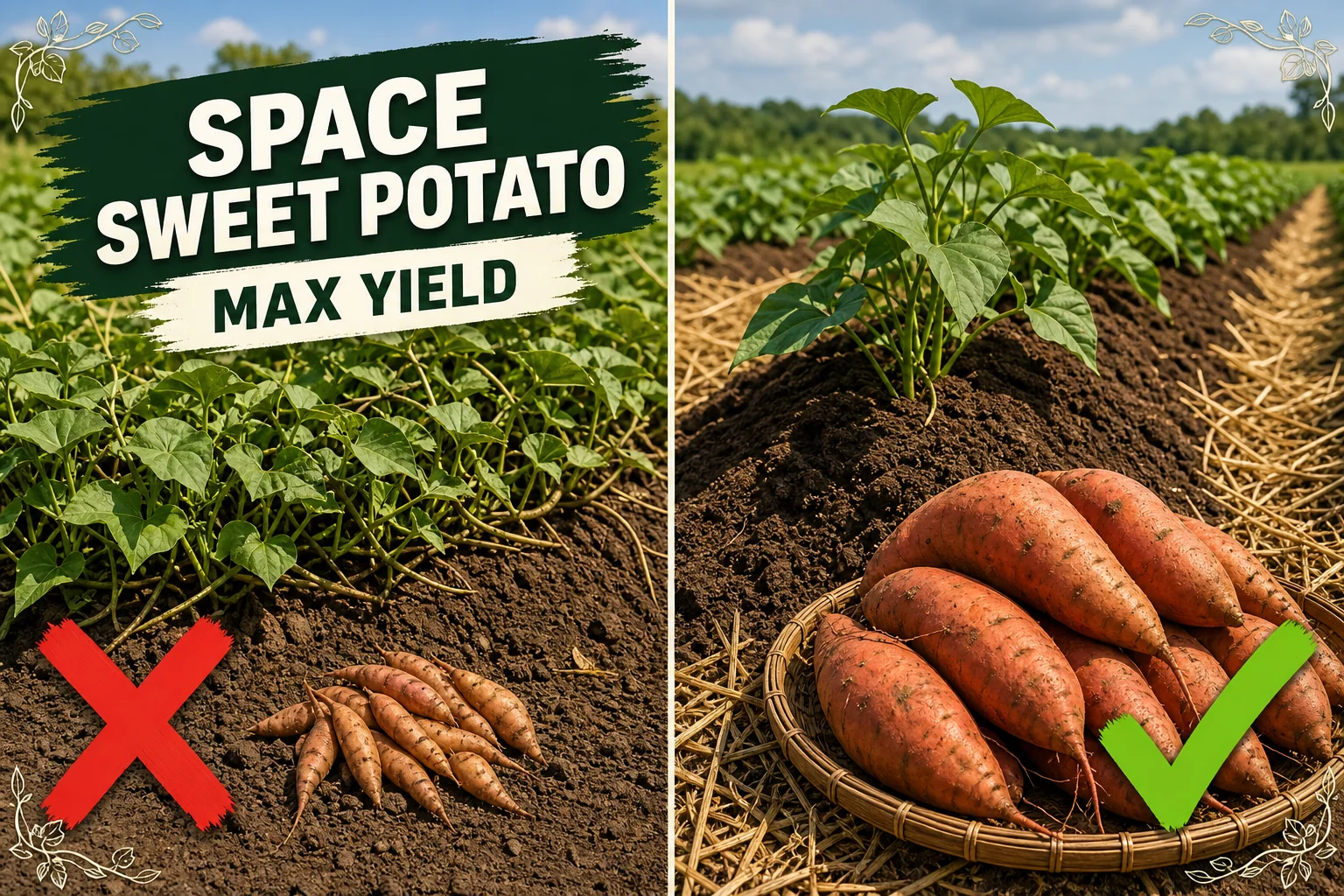
Plant sweet potato slips 30-45 cm (12-18 in) apart in rows 90-120 cm (3-4 ft) wide for maximum tuber size — full guide to spacing, hilling, soil prep, and harvest.
On this page
- Quick answer
- Why spacing matters more than almost any other variable
- Spacing at a glance
- In-row spacing: pick your tuber size
- Row spacing: don’t underestimate the vines
- Why hill them
- Soil preparation
- When to plant slips
- Planting slips step-by-step
- Watering schedule
- Harvest timing
- Curing for flavor and storage
- Common problems
- Related reading
- A note on conditions
Watch the visual walkthrough
Turn ONE Sweet Potato Into 100 LBS Of Sweet Potatoes By Growing SWEET POTATO SLIPS! [Complete Guide]
This video will teach you the BEST WAY to start sweet potato slips! Using this method, you can turn one sweet potato into 100 lbs ...
Sweet potato spacing is one of the most impactful single decisions you’ll make in your garden — too tight and you’ll harvest finger-size tubers; too loose and you waste bed space. This guide covers slip spacing, row width, hilling, and the full timeline from planting to cured harvest.
Quick answer
Plant sweet potato slips 30-45 cm (12-18 in) apart within the row, with rows 90-120 cm (3-4 ft) apart, on raised hills 20-25 cm (8-10 in) tall. Slips go 7-10 cm (3-4 in) deep with 2-3 nodes buried. Wait for soil at least 18°C (65°F). Harvest 90-120 days later, before first fall frost.
Why spacing matters more than almost any other variable
Sweet potatoes (Ipomoea batatas) are one of the few crops where spacing directly determines individual tuber size. Each plant has a fixed photosynthetic capacity — that energy gets divided among however many tubers form. More plants per square meter = more total tubers, but each tuber is smaller. Fewer plants per square meter = fewer tubers, but each one is larger.
For most home gardeners, 38-45 cm (15-18 in) spacing within the row hits the sweet spot: full-size baking and roasting tubers without wasted bed space.
Spacing at a glance
| Parameter | Measurement |
|---|---|
| Spacing within row | 30-45 cm (12-18 in) |
| Row spacing | 90-120 cm (3-4 ft) |
| Hill height | 20-25 cm (8-10 in) |
| Hill width at base | 60-90 cm (24-36 in) |
| Planting depth (slip) | 7-10 cm (3-4 in), with 2-3 nodes buried |
| Slips per 3 m (10 ft) row | 7-10 |
In-row spacing: pick your tuber size
The decision comes down to what you want to harvest:
| In-row spacing | Tuber result |
|---|---|
| 25-30 cm (10-12 in) | Many small to medium tubers, great for roasting whole |
| 30-38 cm (12-15 in) | Standard medium tubers, balanced yield |
| 38-45 cm (15-18 in) | Larger baking-size tubers, fewer per plant |
| 45+ cm (18+ in) | Very large tubers but reduced total yield per bed |
For a household that bakes and mashes sweet potatoes regularly, 38-45 cm (15-18 in) is the right call. For market growers selling roasting wedges, 30 cm (12 in) gives more sellable units per row.
Row spacing: don’t underestimate the vines
Sweet potato vines are aggressive runners. A single Beauregard plant can spread vines 1.8-3 m (6-10 ft) in every direction by mid-season. Two consequences:
- Rows must be 90-120 cm (3-4 ft) apart so vines from neighboring rows don’t form a tangled mat that’s impossible to harvest through.
- Train vines back into their own row every 2-3 weeks so they don’t root at the nodes where they touch bare soil — those rooted nodes form small competing tuber clusters that steal energy from the main plant.
In raised beds, plan a single row down the center for beds narrower than 90 cm (3 ft); two rows are only practical in beds 1.5 m (5 ft) wide or wider.
Why hill them
Hilling is the difference between average sweet potato yields and excellent ones.
Three reasons hills work:
- Drainage. Sweet potatoes rot in standing water. Hills shed rain rather than holding it.
- Warmer soil. A hill catches more sun and warms 3-5°C (5-10°F) faster than flat ground in spring — which lets you plant earlier.
- Loose, deep growing medium. Tubers expand outward and downward; rocky or compact subsoil deforms them. A hill is essentially a deep, soft, drainage-friendly cushion.
How to form hills:
- Use a hoe or shovel to mound soil into long ridges 20-25 cm (8-10 in) tall and 60-90 cm (24-36 in) wide at the base.
- Form hills 1-2 weeks before planting so soil settles and warms.
- Add 5 cm (2 in) of compost mixed into the top of each hill before planting slips.
Unlike white potatoes, you do NOT hill up around growing sweet potato plants. Form the hills first, then plant slips into established hills.
Soil preparation
Sweet potatoes are forgiving of mediocre soil but reward sandy, well-draining soil with the largest tubers.
What sweet potatoes need:
- pH 5.8-6.5 — slightly acidic
- Loose, sandy or sandy loam soil — heavy clay produces stunted, deformed tubers
- Low to moderate nitrogen — too much nitrogen produces aggressive vines and poor tuber formation
- Adequate phosphorus and potassium — these are what build tuber size
How to prepare:
- Test soil pH if you’ve never tested the bed — adjust below 6.5 if needed with sulfur.
- Work 5 cm (2 in) of finished compost into hills, but skip high-nitrogen fertilizer.
- If your soil is heavy clay, build tall hills (25 cm / 10 in) and amend with sand and compost to lighten the texture.
- A balanced starter (e.g. 5-10-10) at planting provides the phosphorus and potassium tubers need without overdoing nitrogen.
When to plant slips
Sweet potatoes are tropical perennials grown as warm-season annuals in temperate gardens. They are extremely frost-sensitive.
Planting requirements:
- Soil temperature at 10 cm (4 in) deep at least 18°C (65°F), ideally 21-24°C (70-75°F)
- All risk of frost passed
- Daytime air temperatures consistently in the high 21-29°C (70-85°F) range
- Typically 3-4 weeks after the last frost date
| Region | Typical planting window |
|---|---|
| Gulf Coast / Florida | March – April |
| Mid-South / Southwest | April – May |
| Mid-Atlantic | Mid-May – early June |
| Midwest / Northeast | Late May – mid-June |
| Pacific Northwest | June (short-season varieties only) |
Planting slips step-by-step
- Soak slips in water for 1-2 hours before planting if they look wilted from shipping.
- Mark slip positions at 30-45 cm (12-18 in) apart along each hill.
- Make planting holes angled, with the bottom of the hole 7-10 cm (3-4 in) deep.
- Lay each slip in at an angle, burying 2-3 nodes (the leaf joints) and leaving the top 2-3 leaves exposed.
- Firm soil around the buried stem so there are no air pockets.
- Water in deeply — about 500 ml (17 fl oz) per slip.
- Continue light daily watering for the first 7-10 days until slips stand up and show new leaf growth.
Slips will look limp and sad for the first 3-5 days. This is normal. As long as the buried portion stays moist, new roots form within a week and the slip stands up.
Watering schedule
Sweet potato water needs change dramatically across the season:
| Stage | Water needs |
|---|---|
| Establishment (weeks 1-2) | Daily light watering, keep top 2.5 cm (1 in) of hill moist |
| Vegetative growth (weeks 3-8) | 2.5 cm (1 in) per week, deep weekly soakings |
| Tuber bulking (weeks 8-14) | 2.5 cm (1 in) per week, consistent (irregular = cracked tubers) |
| Pre-harvest (last 3 weeks) | Reduce watering to firm tubers and improve storage |
A drip line or soaker hose at the hill base is ideal — it keeps foliage dry (reducing fungal disease) and delivers water exactly where roots are.
Harvest timing
Sweet potatoes need 90-120 days from slip planting to harvest depending on variety:
| Variety | Days to maturity |
|---|---|
| Beauregard | 90-100 |
| Centennial | 90-100 |
| Jewel | 100-110 |
| Garnet | 110-120 |
Signs of maturity:
- Yellowing leaves and slight vine die-back
- Tubers visible at the surface when you brush back soil at the base of a plant
- Test-dig one plant — tubers should be 7.5-15 cm (3-6 in) long and full-bodied
How to harvest:
- Wait for a dry day after a stretch of dry weather — wet tubers don’t cure well.
- Cut vines back to make digging easier.
- Insert a digging fork well outside the base of the plant and lever upward.
- Carefully pull tubers free; brush off (don’t wash) loose soil.
- Move to a warm, humid curing space within 1-2 hours.
Critical: do not delay harvest past the first frost. Frost-killed vines turn black and decay rapidly, and the rot can spread down into tubers, ruining the whole crop.
Curing for flavor and storage
Freshly dug sweet potatoes are starchy and bland. Curing converts starches to sugars and heals minor skin nicks, giving you the sweet, well-flavored tubers that store for months.
Curing conditions:
- Temperature: 27-32°C (80-90°F)
- Humidity: 80-90%
- Duration: 7-14 days
- Setup: a warm spare room with a humidifier, a covered greenhouse, or a sealed cardboard box with a damp towel inside
After curing, store at 13-16°C (55-60°F) in a dark, well-ventilated space. Properly cured sweet potatoes keep 4-6 months. Refrigeration ruins them — never store below 13°C (55°F).
Common problems
Slips wilted and didn’t recover
Usually means soil dried out completely in the first 7-10 days. Daily watering is essential during establishment. Some loss is normal — order 10-15% extra slips to fill gaps.
Vines but no tubers
Almost always too much nitrogen or insufficient growing season. Stop nitrogen feeding entirely once vines are 60 cm (24 in) long. If your season is borderline (less than 100 frost-free days at 21°C / 70°F+), choose only fast-maturing varieties like Beauregard.
Small tubers
Either spacing too tight (under 30 cm / 12 in), insufficient growing season, or compact subsoil. Build deeper hills next year and re-check soil pH.
Cracked or split tubers
Inconsistent watering during the bulking phase. Heavy rain after a dry spell causes rapid tuber expansion that splits the skin. Steady weekly watering — drip irrigation makes this easy — prevents most cracking.
Wireworm or weevil damage
Tunneled or pitted tubers. Crop rotation (don’t plant sweet potatoes in the same bed two years in a row) is the primary control. Some growers add beneficial nematodes to the soil 1-2 weeks before planting.
Related reading
- How to plant sweet potato slips — companion guide focused on the planting technique itself.
- How far apart to plant potatoes — spacing guide for white potatoes (very different rules — both are tubers but they grow differently).
- How to plant potatoes in a bucket — small-space option if you don’t have garden bed room.
- How to plant okra — another warm-season crop that pairs well in the same bed rotation.
- Track your sweet potato planting date and 90-120 day harvest countdown with the free Tazart plant app — set alerts for hilling, mulching, and the harvest window.
A note on conditions
Sweet potato yields vary widely by variety, soil texture, season length, and local heat. Hot southern gardens in sandy loam consistently produce huge tubers; northern gardens in heavy clay struggle even with perfect spacing. Use this guide as your baseline and adjust hill height, spacing, and variety choice based on what your first season shows you.
Highly recommended
The supplies that make this guide work



Tazart is an Amazon Associate — we earn from qualifying purchases at no extra cost to you. Thank you for helping us keep these guides free.
Frequently asked questions
How far apart should sweet potato slips be planted?
Plant sweet potato slips 30-45 cm (12-18 in) apart within the row. Tighter spacing (30 cm / 12 in) gives more, smaller tubers per plant; wider spacing (45 cm / 18 in) gives fewer but larger tubers. For market-style baking-size potatoes, 38-45 cm (15-18 in) is ideal. For lots of small roasting-size tubers, 30 cm (12 in) is fine.
How wide should sweet potato rows be?
Space sweet potato rows 90-120 cm (3-4 ft) apart. Wide spacing matters because the vines run aggressively across the soil — 1.8-3 m (6-10 ft) per plant — and tight rows create a tangled mat that makes harvesting brutal and reduces airflow. In raised beds, a single row down the center works for narrow beds; double rows need at least 90 cm (3 ft) between centers.
How deep do you plant sweet potato slips?
Plant sweet potato slips so that 2-3 nodes (the leaf joints on the stem) are below soil level — typically 7-10 cm (3-4 in) deep. Lay the slip at a slight angle with the lower stem buried and the top 2-3 leaves above the surface. New roots and tubers form along the buried nodes, so deeper buried stem = more tuber-forming sites.
Do sweet potatoes need to be hilled?
Yes — sweet potatoes do best in raised hills or ridges 20-25 cm (8-10 in) tall. Hilling improves drainage (sweet potatoes rot in waterlogged soil), warms the soil faster in spring, and gives tubers room to develop without becoming malformed by hard or rocky subsoil. Form hills before planting; do not hill up around growing plants like you would with white potatoes.
How long do sweet potatoes take to grow?
Sweet potatoes need 90-120 days from slip planting to harvest depending on variety. Beauregard and Centennial mature in 90-100 days; Garnet and Jewel in 100-120 days. They need consistent warm temperatures — ideally daytime 24-29°C (75-85°F) — throughout that window. Frost ends the growing season, so harvest before the first fall frost or vines blacken and tuber quality drops.
Can sweet potatoes be grown in raised beds?
Yes, raised beds are excellent for sweet potatoes — they warm faster in spring, drain freely, and have loose soil that allows tubers to expand without deformity. Use a bed at least 30 cm (12 in) deep. A 1.2 m × 2.4 m (4 ft × 8 ft) bed comfortably holds a single row of 6-8 slips at 30-38 cm (12-15 in) spacing. Train vines off the bed edge to avoid them rooting and competing with the main plants.
When should I harvest sweet potatoes?
Harvest sweet potatoes 90-120 days after planting, before the first fall frost. Watch for yellowing leaves and slight vine die-back as a maturity signal. Dig carefully with a fork well outside the plant base to avoid spearing tubers. Cure harvested tubers at 27-32°C (80-90°F) and 80-90% humidity for 7-14 days — this heals minor skin nicks and converts starches to sugars, dramatically improving flavor and storage life.
Why are my sweet potatoes small?
Common causes: spacing too tight (less than 30 cm / 12 in), too much nitrogen fertilizer (encourages vines at the expense of tubers), insufficient growing season (less than 90 days of warm weather), or shallow planting that didn't bury enough nodes for tuber formation. Also check for compact or rocky subsoil — tubers can't expand and stay small or grow deformed.