Edible
How Far Apart to Plant Okra (Row Spacing for Maximum Pod Yield)
Plant okra 30-45 cm (12-18 in) apart in rows 90 cm (3 ft) wide for top yield — full guide to spacing, thinning, dwarf vs tall varieties, and succession sowing.
On this page
- Quick answer
- Why okra spacing matters more than most crops
- Spacing at a glance
- Compact vs tall varieties
- Why 90 cm (3 ft) row spacing
- Thinning is non-optional
- How many plants per person
- Square foot gardening
- Container spacing
- Soil preparation matters with spacing
- Watering by spacing
- Companion planting and rotation
- Common spacing mistakes
- Harvest rhythm = the other half of yield
- Related reading
- A note on conditions
Watch the visual walkthrough
5 Tips How to Grow a Ton of Okra in a Raised Garden Bed
If you would like to know how to grow a big harvest of okra watch this video for my five top tips on okra growing! Support me on ...
Spacing is the single biggest yield-driver for okra. Plants too close stay small, get diseased, and produce poorly; plants too wide waste bed space. This guide gives you exact in-row and row-spacing numbers by variety type, plus the thinning, fertilizing, and harvest rhythm that turn good spacing into a season of continuous pod harvests.
Quick answer
Plant okra 30-45 cm (12-18 in) apart within rows, with rows 90 cm (3 ft) apart. Use 30 cm (12 in) for compact varieties in raised beds, 38-45 cm (15-18 in) for tall in-ground varieties. Sow 2-3 seeds per station then thin to one strong plant. Wait for soil at least 18°C (65°F). Harvest pods at 7-10 cm (3-4 in) every 1-2 days.
Why okra spacing matters more than most crops
Okra (Abelmoschus esculentus) gets very tall — 1.2-1.8 m (4-6 ft) for most home varieties — and runs through a long, hot, humid growing season. Three things go wrong when plants are too close:
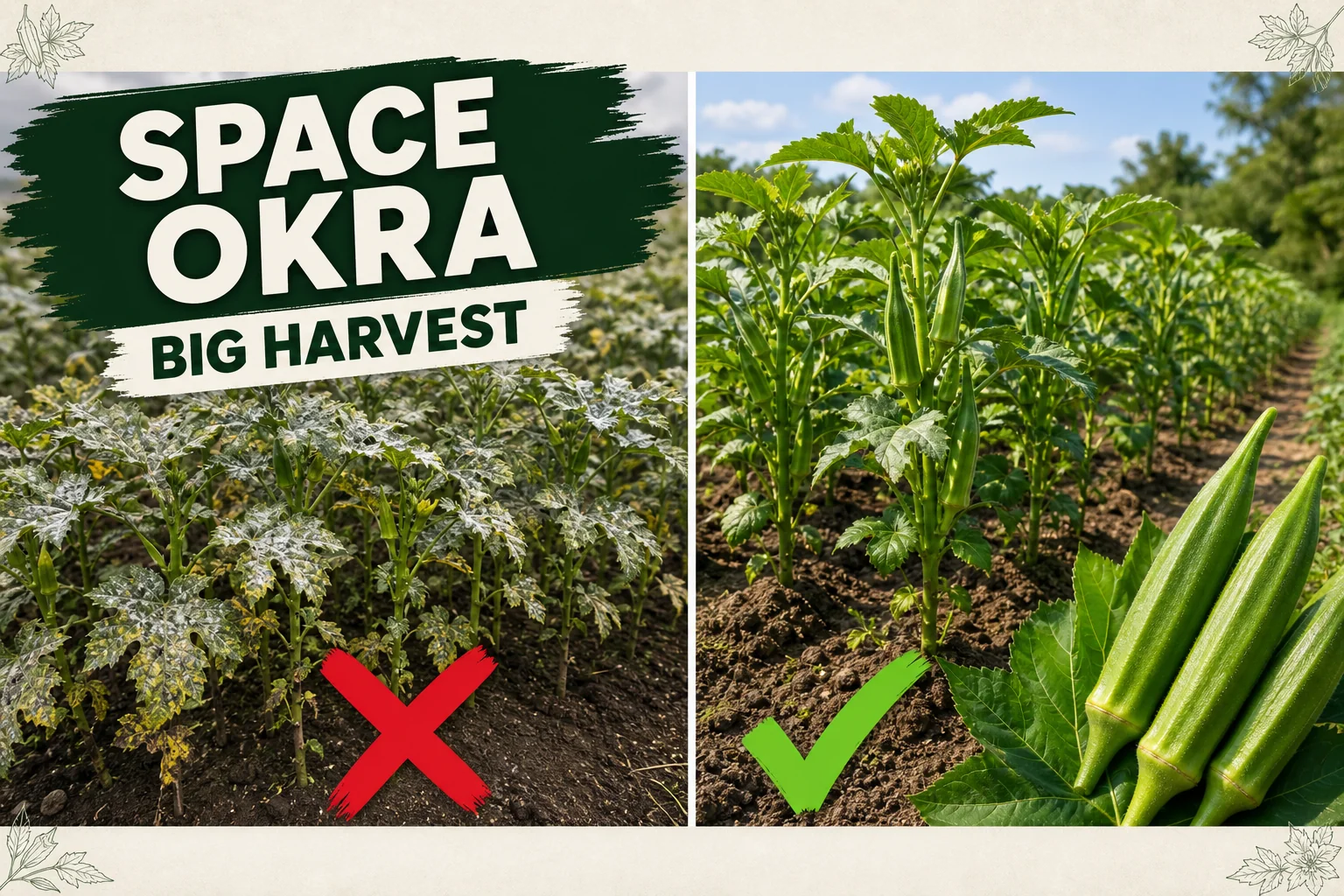
- Powdery mildew explodes mid-summer as airflow drops between crowded plants.
- Daily harvest becomes impossible — you can’t reach every pod, and missed pods turn woody.
- Plants compete for light and produce fewer flowers per plant, dropping total yield.
Adequate spacing fixes all three at once. It’s not optional — it’s the foundation of an okra row that produces from June through frost.
Spacing at a glance
| Parameter | Compact varieties | Tall varieties |
|---|---|---|
| In-row spacing | 30 cm (12 in) | 38-45 cm (15-18 in) |
| Row spacing | 75-90 cm (2.5-3 ft) | 90 cm (3 ft) |
| Mature plant height | 60-90 cm (2-3 ft) | 1.2-1.8 m (4-6 ft) |
| Plants per 3 m (10 ft) row | 9-10 | 7-8 |
| Sowing depth | 2.5 cm (1 in) | 2.5 cm (1 in) |
| Seeds per station | 2-3 (thin to 1) | 2-3 (thin to 1) |
Compact vs tall varieties
Variety choice locks in your spacing strategy:
| Type | Examples | Height | Best spacing | Use case |
|---|---|---|---|---|
| Compact / dwarf | Baby Bubba, Cajun Delight | 60-90 cm (2-3 ft) | 30 cm (12 in) in row, 75-90 cm (30-36 in) rows | Raised beds, containers, square foot gardens |
| Standard tall | Clemson Spineless, Jambalaya | 1.2-1.5 m (4-5 ft) | 38 cm (15 in) in row, 90 cm (3 ft) rows | Standard in-ground gardens |
| Heirloom tall | Cow Horn, Alabama Red, Hill Country Red | 1.5-1.8 m (5-6 ft) | 45 cm (18 in) in row, 90 cm (3 ft) rows | Long-summer regions, big yields per plant |
Compact varieties give more plants per square meter; tall varieties give more pods per plant. Total pod yield per square meter is roughly similar — the trade-off is in plant size, harvest convenience, and how visible the row is in the garden.
Why 90 cm (3 ft) row spacing
Most spacing guides round down to 60 cm (2 ft) row spacing for okra. That’s wrong for any variety taller than 90 cm (3 ft).
The 90 cm (3 ft) row spacing exists because:
- Mature plants are 1.2-1.8 m (4-6 ft) tall with significant lateral branching — they will close the canopy at 60 cm (2 ft) row spacing
- You must walk every row daily at peak season to harvest pods — narrower rows snag clothing and break flower stalks
- Airflow prevents powdery mildew — by far the most common late-season disease
- Sunlight reaches lower leaves and emerging pods — closely spaced rows shade lower pods, slowing development
Compact varieties under 90 cm (3 ft) tall can use 75 cm (2.5 ft) row spacing. Anything taller — stick with the full 90 cm (3 ft).
Thinning is non-optional
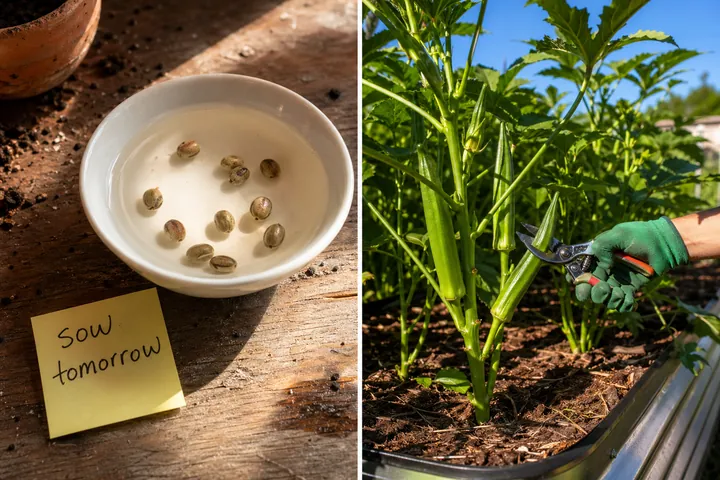
Sowing 2-3 seeds per station is insurance against patchy germination — but you must thin to one strong plant per station once seedlings have 2-3 true leaves.
How to thin:
- Identify the strongest, most upright seedling at each station.
- Cut the others at soil level with sharp scissors — do NOT pull.
- Pulling disturbs the taproot of the keeper plant, which sets it back 1-2 weeks.
Skipping the thin produces 2-3 small spindly plants per station instead of one robust one. Total yield drops sharply, and disease pressure climbs.
How many plants per person
| Use | Plants per person |
|---|---|
| Fresh eating during peak season | 3-5 |
| Heavy fresh use + giving away | 5-8 |
| Canning, freezing, or pickling | 6-10 |
A single mature okra plant in good conditions produces 25-50 pods across an 8-12 week harvest window. Five plants at 38 cm (15 in) spacing fit in a 1.8 m (6 ft) row.
Square foot gardening
Okra is a borderline fit for square foot gardens because of plant height, but compact varieties work:
- One compact plant per 30 × 30 cm (12 × 12 in) square — Baby Bubba or Cajun Delight only.
- Site on the north edge of the bed so 60-90 cm (2-3 ft) plants don’t shade other squares.
- Tall varieties don’t fit — they need full 38-45 cm (15-18 in) spacing and shade everything around them.
Container spacing
Okra grows well in containers if the pot is big enough:
| Container size | Plants per pot | Best variety |
|---|---|---|
| 19 L (5 gal) | 1 | Compact only (Baby Bubba) |
| 38 L (10 gal) | 1-2 | Standard or compact |
| 76 L (20 gal) | 2-3 | Standard or compact |
| Large half-barrel | 3-4 | Any |
Whatever the container, maintain 30 cm (12 in) between plants and water consistently — containers dry faster than ground beds.
Soil preparation matters with spacing
Wider spacing only delivers its yield benefit if soil supports each plant. For row-grown okra:
- pH 6.0-6.8 — slightly acidic to neutral
- Loose, deep, well-draining — the taproot goes 90 cm (3 ft) down in mature plants
- Compost-amended — 5 cm (2 in) of finished compost worked into the top 20 cm (8 in) before sowing
- Skip nitrogen at planting — too much nitrogen early gives foliage at the expense of pods
Side-dress with balanced organic granular fertilizer once the first flower buds appear (50-60 days after sowing) and repeat every 4-6 weeks through the season.
Watering by spacing
Wider-spaced plants have better access to soil moisture and need less watering than crowded plants — but consistent moisture is still essential.
| Stage | Water |
|---|---|
| Germination (days 1-14) | Keep top 2.5 cm (1 in) moist daily |
| Establishment (weeks 2-6) | 2.5 cm (1 in) per week deep |
| Flowering and pod set (weeks 6-16) | 2.5-5 cm (1-2 in) per week |
A drip line down the row at the base of plants is ideal — keeps foliage dry, reduces fungal disease, and uses water efficiently.
Companion planting and rotation
Okra fits well in mixed warm-season vegetable beds:
Good companions:
- Basil (deters pests, similar conditions)
- Peppers (similar heat and sun needs, lower-growing)
- Bush beans (nitrogen-fixers, finish before okra peaks)
- Summer squash (low-spreading, doesn’t compete vertically)
Avoid planting near:
- Sweet potatoes (can root-compete heavily)
- Anything that will shade the okra row from morning or afternoon sun
For crop rotation, don’t plant okra in the same bed two years in a row — rotate with legumes, brassicas, or alliums to reduce soil-borne disease pressure.
Common spacing mistakes
Planting too close to “save space”
The yield trade-off doesn’t work in your favor. Two plants at 15 cm (6 in) spacing produce roughly the same total pods as one plant at 30 cm (12 in) — and they get more disease, fall over more easily, and are harder to harvest. Stick to recommended spacing.
Not thinning at the seedling stage
Multiple seedlings per station is the most common reason gardens look “crowded” even at correct station spacing. Thin ruthlessly to one plant per station.
Using bush-bean row spacing
Some gardeners default to 60 cm (2 ft) row spacing because that’s what they use for tomatoes or peppers. Okra needs more — 90 cm (3 ft) — because of its height and disease pressure.
Compact spacing for tall varieties
Planting Cow Horn at 30 cm (12 in) spacing produces a mat of unhappy plants. Match the spacing to the variety: tall = wide, compact = closer.
Harvest rhythm = the other half of yield
Spacing gets you to a healthy productive plant. Daily harvesting keeps it producing.
Rules:
- Check plants every 1-2 days once pod-set begins
- Snip pods at 7-10 cm (3-4 in) — the moment they go past 12 cm (5 in) they turn woody
- Even unwanted oversized pods must be removed — leaving them signals the plant to slow new bud formation
- Wear gloves and long sleeves — okra pods and stems have fine bristles that irritate skin
Related reading
- How to plant okra — companion guide focused on the planting method itself.
- How far apart to plant peppers — spacing for another warm-season crop with similar conditions.
- How to grow bell peppers — full-season care for a great okra companion.
- How far apart to plant tomatoes — spacing strategy for the other heat-loving staple.
- Track your okra spacing, thinning, and daily-harvest reminders with the free Tazart plant app — set alerts for first flower, fertilizer side-dress, and pod-check checks.
A note on conditions
Okra spacing rules vary slightly by region — humid southeastern gardens benefit most from the wider 90 cm (3 ft) row spacing (disease pressure is higher), while drier western gardens can get away with slightly narrower rows. Use this guide as your baseline and adjust based on what your plants show you in the first month — that’s how every experienced vegetable gardener calibrates their bed.
Highly recommended
The supplies that make this guide work



Tazart is an Amazon Associate — we earn from qualifying purchases at no extra cost to you. Thank you for helping us keep these guides free.
Frequently asked questions
How far apart should okra plants be spaced?
Space okra plants 30-45 cm (12-18 in) apart within the row. Tighter spacing (30 cm / 12 in) works for compact varieties like Clemson Spineless or Jambalaya in raised beds. Wider spacing (45 cm / 18 in) is better for tall open-pollinated varieties like Cow Horn or Alabama Red that grow 1.5-1.8 m (5-6 ft) tall and need room to spread.
How wide should okra rows be?
Space okra rows 90 cm (3 ft) apart. Wider row spacing matters because mature plants reach 1.2-1.8 m (4-6 ft) tall and need full airflow to prevent powdery mildew and aphid buildup. Tight rows also make daily harvest difficult — and okra requires daily harvesting in peak summer to keep pods tender. Three feet gives you room to walk and pick without damaging plants.
Do you need to thin okra seedlings?
Yes — thin okra seedlings to one strong plant per station once they have 2-3 true leaves. Snip extras at soil level with scissors rather than pulling, which can disturb the keeper plant's taproot. Crowded okra stays small, produces fewer pods, and is far more susceptible to fungal disease. Thinning is non-optional for serious yield.
How many okra plants should I grow per person?
Plan 3-5 okra plants per person for fresh eating during peak season. A single mature plant in good conditions produces 25-50 pods over the season. For canning or freezing, double that to 6-10 plants per person. Five plants spaced 38 cm (15 in) apart fit comfortably in a 1.8 m (6 ft) row.
Can okra be grown in raised beds?
Yes, raised beds suit okra well — they warm faster in spring (helping hit the 18°C / 65°F soil temperature okra needs), drain freely, and have loose deep soil. In a raised bed, 30 cm (12 in) plant spacing works for compact varieties. Choose dwarf varieties like Baby Bubba or Cajun Delight (60-90 cm / 2-3 ft tall) for raised beds where you don't want plants towering over neighboring crops.
What is the difference between dwarf and tall okra varieties?
Dwarf okra varieties (Baby Bubba, Cajun Delight) grow 60-90 cm (2-3 ft) tall and tolerate 30 cm (12 in) spacing, making them ideal for raised beds and containers. Tall varieties (Clemson Spineless, Cow Horn, Alabama Red) reach 1.2-1.8 m (4-6 ft) and need 45 cm (18 in) spacing plus 90 cm (3 ft) row spacing. Tall types generally produce more total pods per plant; dwarf types produce more pods per square meter.
Should okra be succession planted?
Succession planting okra is rarely needed — a single planting produces continuously for 8-12 weeks if you harvest pods every 1-2 days. The exception is if you want a second wave of younger plants to extend the season; in long-summer regions (Gulf Coast, Florida), a second sowing 4-6 weeks after the first gives a fresh batch of plants when older ones tire late summer.
How close can okra plants be in a square foot garden?
In a square foot garden, plant one dwarf okra plant per square foot (30 × 30 cm / 12 × 12 in square). Tall varieties don't fit the square foot model well — they need more soil volume and shade neighboring squares. Stick to compact varieties like Baby Bubba or Cajun Delight for square foot beds, and site them on the north end so they don't shade other crops.