Flowers
How Far Apart to Plant Gladiolus Bulbs for Big Blooms
How far apart to plant gladiolus bulbs? Space corms 10–15 cm (4–6 in) apart, rows 30 cm (12 in) wide. Full spacing chart, group planting tips, and row layout inside.
On this page
- Table of contents
- Why spacing matters for gladiolus
- Standard spacing chart
- Row layout vs. cluster planting
- Spacing for containers
- How many corms fit per bed?
- Step-by-step planting guide
- Staking and care after planting
- Common spacing mistakes
- Troubleshooting crowded gladiolus
- Watch: how to plant gladiolus for a full season of blooms
- Related reading
Watch the visual walkthrough
Gladiolus // How to Plant, Grow, Harvest, and Store Gladiolus Corms// Northlawn Flower Farm
Gladiolus are grown from corms, and the corm contains all the necessary food and energy to produce a glorious flower spike with ...
Gladiolus corms planted too close together behave almost identically to corms planted too shallow: they produce weak, thin stems that struggle to bloom well. The fix is giving each corm its own space — and the rule is simpler than most guides make it sound.
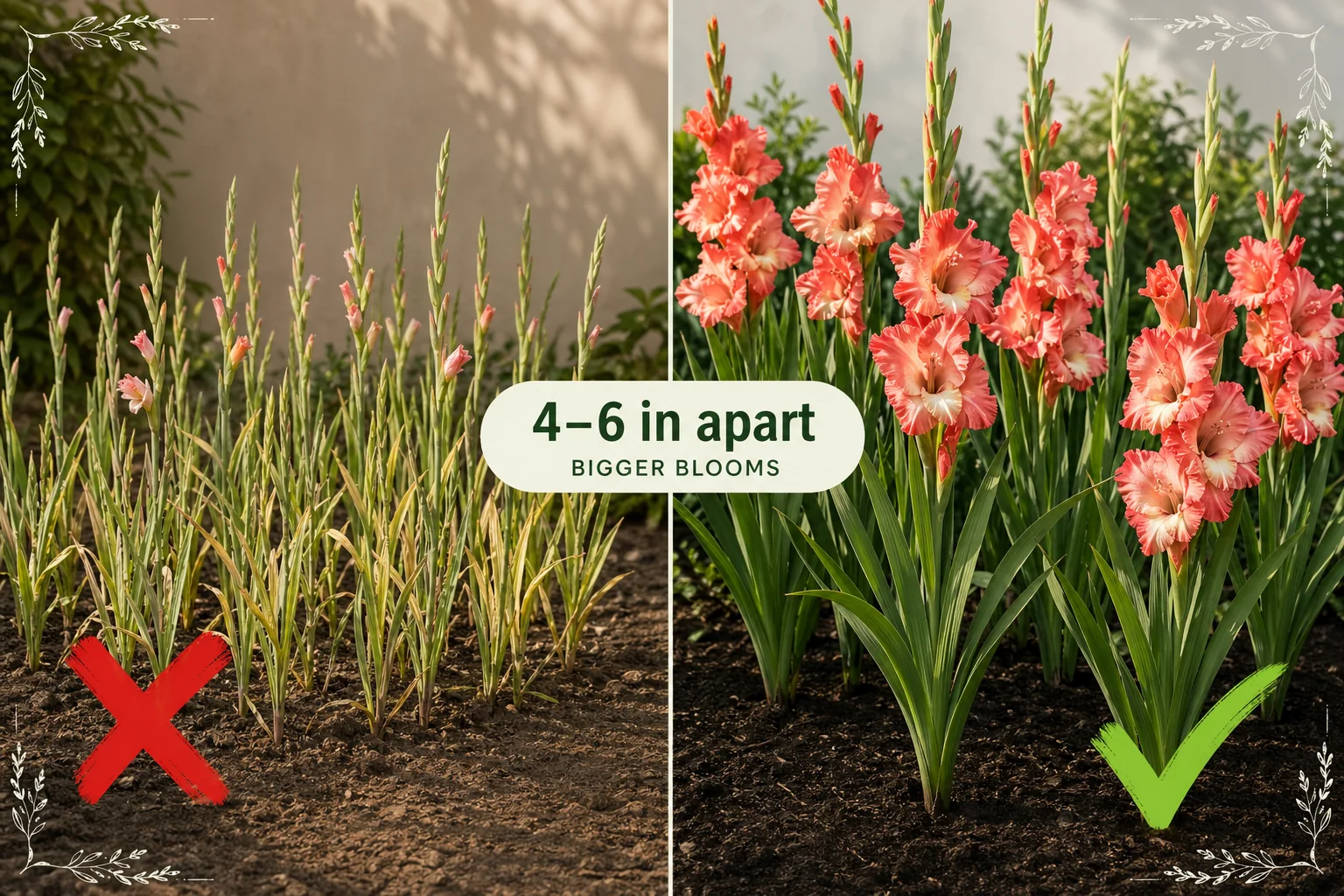
Space gladiolus corms 10–15 cm (4–6 in) apart, with rows 30 cm (12 in) wide. That single measurement covers the vast majority of home garden situations, from cottage-garden clusters to cut-flower rows. The rest of this guide explains what happens if you deviate, how to lay out different planting styles, and how to squeeze the most blooms from a small plot.
Quick answer: Plant gladiolus corms 10–15 cm (4–6 in) apart in all directions. Space rows 30 cm (12 in) apart. For tight cut-flower production, 10 cm (4 in) between corms is the minimum — any closer and you get thin stems and disease. For exhibition-quality single spikes, push to 20 cm (8 in) and stake each corm individually.
Table of contents
- Why spacing matters for gladiolus
- Standard spacing chart
- Row layout vs. cluster planting
- Spacing for containers
- How many corms fit per bed?
- Step-by-step planting guide
- Staking and care after planting
- Common spacing mistakes
- Troubleshooting crowded gladiolus
- FAQs
Why spacing matters for gladiolus
Gladiolus (family Iridaceae) grow from corms — swollen stem bases that store a full season’s energy. Each corm produces one flower spike, one or two side shoots, and a brand-new replacement corm that forms on top of the old one by autumn. That replacement corm needs to be as large and energy-dense as possible if you want strong blooms the following year.
Crowding attacks the plant at every stage:
- Underground: Roots from adjacent corms overlap and compete for water and nutrients. Each corm gets less than it would alone, so the replacement corm shrinks.
- At soil level: Congested stems rub, which opens wounds that invite fungal pathogens like Fusarium and Botrytis.
- Above ground: Dense foliage blocks light and traps humid air — the ideal environment for thrips and grey mould.
Proper spacing — 10–15 cm (4–6 in) between corms — eliminates all three problems at once. It is the single highest-leverage thing you can do for gladiolus quality, and it costs nothing.
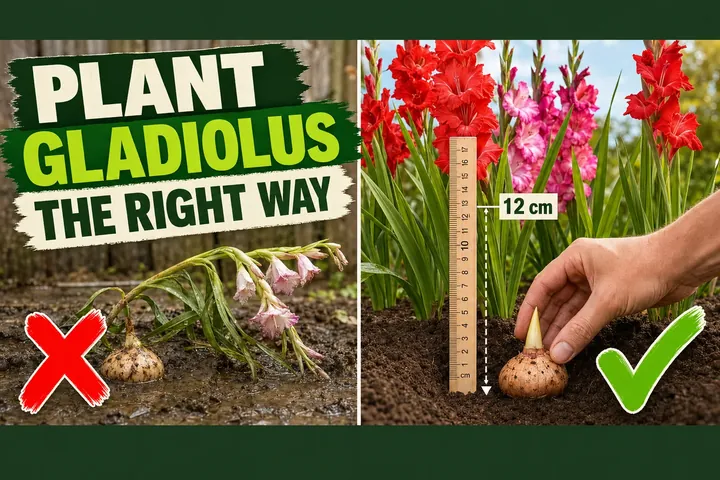
For depth guidance (which works together with spacing), see our companion post on how deep to plant gladiolus bulbs.
Standard spacing chart
The right spacing depends on what you want from the planting:
| Goal | Corm spacing | Row spacing | Notes |
|---|---|---|---|
| Cut flower production | 10 cm (4 in) | 30 cm (12 in) | Tight rows; individual spikes thinner but output per m² is high |
| Garden display (most home gardeners) | 15 cm (6 in) | 30 cm (12 in) | Best balance of spike quality and corm regeneration |
| Exhibition / show blooms | 20 cm (8 in) | 40 cm (16 in) | Maximum spike width and floret count; stake every corm individually |
| Container planting | 10–12 cm (4–5 in) | n/a — plant in a circle | 3–5 corms per pot minimum 30 cm (12 in) wide |
| Cluster / naturalistic border | 10–15 cm (4–6 in) | n/a — loose group | 5–7 corms per cluster, clusters 45–60 cm (18–24 in) apart |
The same logic applies regardless of gladiolus variety — the diameter of the corm changes the planting depth (see the companion depth guide), but spacing stays at 10–15 cm (4–6 in) across all variety sizes.
Row layout vs. cluster planting
Row planting (cut flower style)
Row planting is the default for anyone who wants a steady supply of stems to cut. It is efficient, easy to stake, and simple to weed.
For the complete planting process — from corm selection through soil prep, hole depth, and first watering — the gladiolus bulb planting guide pairs with this spacing reference as the step-by-step companion.
Set up a string line for each row, spaced 30 cm (12 in) from the previous row. Dig a flat-bottomed trench 10–15 cm (4–6 in) deep along the string. Drop corms into the trench with 10–15 cm (4–6 in) between each one, pointed tip up. Backfill, firm gently, and water once.
Succession planting in rows: Plant one row every 14 days from last frost until 10 weeks before your first autumn frost. That gives you a continuous harvest of fresh spikes rather than a single two-week flush. Label each row with the planting date so you know when to expect blooms.
Cluster planting (cottage garden style)
If you want gladiolus to look more naturalistic in a mixed border, skip the rows and plant in loose clusters of 5–7 corms. Keep each corm 10–15 cm (4–6 in) from its neighbours within the cluster. Space clusters 45–60 cm (18–24 in) apart so they read as distinct groups.
Stagger the corms within a cluster slightly in depth — half at 12 cm (4.5 in), half at 10 cm (4 in) — so the spikes open across a 7–10 day window rather than all at once. This extends the display of a single cluster without needing to succession plant.
Plant a taller variety in the back clusters and a shorter variety in the front to build depth. Classic cottage-garden planting of glads often combines coral, cream, and deep burgundy varieties in adjacent clusters for a lush effect.
Spacing for containers
Gladiolus can be grown in pots, but containers are less forgiving than open ground because:
- Moisture swings are more extreme (bone dry vs. waterlogged within hours)
- Nutrients exhaust faster in a confined volume
- Corms cannot spread roots to find water
The minimum workable container is 30 cm (12 in) wide and 30 cm (12 in) deep — enough room for 3–5 standard corms.
Plant corms 10–12 cm (4–5 in) apart in a loose circle or triangle within the pot. Use a free-draining mix — 60% peat-free potting compost and 40% perlite or coarse grit. Water only when the top 5 cm (2 in) of mix feels dry. Feed with a balanced liquid fertilizer every two weeks once shoots are 15 cm (6 in) tall.
One corm per pot looks sparse and produces a single stem that is awkward to stake. Group 3–5 corms in one pot for a bouquet-like effect; the stems support each other and are far easier to manage.
How many corms fit per bed?
At the standard 15 cm (6 in) spacing (both between corms and between rows), a 1 m × 1 m (3 ft × 3 ft) bed holds roughly 40–45 corms — about 4 corms per 900 cm² (1 sq ft).
At the tight 10 cm (4 in) cut-flower spacing, the same bed holds around 80–100 corms, though yield per plant drops. The practical difference shows at harvest: tight-packed corms produce narrower spikes but more stems per square metre.
| Spacing | Corms per m² | Corms per sq ft | Spike quality |
|---|---|---|---|
| 10 cm (4 in) | ~100 | ~9 | Good — slightly narrower |
| 15 cm (6 in) | ~44 | ~4 | Excellent — full-width spikes |
| 20 cm (8 in) | ~25 | ~2.3 | Show-quality — maximum floret count |
These are approximate — real beds have irregular edges and pathway margins. A common beginner mistake is calculating a tight-spacing figure on paper and then crowding an even smaller bed, forgetting that the corms at the edges of the bed also need their full 10–15 cm (4–6 in) from the bed boundary.
Step-by-step planting guide
1. Mark your row lines or cluster positions
Stretch a string between two stakes for each row, or mark cluster centres with a short cane. Get the layout right before you dig — it is much harder to correct underground once you have started.
For rows, spacing 30 cm (12 in) between string lines means an adult can comfortably step between them without stepping on corms. If you cannot walk between rows, your rows are too close.
2. Dig trenches or individual holes at the right depth
For rows, a flat-bottomed trench 12–15 cm (4.5–6 in) deep is faster than individual holes. For clusters, dig individual holes. Refer to the how deep to plant gladiolus bulbs guide for exact depth by corm grade.
Work a handful of organic bone meal or balanced granular fertilizer into the base of the trench before setting corms — phosphorus at the root zone accelerates establishment.
3. Set corms pointed-side up at the correct spacing
Use a marked ruler or a cane with notches every 10 cm (4 in) to keep spacing consistent. Set each corm pointed-side up, measuring 10–15 cm (4–6 in) from the edge of one corm to the edge of the next, not centre to centre (the difference matters for large jumbo corms).
If you are planting a mix of corm sizes, plant the larger corms at the back of a border where they will be tallest; smaller grades in front.
4. Backfill and firm gently
Push the loose soil back over the corms and press down lightly with the back of your hand. Do not stomp — compact soil slows emergence and increases the risk of rot on the newly planted corm.
5. Water once, then stop
Water the whole bed thoroughly immediately after planting to settle soil around each corm. Then do not water again until green shoots appear, typically 2–3 weeks later. Corms sitting in cool moist soil with no leaves yet have no way to use the water — it just pools around the corm and promotes rot.
6. Mark planting dates for succession planning
If you are staggering plantings every 14 days, label each row or section with the planting date. This saves confusion at harvest time (and at digging time in autumn, when corms from different planting waves may be at different stages of ripeness).
Staking and care after planting
Even perfectly spaced gladiolus need support once they start growing, because the top-heavy flower spike creates a leverage problem no amount of good spacing can solve.
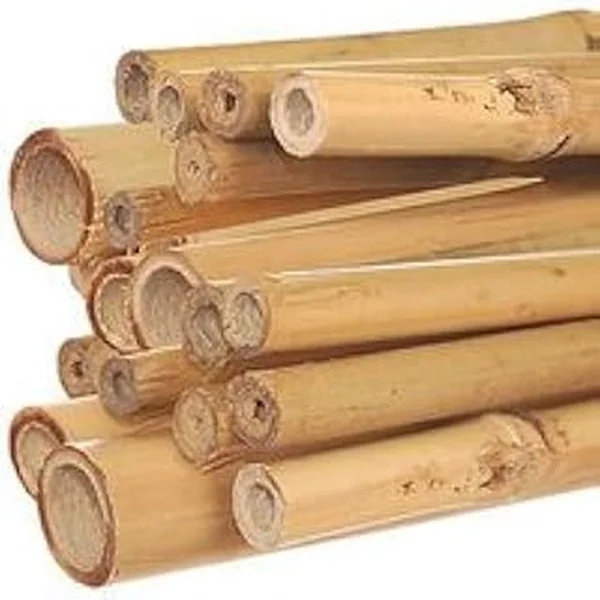
Stake when shoots reach 50 cm (20 in) — before the spike has developed enough to flop. A bamboo cane pushed into the soil beside the corm and a single loose tie at the top of the foliage is enough for most standard varieties. Jumbo varieties (spikes over 1.4 m / 4.5 ft) may need a second tie midway up.
In a row planting, running a horizontal string along both sides of the row — tied to stakes at each end — is faster than staking individual corms and works well for dense cut-flower beds.
Water 2–3 cm (0.75–1 in) per week once shoots are established. Gladiolus in well-spaced, loose soil can go longer between waterings than crowded corms because each plant has access to a larger soil volume.
The Tazart app can hold watering reminders and staking alerts for you, adjusted to your local weather and soil type — useful when you are running multiple succession plantings with different start dates.
Common spacing mistakes
Planting by eye without measuring
The most common error. Most people significantly underestimate 10 cm (4 in) by eye, especially when placing corms in a shallow trench where perspective is distorted. Use a ruler or a marked cane every time.
Using centre-to-centre vs. edge-to-edge measurement
For most small bulbs the difference is trivial. For jumbo gladiolus corms (4+ cm / 1.5 in across), measuring edge-to-edge and centre-to-centre gives you a 4 cm (1.5 in) difference — which adds up across a long row. Always measure edge to edge for large corms.
Overcrowding because it “looks sparse” when planted
Newly planted corms in bare soil always look lonely — trust the measurement. The bed will fill in as leaves unfurl, and properly spaced corms will produce dramatically better spikes than overcrowded ones.
Planting all at once for a “mass display”
A single planting of all your corms produces a spectacular two-week show, then nothing. Stagger every 14 days at the same spacing for continuous colour. The spacing is identical whether you plant all at once or in waves.
Leaving no access path between rows
If rows are only 15–20 cm (6–8 in) apart, you cannot stake, cut, or weed without stepping on corms. Always leave at least 30 cm (12 in) of walking space between cut-flower rows.
Troubleshooting crowded gladiolus
| Symptom | Likely cause | Fix |
|---|---|---|
| Thin, weak flower spikes | Overcrowded corms competing for nutrients | Dig and replant at 15 cm (6 in) spacing next season |
| Stems falling over despite staking | Weak stems from overcrowding or shade | Increase spacing; ensure 6+ hours of direct sun |
| Grey mould (botrytis) on leaves and stems | Poor air circulation from dense planting | Remove affected foliage; thin to 15 cm (6 in) next season |
| Replacement corms smaller than the originals | Root competition depleting corm energy | Increase spacing to 15–20 cm (6–8 in) |
| Corms rotting underground | Waterlogged soil worsened by crowding | Improve drainage; add grit; space corms so soil dries between waterings |
| Spikes opening unevenly across a row | Mixed planting depths or mixed corm grades | Keep corm grades separate; use consistent depth |
Watch: how to plant gladiolus for a full season of blooms
This practical video walks through bed preparation, spacing, and succession planting — a good visual companion to the steps above.
Related reading
If you found this guide useful, these posts cover the rest of the gladiolus planting picture:
- How deep to plant gladiolus bulbs — depth chart by corm grade, pointed-side-up orientation, and the 4× rule
- How to plant peony bulbs — another spring-planted flowering perennial with specific depth and spacing needs
- Coral bells care guide — low-growing perennial that pairs beautifully with tall gladiolus spikes in a mixed border
Highly recommended
The supplies that make this guide work
Tazart is an Amazon Associate — we earn from qualifying purchases at no extra cost to you. Thank you for helping us keep these guides free.
Frequently asked questions
How far apart should gladiolus bulbs be planted?
Space gladiolus corms 10–15 cm (4–6 in) apart in every direction. For cut flowers where tight rows are acceptable, 10 cm (4 in) is fine, though individual spikes will be slightly narrower. For garden display or exhibition-quality blooms, 15–20 cm (6–8 in) between corms gives each plant full access to nutrients and light.
Can gladiolus be planted too close together?
Yes. Corms crowded closer than 10 cm (4 in) compete for water, nutrients, and light. The result is thin weak stems, smaller florets, increased risk of fungal disease from poor air circulation, and corms that shrink rather than fatten for the following year. Give them at least 10 cm (4 in) — no exceptions.
What is the best row spacing for gladiolus?
Space rows 30 cm (12 in) apart when you need to walk between them for staking, cutting, and watering. In a no-access cutting garden where you can reach in from both sides, 20–25 cm (8–10 in) between rows is workable. Never go narrower — air circulation between rows is the main defence against botrytis.
How many gladiolus corms fit per square metre?
At the standard 15 cm (6 in) spacing, roughly 40–45 corms fit in 1 m² (about 4 per sq ft). At the tight 10 cm (4 in) spacing used for commercial cut flower production, that rises to around 100 corms per m² (about 9 per sq ft), though yields per corm drop.
Can I plant gladiolus in groups or clumps instead of rows?
Yes. Planting 5–7 corms in a loose circle 45–60 cm (18–24 in) across looks more naturalistic in a border than a regimented row. Keep 10–15 cm (4–6 in) between individual corms within the group. A cluster of 7 corms staggered to open at different heights is a classic cottage garden technique.
Should I plant gladiolus differently in containers?
In a large pot (at least 30–40 cm (12–16 in) wide), plant 3–5 corms 10–12 cm (4–5 in) apart and 10–12 cm (4–5 in) deep. One corm per pot is wasteful — grouping 3–5 gives you a bouquet effect. Use a gritty, free-draining potting mix and a pot with drainage holes; containers are much more likely to waterlog than open ground.
Does spacing affect how quickly gladiolus bloom?
Spacing has a small but real effect. Tightly crowded corms compete for soil nutrients, which can slow growth and delay flowering by a week or two compared with properly spaced plants. The bigger bloom-time driver is corm size, soil warmth, and the variety — but good spacing removes a variable that works against you.