Edible
How Far Apart to Plant Apple Trees (By Rootstock)
Apple tree spacing depends entirely on rootstock — dwarf 8–10 ft, semi-dwarf 12–18 ft, standard 25–35 ft. Plus pollination distance, row spacing, and home-yard fixes.
On this page
- Quick answer
- Apple tree spacing chart by rootstock
- Why rootstock — not variety — sets the spacing
- How to choose the right rootstock for your space
- Pollination distance: the rule most home growers miss
- Row spacing: the number people forget
- Common mistakes to avoid
- Troubleshooting tight spaces
- Special case: high-density and espalier orchards
- Watch: apple tree spacing visual walkthrough
- Practical checklist before planting
- Related reading
- A note on conditions
Watch the visual walkthrough
The 7 Most COMMON Costly Mistakes Beginners Make When Growing Fruit Trees!
Don't make these mistakes! They will cost you a lot of time and money and eventually will kill off your fruit tree.
Apple tree spacing has one rule that overrides everything else: the rootstock decides the gap, not the variety on top. A Honeycrisp on M9 dwarf rootstock and a Honeycrisp on standard seedling rootstock will end up at completely different sizes and need completely different spacing.
This guide gives you the exact distances by rootstock, the row spacing, the pollination range, and the home-yard fixes that experienced orchardists use when space is tight.
Quick answer
Dwarf apple trees: 2.4–3 m (8–10 ft) apart. Semi-dwarf: 3.6–5.5 m (12–18 ft) apart. Standard (full-size): 7.5–10.5 m (25–35 ft) apart. Plant a compatible second variety within 15 m (50 ft) for pollination, and never plant any apple closer than the chart below unless it’s an espalier or cordon.
Apple tree spacing chart by rootstock
| Rootstock category | Common rootstocks | Mature height | Tree-to-tree spacing | Row-to-row spacing |
|---|---|---|---|---|
| Mini-dwarf | M27, P22 | 1.2–1.8 m (4–6 ft) | 1.5–2 m (5–6 ft) | 3 m (10 ft) |
| Dwarf | M9, B9, G11 | 1.8–2.4 m (6–8 ft) | 2.4–3 m (8–10 ft) | 3.6–4.5 m (12–15 ft) |
| Semi-dwarf | M26, MM106, G30 | 3–4.5 m (10–15 ft) | 3.6–5.5 m (12–18 ft) | 4.5–5.5 m (15–18 ft) |
| Vigorous semi-standard | MM111, M7 | 4.5–6 m (15–20 ft) | 5.5–7.5 m (18–25 ft) | 6–7.5 m (20–25 ft) |
| Standard (seedling) | Antonovka, Bittenfelder | 6–9 m (20–30 ft) | 7.5–10.5 m (25–35 ft) | 9 m (30 ft) |
| Espalier / cordon | Any dwarf | trained to 1.8–2.4 m (6–8 ft) | 75–90 cm (30–36 in) | 1.8 m (6 ft) walkway |
If you don’t know the rootstock on a tree you already bought, look at the tag tied to the trunk — it’s the line under the variety name (e.g. “Gala on M26”). If the tag is missing, ask the nursery; rootstock isn’t optional information.
Why rootstock — not variety — sets the spacing
The variety (Gala, Fuji, Honeycrisp, Granny Smith, Pink Lady) controls fruit flavour, ripening time, and disease tendencies. The rootstock controls how big the tree gets, how fast it bears, how anchored the roots are, and how cold-hardy the lower trunk is.
Two trees grafted with the exact same Honeycrisp scion can end up:
- 2 m (6 ft) tall on M9 dwarf rootstock — staked, 2.4 m (8 ft) apart, fruiting in year 2
- 7.5 m (25 ft) tall on standard seedling rootstock — free-standing, 9 m (30 ft) apart, fruiting in year 6+
If you space a Honeycrisp-on-seedling like a dwarf, you’ll have a jungle in five years. If you space a Honeycrisp-on-M9 like a standard, you’ll waste two-thirds of your yard.
How to choose the right rootstock for your space
Pick the rootstock first, then the variety. Match it to the space you actually have.
You have a small backyard or a single corner: dwarf
- M9, B9, or G11 rootstock
- Tree-to-tree spacing: 2.4–3 m (8–10 ft)
- Mature height: 1.8–2.4 m (6–8 ft)
- Bears fruit in year 2 or 3
- Needs permanent staking — the root system is shallow
This is the right pick for most home growers. You can comfortably fit 3–4 dwarf apple trees in a single 9 m (30 ft) garden bed with full sun.
You have a medium yard or want a longer-lived tree: semi-dwarf
- M26, MM106, or G30 rootstock
- Tree-to-tree spacing: 3.6–5.5 m (12–18 ft)
- Mature height: 3–4.5 m (10–15 ft)
- Bears fruit in year 3–4
- Stake for the first 2–3 years, then free-standing
Semi-dwarf is the most common backyard size in the US and UK because it gives a real climbable tree without needing 9 m (30 ft) of width.
You have an acre or more and want a heritage tree: standard
- Antonovka, Bittenfelder, or seedling rootstock
- Tree-to-tree spacing: 7.5–10.5 m (25–35 ft)
- Mature height: 6–9 m (20–30 ft)
- Bears fruit in year 5–7
- Free-standing, lives 80+ years
Standard trees are the right answer if you want a single legacy apple tree to climb and to outlive you. They’re the wrong answer for a 6 m (20 ft) wide garden.
You only have a wall or fence: espalier or cordon
- Any dwarf rootstock, trained flat
- Spacing: 75–90 cm (30–36 in) apart for cordons, 1.8–2.4 m (6–8 ft) for espalier
- Mature height: trained to 1.8–2.4 m (6–8 ft)
- Bears fruit in year 2–3
This is the only situation where 1.5 m (5 ft) spacing or closer is correct. The form of the tree is constrained, so airflow stays good and sunlight reaches every leaf.
Pollination distance: the rule most home growers miss
Apples are mostly self-incompatible. A single apple tree planted alone, even with perfect spacing, often sets very little fruit. You need a second tree of a different but compatible variety that flowers at the same time.
- Ideal distance: within 15 m (50 ft) of the first tree
- Acceptable distance: up to 30 m (100 ft)
- Beyond 30 m (100 ft): fruit set drops sharply because honeybees forage in tight loops
A few practical fixes when space or layout is tight:
- A neighbour’s apple tree across the fence counts, as long as it’s a different variety in the same flowering group.
- A flowering crab apple counts as a universal pollinator for almost every apple variety. One crab apple in a hedge can pollinate a small home orchard.
- Self-fertile varieties like Cox Self-Fertile, Scrumptious, or Greensleeves still set noticeably more fruit with a partner, even though they don’t strictly require one.
Row spacing: the number people forget
The chart above gives two distances — tree-to-tree and row-to-row. Both matter.
Row spacing controls:
- How much sun reaches the lower branches on both sides of each row
- Whether you can fit a wheelbarrow, mower, or small tractor between rows
- Whether trees on the south edge shade trees on the north edge in autumn
For a home grower planting a single row along a fence, you can ignore row spacing — but allow at least 1.8 m (6 ft) on the open side of the row for picking, mowing, and airflow.
Common mistakes to avoid
- Spacing by the size you see today. A bare-root dwarf apple looks tiny in March. Plant it 1.5 m (5 ft) from the next one and in five years you’ll be sawing one out.
- Mixing rootstocks at the same spacing. Don’t put a vigorous MM111 next to an M9 at 3 m (10 ft) — the MM111 will engulf the M9.
- Planting a single self-incompatible tree. No pollinator within 30 m (100 ft) means almost no apples, no matter how perfect the spacing.
- Planting too close to a wall or fence. Solid barriers block airflow on one side. Allow at least 2.4 m (8 ft) between the trunk and a solid fence for free-standing trees.
- Ignoring the canopy half-rule near property lines. Allow half the mature canopy width — typically 2.4–3 m (8–10 ft) for semi-dwarf — plus harvest access from your own side.
Troubleshooting tight spaces
| Problem | Likely cause | Fix |
|---|---|---|
| Branches tangling between two trees by year 3 | Spacing was set for the variety size, not the rootstock size | Hard summer prune to restore airflow; if it keeps recurring, remove every other tree |
| Low fruit set despite a healthy mature tree | No pollination partner within 30 m (100 ft) | Plant a compatible second variety or a flowering crab apple within 15 m (50 ft) |
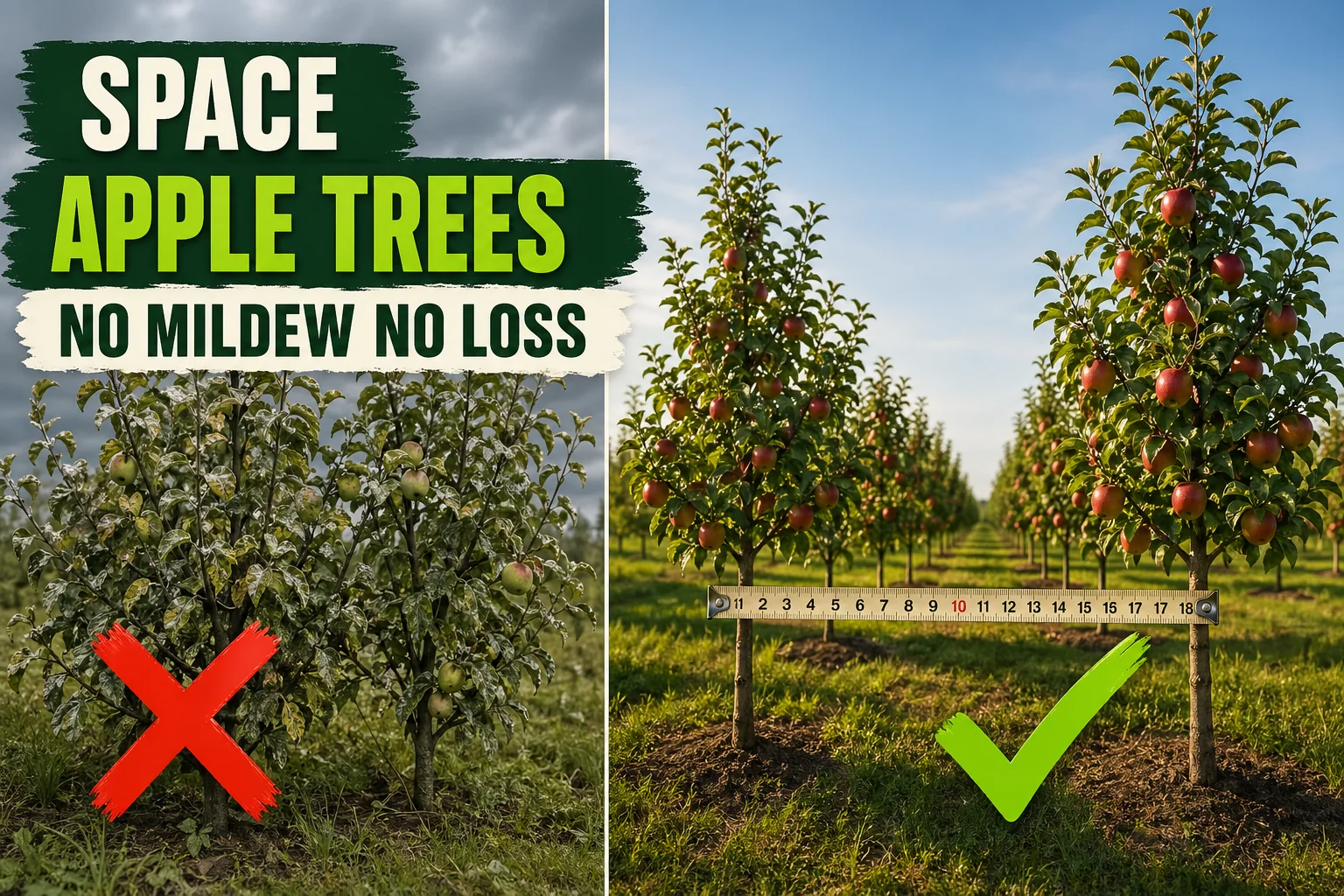
| Powdery mildew on the lower canopy | Trees too close, airflow blocked | Open the centre of the tree by pruning; long term, increase spacing for replants |
| One tree shading the next | Row orientation wrong, or row spacing too tight | Run rows north–south where possible; allow at least 4.5 m (15 ft) between semi-dwarf rows |
| Stake collar girdling the trunk | Stake left in too long on a dwarf tree | Loosen yearly; remove the stake once the trunk is 5 cm (2 in) thick |
Special case: high-density and espalier orchards
Commercial high-density orchards push spacing far tighter than home grower charts suggest — sometimes 60 cm (2 ft) tree-to-tree on M9 with trees trained as a tall slender spindle. That works only because:
- Every tree is on a wire trellis system
- Pruning is constant and severe
- Fungicide and pest spraying is on a strict schedule
- Each tree carries 8–15 kg (18–33 lb) of fruit, not 35–45 kg (75–100 lb)
For a home garden, stick with the chart above. Espalier is the home version of high density: you sacrifice yield per tree and gain the ability to fit a productive apple tree against a 4.5 m (15 ft) wall.
Watch: apple tree spacing visual walkthrough
A short video pairs well with these distances. Search YouTube for apple tree spacing by rootstock and pick a video that shows mature M9 dwarf, MM106 semi-dwarf, and standard trees side by side — seeing the size difference in real life is the fastest way to internalise why the gaps need to be different.
Practical checklist before planting
- Confirm the rootstock written on each tree’s tag
- Mark each planting position with a stake before you dig — easier to adjust the layout on paper than after planting
- Check there’s a compatible pollinator variety within 15 m (50 ft)
- Allow at least 1.8 m (6 ft) of clear walkway on at least one side of every row
- For dwarf trees, install the permanent stake at planting time so you don’t damage roots later
- Mulch a 60–90 cm (24–36 in) ring around each new tree, keeping the mulch 5 cm (2 in) clear of the trunk
- Set up watering from week one — a free plant care app like Tazart can hold the schedule, adjust for your local weather, and alert you on Apple Watch when it’s time
Related reading
- How to plant an apple tree (step-by-step) — once you’ve nailed the spacing, this guide walks through hole prep, root pruning, staking, and the first year of watering.
- How to plant grape vines — the same airflow + sun + pollinator logic applies to grapes; a useful companion if you’re laying out a mixed home orchard.
- How far apart to plant jalapeños — short-season spacing math for an annual edible, a useful contrast to the long-game decisions you make with apples.
A note on conditions
Every site is different. Soil depth, slope, prevailing wind, summer humidity, and your local apple disease pressure all change how far apart your trees should actually be. Use the chart above as a starting point and add 10–20% extra spacing if your climate is humid (apple scab and mildew thrive on still air) or if you’d rather under-plant than over-plant — you can always squeeze in a second tree later, but you can’t ungrow a crowded orchard.
Highly recommended
The supplies that make this guide work
Tazart is an Amazon Associate — we earn from qualifying purchases at no extra cost to you. Thank you for helping us keep these guides free.
Frequently asked questions
How far apart should apple trees be planted?
Spacing is set by the rootstock, not the variety. Dwarf apple trees go 2.4–3 m (8–10 ft) apart, semi-dwarf 3.6–5.5 m (12–18 ft) apart, and standard (full-size) 7.5–10.5 m (25–35 ft) apart. If you don't know the rootstock, ask the nursery — it's printed on the tag.
Can you plant two apple trees close together?
Yes, if you choose the right rootstock. Two dwarf apples on M9 rootstock can sit as close as 2.4 m (8 ft) apart and still produce well. Espaliered apples against a wall can go 1.8–2.4 m (6–8 ft) apart. Don't squeeze standard or semi-dwarf trees closer than the chart below — airflow and sunlight collapse fast.
How far apart do apple trees need to be for pollination?
Apples are mostly self-incompatible, so they need a pollination partner of a different but compatible variety within roughly 15 m (50 ft). Closer is better — bees forage in tight loops. Beyond 30 m (100 ft) fruit set drops sharply. Crab apples count as universal pollinators and can rescue an awkward layout.
What is the spacing for dwarf apple trees?
Dwarf apple trees on M9 or B9 rootstock are spaced 2.4–3 m (8–10 ft) apart in the row, with 3.6–4.5 m (12–15 ft) between rows for orchard layouts. They reach about 1.8–2.4 m (6–8 ft) tall and almost always need staking or a trellis wire.
How far apart should apple tree rows be?
Allow at least 3.6 m (12 ft) between rows of dwarf apples, 4.5–5.5 m (15–18 ft) for semi-dwarf, and 9 m (30 ft) for standard trees. Rows need enough room for sun to reach both sides and for a wheelbarrow, mower, or tractor to pass.
Can apple trees be planted 5 feet apart?
Only as a deliberate espalier or cordon. Free-standing dwarf apple trees planted 1.5 m (5 ft) apart will compete for light, develop weak crotches, and trap moisture that invites scab and powdery mildew. For a single-stem cordon trained against wires, 75–90 cm (30–36 in) apart is the standard.
How close can a semi-dwarf apple tree be to a fence?
Plant the trunk at least 2.4 m (8 ft) out from a solid fence so the canopy has airflow on the back side. For a property line, allow half the mature canopy width — typically 2.4–3 m (8–10 ft) — plus enough space to harvest from your own side.