Flowers
How Deep to Plant Tulip Bulbs (The 3× Rule Explained)
How deep to plant tulip bulbs? The 3× rule means 15–20 cm (6–8 in) for standard bulbs. Depth chart by bulb size, soil type, and zone inside.
On this page
- Quick answer
- Table of contents
- The 3× rule — what it means and why it works
- Depth chart by bulb size
- How soil type changes the numbers
- Depth by USDA hardiness zone
- What the soil looks like at each depth zone
- Planting depth in containers and pots
- What happens when you plant too shallow
- What happens when you plant too deep
- Does depth help tulips perennialize?
- Step-by-step: digging to the right depth
- Common depth mistakes
- Troubleshooting depth-related problems
- Watch: tulip bulb planting depth
- Related reading
- A note on conditions
Watch the visual walkthrough
How to Plant Fall (Spring Flowering) Bulbs // Daffodils, Tulips, Muscari
In todays video, I'm planting fall (spring flowering) bulbs in the new cottage garden. MENTIONED PRODUCTS Bone Meal: ...
The number one reason tulip bulbs rot, get eaten by squirrels, or produce leaves without flowers is they were planted too shallow. Depth is the single most decisive variable in tulip planting — more than soil type, fertilizer, or variety.
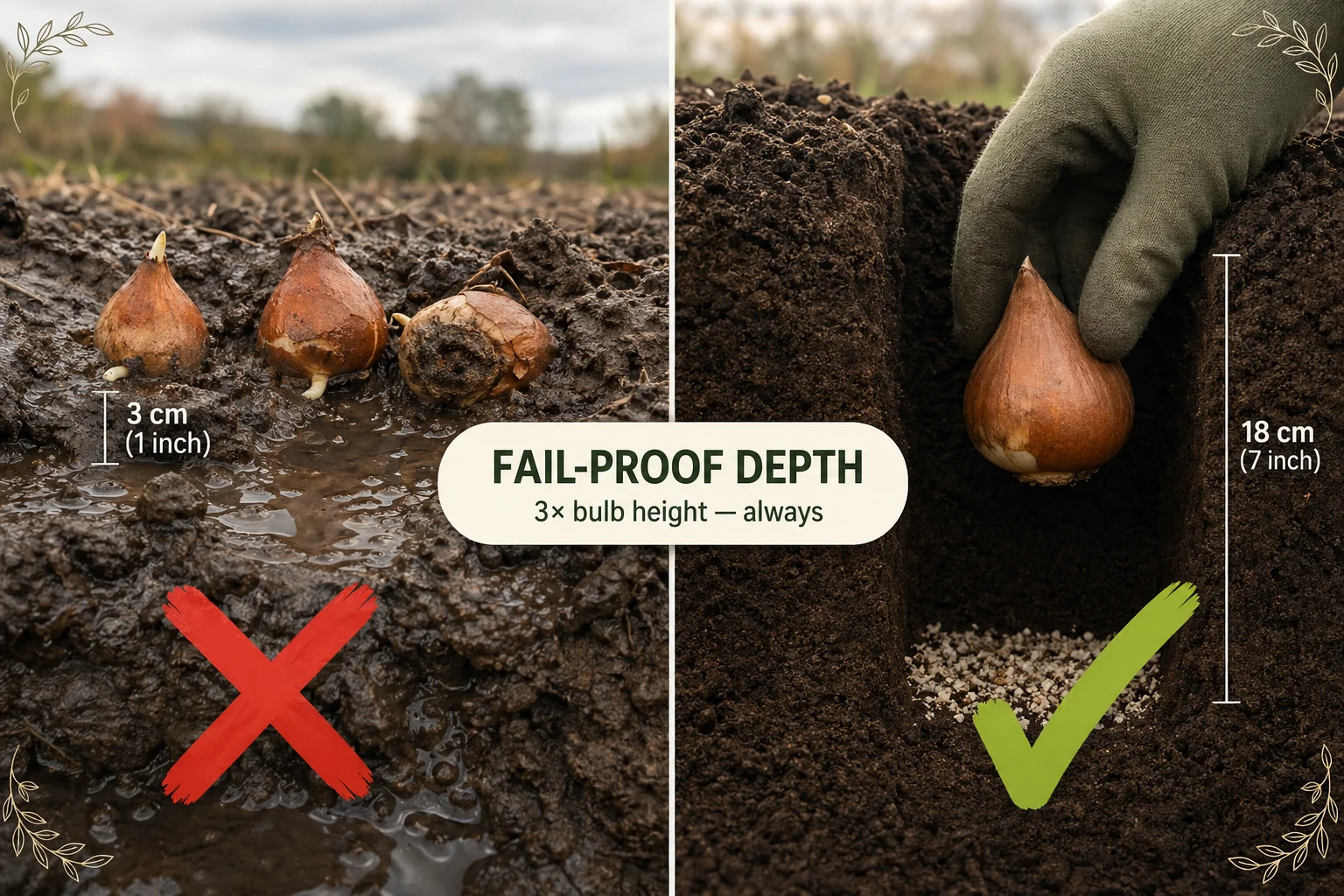
The good news: there’s a simple formula. The 3× rule says plant a tulip bulb at a depth equal to three times the bulb’s height, measured from basal plate to tip. Get that right and most other variables take care of themselves.
This post focuses entirely on planting depth — the exact numbers by bulb size, soil type, and hardiness zone, what the soil zones actually look like underground, and what goes wrong when the depth is off.
For the full planting workflow — timing, orientation, spacing, and after-care — see our broader guide: How to plant tulip bulbs.
Quick answer
Plant tulip bulbs at a depth equal to three times their own height. For a standard 5 cm (2 in) bulb that means a hole 15–20 cm (6–8 in) deep — measured from the soil surface to the top of the bulb, not the bottom. In sandy soil or cold zones, use 18–20 cm (7–8 in). In clay, use 13–15 cm (5–6 in). In containers, go for 10–15 cm (4–6 in) with good drainage below.
Table of contents
- The 3× rule — what it means and why it works
- Depth chart by bulb size
- How soil type changes the numbers
- Depth by USDA hardiness zone
- What the soil looks like at each depth zone
- Planting depth in containers and pots
- What happens when you plant too shallow
- What happens when you plant too deep
- Does depth help tulips perennialize?
- Step-by-step: digging to the right depth
- Common depth mistakes
- Troubleshooting depth-related problems
- FAQs
The 3× rule — what it means and why it works
The 3× rule is the shorthand most bulb growers use: plant a tulip bulb at a depth three times its own height.
To apply it correctly:
- Stand the bulb on a flat surface.
- Measure from the basal plate (the flat bottom where roots emerge) to the pointed tip.
- Multiply that measurement by three.
- That result is the depth from the soil surface to the top of the bulb — not the bottom.
So for a typical bulb that is 5 cm (2 in) tall:
- 5 cm × 3 = 15 cm (6 in) of soil above the top of the bulb
- The hole itself needs to be about 17–18 cm (6.5–7 in) deep so the bulb sits with its top at 15 cm (6 in)
Most gardening advice simplifies this to “plant 15–20 cm (6–8 in) deep” — which is accurate for the bulb sizes sold in most garden centres, but the formula is more useful because bulb sizes vary.
Why this exact depth?
Tulip bulbs evolved on the dry, cold mountain slopes of Central Asia and the Middle East, where they sit in a very specific thermal environment:
- Deep enough that summer soil temperatures stay below ~20°C (68°F) — the threshold above which bulbs break down and exhaust their energy reserves.
- Deep enough to stay below the frost-heave zone — the top 8–10 cm (3–4 in) of soil that expands and contracts with freeze-thaw cycles.
- Deep enough that most rodents don’t bother digging — squirrels typically don’t dig past 10–12 cm (4–4.5 in).
The 3× rule nails all three requirements in one number.
Depth chart by bulb size
Tulip bulbs are sold in different grades based on circumference. Larger-circumference bulbs are physically taller and need to go deeper.
| Bulb grade | Bulb height (approx.) | Planting depth (top of bulb to surface) | Hole depth |
|---|---|---|---|
| Small (9–10 cm circ.) | 3–4 cm (1–1.5 in) | 10–12 cm (4–4.5 in) | 13–15 cm (5–6 in) |
| Standard (11–12 cm circ.) | 4–5 cm (1.5–2 in) | 13–15 cm (5–6 in) | 15–18 cm (6–7 in) |
| Large (12–14 cm circ.) | 5–6 cm (2–2.5 in) | 15–18 cm (6–7 in) | 18–20 cm (7–8 in) |
| Jumbo / exhibition (14+ cm circ.) | 6–7 cm (2.5–2.75 in) | 18–21 cm (7–8.5 in) | 20–23 cm (8–9 in) |
Bottom line: when in doubt, plant deeper. Tulips almost never fail from being too deep. Shallow planting is the consistent cause of failure.
How soil type changes the numbers
The 3× depth is a starting point. Soil type shifts the ideal depth by a few centimetres:
Clay soil
Clay holds water and compacts tightly. A basal plate sitting in a permanently wet clay pocket will rot before it roots.
- Plant at the shallower end: 13–15 cm (5–6 in) of cover for standard bulbs.
- Improve drainage at the base: drop 2–3 cm (1 in) of coarse grit or horticultural sand into the bottom of each hole before placing the bulb.
- Do not plant in a low-lying bed that collects runoff — clay + standing water = guaranteed rot.
Loam soil (ideal)
Well-structured loam drains freely but retains just enough moisture for root growth. Plant at the middle of the range — 15–18 cm (6–7 in) for standard bulbs — with no amendments needed.
Sandy or gravelly soil
Sandy soil drains too fast, and its insulating properties are weak. Surface temperatures swing dramatically, which stresses bulbs in both summer heat and winter cold.
- Plant at the deeper end: 18–20 cm (7–8 in) for standard bulbs.
- The extra depth buffers the temperature swings and keeps the bulb in a more stable zone.
- Mix a handful of compost into the backfill so the roots have some moisture retention during fall establishment.
Raised beds
Raised beds usually have excellent drainage and a loose structure. Plant at the standard 15–18 cm (6–7 in) depth. If the bed is elevated more than 30 cm (12 in) above ground, it can freeze solid in severe winters — treat it like a container (see below).
Depth by USDA hardiness zone
Zone affects how hard winters get and whether summers cook the bulb. Both influence ideal depth.
| USDA zone | Winter low | Recommended depth | Notes |
|---|---|---|---|
| 3–4 | Below −34°C (−30°F) | 20–23 cm (8–9 in) | Extra depth insulates against severe freeze; mulch heavily |
| 5–6 | −28 to −18°C (−20 to 0°F) | 18–20 cm (7–8 in) | Standard deep planting; good perennialization |
| 7 | −18 to −12°C (0 to 10°F) | 15–18 cm (6–7 in) | Standard range; minimal frost heave risk |
| 8 | −12 to −7°C (10 to 20°F) | 15–18 cm (6–7 in) | Pre-chilling helpful in warm-summer sub-zones |
| 9–10 | −7°C (20°F) and above | 18–20 cm (7–8 in) (pre-chilled bulbs) | Treat as annual; depth delays warm-up slightly but won’t offset inadequate chill |
In zones 3–6, deeper planting also improves year-on-year perennialization — see Does depth help tulips perennialize? below.
What the soil looks like at each depth zone
It helps to think of the soil column in three distinct zones when you’re placing a bulb:
0–8 cm (0–3 in): the frost-heave zone This is the layer that expands and contracts with every freeze-thaw cycle. Bulbs in this zone get pushed upward over winter. Squirrels and chipmunks work this zone almost exclusively. A tulip basal plate should never sit in this zone.
8–15 cm (3–6 in): the transition zone Frost still penetrates here in cold winters, but less dramatically. Temperature swings are reduced. This is acceptable depth for small bulbs in zones 6–8, but still risky for squirrel damage.
15–25 cm (6–10 in): the ideal bulb zone Below the frost-heave line in most climates, stable enough that the bulb spends winter at a near-constant cool temperature. Squirrels rarely excavate this deep for a single bulb. Root growth is strong because soil moisture is consistent. This is where you want your tulip basal plate to sit.
The 3× rule for a standard 5 cm (2 in) bulb puts the basal plate at roughly 20–22 cm (8–8.5 in) deep — comfortably in the ideal zone.
Planting depth in containers and pots
Containers have less soil mass than open ground, which means they heat up faster in summer and freeze faster in winter. Adjustments are needed:
- Minimum pot depth: 30 cm (12 in) from rim to base.
- Drainage layer: 5 cm (2 in) of gravel or coarse grit at the bottom — non-negotiable. Containers with no drainage layer rot nearly every bulb.
- Bulb depth: 10–15 cm (4–6 in) of potting mix above the top of the bulb.
- The lasagna method: In a deep pot (40 cm / 16 in or more), you can plant two layers — larger late-season tulips at the bottom (15 cm / 6 in cover), smaller early-season varieties 5–8 cm (2–3 in) above them. Both emerge in sequence for a longer display window.
- Cold storage: Move the pot to an unheated garage or shed for 12–14 weeks of cold — 4–9°C (40–48°F). Bring back outside in late winter when green shoots emerge.
Containerized tulips are almost always single-season displays. Replace the bulbs each fall rather than trying to rebloom them.
What happens when you plant too shallow
Planting tulip bulbs at less than 10 cm (4 in) causes a cascade of problems:
Frost heave. The top 8 cm (3 in) of soil expands when it freezes and contracts when it thaws. Bulbs in this zone get physically pushed toward the surface. By late winter you can find them sitting half-exposed, often with frost damage to the basal plate.
Squirrel and rodent predation. Squirrels, chipmunks, and voles work the top 8–12 cm (3–4.5 in) of soil. A bulb at 5–8 cm (2–3 in) depth is an easy target; at 18–20 cm (7–8 in) it’s rarely worth the effort.
Floppy, weak stems. The stem needs deep soil to anchor itself against wind and the weight of the flower. Shallow-planted tulips emerge fast but flop over as soon as the bud opens.
Premature sprouting. Soil at 5 cm (2 in) depth warms weeks earlier than soil at 15 cm (6 in) in spring. Shallow bulbs sometimes send up growth during a warm spell in late winter, then get killed back by a hard frost.
Short flowering season. Without the stable temperature buffer of deeper soil, the flower opens and fades faster — sometimes only 3–5 days versus 10–14 days for a properly planted bulb.
What happens when you plant too deep
There is a genuine upper limit, but it’s harder to exceed than most people think:
- At 25–30 cm (10–12 in) in heavy clay, the basal plate is below the drainage zone in many soils — rot risk increases.
- In very cold zones (3–4), the soil at 25 cm (10 in) may freeze solid for the entire winter, potentially damaging the root system.
- The stem needs energy to push through an extra-long column of soil — small or low-grade bulbs may fail to emerge if planted too deep in compacted soil.
In practice, home gardeners almost never plant too deep. The 3× rule in good garden soil has a comfortable safety margin in either direction.
Does depth help tulips perennialize?
Yes — depth is one of the three main factors that determine whether tulips rebloom year after year.
The other two are: summer soil temperature (below ~20°C / 68°F is ideal for bulb dormancy) and bulb size at planting (larger bulbs have more energy reserves).
Depth helps perennialization in two ways:
-
Lower summer soil temperature. Soil at 15–20 cm (6–8 in) stays significantly cooler than surface soil in summer. In zones 5–6, this can mean the difference between the bulb staying viable for 3–4 seasons versus 1.
-
Less competition and disturbance. Deeper bulbs are less likely to be dug by rodents, accidentally forked up during weeding, or divided prematurely.
In zones 7–9, summer heat is extreme enough that even a perfectly deep-planted tulip often exhausts its energy in year one. For reliable perennialization in those zones, look for species tulips (Tulipa clusiana, T. sylvestris, T. bakeri) rather than large hybrid varieties.
Step-by-step: digging to the right depth
1. Measure the bulb
Stand the bulb on a table. Measure its height from basal plate to tip. Multiply by three. Write that number down — it’s your target depth for the top of the bulb.
2. Choose your digging tool
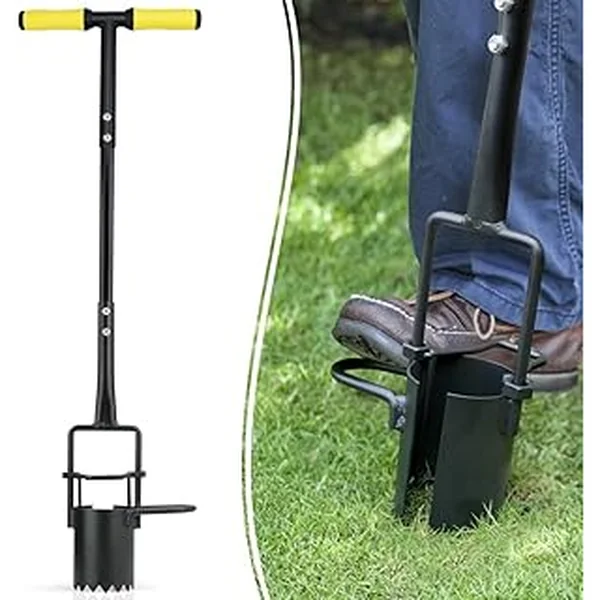
A long-handled bulb planter cuts a clean, measured cylinder. Most are marked with depth lines at 5 cm (2 in) intervals. For standard tulip bulbs, a planter marked to 20 cm (8 in) is ideal.
A trowel works for small quantities — push it in at an angle, lever it back, drop the bulb, close the soil. Use a ruler or your finger length as a depth gauge.
3. Improve the base if needed
In clay soil: drop 2–3 cm (1 in) of coarse grit into the hole bottom. In sandy soil: fork the sides of the hole lightly so roots can penetrate.
4. Add bone meal
A tablespoon of organic bone meal placed at the base of the hole before the bulb goes in gives phosphorus exactly where new roots will reach it during fall establishment. Do not use high-nitrogen fertilizer — it pushes leaf growth at the expense of root establishment.
5. Place the bulb
Pointed tip up, basal plate down. The top of the bulb should be at your target depth (e.g., 15 cm / 6 in from the surface). If you’re not sure which end is up, plant the bulb on its side — the stem will right itself.
6. Backfill, firm, water once
Replace the removed soil and press gently to close air pockets. Water slowly once to settle the soil and trigger root growth. Do not soak — tulip bulbs in waterlogged soil rot quickly.
7. Mulch
Lay 5–8 cm (2–3 in) of shredded bark or leaf mould over the surface. Mulch does three things: it insulates the soil temperature, it hides bulb scent from foraging rodents, and it locks in moisture during dry autumn spells.
Common depth mistakes
Using “hole depth” and “bulb depth” interchangeably. The standard “plant 15 cm (6 in) deep” means 15 cm (6 in) of soil above the top of the bulb — not the depth of the hole. The hole for a 5 cm (2 in) tall bulb needs to be 20–22 cm (8–8.5 in) deep so the top of the bulb sits at 15 cm (6 in). Many gardeners under-plant by 5–8 cm (2–3 in) because of this confusion.
Planting at uniform depth regardless of bulb size. Large exhibition bulbs need more depth than the 11 cm (4.5 in) bags at a supermarket. Measure each batch separately.
Planting in a low spot. Even correct planting depth does not help if water pools in the bed. A 15 cm (6 in) deep bulb in a drainage-free low spot rots just as fast as a shallow one. Choose a spot on a gentle slope or amend heavily with grit.
Skipping grit in clay soil. Clay compacts around the basal plate and holds moisture against it. A small handful of grit at the base of each hole is a cheap, reliable fix.
Mulching before planting. Mulch after planting, not before — so you know the soil surface is at the true level.
Troubleshooting depth-related problems
| Symptom | Likely depth cause | Fix |
|---|---|---|
| Bulbs pushed out of ground by spring | Planted in frost-heave zone (< 10 cm / 4 in) | Replant at 15–18 cm (6–7 in) next fall |
| Bulbs disappeared before spring | Squirrels — too shallow | Plant at 18–20 cm (7–8 in); cover with chicken wire pinned flat over the bed |
| All leaves, no flowers | Too shallow, or too little cold chill | Replant deeper; in warm zones, pre-chill for 10–12 weeks at 4–9°C (40–48°F) |
| Stems emerge then flop immediately | Shallow anchor + wind | Replant 5–7 cm (2–3 in) deeper next fall; stake affected plants this season |
| Bulbs rotted before spring | Basal plate sitting in wet clay | Move to a raised bed or work coarse grit into the base of each hole |
| Bulbs sprouted in late winter, frost-killed | Too shallow — warm soil triggered early growth | Plant at full 18–20 cm (7–8 in) depth for stable temperature buffering |
| Flowers tiny, fade in 3–4 days | Shallow + high summer soil temp exhausting bulb | Plant deeper; in zones 7+, switch to species tulips |
Watch: tulip bulb planting depth
A visual walkthrough pairs well with the depth chart above. Search YouTube for “how deep to plant tulip bulbs” to find practical demonstrations of the 3× rule in action. Look for videos from university extension programs or established bulb growers that show a cross-section of the soil with the bulb in position — that visual makes the depth zones click.
Related reading
- How to plant tulip bulbs — the complete guide: broader coverage of timing, soil prep, orientation, spacing, and after-care to pair with the depth detail here.
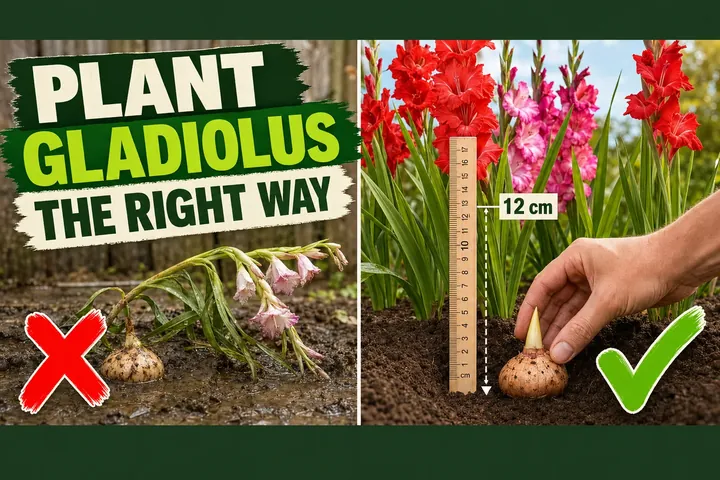
- How deep to plant gladiolus bulbs: the same 3× principle applied to summer corms — good for planning a continuous bloom schedule.
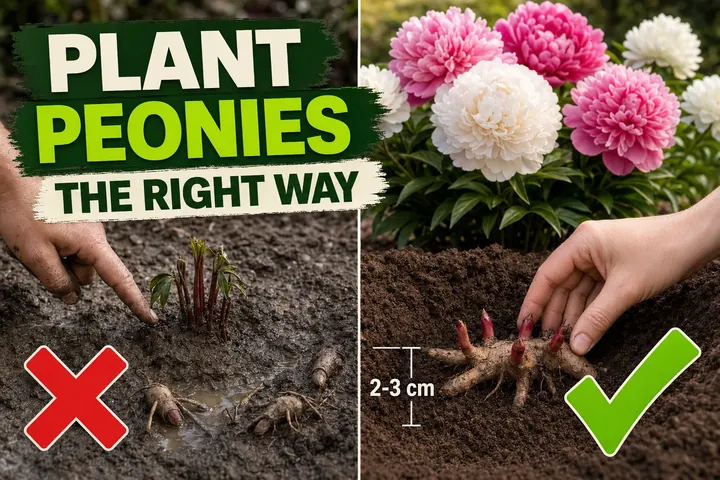
- How to plant peony bulbs: another depth-critical bulb where getting the eyes at the right level determines whether peonies flower at all.
A note on conditions
Soil structure, rainfall, squirrel pressure, and local frost patterns all vary. Use the depth figures above as a calibrated starting point and adjust based on how your tulips perform in their first spring. A bed of floppy-stemmed tulips almost always has a depth-fix available for the following fall.
The Tazart plant care app tracks your planting dates, cold-chill windows, and local frost timing — useful for managing a mixed bulb bed across multiple fall plantings.
Highly recommended
The supplies that make this guide work


Tazart is an Amazon Associate — we earn from qualifying purchases at no extra cost to you. Thank you for helping us keep these guides free.
Frequently asked questions
How deep do you plant tulip bulbs?
The standard rule is three times the height of the bulb. For a typical 5 cm (2 in) tall tulip bulb that means a planting hole 15 cm (6 in) deep, measured from the top of the bulb to the soil surface. Large exhibition-grade bulbs — 6–7 cm (2.5–2.75 in) tall — go 18–20 cm (7–8 in) deep. In cold zones or sandy soil, always use the deeper end of the range.
What is the 3× rule for planting tulip bulbs?
The 3× rule is a simple formula: measure the height of the bulb from basal plate to tip, then multiply by three. That number is the minimum depth from the soil surface to the top of the bulb. A 5 cm (2 in) tall bulb needs 15 cm (6 in) of soil above it. A 7 cm (2.75 in) tall bulb needs at least 20 cm (8 in). The extra soil acts as a thermal blanket, anchors the stem, and hides the bulb from digging squirrels.
What happens if you plant tulip bulbs too shallow?
Shallow-planted tulips (less than 10 cm / 4 in of soil cover) suffer four compounding problems: frost heave lifts the bulbs out of the ground during freeze-thaw cycles; squirrels and chipmunks dig them up easily; stems emerge short and floppy with less anchoring mass; and the bulb dries out or rots faster without the stable temperature buffer deep soil provides. In most cases the bulb produces leaves but not flowers.
Does planting depth change in clay soil versus sandy soil?
Yes, slightly. In heavy clay that holds moisture, use the shallower end of the range — 13–15 cm (5–6 in) — so the basal plate isn't sitting in a permanently wet zone. In fast-draining sandy or gravelly soil, plant at the deeper end — 18–20 cm (7–8 in) — because the insulating effect is weaker and surface temperatures swing more dramatically.
How deep should tulip bulbs be in containers?
In containers, aim for 10–15 cm (4–6 in) of soil above the top of the bulb, with at least 5 cm (2 in) of drainage material (gravel or coarse grit) at the bottom. Use a pot at least 30 cm (12 in) deep. You can plant bulbs in layers — larger bulbs lower, smaller bulbs 5–8 cm (2–3 in) above them — which is called the 'lasagna' method and gives a longer display window.
Does deeper planting help tulip bulbs perennialize?
Yes. Tulips planted at 18–20 cm (7–8 in) perennialize much better than shallow-planted ones, especially in zones 4–6. The extra depth keeps the bulb cooler in summer (which halts premature regrowth), further from foraging squirrels, and more insulated against the temperature extremes that exhaust bulb energy reserves. In zones 7–9, depth alone isn't enough — the summers are simply too warm — but it still extends repeat-flowering by 1–2 extra seasons.
How deep to plant tulip bulbs in zone 7 or zone 9?
In zone 7, plant at the standard 15–20 cm (6–8 in) — the same rule applies, and pre-chilling isn't needed. In zone 9, plant at the maximum depth (20 cm / 8 in) with bulbs that have been pre-chilled for 8–10 weeks at 4–9°C (40–48°F) in the refrigerator. The deeper hole slightly delays soil warm-up, giving bulbs a marginally better start, but zone 9 tulips are reliably single-season displays regardless of depth.