Houseplants
Donkey Tail Plant Care: The Complete Guide
Everything you need to grow Sedum morganianum (burro's tail) — light, watering, soil, pot choice, dropped-leaf fixes, and free propagation from a single leaf.
On this page
Watch the visual walkthrough
A Chaotic Burros tail repot and propagation
HELLLOOOOO Good morning and BUENOS DIAS! I never know what to expect when I sit down and get to repotting my burros tail ...
Sedum morganianum — the donkey tail plant, or burro’s tail — is one of the most visually striking succulents you can grow. Its long trailing stems are packed with plump, silvery blue-green bead-like leaves that cascade beautifully from a hanging pot. But it has a reputation: it’s fragile, it drops leaves constantly, and it rots fast if you water it wrong.
This guide covers everything — light, watering, soil, pot choice, temperature, the leaf-drop problem, propagation, and the six most common mistakes. Follow the numbers here and you’ll have a dense, cascading plant instead of a bare, stringy one.
Quick answer
Donkey tail needs bright indirect light or a few hours of direct sun, water only every 2 to 3 weeks when the soil is completely bone-dry, a gritty 50/50 cactus mix and perlite blend, and a hanging pot it won’t be touched. Leaves fall off at the slightest contact — that’s normal, not a death sentence.
Why donkey tail is perfect for hanging displays
Most succulents grow as compact rosettes or upright stems. Sedum morganianum is different: its stems can trail 60 to 90 cm (2 to 3 feet) long when mature, each one densely packed with overlapping leaves that look like a rope of jade beads. That cascading habit has no rival in the succulent world.
A hanging pot near a bright window is the ideal setup. It gets the plant out of reach — reducing accidental leaf loss — while giving the stems room to hang freely without touching a shelf or sill. The visual payoff of a full, mature donkey tail swaying gently in a window is worth every week of patient care.
Light
Donkey tail wants full bright indirect light or several hours of direct sun daily — ideally 4 to 6 hours. The best spots indoors:
- South-facing window: the gold standard; provides the most consistent bright light year-round
- East-facing window: gentle morning sun, bright indirect light the rest of the day — very good
- West-facing window: afternoon sun works well but can be intense in summer; watch for sunburn on pale, papery patches on the leaves
Insufficient light causes etiolation: stems stretch thin and pale, leaves shrink and space out instead of packing tightly. Once a stem etiolates, it won’t recompact — the only fix is to cut the stretched section and propagate the tip. Prevention (more light, earlier) is always better.
Outdoors in summer, acclimate slowly to avoid sunburn. Start in shade, move to part sun over two weeks.
Watering
This is where most donkey tail plants die. The rule is simple but must be applied strictly:
Water only when the soil is completely bone-dry — all the way through the pot. Then water deeply.
In practice:
- Spring and summer (active growth): every 2 to 3 weeks
- Autumn and winter (rest period): once a month or less
- Always: tip the pot — if it feels light, it’s dry; if it feels heavy, wait another week
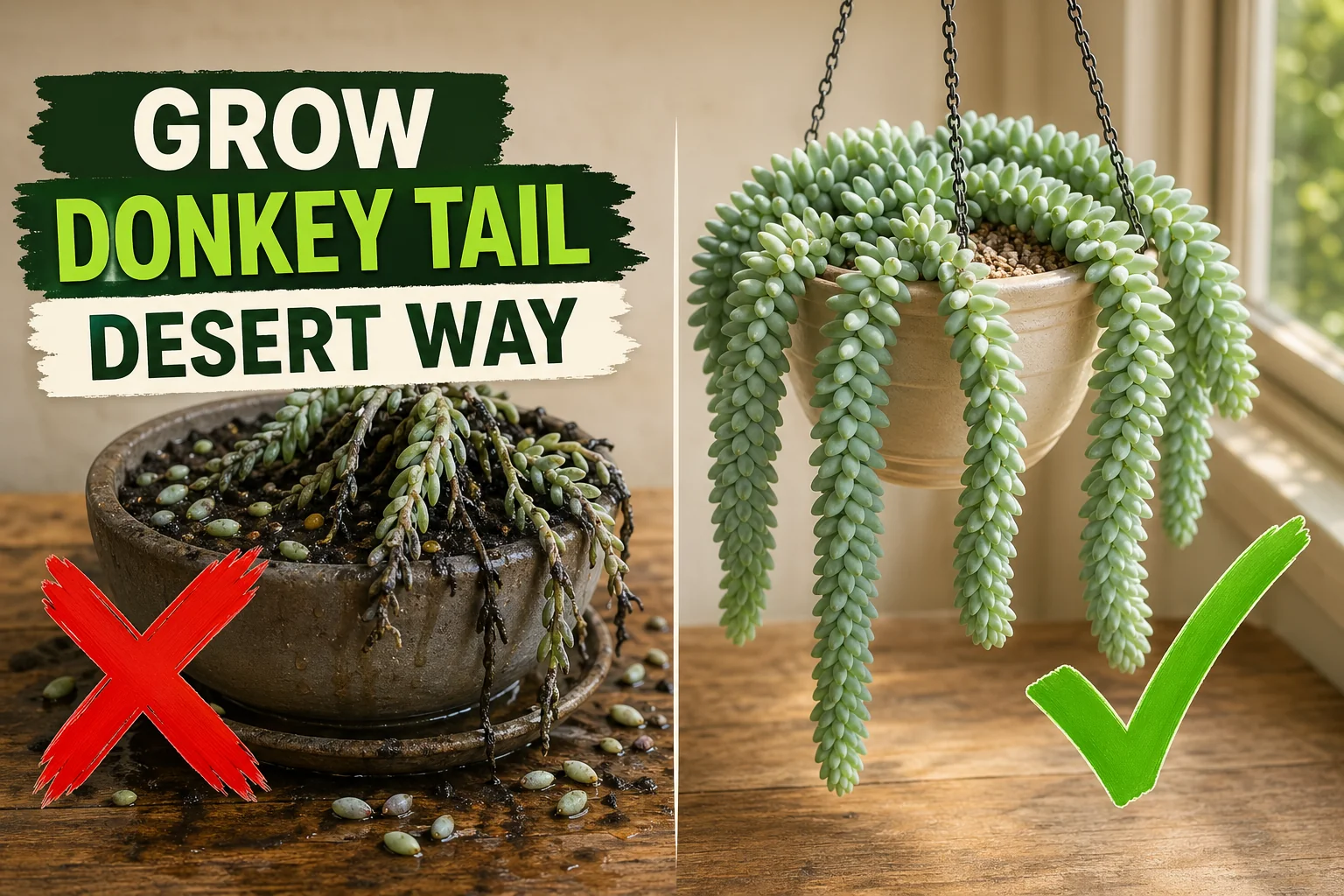
When you do water, pour slowly until water drains freely from the drainage holes. This saturates the full root zone. Then leave it completely alone until the next dry-out cycle.
Never water on a schedule. Season, pot size, soil type, and your home’s humidity all change how fast the soil dries. Check the soil, not the calendar.
Signs of overwatering: mushy or translucent leaves, blackened stems at the soil line, a sour smell from the pot. Signs of underwatering: wrinkled or shriveled leaves that feel papery rather than plump.
Soil and drainage
Standard potting mix holds too much moisture for donkey tail. Use a 50% cactus mix + 50% perlite blend. This ratio drains fast enough that even a slightly generous watering won’t sit wet for long.
What to avoid:
- Standard potting compost on its own — stays wet too long
- Garden soil — compacts and chokes roots
- Peat-heavy mixes — retain moisture and lower pH too much
The pot must have drainage holes. No exceptions. A pot without drainage turns any watering into a slow rot event.
Temperature
Donkey tail is comfortable in 18 to 26°C (79°F) — which covers most indoor environments year-round. It tolerates brief dips to around 10°C (50°F) but is not frost-hardy. Keep it away from:
- Cold draughts from windows or air conditioning vents in winter
- Radiators or heating vents that dry the air excessively (this is less of a problem than cold, but worth noting)
In warm climates it can live outdoors year-round. In temperate climates, bring it inside before the first frost.
Pot and repotting
A hanging pot is strongly recommended. It solves two problems at once: the stems can trail freely, and the plant is out of the traffic zone where it gets bumped and loses leaves.
Use a small-to-medium terracotta or unglazed clay pot — the porous walls wick away excess moisture, which pairs perfectly with the fast-draining gritty mix.
Repot only when roots are visibly escaping the drainage holes — roughly every 2 to 3 years for a healthy plant. When you repot:
- Water the plant 2 to 3 days before repotting so roots are hydrated but the soil isn’t soaking
- Choose a pot only 2 to 3 cm (1 in) (1 inch) wider than the current one — too large a pot holds too much soil moisture
- After repotting, wait 1 week before watering to let any damaged roots callous
Why leaves keep falling off
This is the most-asked donkey tail question, and the answer is: it’s the plant, not you (mostly).
Sedum morganianum has evolved to propagate itself by dropping leaves. The leaf base detaches at a predetermined break point with almost no force needed. A brush of your hand, a slight knock from a passing bag, even a gust from a fan — all of these can remove leaves.
What you can do:
- Hang it out of reach or place it somewhere it won’t be touched
- Handle it as little as possible — repot slowly and deliberately
- Don’t stress about fallen leaves — collect them and propagate (see below)
Leaves also drop from stress — overwatering, root rot, extreme underwatering, or a sudden change in light or temperature. If leaves are dropping in large numbers and also look mushy or shriveled, that’s a care problem. If a few fall every week from an otherwise healthy plant, that’s just donkey tail being donkey tail.
Propagation from leaves (free plants)
Every leaf that falls is a potential new plant. This is one of the easiest and most satisfying propagation methods in the succulent world.
Step-by-step:
- Collect fallen leaves — or gently twist a healthy plump leaf off cleanly at the base (no tearing)
- Let them callous — lay the leaves on a dry surface away from direct sun for 1 to 2 days until the cut end seals over
- Place on dry gritty soil — lay them flat on top of a tray filled with the same 50/50 cactus mix + perlite blend; do not bury them
- Do not water yet — the leaves have enough moisture stored internally to start growing
- Wait 2 to 4 weeks — tiny pink roots will appear from the base, followed by a small rosette of new leaves
- Begin misting lightly once roots appear — just enough to keep the top layer of soil barely damp
- Transition to normal watering once the plantlet is about 2 cm (0.75 in) across (roughly 4 to 6 weeks total)
You don’t need a heat mat, grow lights, or rooting hormone. Warm room temperature (20 to 24°C (75°F) / 68 to 75°F) and bright indirect light are all that’s needed.
Watch: donkey tail care guide
A visual walkthrough is genuinely useful for this plant — seeing how stems are handled without knocking leaves, and what healthy vs. etiolated growth looks like, saves a lot of guesswork. Search for Sedum morganianum care and propagation on YouTube and look for a channel that shows the leaf propagation process in real time.
Watch: Donkey Tail Plant Care & Propagation
This short visual guide pairs well with the sections above — especially if you want to see correct leaf handling and what etiolated growth actually looks like before it happens to your plant.
Common mistakes
-
Watering on a fixed weekly schedule. Donkey tail in a small terracotta pot may need water once every 3 weeks in winter. The same plant in summer may need it every 10 days. Always check the soil — never go by the calendar.
-
Using a pot that’s too large. A large pot holds more soil, which holds more moisture, which stays wet longer. For a small donkey tail, a pot just large enough to contain the root ball is the right size.
-
Placing it where it gets touched. On a busy shelf, a windowsill people reach past, or a table where bags get set down — any of these guarantees constant leaf loss. Hang it or isolate it.
-
Misting the leaves. Donkey tail is a desert plant. Misting introduces moisture to a plant that wants dry air and dry leaves. It can cause fungal spots on the waxy leaf surface. Water at the soil level only.
-
Ignoring etiolation until it’s severe. A few stretched centimetres can be managed by moving the plant closer to light. Once a stem has stretched 15 to 20 cm (8 in), the only option is to propagate the tip. Check your plant monthly for signs of stretching.
-
Repotting into fresh wet soil. Always let gritty mix dry to room temperature before planting into it, and wait a week after repotting before watering. Wet soil around freshly disturbed roots is a fast route to rot.
Troubleshooting
| Symptom | Likely cause | Fix |
|---|---|---|
| Leaves wrinkled, papery, deflated | Underwatering | Water deeply until drainage runs free; resume every 2–3 week dry-out cycle |
| Leaves mushy or translucent, stems blackening | Overwatering / root rot | Remove from pot, cut off rotten roots, let dry 2–3 days, repot in dry gritty mix |
| Stems thin and pale, leaves spacing out | Not enough light (etiolation) | Move to a brighter spot; propagate stretched stem tips |
| Leaves dropping constantly with no other symptoms | Normal fragility / accidental contact | Rehang or relocate away from foot traffic; this is the plant’s nature |
| White crusty deposit on soil surface | Mineral buildup from tap water | Top-dress with fresh gritty mix; switch to filtered or rainwater |
| Leaves pale, bleached, papery patches | Sunburn from sudden intense direct sun | Move to bright indirect light; acclimate to direct sun gradually over 2 weeks |
Related reading
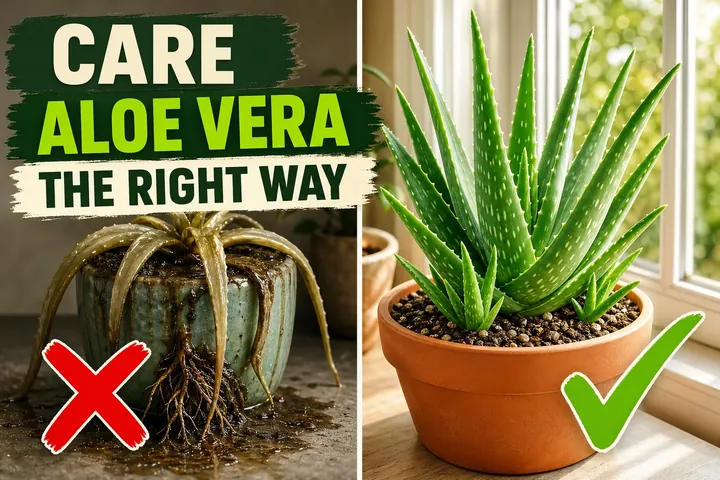
- How to care for aloe vera — another drought-tolerant succulent with a similar “water deeply, then ignore” rhythm
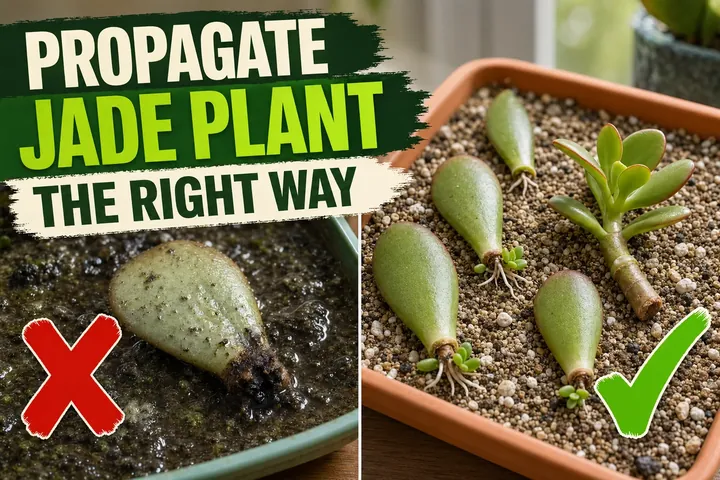
- How to propagate jade plant — jade leaf and stem propagation uses the same callous-and-wait method as donkey tail leaves
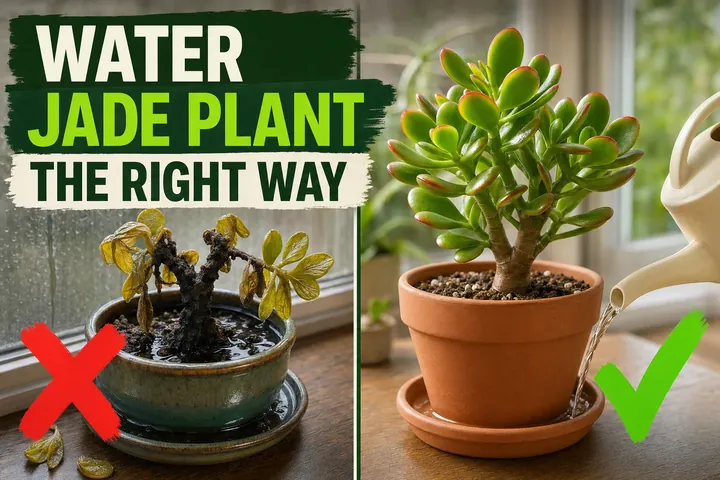
- How often to water jade plant — the dry-soil-first watering rule explained in detail, directly applicable to donkey tail
- Calandiva plant care — the flowering supermarket cousin in the succulent world, with the same gritty-mix and dry-out watering rules
Set up a Tazart watering reminder for your donkey tail and it will alert you based on your local season — so you never accidentally water on a schedule again.
A note on conditions
Every home is different. The 2-to-3-week watering interval assumes a small-to-medium terracotta pot in gritty mix at 20 to 24°C (75°F) with moderate light. In a humid climate, a large pot, or very low light, soil dries more slowly — water less often. In a hot dry room near a south window, it may dry faster — check more often. Use the guidance above as a starting point, then adjust based on how your specific plant actually behaves week to week. That responsiveness is what separates a thriving donkey tail from a dead one.
Highly recommended
The supplies that make this guide work

Tazart is an Amazon Associate — we earn from qualifying purchases at no extra cost to you. Thank you for helping us keep these guides free.
Frequently asked questions
Why do donkey tail leaves keep falling off?
Donkey tail leaves detach extremely easily — even a light bump or brush against the stem is enough to knock several off. This is normal and not a sign of sickness. It is one of the most fragile succulents you can own. Place it somewhere you won't accidentally touch it, and accept that a few leaves will always fall. The fallen leaves will propagate into new plants on their own if you lay them on dry soil.
How often should I water a donkey tail plant?
Water every 2 to 3 weeks in spring and summer — only when the soil is completely bone-dry all the way to the bottom of the pot. In autumn and winter, reduce to once a month or less. Always err on the side of too dry rather than too wet. Overwatering causes root rot far faster than underwatering in this species.
Does donkey tail need direct sunlight?
It thrives in full bright indirect light or several hours of gentle direct sun each day — ideally 4 to 6 hours. A south- or east-facing window is ideal indoors. Too little light causes etiolation: the stems stretch out thin and pale, and leaves space out instead of packing tightly together.
How do you propagate donkey tail from leaves?
Pick up any fallen leaf — it does not need to be cut, just detached cleanly at the base. Let it callous over on a dry surface for 1 to 2 days. Then lay it flat on top of dry, gritty succulent soil. Do not bury it or water it yet. Within 2 to 4 weeks, a tiny rosette and roots will emerge from the leaf base. Only then begin misting lightly. Full plantlets take 4 to 6 weeks to establish.
Why is my donkey tail succulent shriveling?
Shriveled, deflated-looking leaves on donkey tail usually mean underwatering — the plant is drawing moisture reserves from its own leaves. Water deeply until it drains from the bottom, then let it dry completely before watering again. If the leaves are also mushy or translucent, that is overwatering and you should check the roots for rot immediately.
Can donkey tail grow indoors?
Yes — donkey tail is one of the best succulents for indoors because it does not need direct sun to survive, just very bright indirect light. A sunny windowsill works well. Indoors it also benefits from lower-humidity environments, which suits most heated or air-conditioned rooms. Its main indoor enemy is overwatering, not low light.