Flowers
Dahlia Plant Care: Complete Tuber-to-Bloom Guide
Dahlia plant care made simple — full sun, well-drained loam, stake at planting, pinch at four leaf pairs, and lift tubers before hard frost.
On this page
Watch the visual walkthrough
Get started with dahlias 🌿 A guide to the basics
Don't be afraid of dahlias: They aren't the divas you might think they are. I'm sharing all the basics you need to know to start ...
Dahlias have a reputation for being fussy. They aren’t — they’re demanding, which is different. Give them the four things they want (full sun, rich well-drained loam, support installed at planting, and disciplined pinching) and you’ll cut armfuls of flowers from August until your first hard frost. Skip any one of those four levers and you’ll get a tall, floppy, leafy plant that never quite earns the space.
This guide covers everything from tuber planting to winter storage, with the common failure modes that turn first-year growers into people who say “I can’t grow dahlias.”
Quick answer
Plant dahlia tubers in full sun (6-8 hours) in deep, rich, well-drained loam with a pH of 6.5-7.0, 10-15 cm (4-6 in) deep with the eye facing up. Drive a stake at planting — never later. Wait to water until shoots emerge. Pinch the growing tip at the 4th leaf pair. Feed with a low-nitrogen flowering fertilizer (5-10-10), deadhead religiously, and lift tubers after the first hard frost in zones 7 and colder.
Table of contents
- What a dahlia is
- Light
- Soil and planting depth
- Watering
- Staking — do it at planting
- Pinching
- Fertilizing
- Deadheading
- Common pests
- Lifting and storing tubers
- Troubleshooting
- FAQ
What a dahlia is
Dahlias (Dahlia hybrida) are tuberous-rooted perennials in the Asteraceae family, native to the mountains of Mexico and Central America. They were the national flower of Mexico long before they reached European gardens in the late 1700s. There are 42 wild species and tens of thousands of named hybrid cultivars — pompon, ball, decorative, cactus, single, anemone, dinnerplate — covering nearly every colour except true blue.
Hardiness matters here. Dahlias are reliably hardy outdoors only in USDA zones 8-10. In zones 7 and colder, the tubers freeze and rot in winter soil and must be lifted and stored dry. This is the single biggest decision point for new growers: are you treating them as perennials in the ground or as lift-and-store annuals?
Light
Dahlias are full-sun plants. Six hours of direct sun is the minimum; eight hours is ideal for thick stems, saturated colour, and reliable flowering. In zones 9-10, light afternoon shade extends bloom life on dark varieties — burgundy and deep red petals scorch in 35°C (95°F) afternoons — but morning sun is non-negotiable.
If you’ve got dahlias under six hours of sun, they will grow tall, leggy, and disappointingly bloomless. Move them in fall, not spring, and lift the whole clump.
Soil and planting depth
Target pH: 6.5-7.0 — slightly acidic to neutral. Test if you’re unsure. Texture matters more than pH: dahlias want deep, rich, well-drained loam. Heavy clay holds water around the tuber and rots it; pure sand drains too fast and starves the plant of moisture during summer flowering.
Improve native soil before planting:
- Dig the bed to 30 cm (12 in) and loosen it.
- Mix in 5-7 cm (2-3 in) of finished compost.
- Add 1-2 tablespoons of bone meal per planting hole for slow-release phosphorus.
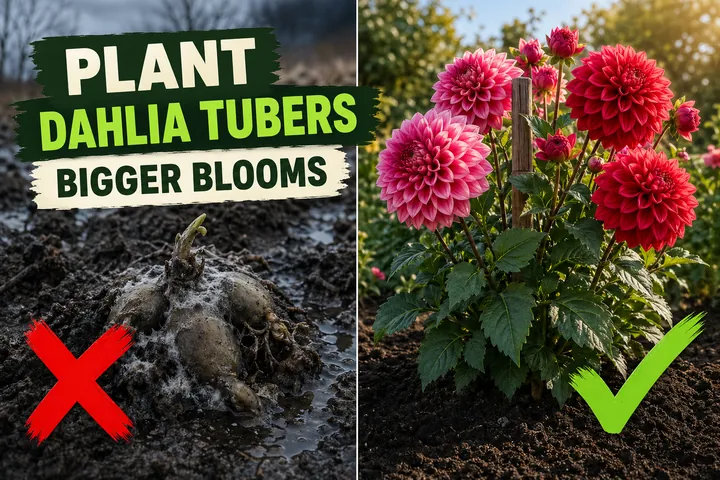
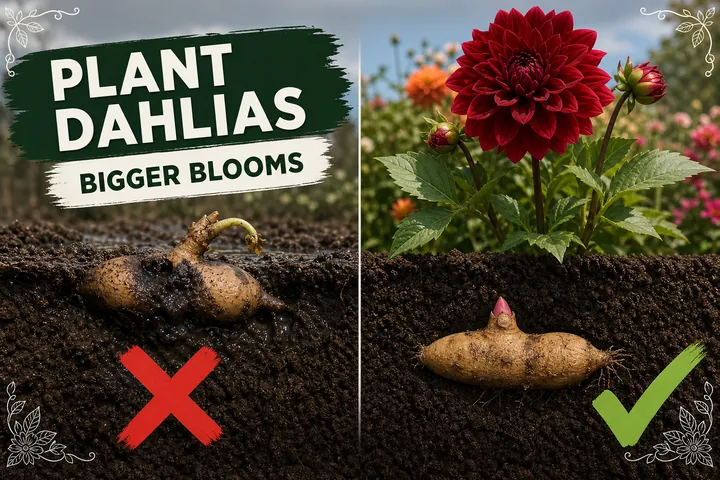
Planting depth: lay the tuber on its side with the eye (the small bump at the top of the neck) pointing up, 10-15 cm (4-6 in) below the soil surface. Don’t water in until you see shoots break the ground — wet, cool soil is the most common reason new tubers rot before they sprout. For the exact technique, see how to plant dahlia tubers and the depth chart in how deep to plant dahlia tubers.
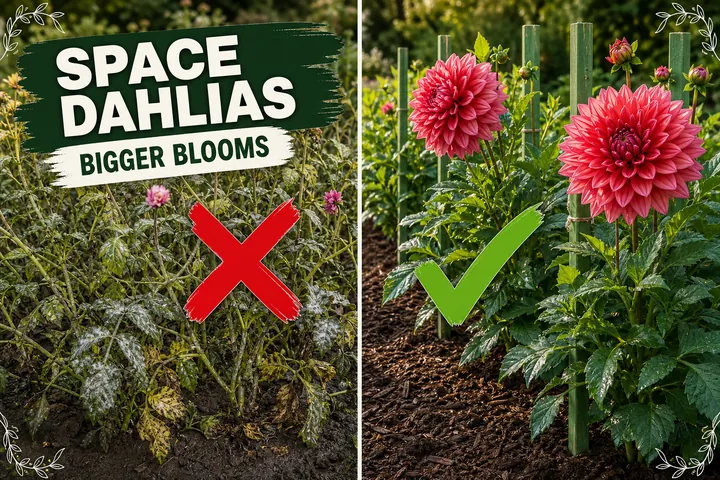
Spacing matters too. Dwarf bedding dahlias go 30 cm (12 in) apart; standard varieties 45-60 cm (18-24 in); dinnerplate types 90 cm (36 in). Crowded dahlias get powdery mildew because air can’t move through them — see how far apart to plant dahlias for the full spacing chart by class.
Watering
This is where most first-time growers slip. Do not water freshly planted tubers until the shoots emerge. The tuber has all the moisture it needs to sprout; adding water to cool spring soil is what rots them.
Once the plant is up and growing:
- Stage 1 (shoots to 30 cm/12 in): A deep soak twice a week if rain hasn’t fallen, about 2.5 cm (1 in) of water each time.
- Stage 2 (buds forming through flowering): Deep soak 2-3 times a week, more often in hot, dry weeks.
Always water at the soil level — drip irrigation or a soaker hose is ideal. Overhead watering wets the foliage and triggers powdery mildew. Mulch with 5 cm (2 in) of bark or straw to slow evaporation and keep root-zone moisture even.
Staking — do it at planting
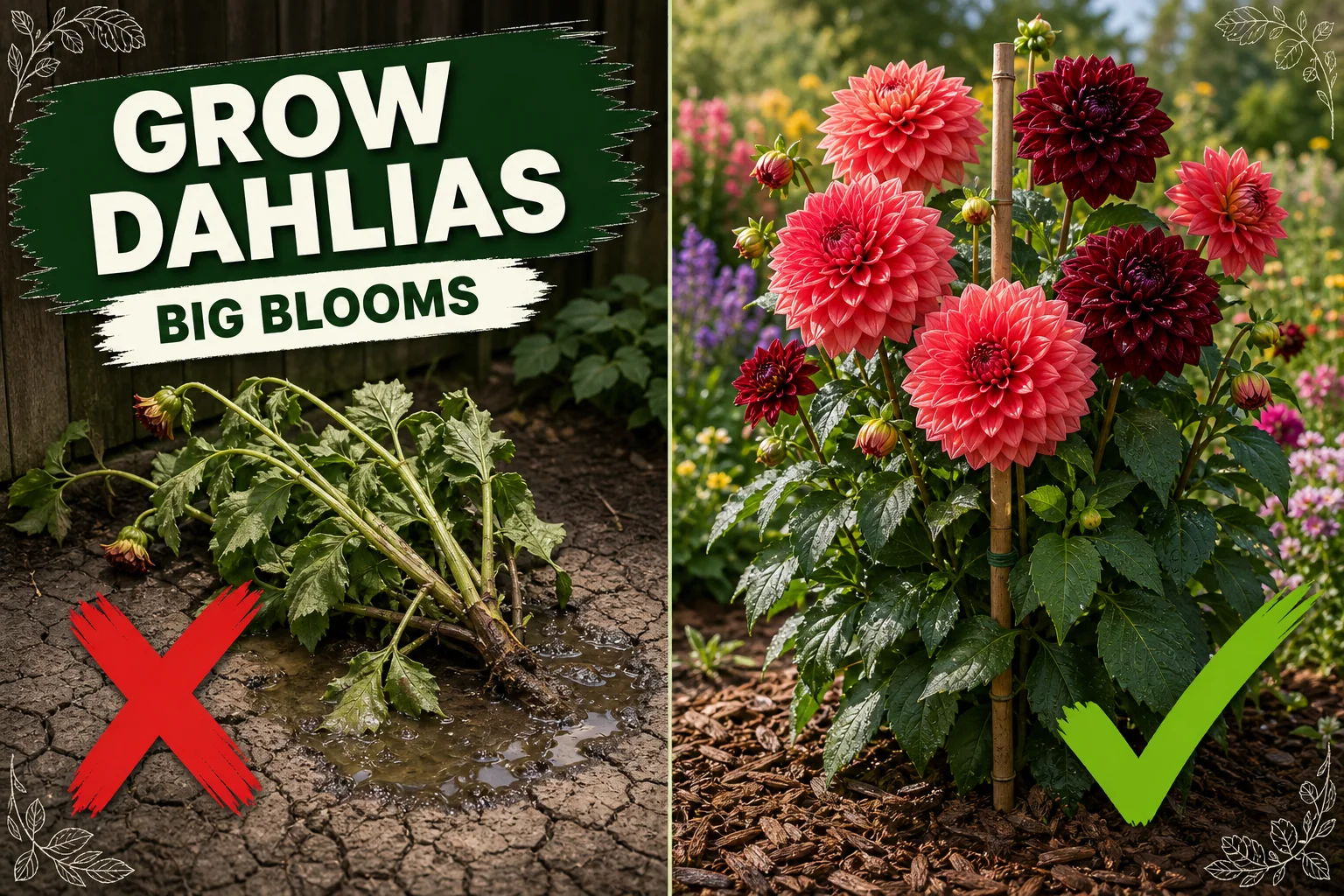
The single most common dahlia mistake: planting first, intending to stake later. By the time the plant is 60 cm (24 in) tall and clearly flopping, you spear the tuber driving in the stake.
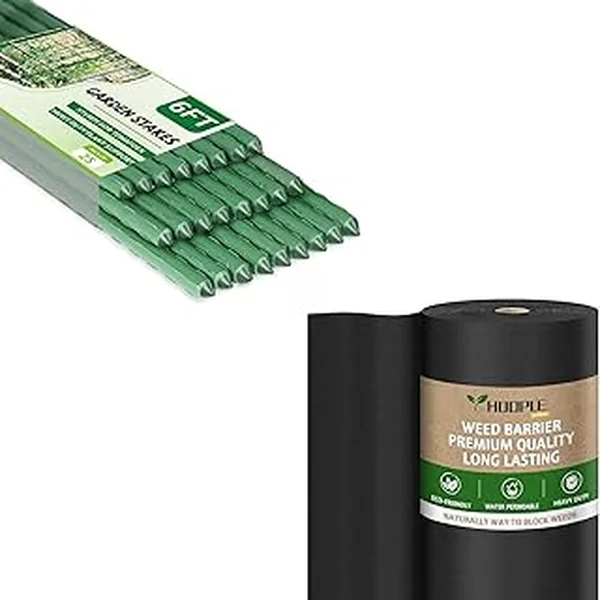
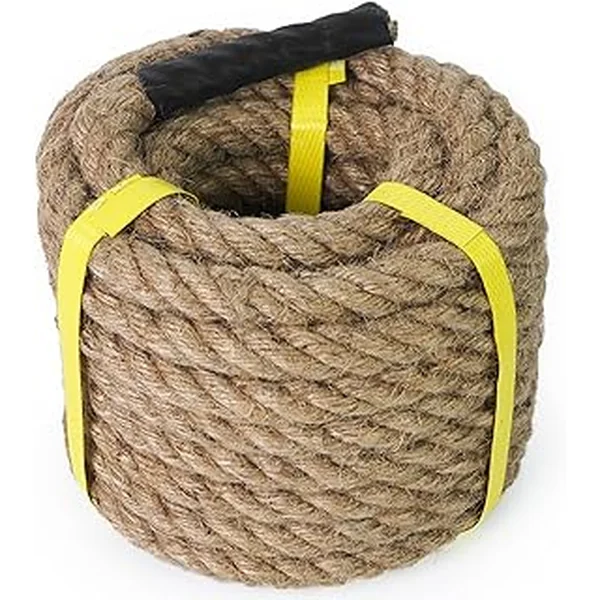
Drive a 1.5-1.8 m (5-6 ft) bamboo or hardwood stake into the planting hole before you set the tuber. Position it 5 cm (2 in) from where the neck of the tuber will sit. Tie the stem to the stake with soft jute twine in loose figure-eight loops as the plant grows, adding ties every 30 cm (12 in). For dinnerplate varieties carrying 25 cm (10 in) blooms, double-stake them.
Dwarf bedding dahlias (under 60 cm / 24 in) don’t need staking. Everything taller does.
Pinching
Pinching is the technique that turns an okay dahlia into a spectacular one. When the main stem has produced 4 sets of true leaves (usually 30-40 cm / 12-16 in tall), use clean shears or your fingers to snap out the growing tip just above the 3rd or 4th leaf pair.
This breaks apical dominance, forces the plant to branch from the leaf axils below, and turns one stem into 4-8 stems. Each branch becomes a flowering stem, multiplying total bloom count dramatically.
Don’t skip pinching on standard garden dahlias. The only time to leave a plant unpinched is when you’re growing a single specimen for an extra-long cut stem (some florists do this for pompon types) — the trade-off is fewer total flowers.
Fertilizing
Less nitrogen, more phosphorus. Dahlias punished with high-nitrogen lawn fertilizer turn into 1.5 m (5 ft) leaf factories with no flowers.
Use a low-nitrogen flowering or tomato fertilizer — something in the 5-10-10 range or a balanced organic bloom formula. Apply:
- Two weeks after shoots emerge: a small scratch-in dose around the drip line.
- When buds form: a second feed, slightly heavier, watered in.
- Mid-flowering (late summer): a final feed to push tubers to size up for storage.
A 5 cm (2 in) top-dress of compost in early summer is excellent and gentle. Avoid synthetic high-N feeds entirely. If you’re unsure where to start with fertilizing in general, our starter fertilizer guide covers the basics across plant types.
Deadheading
Dahlias are programmed to set seed and stop flowering once they succeed. Cutting spent flowers off before they form seed pods tells the plant to keep producing.
Two tips that separate good deadheading from bad:
- Cut the entire stem back to the next set of leaves, not just the bloom. A bare flower stem produces nothing.
- Learn the difference between a spent bloom (rounded, pointed at the tip) and a fresh bud (oval, flat-topped). They look similar at a glance; remove the wrong one and you’ve cost yourself a flower.
Deadhead every 3-4 days during peak season and the plant will produce flowers from late July until frost.
Common pests
Earwigs
Active at night, hide during the day. They chew small holes in young petals and leaves. Set crumpled newspaper or rolled-up cardboard tubes near the plants in the evening; earwigs hide inside them by morning and you dump them in soapy water. Avoid broad-spectrum sprays — they kill beneficial ground beetles that also eat earwigs.
Slugs and snails
Silvery slime trails and ragged holes in young foliage. Iron-phosphate slug bait (pet- and bird-safe) is the gold standard. Avoid metaldehyde-based pellets, which are toxic to dogs.
Aphids
Sticky honeydew on stems and curled new growth. Knock them off with a strong jet of water early in the day; encourage ladybirds and lacewings; spray heavy infestations with insecticidal soap. See how to get rid of aphids for the step-by-step.
Spider mites
Hot, dry weather brings spider mites. Look for fine yellow stippling on the upper leaf surface and webbing on the underside. Rinse foliage forcefully with water; lift humidity around plants with a mulch layer. Heavy infestations may need horticultural oil or insecticidal soap. Full protocol in how to get rid of spider mites.
Powdery mildew
White powdery coating on leaves, common in late summer. Caused by hot days, cool nights, and crowded plants. Space correctly, water at the base, prune lower foliage for airflow, and apply a potassium-bicarbonate-based fungicide if it’s spreading.
Lifting and storing tubers
In zones 7 and colder, lifting is mandatory. In zones 8-10, you can leave tubers in the ground if drainage is excellent — mulch heavily after the foliage dies back.
Step-by-step lifting:
- Wait for the first hard frost to blacken the foliage (-2°C / 28°F or lower). Frost signals the plant to push energy down to the tuber.
- Cut stems to 10 cm (4 in) above ground.
- Wait 7-10 days if weather is dry — this lets the tuber neck heal and the skin firm up.
- Dig the clump with a fork well outside the drip line. Lift gently; tubers snap easily at the neck.
- Wash off all soil with a hose. Inspect each tuber. Discard any that are soft, hollow, or mouldy.
- Air-dry the clump under cover for 1-2 days (not in sun).
- Pack in barely damp peat, sawdust, or vermiculite in a cardboard box.
- Store at 4-10°C (40-50°F) in a frost-free garage, basement, or cellar.
Check monthly. Mist any that shrivel; discard any that go soft. Replant in spring after the soil warms above 13°C (55°F) — typically 1-2 weeks after your last frost date.
Troubleshooting
| Symptom | Likely cause | Fix |
|---|---|---|
| Plant is tall, leafy, no flowers | Too much nitrogen, too little sun, or unpinched | Switch to 5-10-10, relocate if shaded, pinch at 4-leaf stage next year |
| Tubers rotted before sprouting | Soil too cold and wet | Wait for 13°C (55°F) soil, plant in raised beds, don’t water in |
| Stems snap in wind | No stake | Stake at planting next year, double-stake dinnerplates |
| Petals scorch / fade fast | Too much heat | Provide afternoon shade in zones 9-10 |
| White powder on leaves | Powdery mildew | Increase spacing, water at base, apply potassium-bicarbonate fungicide |
| Yellow stippling, webbing | Spider mites | Rinse foliage, lift humidity, apply horticultural oil |
| Holes in young petals | Earwigs at night | Set newspaper traps, empty daily |
| Silvery trails, ragged leaves | Slugs / snails | Iron-phosphate pellets, copper tape |
| Soft, hollow tuber in storage | Too warm or too damp | Store at 4-10°C (40-50°F), reduce moisture in packing |
FAQ
See the full FAQ block at the top of this guide — the same questions are emitted as FAQPage JSON-LD so they appear in Google AI Overviews and rich results.
Related reading
- How to plant dahlia tubers — exact depth, spacing, and watering timing for a successful first sprout.
- How deep to plant dahlia tubers — the depth chart by tuber size and variety class.
- How far apart to plant dahlias — spacing chart that prevents powdery mildew.
- Peony plant care — another long-lived perennial that pairs perfectly with dahlias in a cutting border.
- How to get rid of aphids — protocol for the most common dahlia pest in spring.
Track your pinching window, fertilizer schedule, and tuber-lift date with the free Tazart plant care app — late-summer reminders are easy to forget, and missing the first hard frost by a week is the difference between healthy storage tubers and a mushy compost pile.
A note on conditions
Soil, drainage, USDA zone, and microclimate all shift the numbers. The constants are full sun, low nitrogen, water deeply when growing, and stake at planting. Everything else is a variable you adjust in year 2 based on what the plant tells you. Dahlias are honest reporters — a leggy plant means more sun; a leafy bloomless plant means less nitrogen; a flopped plant means earlier staking.
Highly recommended
The supplies that make this guide work

Tazart is an Amazon Associate — we earn from qualifying purchases at no extra cost to you. Thank you for helping us keep these guides free.
Frequently asked questions
How much sun do dahlias need?
Dahlias need a minimum of 6 hours of direct sun per day — 8 hours is ideal. In the hottest part of zones 8-10, gentle afternoon shade keeps petals from scorching, but anything under 6 hours produces tall, weak, leafy stems with few flowers. Pick the brightest spot in the garden and don't crowd them.
Why are my dahlias not blooming?
The most common cause is too much nitrogen — dahlias fed with lawn-style fertilizers grow huge dark-green plants and almost no flowers. Other causes include too much shade (under 6 hours of sun), skipped pinching (the plant stays single-stemmed and produces fewer buds), failure to deadhead (energy goes into seed production instead of new flowers), or tubers planted in cold, wet soil that rotted before sprouting. Audit nitrogen, light, and pinching first.
How often should I water dahlias?
Wait until shoots break the surface before watering — wet, cool soil rots tubers. Once the plant is 15 cm (6 in) tall, water deeply 2-3 times a week in dry weather, aiming for about 2.5 cm (1 in) of water per session at the root zone. Mulch with 5 cm (2 in) of bark or straw to even out moisture. Drip irrigation or a soaker hose beats overhead watering because wet foliage invites powdery mildew.
When should I pinch dahlia plants?
Pinch when the plant has 4 sets of true leaves — typically 30-40 cm (12-16 in) tall. Use clean shears to snip out the top growth just above the 3rd or 4th leaf pair. This forces the plant to branch low, doubles or triples the number of stems, and gives you many more flowers. Skip pinching only on very early-flowering pompon varieties grown for cut flowers where stem length matters more than count.
How do I store dahlia tubers over winter?
In USDA zones 7 and colder, lift tubers after the first hard frost blackens the foliage. Cut stems to 10 cm (4 in), gently dig the clump, wash off soil, and let tubers dry under cover for 1-2 days. Pack them in barely-damp peat, sawdust, or vermiculite in a cardboard box and store at 4-10°C (40-50°F) in a frost-free garage or basement. Check monthly — discard any that go soft or mouldy, mist any that shrivel.
Do dahlias come back every year?
In USDA zones 8-10, dahlias overwinter in the ground and return reliably each spring if drainage is good. In zones 7 and colder, tubers freeze and rot in the ground — you must lift them after the first frost, store them dry and cool, and replant in spring after soil warms above 13°C (55°F). With proper lifting and storage, a single tuber multiplies into several each year, so dahlias actually become cheaper the longer you grow them.
What is eating my dahlia leaves?
Ragged holes in young leaves are usually earwigs (active at night) or slugs and snails (silvery slime trails). Fine yellow stippling and webbing under leaves means spider mites — common in hot, dry weather. Set out crumpled newspaper traps at dusk for earwigs (they hide in them overnight and you bin them in the morning), use iron-phosphate slug bait, and rinse mite-infested leaves hard with water early in the day to break the cycle.