Houseplants
Corn Plant Care (Dracaena fragrans Indoors Made Easy)
Complete corn plant care guide for Dracaena fragrans (Massangeana cane). Light, watering, soil, brown tip fix, propagation — everything to grow it indoors.
On this page
- Quick answer
- Table of contents
- What is a corn plant? (Dracaena fragrans, not corn the crop)
- Light requirements
- Watering — and the fluoride problem
- Soil and potting
- Temperature and humidity
- Feeding
- Brown tips — the corn plant’s signature problem
- Pruning and shaping
- Propagation from cane cuttings
- Toxicity warning
- Common mistakes
- Troubleshooting
- Watch: corn plant care guide
- Related reading
- A note on conditions
Watch the visual walkthrough
Growing Rainbow Corn & What Does It Taste Like?
In this video, I share my experience in growing rainbow corn also known as gem, glass, and Aztec corn also give my thoughts on ...
The corn plant — botanically Dracaena fragrans, often sold as Mass cane or Massangeana — is the tall woody-stemmed houseplant with strappy variegated leaves you see in offices, hotel lobbies, and bright living rooms. It is not corn the crop. No cobs, no kernels, no farming. The name comes from the leaves, which look a bit like maize foliage spilling out from the top of a cane.
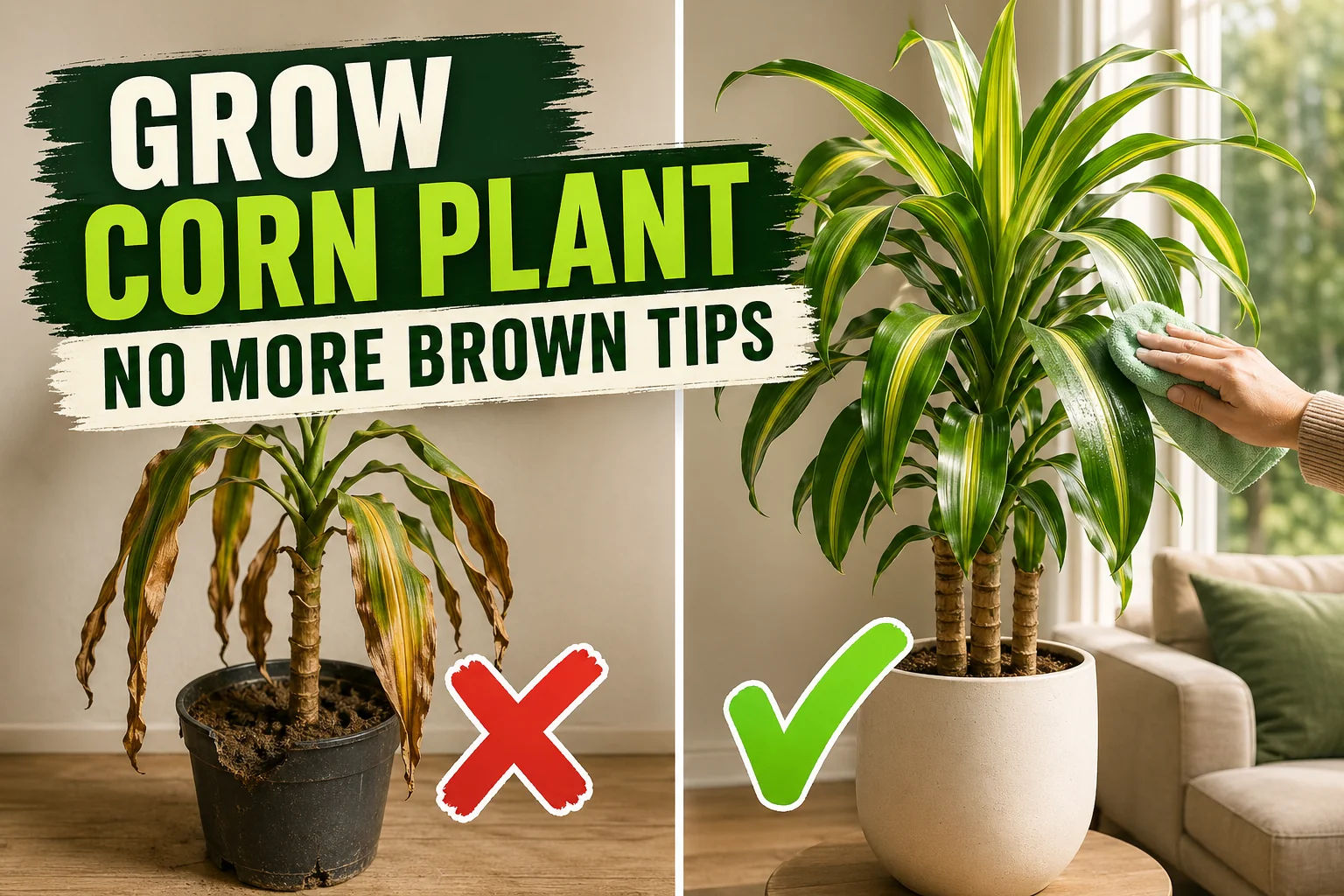
It’s one of the most forgiving large houseplants you can own. Tolerates low light, low humidity, and the occasional missed watering. The catch: it’s extremely sensitive to fluoride in tap water, so if your leaf tips keep turning brown and crispy, that’s almost always why. This guide gives you every specific number and condition you need to grow a healthy 1.8 m (6 ft) corn plant indoors.
Quick answer
A corn plant (Dracaena fragrans) wants medium to bright indirect light, watering with distilled or filtered water when the top 5 cm (2 in) of soil are dry, a well-draining peat-free potting mix, temperatures of 18–24°C (65–75°F), and 40–50% humidity. Fluoride in tap water is the #1 cause of brown leaf tips. Feed once a month in spring and summer, never in winter.
Table of contents
- What is a corn plant? (Dracaena fragrans, not corn the crop)
- Light requirements
- Watering — and the fluoride problem
- Soil and potting
- Temperature and humidity
- Feeding
- Brown tips — the corn plant’s signature problem
- Pruning and shaping
- Propagation from cane cuttings
- Toxicity warning
- Common mistakes
- Troubleshooting table
- Watch: corn plant care guide
- Related reading
- A note on conditions
What is a corn plant? (Dracaena fragrans, not corn the crop)
When people say “corn plant” in a houseplant context, they almost always mean Dracaena fragrans ‘Massangeana’ — a slow-growing tropical tree from Africa with thick woody canes and long strap-shaped leaves arching out the top. It belongs to the Asparagaceae family, and is closely related to other Dracaenas like the dragon tree and the lucky bamboo.
The most common cultivars you’ll see in stores:
- ‘Massangeana’ (Mass cane): green leaves with a wide cream-yellow centre stripe — the classic
- ‘Lemon Lime’: bright lime-green and white striped leaves, more compact
- ‘Lindenii’: cream-yellow margins on the outside, green centre
- ‘Janet Craig’: solid deep green leaves, no variegation, very low-light tolerant
It is a true cane plant: nurseries grow long woody trunks, then graft or root cuttings on top so the leaves emerge from the cane like a cluster of green fountains. That’s why a “corn plant” in your living room often has 2–3 canes of different heights in one pot.
Light requirements
Dracaena fragrans is one of the most light-flexible houseplants, but light directly controls how much variegation you keep and how fast it grows.
What works:
- Medium to bright indirect light is the sweet spot — 1–2 m (3–6 ft) back from a south, east, or west window
- Low to medium indirect light — fine for solid green cultivars like ‘Janet Craig’; growth slows but the plant survives for years
- A north-facing window works for green cultivars; not enough for the variegated Massangeana to look its best
What doesn’t work:
- Direct harsh sun — burns the leaves within a few hours, leaving bleached white patches that never recover
- Deep dark corners with no natural light at all — leaves drop, canes weaken, and the plant slowly fails
If your Massangeana’s cream-yellow stripe is fading to plain green, light is the answer. Move it 30–60 cm (12–24 in) closer to a window. New leaves should emerge with restored variegation in 6–8 weeks.
Watering — and the fluoride problem
Watering a corn plant has two parts: how often, and what water you use. Most people get the first part right and skip the second, which is exactly why their plant develops brown tips.
How often
Water when the top 5 cm (2 in) of soil feel dry. Press a finger into the soil — if it comes out with wet soil clinging, wait. If it comes out dry or barely damp, water thoroughly until water drains from the bottom of the pot.
Seasonal rhythm:
- Spring and summer: every 7–14 days on average
- Autumn and winter: every 14–21 days — growth is slow and the plant needs much less
The woody canes store water, so the plant tolerates drought far better than waterlogging. Soggy soil rots the roots within a week or two.
What water you use
This is the big one. Dracaena fragrans is highly sensitive to fluoride and chlorine in tap water. Most municipal tap water in the US, UK, and parts of Europe is fluoridated — and that fluoride accumulates in the leaf tips, killing the cells and turning them crispy brown.
Best to worst:
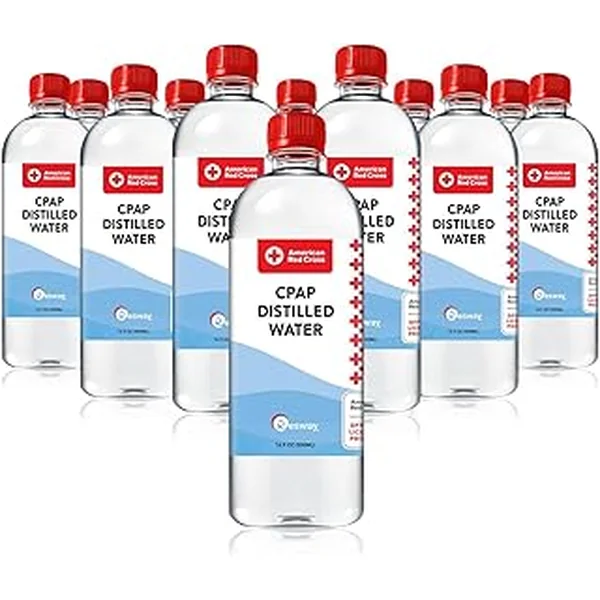
- Distilled water — zero fluoride, zero chlorine, perfect
- Rainwater (collected in a clean container) — naturally soft and fluoride-free
- Filtered water through a reverse-osmosis or carbon filter — much better than tap
- Tap water left out 24 hours — chlorine evaporates but fluoride stays. Better than nothing
- Straight tap water — guaranteed brown tips over time
If you only own one corn plant, a 4 L (1 gal) jug of distilled water lasts a month and costs about as much as a coffee. It is the single biggest upgrade you can make.
If you struggle to remember when you last watered, a free plant care app like Tazart tracks the schedule for you, adjusts it by season, and pings you when the soil should be checked.
Soil and potting
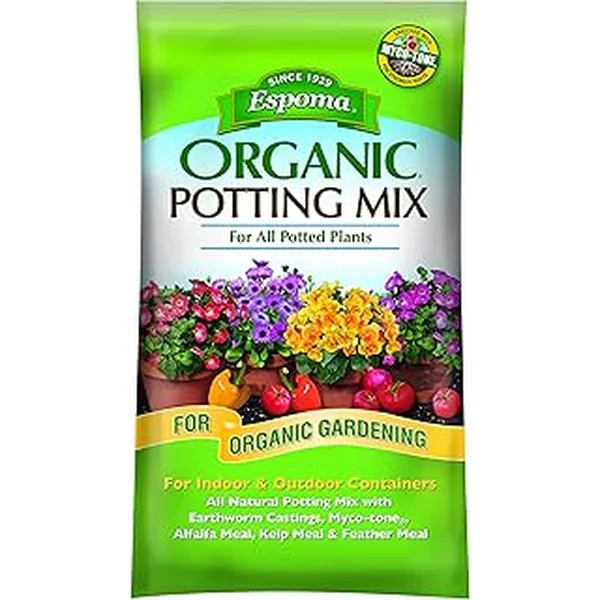
Corn plants need a well-draining, peat-free or low-peat mix that holds light moisture without staying soggy. Dense, water-retentive soil is the second-fastest way to kill a Dracaena (after fluoride).
Good mix recipe:
- 60% peat-free potting compost (coir-based or bark-based)
- 25% perlite (for air pockets and drainage)
- 15% coarse orchid bark or pine bark fines
Pot choice:
- Always a pot with drainage holes — no exceptions
- Heavy ceramic or terracotta in a 25–30 cm (10–12 in) wide, deep pot — the canes are top-heavy and a light plastic pot tips over
- Only go up one pot size (2–3 cm / 1 in wider) when repotting — too much fresh soil holds excess moisture the roots can’t use
Repotting schedule: every 2–3 years, in spring. Use fresh mix each time. Old, compacted soil holds water and provides almost no nutrition. If the canes are very tall and you’re worried about disturbing them, top-dress with fresh soil instead — scrape off the top 5 cm (2 in) and replace with new mix.
Temperature and humidity
Dracaena fragrans is tropical and intolerant of cold.
Ideal temperature: 18–24°C (65–75°F)
Absolute minimum: 13°C (55°F) — never below this, even briefly. Cold damage shows up as sudden leaf yellowing, blackened spots on stems, and curling leaves within 24–48 hours.
Practical tips:
- Move plants away from cold windows in autumn and winter
- Never place a corn plant directly under or beside an air conditioning vent — the dry cold blast burns the leaf tips faster than tap water does
- Avoid drafty hallways and doors that open to outside in winter
Humidity
Corn plants prefer 40–50% relative humidity, which matches a typical home in spring and summer. They tolerate 30–40% but you’ll see more brown tips at the lower end.
Easy ways to raise humidity:
- Group plants together
- Place a tray of pebbles with water under the pot (water below the pot base, not touching it)
- Run a small humidifier nearby in winter when central heating dries the air
- A weekly leaf wipe with a damp microfiber cloth keeps dust off and creates brief humidity at the leaf surface
Avoid heavy misting in cool conditions — wet leaves plus cool air invites fungal spotting.
Feeding
Corn plants are light feeders and overfertilising builds salt in the soil, which burns roots and — yes — causes brown leaf tips.
Schedule:
- Spring and summer: once a month with a balanced liquid fertiliser (e.g. 10-10-10 or 20-20-20) diluted to half strength
- Autumn and winter: no feeding — growth is slow or paused and the plant cannot use the nutrients
Flush the soil with plain water (distilled or rain water if possible) every 3–4 months to wash out salts. Pour water through until it runs freely from the drainage holes, wait a few minutes, and repeat once.
Brown tips — the corn plant’s signature problem
Brown crispy leaf tips are the single most-asked corn plant question, so it gets its own section. There are four causes, and the fix depends on which one you’re dealing with.
| Cause | Tell-tale sign | Fix |
|---|---|---|
| Fluoride / chlorine in tap water | Brown tips appear gradually on most leaves | Switch to distilled, filtered, or rainwater |
| Low humidity (under 30%) | Brown tips with slight leaf curl, often worse in winter | Pebble tray or humidifier, group plants |
| Fertiliser salt buildup | Brown tips plus a white crust on the soil surface | Flush the soil with plain water; halve fertiliser frequency |
| Underwatering | Brown tips with very dry, pulling-away-from-pot soil | Water deeply, then resume the “top 5 cm (2 in) dry” rule |
Trimming brown tips: cut at an angle with clean scissors, following the natural pointed shape of the leaf. Don’t cut the brown bit straight off — it looks unnatural. Trim only the dead tissue; cutting into green tissue invites more browning.
Once you’ve fixed the underlying cause, new leaves grow in clean — but existing damaged tips don’t reverse. Be patient: it takes 6–12 weeks for visibly brown-tipped foliage to be replaced by fresh green leaves.
Pruning and shaping
Corn plants need very little pruning. Most cuts are cosmetic.
What to prune:
- Yellow or fully brown leaves: pull them off gently or cut at the base
- Brown leaf tips: trim at an angle with clean scissors
- A leggy or too-tall cane: cut it back at any height — the cane will branch out below the cut and grow 1–2 new leaf clusters
The big cane chop: if a cane is too tall (say 1.8 m / 6 ft and bumping the ceiling), cut it down to the height you want. Within 4–8 weeks, 1–3 new leaf rosettes sprout below the cut. Save the chopped section — it propagates easily (see below).
Always use clean, sharp scissors or pruners. Wipe with rubbing alcohol between plants to avoid spreading disease.
Propagation from cane cuttings
Corn plant propagation is satisfyingly simple. The woody canes root readily.
Method 1: water rooting (easiest)
- Cut a healthy cane section, 15–30 cm (6–12 in) long, with clean sharp shears. Each section should have at least one growth node (a faint horizontal ring on the cane)
- Note which end was the bottom (the end closest to the roots) — that’s the end that goes in water
- Stand it upright in a glass of water with the bottom end submerged 5–7 cm (2–3 in)
- Place in bright indirect light at room temperature 21–24°C (70–75°F)
- Change the water every 5–7 days
- Roots appear in 4–8 weeks; pot up once roots reach 5 cm (2 in)
Method 2: soil rooting
- Take a cutting as above
- Dust the bottom end with rooting hormone powder (optional but speeds rooting by 1–2 weeks)
- Push the bottom end 5–7 cm (2–3 in) deep into a small pot of moist propagation mix (50% perlite, 50% peat-free compost)
- Keep the soil lightly moist — never soggy
- Loosely cover with a clear plastic bag for the first 2–3 weeks to hold humidity
- Roots and new shoots in 6–10 weeks
A new leaf rosette will eventually sprout from the top of the cane after roots establish below. That’s how nurseries make multi-cane corn plants — staggered cuttings of different heights, all rooted together in one pot.
Toxicity warning
Dracaena fragrans is toxic to pets, especially cats.
The leaves contain saponins — soapy compounds that are bitter and irritating. When chewed or swallowed, saponins cause:
- Vomiting (sometimes with blood)
- Excessive drooling
- Loss of appetite and lethargy
- Dilated pupils — particularly in cats
- Stomach ache
It is not lethal in small amounts, but cats are drawn to the strappy leaves the way they are to grass, and chewing ends badly. If ingestion is suspected, contact a vet or pet poison hotline immediately.
It is generally considered safe-ish for humans — the bitter taste prevents serious ingestion — but keep curious children away. Wash hands after pruning.
Common mistakes
-
Using tap water indefinitely. Fluoride and chlorine slowly poison the leaf tips. Switch to distilled, filtered, or rainwater — the single biggest fix.
-
Watering on a fixed schedule. Corn plants need the soil to dry between waterings. A “weekly watering” routine kills more Dracaenas than anything except cold damage.
-
Tiny pot, top-heavy plant. A 1.5 m (5 ft) corn plant in an 18 cm (7 in) plastic pot will fall over and dry out unevenly. Use a heavy ceramic pot at least 25–30 cm (10–12 in) wide.
-
Direct sun. Corn plants come from shaded tropical understorey. Direct sun bleaches leaves within hours.
-
Fertilising in winter. Growth pauses in winter. Adding fertiliser when the plant can’t use it leads to salt buildup and root burn.
-
Cutting brown tips off straight across. It looks unnatural and weirdly stumpy. Trim at an angle following the original leaf shape.
-
Ignoring the cold draught from an AC vent. Corn plants near a vent will brown faster than anything you can fix with watering changes.
Troubleshooting
| Symptom | Likely cause | Fix |
|---|---|---|
| Brown crispy leaf tips on most leaves | Fluoride/chlorine in tap water | Switch to distilled, filtered, or rainwater |
| Yellow leaves starting from the bottom | Over-watering / root rot | Check roots; cut rotted ones; repot in fresh, dry mix; reduce watering |
| Pale washed-out leaves, weak new growth | Too little light | Move 30–60 cm (12–24 in) closer to a window; avoid direct sun |
| Bleached white patches on leaves | Direct sun burn | Move to bright indirect light |
| Sudden leaf drop, blackened stems | Cold damage | Move away from drafts; keep above 13°C (55°F) |
| Brown tips plus white crust on soil | Fertiliser salt buildup | Flush soil with plain water; halve fertiliser frequency |
| Leggy cane with leaves only at the very top | Low light + age | Cut the cane back; new shoots sprout below the cut in 4–8 weeks |
| Sticky residue on leaves, tiny brown bumps | Scale insects | Wipe with diluted neem oil weekly until clear |
| Plant tilting / falling over | Top-heavy in a small pot | Repot in a heavier ceramic pot at least 25 cm (10 in) wide |
Watch: corn plant care guide
A visual walkthrough pairs well with the steps above — watching someone trim brown tips at the right angle, spot fluoride damage versus underwatering, and propagate a cane cutting makes the rules easier to internalise. Search YouTube for Dracaena fragrans corn plant care — credible houseplant channels often show the before-and-after of brown tip recovery and the cane chop technique.
Related reading
- Aglaonema (Chinese Evergreen) care guide — another low-light tolerant indoor plant with similar watering principles to a corn plant
- Dieffenbachia plant care — a close relative for the same bright-but-not-direct light spot, with the same watering rhythm
- Pothos plant care — pair with a corn plant on a shelf below for a layered tropical look in the same room
- Money tree care (Pachira aquatica) — the braided-trunk lucky houseplant that thrives next to a corn plant under the same bright indirect light
Track your corn plant’s watering schedule automatically with the free Tazart plant care app. It adjusts reminders by season, lets you log the last watering date, and Dr. Afrao — the in-app AI plant assistant — can diagnose brown tips, yellowing, and root rot from a photo.
A note on conditions
Every home is different. The numbers in this guide — 18–24°C (65–75°F), 40–50% humidity, water every 7–14 days — are solid starting points, but your specific light levels, pot size, soil mix, season, water source, and local climate all change how a corn plant actually behaves. Watch the plant for the first month after you bring it home. New leaf colour, tip condition, and how fast the soil dries will tell you what to adjust. That feedback loop — observe, adjust, observe again — is how every confident plant owner is made.
Highly recommended
The supplies that make this guide work

Tazart is an Amazon Associate — we earn from qualifying purchases at no extra cost to you. Thank you for helping us keep these guides free.
Frequently asked questions
How often should I water a corn plant?
Water when the top 5 cm (2 in) of soil feel dry — usually every 7–14 days in spring and summer, and every 14–21 days in autumn and winter. Corn plants store water in their woody canes and rot quickly if kept soggy. Always check the soil with your finger before watering, never on a fixed schedule.
Why does my corn plant have brown tips?
Brown tips on a Dracaena fragrans are almost always caused by fluoride and chlorine in tap water, dry indoor air below 30% humidity, or fertiliser salt buildup. Switch to distilled or filtered water, raise humidity with a pebble tray, and flush the soil every 3–4 months. Trim the brown tips at an angle with clean scissors so the plant looks tidy.
Can a corn plant grow in low light?
Yes — Dracaena fragrans tolerates low to medium indirect light better than most houseplants, which is why you see it in offices and hotel lobbies. However, growth slows dramatically in low light and the cream-yellow stripe on Massangeana cultivars fades. For the best colour and steady growth, give it medium to bright indirect light, 1–2 m (3–6 ft) from a window.
Is the corn plant toxic to cats and dogs?
Yes. Dracaena fragrans contains saponins that are toxic to cats and dogs. Chewed leaves cause vomiting (sometimes with blood), drooling, dilated pupils in cats, and loss of appetite. It is not deadly in small amounts, but it is a known pet poison — keep it out of reach of pets and contact a vet if ingestion is suspected.
How do you propagate a Dracaena fragrans?
The easiest method is cane cuttings. Cut a 15–30 cm (6–12 in) section of woody cane with clean shears, dust the cut end with rooting hormone, and stand it upright in moist potting mix or place it in a glass of water. Keep warm — at least 21°C (70°F) — and bright indirect light. Roots appear in 4–8 weeks, and new shoots emerge from the top of the cane shortly after.
How tall does a corn plant grow indoors?
Indoors, a corn plant typically reaches 1.2–1.8 m (4–6 ft) over many years, and can occasionally hit 2.4 m (8 ft) in a bright spot with a tall ceiling. Outdoors in tropical climates it grows to 4.5–6 m (15–20 ft). Indoor growth is slow — expect about 10–15 cm (4–6 in) of new growth per year on each cane.