Flowers
Coral Bells Care (Heuchera): The Complete Foliage Guide
Grow coral bells (Heuchera) for jewel-toned foliage in lime, peach, plum, silver, and near-black. Full care guide: light, soil, water, dividing, and frost heave fixes.
On this page
- Quick answer
- What coral bells actually are
- Light — part shade is the sweet spot
- Soil — humus-rich and well-draining
- Watering
- Fertilizing
- Common problems and how to fix them
- Best varieties to recommend by colour and zone
- Dividing coral bells
- Watch: coral bells care
- Common mistakes
- Related reading
- A note on conditions
Watch the visual walkthrough
CORAL BELLS (Heuchera spp.) - Where to Plant & How to Grow
Link to some of my favorite garden tools! https://amzn.to/3si8LJC The lovely Coral Bells!! These are some of my favorite plants to ...
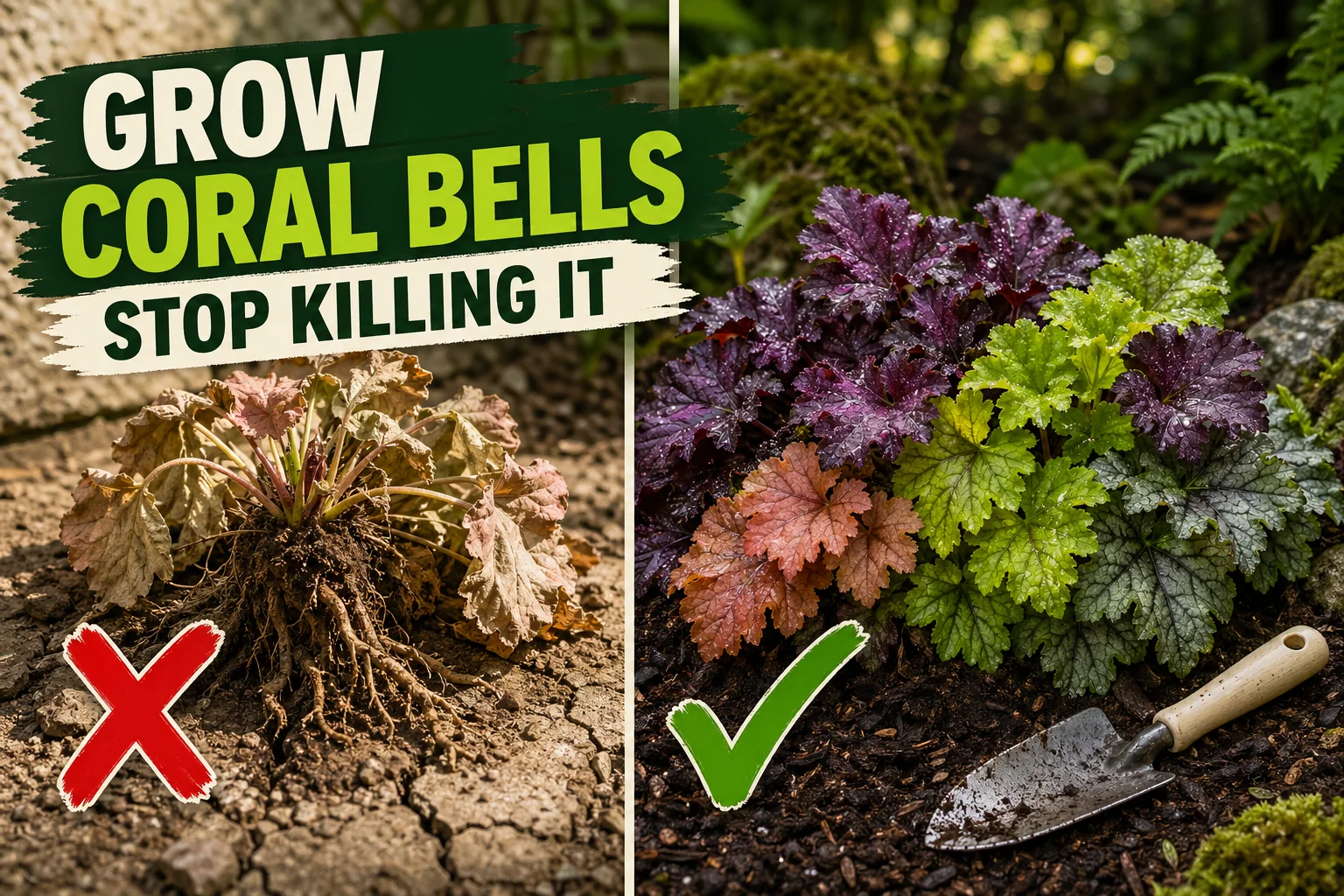
Coral bells (Heuchera) are the foliage perennial that quietly stole the shade garden. Forty years ago they were grown for their wiry summer flower spikes; today they are grown for their leaves — lime, peach, plum, silver, caramel, hot red, and a near-black so dark it absorbs light. A well-placed clump throws colour across a shade border from spring through hard frost, and most cultivars stay evergreen through winter.
This guide covers everything you need to grow them well: the part-shade sweet spot, humus-rich soil, the frost-heave problem that kills more coral bells than any pest, and the best varieties to pick by colour and zone.
Quick answer
Plant coral bells in part shade (about 4 hours of gentle morning sun, afternoon shade) in humus-rich, well-draining soil at pH 6.0–7.0. Water consistently — keep the top 5 cm (2 in) of soil lightly moist, never waterlogged. Mulch 5 cm (2 in) deep in autumn to prevent winter heaving. Feed lightly with compost in spring. Hardy in USDA zones 4–9, mostly evergreen. Divide every 3–4 years to refresh the woody crown.
What coral bells actually are
Coral bells are clump-forming herbaceous perennials in the genus Heuchera, family Saxifragaceae. They are native to North America — woodland margins, rocky outcrops, and shaded slopes from the Rockies to the eastern deciduous forests. Most modern garden cultivars are hybrids built from three parent species:
- Heuchera americana — the eastern woodland species, the toughest and most heat-tolerant.
- Heuchera villosa — gives heat and humidity tolerance, plus the silvery purple foliage of cultivars like ‘Autumn Bride’ and the ‘Southern Comfort’ line.
- Heuchera sanguinea — the original “coral bells” with the bright red flower spikes that gave the plant its common name, native to the southwestern US.
The leaves are the show. They are roughly maple- or palm-shaped, often ruffled or scalloped, and they hold their colour all season. In late spring through midsummer, wiry stems lift sprays of small bell-shaped flowers — coral, white, pink, or red — that pollinators love and that gardeners cut for delicate floral arrangements.
Most cultivars sold today are hardy from USDA zone 4 to zone 9, evergreen in zones 6 and warmer, semi-evergreen in colder zones where the leaves may flatten under snow but rebound in spring.
Light — part shade is the sweet spot
This is the single most common care mistake. Coral bells are sold in nurseries with bright leaves under full overhead light, which makes new growers think they want full sun. They don’t.
- Full sun (6+ hours direct) bleaches the dark cultivars (plum, near-black, bronze) to a tired beige within a few weeks. It also dries the shallow root system faster than the plant can keep up, leading to scorched leaf edges.
- Deep shade (less than 2 hours direct) fades the bright cultivars (lime, peach, caramel) toward green and gives weak, leggy flower stems that flop.
- Part shade — about 4 hours of morning sun, then afternoon shade — is ideal for the vast majority of cultivars. Dappled light through deciduous trees works equally well.
Two practical exceptions:
- Hot, humid zones (USDA 7–9): push toward more shade. Hot afternoon sun is too punishing.
- Cool, cloudy zones (USDA 4–5, Pacific Northwest, UK): push toward more sun. Bright cultivars hold colour better and bloom heavier.
If a clump’s leaves look tired, scorched at the edges, or oddly faded, the first thing to assess is light. Move it 30 cm (12 in) further into the shade and wait a season — most cultivars rebound fast.
Soil — humus-rich and well-draining
Coral bells evolved on woodland edges where decades of leaf litter have built deep, crumbly, organic-rich soil over a free-draining mineral base. Reproduce that and they are nearly bulletproof.
Target conditions:
- pH 6.0 to 7.0 — slightly acidic to neutral. Most garden soil falls naturally into this range; only chalky or limestone soils need amendment.
- Humus-rich — well-rotted compost, leaf mould, or aged bark fines forked into the planting hole at a depth of 20–25 cm (8–10 in).
- Well-draining — water should never pool around the crown. Heavy clay is the single biggest killer in winter; soggy soil rots the woody crown within weeks of a freeze-thaw cycle.
Heavy clay sites benefit from raised beds 20–30 cm (8–12 in) above grade, or planting on a gentle slope where surface water runs off. Sandy soils need extra organic matter mixed in to hold moisture between waterings.
When planting, set the crown so the topmost growing point sits level with the soil surface — never below, never proud. Burying the crown encourages rot; planting too high accelerates frost heaving in winter.
Watering
Consistent moisture is the watchword — coral bells dislike both drought and waterlogging.
- Water deeply when the top 2–3 cm (1 in) of soil feels dry to the touch.
- In a typical garden bed in summer, that’s 2.5 cm (1 in) of water per week from rainfall plus irrigation combined.
- Container-grown plants dry out much faster — check daily in summer.
- Stop frequent watering by late autumn so the crown enters winter on the drier side; soggy frozen soil is the worst combination for crown rot.
If you’re planting coral bells alongside other shade-loving perennials, water avens (Geum rivale) is a natural companion that shares the same humus-rich, evenly moist soil requirements and blooms at a similar height.
Mulching matters. A 5 cm (2 in) layer of pine bark, composted leaves, or shredded hardwood mulch around the crown (but not over it) keeps the root zone evenly moist, suppresses weeds, and slowly feeds the humus content of the soil as it breaks down. Pull the mulch back from the crown itself in autumn so the woody base can dry between rains.
Fertilizing
Coral bells are light feeders. Heavy fertilizer is actively counterproductive — it forces fast soft growth, weakens the crown, and dilutes leaf colour.
- Spring: top-dress with a 2–3 cm (1 in) layer of well-rotted compost or aged manure around the crown. This is enough for most plants.
- Container plants: a single application of a balanced slow-release perennial fertilizer in early spring at half the label rate is sufficient.
- Avoid high-nitrogen lawn fertilizers, fresh manure, or anything labelled for tomatoes — these all push leggy growth and burn the shallow root system.
If a clump genuinely looks pale and stunted in early summer, a single liquid feed at quarter strength can be applied. More than that is rarely needed.
Common problems and how to fix them
For another shade-tolerant perennial that pairs beautifully with coral bells in a woodland-edge border and shares the same preference for cool, moist soil, the bleeding heart plant care guide covers a classic companion with arching stems and heart-shaped flowers.
Frost heaving (the number-one killer)
Heuchera build a short woody stem at the base, and as the soil freezes and thaws across winter, that stem lifts the crown out of the ground. Within one or two seasons the roots are partly exposed to air, the plant dries out in spring sun, and dies before anyone notices what happened.
Fix: mulch 5 cm (2 in) deep around (not on top of) the crown in late autumn. In spring, walk the bed once the ground has thawed and replant any heaved crowns by gently pressing the woody base back into firm soil — or lift, refresh the hole with compost, and replant deeper with the topmost growing point level with the soil surface.
This is the single most important winter task for coral bells in zones 4–6.
Foliar nematodes
Microscopic worms (Aphelenchoides species) live inside the leaf tissue and cause dark, angular, wedge-shaped lesions bounded by the leaf veins. The damage usually appears in late summer on the lower leaves first.
Fix: there is no chemical cure available to home gardeners. Remove and burn or bin affected leaves — never compost them. Avoid overhead watering, which spreads the nematodes between leaves. In severe cases lift the plant, discard it, and replant elsewhere in fresh soil.
Vine weevils
Adult vine weevils chew scalloped notches out of the leaf edges at night; the white grubs eat the roots and woody crown underground. A plant that wilts dramatically despite moist soil and lifts out of the ground with little resistance has almost always lost its roots to vine weevil grubs.
Fix: apply parasitic nematodes (Steinernema kraussei or Heterorhabditis) to the soil in late summer or early autumn when soil temperatures are still 10°C (50°F) or warmer. Hand-pick adults at night with a torch in spring. Container plants are especially vulnerable — drench the compost annually.
Crown rot
Black, mushy stems at soil level after a wet winter — almost always caused by waterlogged clay soil or burying the crown too deep at planting.
Fix: lift the plant, slice off any black or mushy tissue with a clean knife, and replant in a raised bed with added grit and compost. Set the crown level with the soil surface, not below.
Best varieties to recommend by colour and zone
The 2014 Mt. Cuba Center Heuchera trial — the most respected scientific evaluation of coral bells — concluded that H. villosa-derived cultivars vastly outperformed pure H. americana hybrids in heat and humidity. Use that as a buying guide for warmer zones.
| Cultivar | Foliage colour | Best in | Notes |
|---|---|---|---|
| ’Autumn Bride’ | Pale lime green, large leaves | USDA 4–9 | The Mt. Cuba Center top performer; tough, vigorous, white flowers |
| ’Caramel’ | Apricot-peach turning amber | USDA 4–9 | Heat-tolerant villosa hybrid; holds colour all season |
| ’Obsidian’ | Glossy near-black | USDA 4–9 | Best in part shade; bleaches in full sun |
| ’Lime Marmalade’ | Vivid chartreuse-lime | USDA 4–9 | Brightens deep-shade corners; ruffled leaves |
| ’Plum Pudding’ | Deep plum-purple | USDA 4–8 | Reliable mid-zone performer; coral pink flowers |
| ’Palace Purple’ | Bronze-purple | USDA 4–9 | The original purple cultivar; tough as old boots |
| ’Berry Smoothie’ | Hot rose-pink turning purple | USDA 4–9 | Strong heat tolerance; vivid year-round |
| ’Silver Scrolls’ | Silver with purple veining | USDA 4–9 | Striking under dappled shade; villosa parentage |
Pair two or three contrasting colours in a drift — lime next to plum, peach next to silver — and the bed reads as a permanent low tapestry through the whole growing season.
Dividing coral bells
Every 3–4 years the central crown becomes woody, the middle dies back, and the lower leaves start to lift. That’s the cue to divide.
If you’re building a shade border around coral bells, columbine (Aquilegia) makes an excellent companion — it blooms earlier in spring, fills the same dappled-shade niche, and self-seeds to fill gaps between heuchera clumps.
- Lift the entire clump in early spring or early autumn, when soil is moist and temperatures are mild.
- Wash or shake the soil off the crown so you can see the structure clearly.
- Use a sharp knife or hand pruners to slice the crown into sections, each with healthy white roots and 3–5 leaf rosettes.
- Discard the dead woody centre piece — it never re-roots well.
- Replant each division in a refreshed hole with added compost. Set the topmost growing point level with the soil surface, never buried, never proud.
- Water in well, mulch 5 cm (2 in) deep around (not over) the crown.
Each division typically reaches full size again within 1–2 seasons. A single mature clump can usually yield 3–5 healthy divisions, making this the cheapest way to fill a long shade border.
Watch: coral bells care
A short visual walkthrough is helpful for spotting frost heaving on a real plant and seeing the difference between a properly seated crown and a buried one. Search YouTube for “Heuchera dividing and replanting” for practical division demonstrations that pair well with the steps above.
Common mistakes
- Planting in full sun. Bleaches dark cultivars and dries the shallow roots out. Move to part shade.
- Burying the crown. Causes rot within weeks. Set the topmost growing point level with the soil surface.
- Skipping winter mulch. Frost heaving kills more coral bells than any pest. Mulch 5 cm (2 in) deep in autumn.
- Overfeeding. Forces leggy soft growth and weakens the crown. Compost in spring is enough.
- Heavy clay without amendment. Crown rot in winter. Raise the bed or amend heavily with compost and grit.
- Composting nematode-infected leaves. Spreads the problem across the garden. Bin or burn them.
- Not dividing. Crown lifts out of the soil and the plant declines after 4–5 years. Divide every 3–4 years.
Related reading
- Azalea plant care — another acid-leaning shade-loving perennial that rewards careful soil prep at planting time.
- Chinese lantern plant care — a hardy clump-forming perennial that pairs well with coral bells in autumn borders.
- How to plant hosta seeds — the classic shade-bed companion for coral bells; the two combine into the backbone of any woodland border.
Track your coral bells dividing schedule, autumn mulch reminders, and spring frost-heave check with the free Tazart plant care app. Two reminders that pay off: a “mulch coral bells” alert in late autumn and a “check for heaved crowns” alert at the first thaw.
A note on conditions
Every garden is different. Local soil pH, summer humidity, winter freeze-thaw cycles, the angle of light through the year, and the trees overhead all change how coral bells actually grow in your specific spot. Use the numbers in this guide as a starting point, watch how the leaves respond in their first full season, and adjust from there. A cultivar that bleaches in one corner of the garden often holds colour beautifully under a different tree two metres away — coral bells are honest plants, and the foliage tells you when the conditions are wrong long before the crown starts to fail.
Highly recommended
The supplies that make this guide work

Tazart is an Amazon Associate — we earn from qualifying purchases at no extra cost to you. Thank you for helping us keep these guides free.
Frequently asked questions
Are coral bells perennial?
Yes — coral bells (Heuchera) are hardy herbaceous perennials, mostly evergreen, that live for many years in USDA zones 4–9. The clump expands slowly each season and the same plant can flower and refresh its foliage for a decade or more if divided every 3–4 years to refresh the crown.
Do coral bells like sun or shade?
Part shade is the sweet spot — roughly 4 hours of gentle morning sun followed by afternoon shade. Full sun bleaches the dark plum, near-black, and bronze cultivars, while deep shade fades the bright lime and peach varieties and weakens the flower stems. North- and east-facing borders, or dappled light beneath deciduous trees, suit them best.
Why are my coral bells leaves curling?
The three usual causes are scorching afternoon sun, dry soil during a heatwave, or foliar nematodes (microscopic worms inside the leaf tissue causing dark angular patches between veins). Move the plant to part shade, deep-water during dry spells, and remove and bin any leaves with the dark wedge-shaped lesions that signal nematodes — never compost them.
Do coral bells spread?
Coral bells form a slowly expanding clump from a central woody crown — they are clump-formers, not aggressive spreaders. A typical plant reaches 30–45 cm (12–18 in) wide in 3 years. They do not run via rhizomes or stolons and never become invasive, which makes them ideal for tidy front-of-border planting.
When should I divide coral bells?
Every 3–4 years in early spring or early autumn, when the centre of the clump becomes woody and the lower stems start to lift out of the soil. Dig the whole crown, slice it into sections each with healthy roots and 3–5 leaf rosettes, and replant deeper than before with the crown level with the soil surface — never proud.
How long do coral bells live?
10 years or more is realistic with regular division. Without division, the woody crown lifts out of the soil over time (a process called heaving), the centre dies out, and the plant declines after 4–5 years. Replanting divisions deeper every few seasons resets the clock indefinitely.
Are coral bells deer resistant?
Yes — coral bells are rated highly deer-resistant by most university extension services. The slightly hairy, semi-leathery leaves are unappetising to deer and rabbits. They can still be browsed in a hard winter when other food is scarce, but they are rarely the first thing eaten in a mixed border.