Houseplants
Cat Safe Houseplants: 18 Non-Toxic Picks for Your Home
Complete list of cat safe houseplants verified by the ASPCA — plus the most common toxic ones to avoid and what to do if your cat eats a plant.
On this page
Watch the visual walkthrough
Don’t Poison Your Fur Babies With These Houseplants!
I have a Patreon!!! https://www.patreon.com/Patadendron?fan_landing=true A lot of us have pets and this video is all about ...
If you own a cat and love houseplants, you’ve probably done the anxious Google search at 11 pm after spotting a chewed leaf. The good news: a large number of the most popular, most attractive indoor plants are completely safe for cats. The bad news: some of the most widely sold beginner plants — pothos, philodendron, ZZ plant — are genuinely toxic.
This guide gives you a verified, ASPCA-sourced list of 18 non-toxic plants worth growing, the most dangerous ones to remove or relocate, and exactly what to do if your cat eats something questionable.
Quick answer
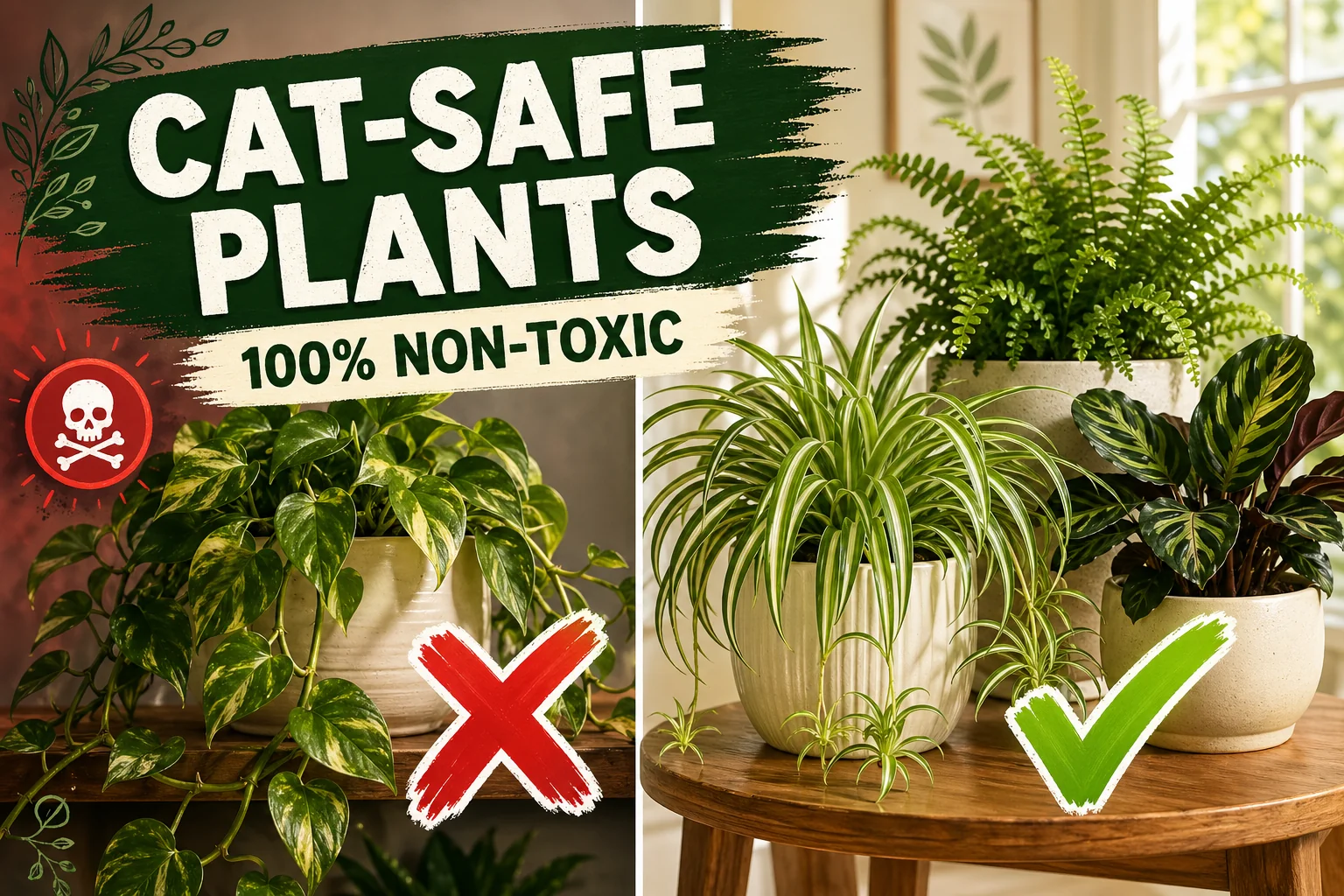
The safest cat-friendly houseplants include spider plant, Boston fern, calathea, prayer plant, areca palm, parlor palm, peperomia, African violet, friendship plant, air plants, baby tears, and most haworthias. The most dangerous common houseplants for cats are true lilies, sago palm, pothos, philodendron, dieffenbachia, and ZZ plant. When in doubt, verify against the ASPCA Toxic and Non-Toxic Plants database before buying.
18 verified cat-safe houseplants
Every plant in this list is confirmed non-toxic to cats by the ASPCA database. “Non-toxic” means the plant does not contain compounds known to cause systemic poisoning in cats. Some may still cause mild stomach upset if eaten in quantity — the way eating grass or dirt does — but none are classified as toxic.
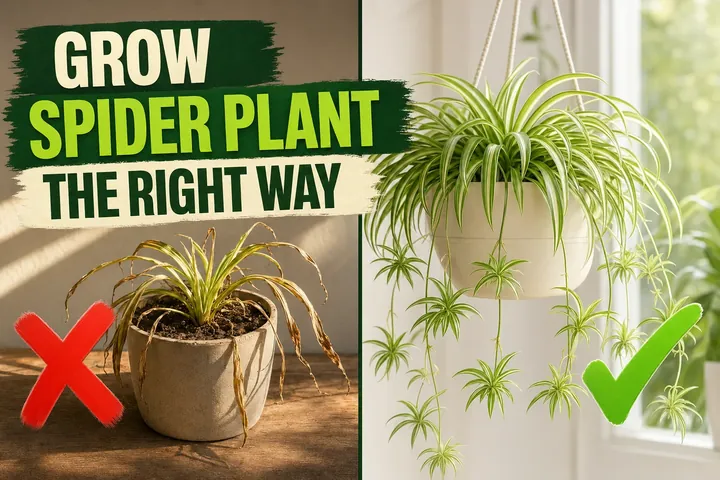
1. Spider plant (Chlorophytum comosum)
One of the most forgiving houseplants you can own, and completely safe. Spider plants contain mild compounds loosely related to opiates that can cause mild stomach upset or fascination in cats (some cats actively seek them out to chew), but the ASPCA does not classify them as toxic. Hang them in a macrame basket at 1.5–1.8 m (5–6 ft) above the floor if your cat is a persistent chewer.
Care: Bright indirect light, water when the top 3 cm (1 in) of soil is dry, use rainwater or distilled water to avoid brown tips. Full spider plant care guide here.
2. Boston fern (Nephrolepis exaltata)
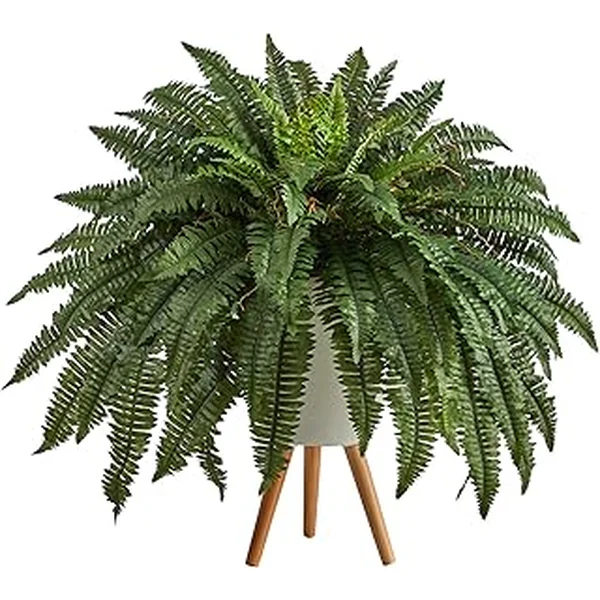
One of the most popular non-toxic hanging plants. The full, arching fronds of a Boston fern are safe if nibbled, and the cascading shape looks striking in a ceiling-hung pot well above cat level.
Care: High humidity (50–70%), consistent moisture, bright indirect light. Avoid heating vents — they dry the fronds fast.
3. Calathea / Goeppertia (formerly Calathea, now Goeppertia)
Calatheas — including the popular rattlesnake plant, orbifolia, and medallion — are all ASPCA-listed non-toxic. Their intricate patterned leaves and dramatic leaf movements (they fold and track light just like prayer plants) make them one of the most attractive cat-safe tropical options available.
Care: Indirect light, filtered water, 50–60% humidity. Calatheas are sensitive to tap water minerals — the same fluoride issue as spider plants.
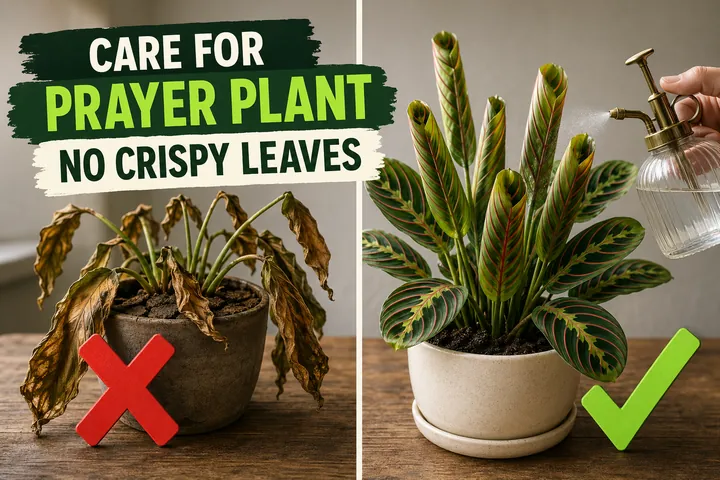
4. Prayer plant (Maranta leuconeura)
The Maranta prayer plant is non-toxic and safe for homes with cats. It’s also one of the most visually interesting low-light houseplants, with herringbone-patterned leaves that fold up each evening. Full prayer plant care guide here.
Care: Bright indirect light, 50–60% humidity, filtered water, temperature 18–27°C (64–81°F).
5. Areca palm (Dypsis lutescens)
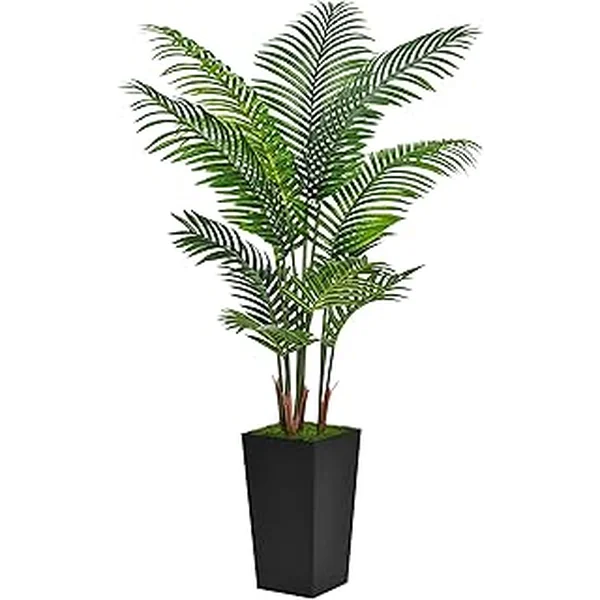
The areca palm is one of the few cat-safe plants that delivers genuine height and drama — it can reach 1.8–2.1 m (6–7 ft) indoors. The ASPCA lists it as non-toxic to both cats and dogs. An excellent floor statement plant.
Care: Bright indirect to filtered direct light, consistent watering, high humidity. Avoid soggy soil — palms rot quickly with no drainage.
6. Parlor palm (Chamaedorea elegans)
A smaller, shadier-tolerant alternative to the areca palm, and equally non-toxic. Parlor palms tolerate lower light than most palms and grow slowly, reaching around 1–1.2 m (3–4 ft) indoors.
Care: Low to medium indirect light, water when the top 3–5 cm (1–2 in) of soil is dry. One of the most forgiving palms for indoor conditions.
7. Peperomia (Peperomia spp.)
With over 1,000 species, peperomia is one of the safest and most diverse genera for cat households. The ASPCA lists the genus as non-toxic. Watermelon peperomia (P. argyreia), baby rubber plant (P. obtusifolia), and ripple peperomia (P. caperata) are all widely available and safe.
Care: Bright indirect light, water when the top 3 cm (1 in) is dry, tolerates average humidity. Semi-succulent — far more tolerant of underwatering than overwatering.
8. African violet (Streptocarpus ionanthus, formerly Saintpaulia)
A classic flowering houseplant that is safe for cats. African violets produce purple, pink, or white blooms nearly year-round in the right conditions. Their compact size (typically 10–15 cm / 4–6 in across) makes them easy to place on high shelves out of cat reach if needed.
Care: Bright indirect light (east- or north-facing window), water from the bottom to avoid crown rot, average humidity. Feed monthly with a low-nitrogen fertilizer.
9. Friendship plant (Pilea involucrata)
Also called the moon valley plant, the friendship plant has deeply textured, quilted leaves in bronze-green. It is ASPCA non-toxic and grows in a compact mound of around 15–20 cm (6–8 in) tall — making it a great windowsill plant well above ground level.
Care: Bright indirect light, consistent moisture (not soggy), moderate humidity.
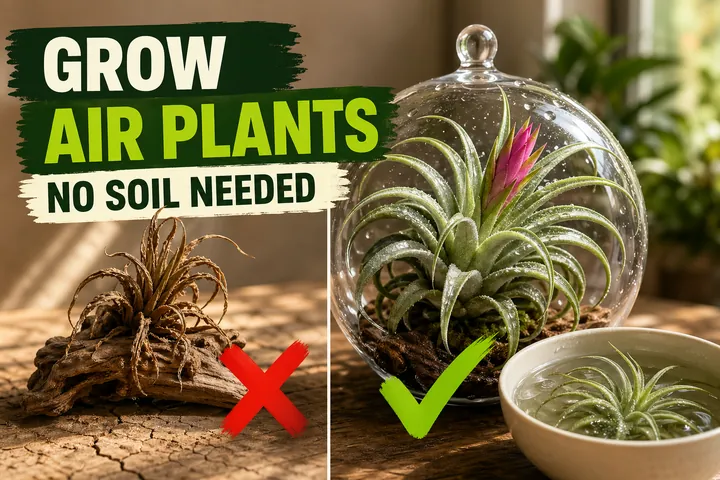
10. Air plants (Tillandsia spp.)
Air plants are genuinely unique: they grow without soil, drawing moisture and nutrients from the air and occasional misting. All common Tillandsia species are non-toxic to cats. Because they are typically displayed mounted on wood or in glass globes at eye level or higher, cats rarely reach them — but if they do, no harm done.
Care: Bright indirect or filtered direct light, soak in water for 20–30 minutes once a week, shake dry and return to their mount. Full air plant care guide here.
11. Baby tears (Soleirolia soleirolii)
Baby tears forms a dense carpet of tiny round leaves — a beautiful low-growing plant that spills over pot edges. It is non-toxic and is one of the best non-toxic alternatives to the toxic trailing creeping plants (like pothos) that are usually sold for the same aesthetic purpose.
Care: Bright indirect light, keep consistently moist (it dries out fast), moderate to high humidity.
12. Haworthia (Haworthia spp.)
Most haworthias — including the widely available H. fasciata (zebra haworthia) and H. cooperi — are non-toxic to cats. This makes them the go-to safe succulents: drought-tolerant, nearly indestructible, and cat-safe. Note that Aloe vera — superficially similar in appearance — is mildly toxic, so verify species before buying.
Care: Bright indirect light, water when soil is completely dry (every 2–3 weeks), well-draining succulent mix.
13. Cast iron plant (Aspidistra elatior)
The cast iron plant earns its name — it tolerates low light, low humidity, irregular watering, and drafts better than almost any other houseplant. It is also fully non-toxic to cats. Slow-growing, so not a fast-fill option, but nearly unkillable once established.
Care: Low to medium indirect light, water every 2–3 weeks, average humidity.
14. Chinese money plant (Pilea peperomioides)
The trendy coin-shaped Pilea is non-toxic to cats. It grows in a tidy upright rosette shape to about 30 cm (12 in) tall, making it easy to place on shelves. It also propagates prolifically — once established, it pushes out offshoots you can share (hence its other nickname, “pass-it-along plant”). Full care guide here.
Care: Bright indirect light, water when the top 2–3 cm (0.75–1 in) is dry, rotate weekly for even growth.
15. Lemon button fern (Nephrolepis cordifolia ‘Duffii’)
A compact relative of the Boston fern, with small round leaflets and a faint citrus scent when touched. Non-toxic and well-sized for small shelves or bathroom counters where steam provides natural humidity.
Care: Bright indirect light, consistently moist soil, 50–60% humidity.
16. Banana plant (Musa spp.)
A bold, architectural choice that is safe for cats. The large paddle-shaped leaves add instant tropical drama. Indoor bananas rarely fruit, but they grow fast — 30–60 cm (12–24 in) per year — making them a striking focal point in bright rooms.
Care: Bright indirect to filtered direct light, consistent moisture, temperatures above 16°C (60°F), regular feeding in spring and summer.
17. Staghorn fern (Platycerium bifurcatum)
Staghorn ferns are mounted on boards and hung on walls — their unusual antler-shaped fronds and wall-mount habit naturally keeps them out of cat reach. The ASPCA lists them as non-toxic. An excellent choice for cat households with limited shelf space.
Care: Bright indirect light, soak the mount in water for 15–20 minutes once a week, mist the fronds between soaks.
18. Orchids (Phalaenopsis spp.)
Phalaenopsis orchids — the flat-faced grocery-store orchids sold everywhere — are non-toxic to cats. Some cats are attracted to the roots or will chew flower spikes, but there is no toxicity risk. Place them on high windowsills or on top of refrigerators for both good light and cat-inaccessible height.
Care: Bright indirect light, water once a week by soaking the pot for 10–15 minutes, no direct midday sun. Fertilize monthly at quarter strength.
Comparison table: safe vs. toxic common houseplants
| Plant | Safe for cats? | Notes |
|---|---|---|
| Spider plant | Safe | Mild stomach upset if eaten in large amounts; ASPCA non-toxic |
| Boston fern | Safe | ASPCA non-toxic; great hanging option |
| Calathea / Goeppertia | Safe | ASPCA non-toxic |
| Prayer plant (Maranta) | Safe | ASPCA non-toxic |
| Areca palm | Safe | ASPCA non-toxic; large floor plant |
| Parlor palm | Safe | ASPCA non-toxic; tolerates low light |
| Peperomia | Safe | ASPCA non-toxic; 1,000+ species |
| African violet | Safe | ASPCA non-toxic; blooms nearly year-round |
| Air plants (Tillandsia) | Safe | ASPCA non-toxic; wall-mount keeps out of reach |
| Haworthia | Safe | ASPCA non-toxic; most species confirmed safe |
| Chinese money plant | Safe | ASPCA non-toxic |
| Orchid (Phalaenopsis) | Safe | ASPCA non-toxic |
| Pothos | TOXIC | Calcium oxalate crystals; oral pain, vomiting |
| Philodendron | TOXIC | Calcium oxalate crystals |
| ZZ plant | TOXIC | Calcium oxalate; irritation and vomiting |
| Dieffenbachia | TOXIC | Calcium oxalate; severe swelling, can obstruct airways |
| True lilies (Lilium) | HIGHLY TOXIC | Can cause acute kidney failure from small exposure |
| Sago palm | HIGHLY TOXIC | Can cause liver failure; extremely dangerous |
| Aloe vera | Mildly toxic | Saponins and anthraquinones cause vomiting, lethargy |
| Jade plant | TOXIC | Causes vomiting, incoordination, lethargy |
Plants to avoid entirely
These are the plants most likely to harm or kill a cat if ingested. If you currently have them in your home, relocate them to a completely cat-inaccessible space (a room the cat never enters) or rehome them entirely.
True lilies — the highest-priority risk
True lilies (Lilium spp.) and daylilies (Hemerocallis spp.) are acutely nephrotoxic to cats — meaning they cause kidney failure. The specific toxic compound has not been identified, but the entire plant is dangerous: leaves, flowers, pollen, stems, and even the water in a vase holding cut lilies. Pollen falling on a cat’s coat and being groomed off is enough to trigger toxicity. There is no safe level of exposure. Easter lilies, tiger lilies, Asiatic lilies, and stargazer lilies are all in this category.
Symptoms appear within 2–6 hours: vomiting, lethargy, loss of appetite. Kidney failure follows within 24–72 hours without treatment. If caught within 6 hours, aggressive IV fluid therapy can prevent kidney damage. After 24 hours, the prognosis becomes significantly worse.
If you have a cat: do not bring lilies into your home, ever.
Sago palm (Cycas revoluta)
Every part of the sago palm — seeds, leaves, roots — contains cycasin, a compound that causes severe liver failure in cats and dogs. It is sold as an ornamental plant in many garden centres without adequate warnings. Even one or two seeds can be fatal. Treatment success drops sharply if more than a few hours have passed.
Pothos (Epipremnum aureum)
The world’s most popular beginner houseplant is toxic to cats. The insoluble calcium oxalate crystals in the leaves and stems cause immediate and intense oral pain, drooling, pawing at the mouth, and vomiting. It is rarely life-threatening, but the pain and distress are significant. Replace with baby tears or a non-toxic trailing plant.
Philodendron (Philodendron spp.)
Same calcium oxalate mechanism as pothos — oral pain, swelling, and GI upset. Both heartleaf philodendron (P. hederaceum) and split-leaf philodendron (often sold as Monstera deliciosa, which is a different genus but equally toxic) cause problems if chewed.
Dieffenbachia (Dieffenbachia spp.)
Also called dumb cane. Contains some of the highest concentrations of calcium oxalate raphides of any common houseplant. Chewing a leaf causes intense burning, swelling of the tongue and throat, and in severe cases can obstruct swallowing. Keep completely away from cats.
ZZ plant (Zamioculcas zamiifolia)
Technically toxic (calcium oxalate crystals) but less acutely dangerous than lilies or sago palm. Still causes oral pain and vomiting and should be kept out of reach or replaced.
What to do if your cat eats a plant
Step 1: Identify the plant immediately. Take a photo of the whole plant and the chewed part. Check the ASPCA database at aspca.org/pet-care/animal-poison-control/toxic-and-non-toxic-plants.
Step 2: Call for help if the plant is toxic or unknown.
- ASPCA Animal Poison Control Center: (888) 426-4435 — available 24/7. A per-incident consultation fee applies.
- Your nearest emergency veterinary clinic.
- Do not wait for symptoms to appear with high-risk plants like lilies — kidney damage begins before symptoms are visible.
Step 3: Do not induce vomiting without vet instruction. Inducing vomiting can sometimes cause additional harm, particularly with plants that cause swelling or burning in the mouth and throat. A vet or poison control specialist will tell you whether it’s appropriate.
Step 4: Bring the plant to the vet. A physical sample or a clear photo makes identification faster and more accurate. Many ER vets see several plant poisoning cases per week and will recognize common toxic plants immediately.
Step 5: Monitor for symptoms even after a “safe” verdict. Even non-toxic plants can cause mild GI upset in cats with sensitive stomachs. Watch for vomiting, lethargy, excessive drooling, or lack of appetite for 24 hours after any plant-eating incident.
Sourcing plants: how to verify before buying
The ASPCA maintains the most comprehensive and frequently updated database of toxic and non-toxic plants for cats and dogs. The database is searchable by common name and Latin name at aspca.org/pet-care/animal-poison-control/toxic-and-non-toxic-plants.
A few practical habits when buying new plants:
- Always verify the Latin name. Common names are unreliable. “Peace lily” (Spathiphyllum) sounds calming but is toxic. “Spider plant” (Chlorophytum comosum) sounds alarming but is safe. Search by scientific name on the ASPCA database.
- Ask the nursery staff for the full species name. Reputable nurseries will know. If they can’t tell you, photograph the label and check before taking the plant home.
- Assume unlabelled plants are unknown until verified. This applies to cuttings from friends, market finds, and plants labeled only by colour (e.g. “variegated tropical” or “trailing green”).
- Use a plant ID app. A tool like Tazart can identify a plant from a photo in seconds, giving you the Latin name you need to look up.
Related reading
- How to take care of a spider plant — the most popular cat-safe trailing houseplant, with a full watering and brown-tip guide.
- How to take care of a prayer plant — humidity, watering, and light guide for Maranta leuconeura.
- Air plant care: how to grow Tillandsia indoors — soil-free, non-toxic, and naturally mounted out of cat reach.
- Identify any unfamiliar plant from a photo instantly with the free Tazart plant identifier — get the Latin name you need for the ASPCA database lookup.
A note on conditions and individual cats
Every cat is different. Some cats never touch houseplants; others make it their mission to chew every leaf in the room. The toxicity information in this guide reflects established veterinary consensus as of 2026, sourced from the ASPCA database, Cornell Feline Health Center, and the Royal Horticultural Society. However, individual cats can have idiosyncratic sensitivities, and new research occasionally reclassifies plants. Always cross-reference with the current ASPCA database before introducing a new plant to a home with cats — the database is updated more frequently than any printed or static guide.
Highly recommended
The supplies that make this guide work

Tazart is an Amazon Associate — we earn from qualifying purchases at no extra cost to you. Thank you for helping us keep these guides free.
Frequently asked questions
Are spider plants safe for cats?
Yes. Spider plants (Chlorophytum comosum) are listed as non-toxic to cats by the ASPCA. However, they contain mild compounds related to opiates that can cause mild stomach upset or vomiting if eaten in large quantities — the same way eating grass does. The plant is safe, but keep an eye out if your cat is a persistent chewer.
What houseplants are most toxic to cats?
The most dangerous are true lilies (Lilium and Hemerocallis species) — even a small amount can cause acute kidney failure in cats. Other high-risk plants include sago palm, which causes liver failure; dieffenbachia and pothos, which contain calcium oxalate crystals causing burning and swelling; philodendron; and ZZ plant. If your cat has been near any of these, call the ASPCA Animal Poison Control Center at (888) 426-4435 immediately.
Is pothos safe for cats?
No. Pothos (Epipremnum aureum) is toxic to cats. It contains insoluble calcium oxalate crystals that cause immediate oral pain, drooling, swelling, and vomiting if chewed. It is one of the most common causes of plant-related calls to the ASPCA Poison Control line because it is so widely sold as a beginner houseplant. Replace it with a trailing non-toxic alternative like baby tears (Soleirolia soleirolii) or string of hearts (Ceropegia woodii).
Is calathea safe for cats?
Yes. Calathea (now largely reclassified as Goeppertia) is listed as non-toxic to cats and dogs by the ASPCA. It is one of the best cat-safe tropical houseplants available because it also thrives in the same low-to-medium indirect light that most indoor rooms offer.
What should I do if my cat eats a houseplant?
Act quickly. First, identify the plant. If the plant is known toxic or you are unsure, call the ASPCA Animal Poison Control Center at (888) 426-4435 (a consultation fee applies) or your nearest emergency vet. Do not wait for symptoms to appear — with lilies in particular, kidney damage progresses within hours. Bring a photo or cutting of the plant to the vet. Do not induce vomiting unless a veterinarian explicitly instructs you to.
Are succulents safe for cats?
It depends on the species. Most haworthias are safe. However, Aloe vera is mildly toxic to cats — the saponins and anthraquinones in the latex layer cause vomiting and lethargy. Jade plant (Crassula ovata) is also toxic. Echeveria species are generally considered non-toxic. Always verify the exact species against the ASPCA database before placing any succulent where a cat can reach it.
Is ZZ plant toxic to cats?
Yes. ZZ plant (Zamioculcas zamiifolia) contains calcium oxalate crystals throughout its leaves, stems, and rhizomes. Contact causes oral irritation, drooling, and vomiting. It is not considered as severely toxic as lilies or sago palm, but it should be kept completely out of reach or replaced with a non-toxic look-alike. The ASPCA lists it as toxic to both cats and dogs.
Is Boston fern safe for cats?
Yes. Boston fern (Nephrolepis exaltata) is listed as non-toxic to cats and dogs by the ASPCA. It is one of the most popular cat-safe hanging plants because its full, cascading fronds stay well above floor level and the plant itself poses no chemical risk if nibbled.