Houseplants
Calandiva Plant Care (How to Get It to Re-Bloom)
Calandiva plant care made simple — light, water, deadheading, and the 6-week dark trick that forces a tired Kalanchoe 'Calandiva' to re-bloom every year.
On this page
- Quick answer
- What is Calandiva?
- What you’ll need
- Light: bright, but not scorching
- Water: less than you think
- Soil and pot
- Temperature and humidity
- Fertilizing
- Deadheading: the easy lifespan extender
- How to get Calandiva to rebloom (the 6-week dark trick)
- Pruning after blooming
- Common mistakes to avoid
- Troubleshooting
- Watch: Calandiva care and rebloom walkthrough
- Calandiva care checklist
- Related reading
- A note on conditions
Watch the visual walkthrough
Best Tips for KALANCHOE Plant Care - How Professionals Care For Their Kalanchoes #kalanchoe
Kalanchoe Plant Care Tips | How to Keep Your Kalanchoe Blooming & Healthy Learn how to care for your Kalanchoe, ...
Calandiva is the supermarket houseplant everyone loves on the way home and quietly throws away two months later. It doesn’t have to be that way. With the right light, watering rhythm, and one annual six-week trick, the same little plant blooms heavily every year — sometimes twice.
This guide covers everything: where to put it, how often to water, how to deadhead, how to feed, and exactly how to force it to re-bloom.
Quick answer
Give Calandiva 4–6 hours of bright light, water only when the top 3 cm (1 in) of soil is dry, and use a gritty succulent mix in a pot with drainage. To rebloom, give the plant 14 hours of complete darkness and 10 hours of bright light per day for 6 weeks — buds appear 2–3 weeks after you return it to normal light.
What is Calandiva?
Calandiva is a patented cultivar group of Kalanchoe blossfeldiana — the cheerful little succulent sold by the millions in supermarkets and garden centres from October to March. The difference from regular Kalanchoe is the flower: each Calandiva bloom has 32 or more petals layered into a tight rosette, like a miniature rose.
Care is identical to standard Kalanchoe. It’s a tough succulent from Madagascar, not a fussy florist plant — once you understand it’s basically a flowering jade with extra steps, it gets very easy.
What you’ll need
- A 12–15 cm (5–6 in) pot with a drainage hole
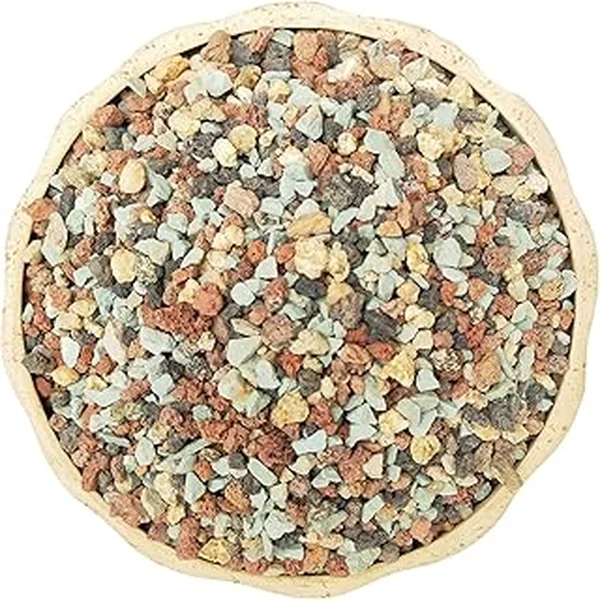
- Gritty succulent or cactus mix (or 2 parts potting soil + 1 part perlite + 1 part coarse sand)
- A bright south- or east-facing windowsill
- A watering can with a narrow spout
- Sharp clean snips for deadheading
- Optional: bloom-booster fertilizer for the rebloom phase
- Optional: a cardboard box or closet for the 6-week dark treatment
Light: bright, but not scorching
Calandiva wants 4–6 hours of bright direct light per day. Indoors, that’s a south- or east-facing window in winter, or an east window in summer (a south window in summer can scorch the leaves).
You’ll know you’ve got the light right when:
- New leaves stay tight and rosette-shaped, not stretched
- Stems stay short and stocky between leaves
- Existing blooms hold their colour for the full 6–8 weeks
If the plant gets leggy with long bare stems and pale leaves, it’s reaching for light — move it closer to the window or supplement with a small grow light.
Water: less than you think
Calandiva is a succulent, so the rule is the same as jade or aloe: water deeply, then let the soil dry.
Practical schedule:
- Indoors, summer: every 7–10 days
- Indoors, winter or rebloom phase: every 14–21 days
- Outdoors, hot summer pot: every 5–7 days
Always test with a finger first. Push it 3 cm (1 in) into the soil — if you feel any moisture, wait. If it’s bone dry, water until you see drips at the drainage hole, then empty the saucer 10 minutes later. Standing water rots the roots within days.
A free plant care app like Tazart can hold the watering schedule for you, adjust it for your local weather, and ping you when it’s actually time to water — useful if Calandiva is one of several succulents on your shelf.
Soil and pot
Use a gritty succulent or cactus mix — not standard houseplant soil, which holds too much water for a Madagascan succulent. If you only have regular potting mix, cut it 1:1 with perlite or coarse sand.
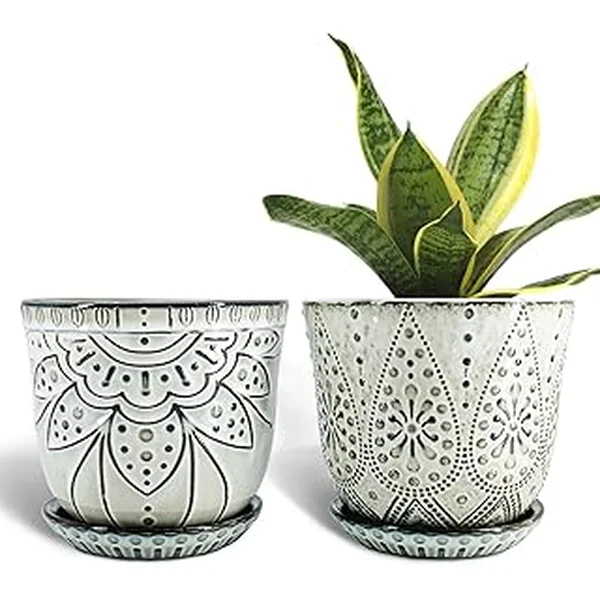
The pot should be 12–15 cm (5–6 in) wide with a drainage hole. The decorative cellophane and plastic nursery pots Calandivas come in trap moisture and are the single biggest reason supermarket plants die. Repot within a week of bringing one home.
Temperature and humidity
- Ideal day: 18–24°C (65–75°F)
- Ideal night: 13–18°C (55–65°F)
- Hard low: do not let it dip below 10°C (50°F)
Average household humidity (30–50%) is fine. Calandiva does not need misting — wet leaves invite fungal spots.
Fertilizing
Calandiva is a light feeder. While the plant is in active bloom or building buds, feed every 2–4 weeks with a half-strength bloom-booster fertilizer (high phosphorus, lower nitrogen). Skip feeding entirely during the dark rebloom treatment and during deep winter rest.
Too much nitrogen = lots of leaves, no flowers. If your plant is leafy and refusing to bloom, switch to a phosphorus-leaning bloom feed for the next two cycles.
Deadheading: the easy lifespan extender
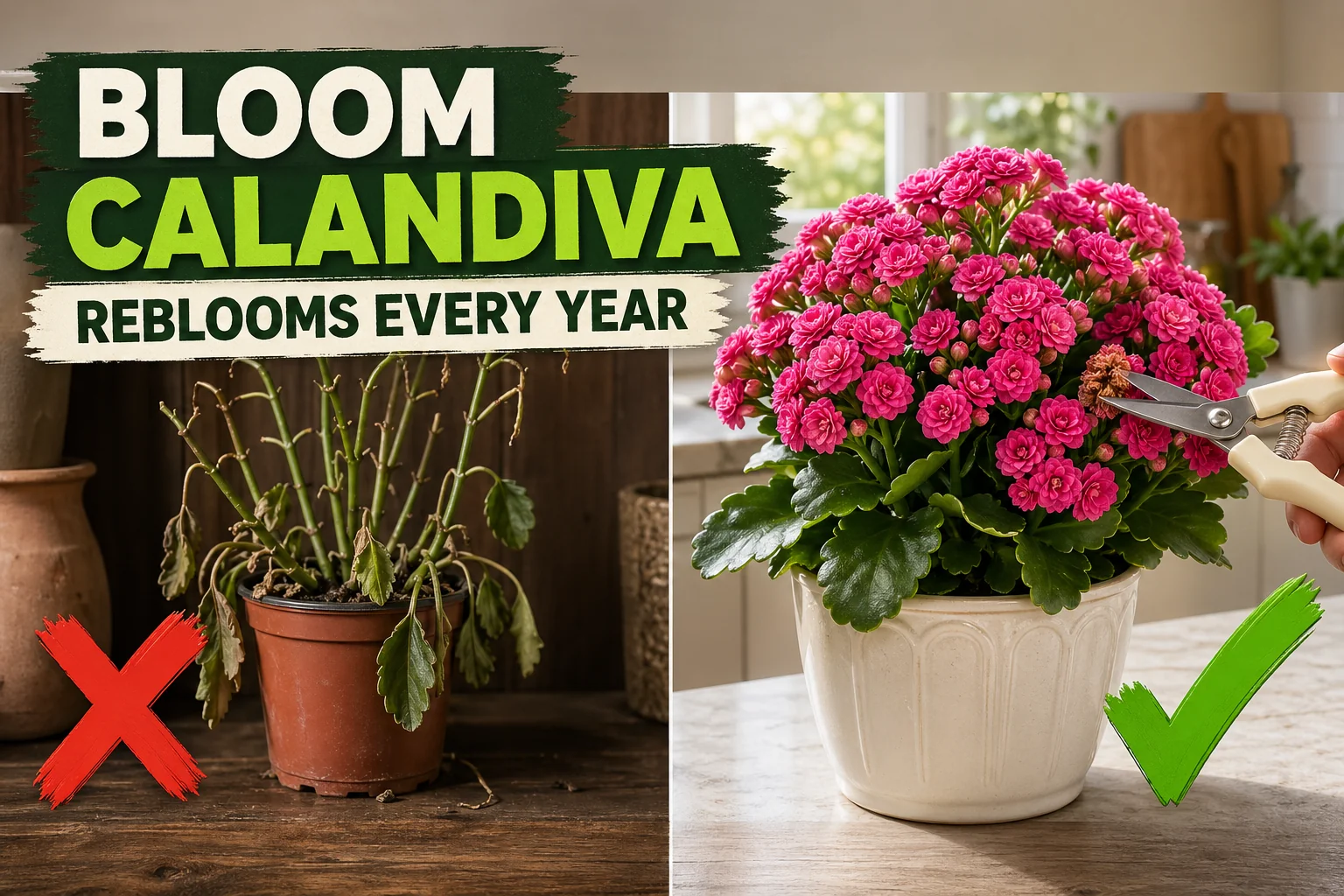
When a flower cluster fades, snip the entire spent stem back to the next pair of healthy leaves — not just the dead petals. This redirects energy into new buds instead of seed production.
Use clean sharp snips. A clean cut heals in a day; a torn stem invites rot.
Deadhead through the whole flowering period. Done weekly, you’ll often add 2–3 weeks to the bloom show before the plant naturally rests.
How to get Calandiva to rebloom (the 6-week dark trick)
Calandiva is photoperiodic — it sets flower buds only when nights are long enough to convince the plant that winter is coming. Modern houses with lamps on past sunset confuse this cue, which is why most Calandivas never bloom again.
The fix is six weeks of forced darkness. Plan backwards from when you want flowers — buds appear about 2–3 weeks after the dark treatment ends, so 6 weeks of dark + 3 weeks of waiting = roughly 9 weeks total.
The routine
- Pick a starting date. Most growers begin in early September for Christmas blooms, or early March for spring blooms.
- Each day, give the plant 10 hours of bright light (a sunny windowsill from 8 am to 6 pm works perfectly).
- Each evening at 6 pm, place the plant somewhere with complete darkness for 14 hours until 8 am the next morning. Options:
- A closet that no one opens at night
- A cardboard box flipped over the plant in a dark room
- A blackout grow tent
- During the 6 weeks, water sparingly — every 2–3 weeks is plenty — and skip fertilizer.
- After 6 full weeks, return the plant to its normal sunny windowsill and resume regular watering.
- Buds appear 2–3 weeks later. Resume half-strength bloom fertilizer once buds show colour.
Why “complete” darkness matters
Even brief exposure to light at night — a hallway lamp, a 30-second closet check, a phone flashlight — resets the plant’s internal clock and breaks the bud-set signal. If the dark routine isn’t working, this is almost always why. Tape the closet door, or use a cardboard box in a room you don’t go into after dark.
Pruning after blooming
Once all the flowers fade and you’ve deadheaded the last clusters, give the whole plant a tidy haircut. Cut the stems back by about a third, leaving 4–6 leaves on each shoot. The plant looks dramatic for a week, then bushes out fast — and a bushier plant produces more flower clusters next round.
This is also the perfect time to take cuttings. Calandiva roots from stem tips in about 14 days in a glass of water or directly in soil — see how to propagate jade plant for the same technique applied to a related succulent.
Common mistakes to avoid
- Leaving it in the cellophane sleeve. Traps moisture against the leaves and stem — strip it the day you bring the plant home.
- Watering on a fixed weekly schedule. Calandiva needs the soil to dry out. Always finger-test first.
- Using regular potting mix. Compacts and stays wet. Mix in perlite or buy a cactus blend.
- Feeding high-nitrogen fertilizer. Pushes leaves at the expense of flowers. Use a bloom feed.
- Skipping deadheading. Spent flowers signal the plant to make seed and stop blooming. Snip them weekly.
- Giving up after one bloom. The 6-week dark trick is the entire reason this plant is sold as a “perennial gift” in Europe — most owners just never knew.
Troubleshooting
| Symptom | Likely cause | Fix |
|---|---|---|
| Leaves yellowing, soft, mushy at the base | Overwatering | Stop watering, repot into dry gritty mix, trim any rotted roots, water only when top 3 cm (1 in) is dry |
| Leaves wrinkled, papery, edges curling in | Underwatering | Soak the pot in a bowl of water for 15 minutes, then let drain fully — leaves recover overnight |
| Plant stretches with long bare stems | Not enough light | Move closer to a south- or east-facing window, or add a small grow light |
| No buds after 6 weeks of darkness | Light leak during dark phase | Use an opaque box, tape the closet door, eliminate any night-time light source |
| Buds form, then drop before opening | Cold draft or sudden temperature swing | Move away from cold windows in winter; keep night temps above 13°C (55°F) |
| Brown spots on leaves | Water sitting on foliage / fungal | Water at the soil line only, never overhead; improve airflow |
| Tiny black flying insects in soil | Fungus gnats from staying too wet | Let soil dry fully; top with a 1 cm (0.5 in) layer of dry sand |
| Lots of leaves, never flowers | Too much nitrogen, or never given dark treatment | Switch to bloom fertilizer; run the 6-week 14-hour-dark routine |
Watch: Calandiva care and rebloom walkthrough
A short visual walkthrough pairs well with the steps above. If you’re a visual learner, search YouTube for Calandiva Kalanchoe rebloom 14-hour dark and pick a clip that shows the closet routine — then come back to this guide for exact watering and feeding numbers.
Calandiva care checklist
- Bright window with 4–6 hours of direct light
- Pot with drainage, gritty succulent mix
- Water only when top 3 cm (1 in) of soil is dry
- Half-strength bloom fertilizer every 2–4 weeks while flowering
- Deadhead spent flower clusters weekly
- 6 weeks of 14-hour complete darkness once a year
- Light prune after every bloom cycle
- Day temps 18–24°C (65–75°F), nights above 10°C (50°F)
Related reading
- How to care for an aloe vera plant — same dry-out-between-waterings rule applies to most household succulents.
- Donkey tail plant care — another low-light-tolerant succulent that benefits from a gritty mix and minimal watering.
- How to propagate a jade plant — the same stem-cutting method works for the leggy stems you trim off Calandiva after blooming.
- Set up the watering schedule for your Calandiva and the rest of your succulents in the free Tazart plant care app.
A note on conditions
Every home is different. Light, pot size, soil mix, season, humidity, and your local weather all change how fast a Calandiva grows and how often it needs water. Use the steps above as a starting point and adjust based on what your plant actually does in week two — that’s how every good plant grower learns.
Highly recommended
The supplies that make this guide work


Tazart is an Amazon Associate — we earn from qualifying purchases at no extra cost to you. Thank you for helping us keep these guides free.
Frequently asked questions
How do you take care of a Calandiva plant?
Treat Calandiva like a flowering succulent. Give it 4–6 hours of bright direct light, water only when the top 3 cm (1 in) of soil is fully dry, use a fast-draining cactus or succulent mix, and feed every 2–4 weeks with a half-strength bloom fertilizer while it's in flower. Deadhead spent rosettes to extend the show.
How do you get a Calandiva to bloom again?
Calandiva is photoperiodic — it sets buds only when nights are long. Starting about 6 weeks before you want flowers, give the plant 14 hours of complete darkness and 10 hours of bright light per day. A closet or a cardboard box flipped over the plant from 6 pm to 8 am works. Keep this routine for 6 weeks, then return it to a normal sunny spot — buds appear in 2–3 weeks.
How often do you water a Calandiva?
Roughly every 7–14 days indoors, but always check the soil first. The top 3 cm (1 in) must feel completely dry before you water again. In winter or during the dark/rebloom period, stretch it to every 2–3 weeks. Calandiva rots faster from overwatering than from drought.
Is Calandiva an indoor or outdoor plant?
Both, depending on your climate. It's hardy outdoors only in USDA zones 10–11 (above 10°C / 50°F year-round). Anywhere colder, grow it as an indoor houseplant on a bright windowsill, or move it outside for summer and back in before nights drop below 10°C (50°F).
Why is my Calandiva not flowering?
Almost always one of three reasons: (1) not enough darkness — modern households leave lamps on past sunset, which blocks bud formation; (2) not enough light during the day, so the plant is too weak to bloom; (3) it never got a cool rest period. Run the 6-week 14-hour-dark routine and you'll usually get blooms within 8–9 weeks.
How long do Calandiva blooms last?
Each flush lasts 6–8 weeks, sometimes longer than the original supermarket bloom because home conditions are gentler than greenhouse forcing. Deadhead spent clusters as soon as they brown to push energy into the next round of buds.
Is Calandiva the same as Kalanchoe?
Calandiva is a patented double-flowered cultivar series of Kalanchoe blossfeldiana — same species, more petals. Each flower has 32+ petals arranged like a tiny rose, instead of the flat 4-petal flowers on a standard Kalanchoe. Care is identical.