Houseplants
Caladium Plant Care (Show-Stopping Heart-Shaped Leaves)
Caladium plant care made simple — light, water, humidity, and the warm-soil trick that wakes a dormant tuber back into a riot of pink, white, and green leaves.
On this page
- Quick answer
- Table of contents
- Light requirements
- Watering — keep it evenly moist
- Soil and potting
- Temperature and warmth
- Humidity — the colour key
- Feeding
- Dormancy and overwintering tubers
- Propagation by tuber division
- Toxicity warning
- Common mistakes
- Troubleshooting
- Watch: caladium care visual walkthrough
- Care checklist
- Related reading
- A note on conditions
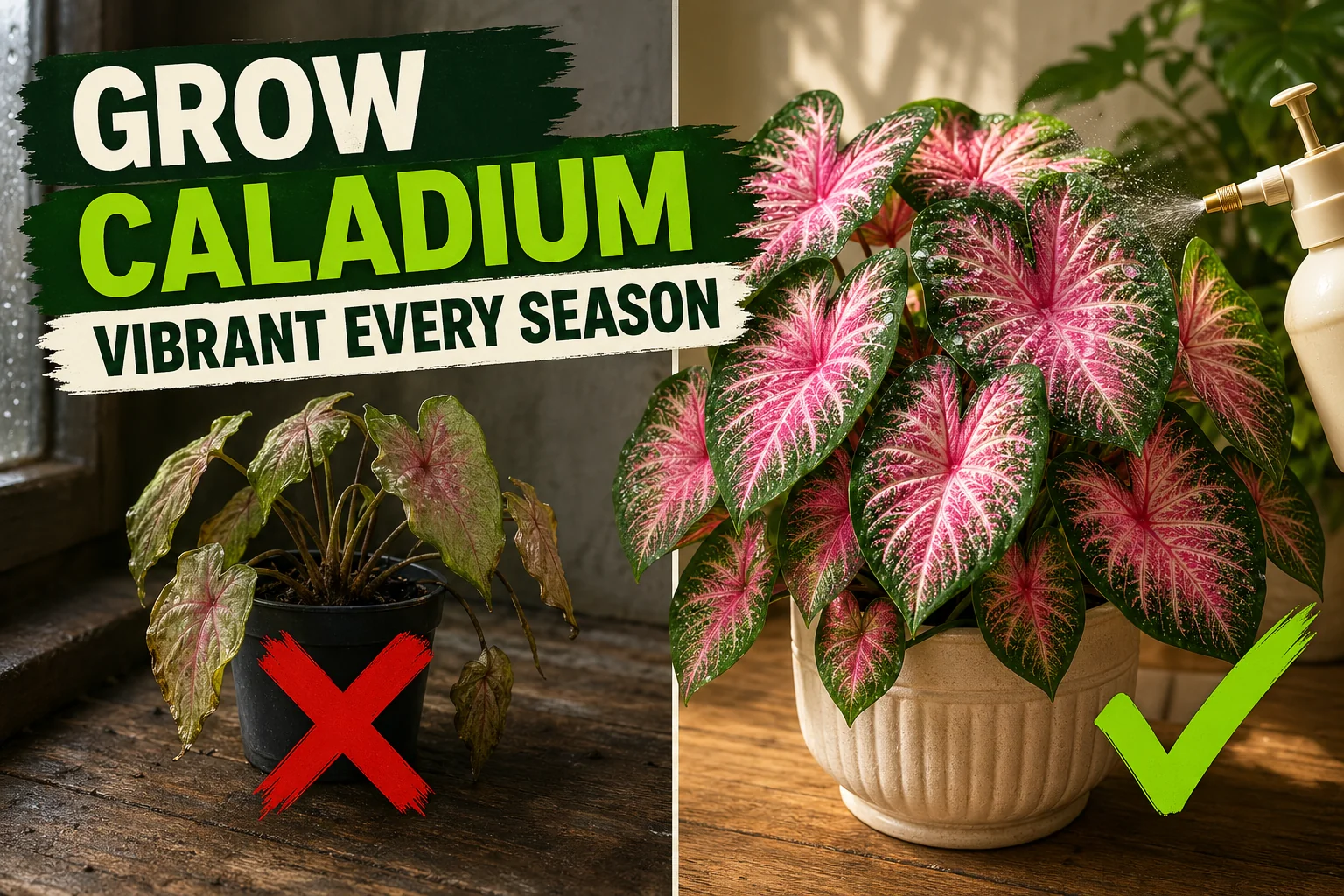
Caladium is one of the most dramatic foliage plants you can grow — giant heart-shaped leaves splashed with hot pink, deep red, and snow-white veining over a forest-green base. A single tuber pushes out a clump of leaves that can stop conversations in a room.
The catch is that Caladium is a tropical tuberous perennial, not a permanent leafy houseplant. It grows hard in spring and summer, fades in autumn, and rests as a dormant tuber through winter. Get the warmth, humidity, and watering right during its growing season, and you’ll have a riot of foliage every year for the price of one tuber.
Quick answer
Caladium bicolor needs bright indirect light, warm temperatures of 21–27°C (70–80°F), humidity above 50%, and evenly moist (not soggy) soil. Water when the top 2–3 cm (1 in) feels dry, feed every 2–4 weeks in spring and summer, and let the tuber go dormant when leaves yellow in autumn. Never expose to temperatures below 13°C (55°F).
Table of contents
- Light requirements
- Watering — keep it evenly moist
- Soil and potting
- Temperature and warmth
- Humidity — the colour key
- Feeding
- Dormancy and overwintering tubers
- Propagation by tuber division
- Toxicity warning
- Common mistakes
- Troubleshooting table
- FAQ
Light requirements
Caladium evolved on the shaded floor of South American rainforests. Indoors, that translates to bright indirect light — never direct midday sun, which scorches the thin papery leaves within hours.
The right spots:
- 1–2 m (3–6 ft) back from an east- or north-facing window
- Behind a sheer curtain on a south- or west-facing window
- Outdoors: dappled shade under a tree, or morning-only sun until 10 am
A few newer cultivars labelled “sun-tolerant” — like ‘Florida Sweetheart’ or ‘Red Flash’ — can handle 3–4 hours of direct light if the soil never dries out. Most fancy-leaf strap-leaf varieties cannot.
If your Caladium leaves look pale, undersized, or the pink markings are washing out to off-white, it’s getting too much light, not too little. Move it back from the window 30 cm (12 in) at a time until the colours intensify.
Watering — keep it evenly moist
This is the make-or-break factor. Caladium leaves wilt the moment the soil dries out — within a few hours on a warm day — but the tuber rots if it sits in standing water for more than two or three days.
The rule: water as soon as the top 2–3 cm (about 1 in) of soil feels dry to the touch.
In practice that means:
- Spring/summer (active growth): every 3–5 days indoors, more often outside in heat
- Late summer (slowing): every 5–8 days
- Autumn (going dormant): stop watering once leaves start yellowing
- Winter (dormant tuber): no water at all
When you water, water deeply until you see drips at the drainage holes, then empty the saucer 10 minutes later. Letting the pot sit in water is the #1 cause of Caladium tuber rot.
Soil and potting
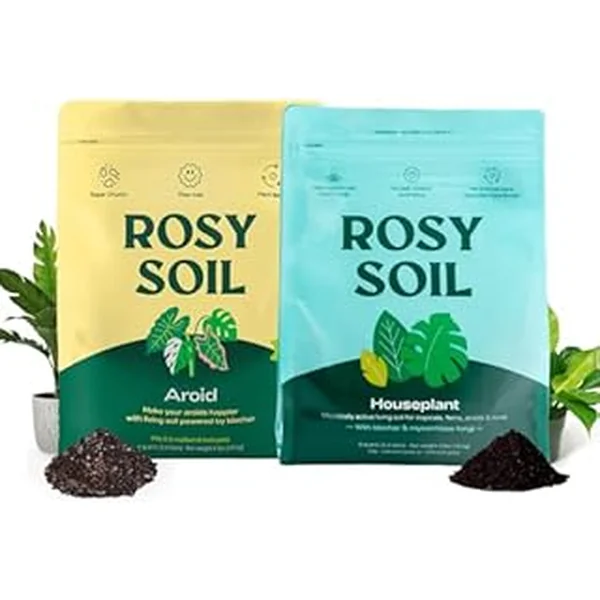
Use a peat-free chunky aroid mix — bark, perlite, coir, and a little compost — that holds steady moisture without compacting. A standard houseplant mix lightened with 20–30% perlite also works.
Pot size:
- One tuber → 15–20 cm (6–8 in) wide pot, 15 cm (6 in) deep
- Two or three tubers → 25–30 cm (10–12 in) pot
Always pick a pot with a drainage hole. A drainage saucer is fine, but never let water sit in it for hours.
Plant the tuber knobby-side up, smooth-side down, buried 5 cm (2 in) deep. If you can’t tell which side is up, plant it sideways — the shoots will find their way.
Temperature and warmth
Caladium is the warmest-loving aroid most home growers will own. It refuses to grow at all below 18°C (65°F) and is killed by anything below 10°C (50°F).
Targets:
- Day: 21–27°C (70–80°F)
- Night: 18–21°C (65–70°F)
- Hard floor: never below 13°C (55°F)
Don’t put potted Caladium outside in spring until night-time temperatures stay above 18°C (65°F). Putting it out a week early means a smaller, slower plant for the rest of summer.
Humidity — the colour key
Caladium leaves are thin and flat — they lose water fast. In dry indoor air (below 40% humidity) the edges turn brown and crispy, and the bright pink and white veining fades quickly.
Aim for 50–70% humidity. Easy ways to get there:
- A small warm-mist humidifier within 1 m (3 ft) of the plant
- A pebble tray of water under the pot
- Group it with other tropicals so they share moisture
- A bathroom or kitchen with regular shower/cooking steam
Misting helps briefly but is not enough on its own. A humidifier or pebble tray gives steady results.
Feeding
Caladium grows fast and uses a lot of nitrogen to build those big leaves.
- Spring/summer: balanced 10-10-10 liquid fertilizer at half strength every 2–4 weeks
- Late summer: stop feeding 6 weeks before you expect dormancy
- Autumn/winter: no feeding while dormant
Slow-release granules sprinkled on the soil surface in spring (1 teaspoon per 20 cm / 8 in pot) is a low-effort alternative.
Dormancy and overwintering tubers
By late summer or early autumn, Caladium leaves yellow, droop, and die back. This is normal — not a disease. The tuber is pulling energy back underground for winter rest.
The right routine:
- When leaves start yellowing, stop fertilising
- Cut watering by half, then stop entirely once foliage is fully brown
- Let leaves dry crispy on their own — don’t cut them off green
- Lift the tuber, brush off soil, air-dry it for 5–7 days in a warm spot
- Store the tuber dry in a paper bag or box of dry peat/vermiculite
- Keep storage temperature 18–21°C (65–70°F) — never below 13°C (55°F)
- In spring, when nights stay above 18°C (65°F), repot in fresh moist soil and resume watering — shoots appear in 2–4 weeks
If you live in USDA zone 9–11 (winter lows above −1°C / 30°F), tubers can stay in the ground outdoors year-round under a 5 cm (2 in) mulch.
Propagation by tuber division
The easiest way to get more Caladiums is to divide a stored tuber in spring before potting up.
- Take the dormant tuber out of storage in early spring
- Look for the “eyes” (bumpy growth points) on the smooth top
- Use a clean knife to cut the tuber into pieces, each piece with at least 2 eyes
- Dust the cut surfaces with cinnamon or sulphur powder to prevent rot
- Let the cuts callus over for 24–48 hours in a warm dry spot
- Plant each section eyes-up, 5 cm (2 in) deep, in moist soil
A 7 cm (3 in) parent tuber typically gives 2–3 healthy divisions.
Toxicity warning
Caladium is toxic to cats, dogs, and humans. Every part of the plant — leaves, stems, and tubers — contains calcium oxalate crystals that cause:
- Burning and pain in the mouth
- Heavy drooling
- Tongue and throat swelling
- Vomiting
Keep out of reach of pets and toddlers. Wear gloves when planting tubers or pruning, and wash your hands afterwards. If a pet chews a leaf, contact a vet.
Common mistakes
- Direct sun. Most Caladium cultivars scorch within hours of midday sun — bright indirect only.
- Cold draughts. Air-conditioning vents, open windows in shoulder season, and cold floors all stress the plant. Keep above 18°C (65°F) day and night.
- Soggy soil. A drainage hole and an empty saucer are non-negotiable. Standing water kills the tuber within days.
- Cutting yellow leaves off too early. Let foliage die back fully — that’s when energy goes into the tuber for next year.
- Storing tubers in a cold basement. Below 13°C (55°F) the tuber rots in storage. Keep it warm and dry.
Troubleshooting
| Symptom | Likely cause | Fix |
|---|---|---|
| Leaves drooping but soil is moist | Cold air below 15°C (60°F) | Move away from cold windows or vents; aim for 21°C (70°F) day |
| Leaves drooping and soil is dry | Underwatering — leaves wilt within hours | Water deeply; leaves perk up in 2–4 hours |
| Pink/white markings fading to washed-out | Too much light | Move 30 cm (12 in) further back from the window |
| Crispy brown leaf edges | Humidity below 40% | Add a humidifier or pebble tray; aim for 50–70% |
| Yellow leaves in autumn | Natural dormancy starting | Normal — stop watering and let it die back |
| Yellow leaves in mid-summer | Overwatering or rotting tuber | Check tuber: firm = reduce watering; mushy = lift, cut out rot, dust with cinnamon, repot in dry mix |
| No new shoots in spring | Tuber stored too cold or too dry | Soak the tuber in warm water for 1 hour, repot in moist soil at 24°C (75°F) — should sprout in 2–3 weeks |
| Small undersized leaves | Not enough light or feeding | Move closer to the window; feed half-strength balanced fertilizer every 2 weeks |
| Tiny black flying insects in soil | Fungus gnats from staying too wet | Let top 3 cm (1 in) dry out fully; top with a 1 cm (0.5 in) layer of dry sand |
Watch: caladium care visual walkthrough
A short visual walkthrough pairs well with the steps above. If you’re a visual learner, watch a quick tutorial like Caladium Plant Care and How to Wake Up a Tuber on YouTube and then come back to follow the timing in this guide.
Care checklist
- Bright indirect light, no direct midday sun
- Top 2–3 cm (1 in) of soil dry → water deeply
- Day temperature 21–27°C (70–80°F), never below 13°C (55°F)
- Humidity above 50% — humidifier or pebble tray
- Half-strength balanced liquid fertilizer every 2–4 weeks in spring/summer
- Stop watering when leaves yellow in autumn — let dormancy happen
- Store dry tuber at 18–21°C (65–70°F) over winter
- Keep away from cats, dogs, and small children
A free plant care app like Tazart can hold your watering schedule, adjust it for the warm growing months, and remind you when it’s time to lift and store the tuber for winter.
Related reading
- Prayer plant care guide — another tropical with the same humidity and warm-soil rules.
- Aglaonema (Chinese Evergreen) care — a less-fussy aroid cousin with similar pink-and-green foliage.
- Pothos plant care — pair with Caladium for a layered tropical look that’s easier in low light.
A note on conditions
Every home is different. Light, pot size, soil mix, season, humidity, and your local climate all change how fast a Caladium grows and how long its leaves last. Use the numbers above as a starting point and adjust based on what your plant actually does in week two — that’s how every good plant grower learns.
Highly recommended
The supplies that make this guide work


Tazart is an Amazon Associate — we earn from qualifying purchases at no extra cost to you. Thank you for helping us keep these guides free.
Frequently asked questions
How do you take care of a caladium plant?
Give Caladium bright indirect light, soil that stays evenly moist (never soggy), warm temperatures of 21–27°C (70–80°F), and humidity above 50%. Feed every 2–4 weeks in spring and summer with a balanced liquid fertilizer at half strength. When leaves yellow and die back in autumn, let the tuber go dormant — it'll re-sprout when warmth and water return.
Do caladiums like sun or shade?
Mostly shade. Caladiums evolved on the forest floor of South America and burn in direct sun. Indoors, place them 1–2 m (3–6 ft) from a bright east- or north-facing window. Outdoors, give them dappled shade or morning-only sun. The exception is a few new sun-tolerant cultivars (e.g. 'Florida Sweetheart'), which take 3–4 hours of direct light if kept well-watered.
How often should I water my caladium?
Water as soon as the top 2–3 cm (about 1 in) of soil feels dry — usually every 3–5 days in summer, less in cooler weather. Caladium leaves wilt within hours of dry soil but recover quickly once watered. Never let the pot sit in standing water — that rots the tuber within a week.
Why is my caladium drooping?
Three common causes: (1) the soil dried out — water deeply and the leaves usually perk up in 2–4 hours; (2) the room is too cold — anything below 15°C (60°F) makes leaves flop; (3) the tuber is starting natural dormancy in late summer or autumn, which is normal — let the foliage die back and store the tuber dry until spring.
Do caladiums come back every year?
Yes — Caladium grows from a tuber that goes dormant when temperatures drop and re-sprouts when warmth and moisture return. In USDA zones 9–11 they overwinter outdoors. Anywhere colder, dig up the tuber after the foliage dies back, dry it for a week, and store it in dry peat or vermiculite at 18–21°C (65–70°F) until spring.
Are caladiums toxic to pets?
Yes. Caladium belongs to the Araceae family (alongside Philodendron, Pothos, and Dieffenbachia) and contains calcium oxalate crystals throughout its leaves and tubers. Chewing causes mouth pain, drooling, swelling, and vomiting in cats, dogs, and humans. Keep out of reach of pets and small children, and wear gloves when planting tubers or pruning leaves.
How do I store caladium tubers over winter?
When leaves yellow and die back in autumn, stop watering. Once the foliage is fully crispy, lift the tuber, brush off soil, and let it air-dry for 5–7 days in a warm spot. Store it dry in a paper bag or box of peat moss or vermiculite at 18–21°C (65–70°F) — never below 13°C (55°F). Re-pot in fresh soil in spring when nights stay above 18°C (65°F).