Edible
Borage Plant Care: The Bee Magnet Edible Herb (Grower's Guide)
Borage is the easiest pollinator herb you can grow — here's exact spacing, sun, watering, and harvest tips for non-stop blue flowers all summer.
On this page
Watch the visual walkthrough
This Plant Does EVERYTHING | Borage Growing Guide
Get free seeds, shipping, and returns: https://www.epicgardening.com/greenhouse/ Borage is an essential and easy plant to add ...
Borage is the plant every kitchen garden secretly needs. It’s an unfussy hardy annual that throws out hundreds of vivid sky-blue star-shaped flowers from late spring through autumn, draws bees from streets away, and tastes faintly of cucumber when you nibble a leaf. Plant it once and it’ll usually re-seed itself for years.
This guide covers exactly how to grow a thriving borage plant — from seed to harvest — with the same straightforward steps experienced kitchen gardeners use, and the small handful of common mistakes that turn a generous self-seeder into a leggy slug-bait disappointment.
Quick answer
Direct-sow borage seeds 1 cm (0.5 in) deep in full sun after the last frost, spacing plants 30–45 cm (12–18 in) apart in moderately fertile, well-drained soil. Water deeply once a week and let the top 3–5 cm (1–2 in) of soil dry between waterings. Skip the fertilizer — rich soil pushes leaves at the expense of flowers. Harvest young leaves and blue star flowers as soon as they appear; deadhead some heads to control its enthusiastic self-seeding.
Why grow borage?
Borage (Borago officinalis) earns space in any garden for three reasons.
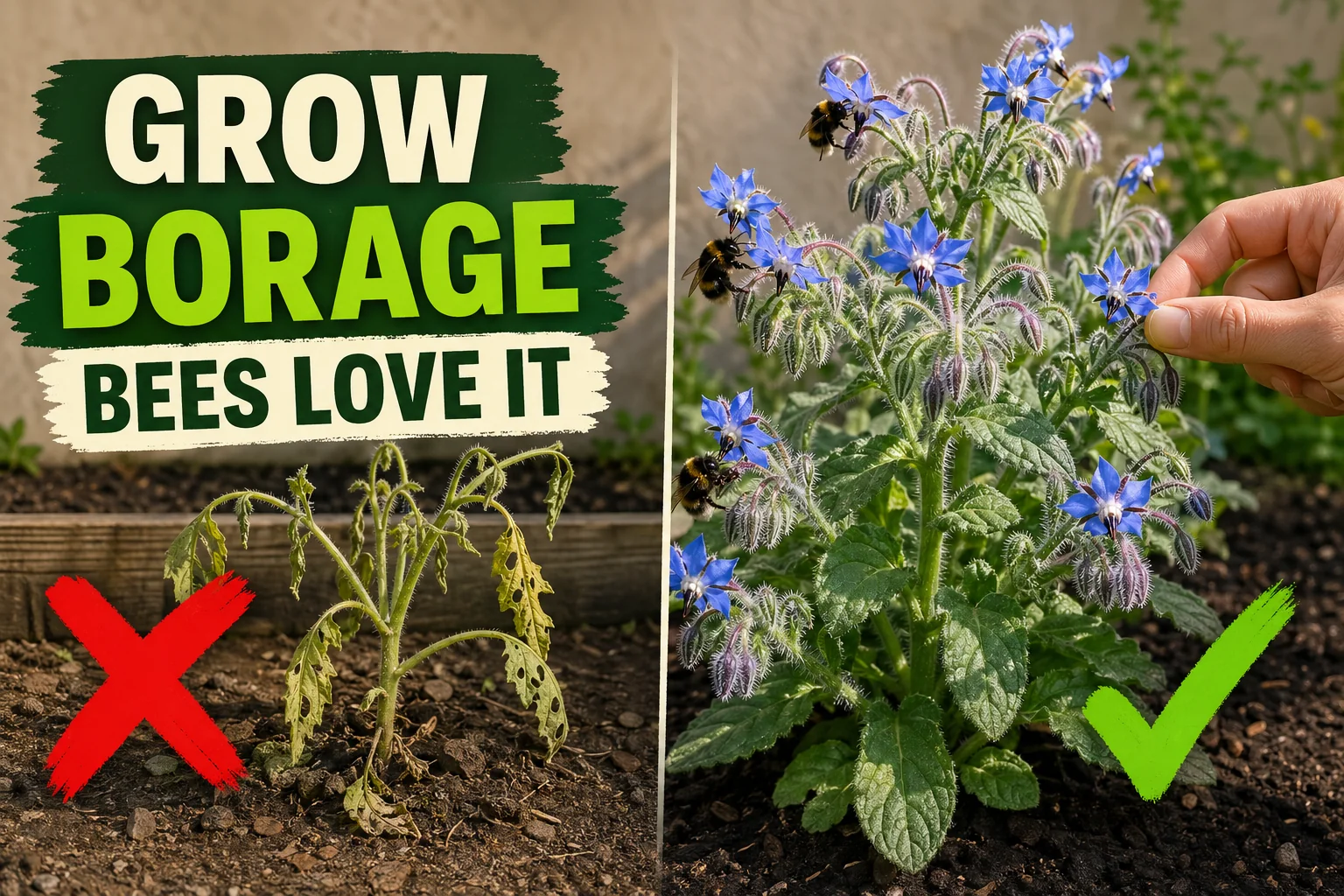
Pollinators. Borage flowers refill their nectar every two minutes — among the fastest of any garden plant. Bumblebees, honeybees, and hoverflies visit constantly from morning to dusk. Plant it near tomatoes, squash, or strawberries and pollinator visits to those crops climb noticeably.
Edible flowers and leaves. The blue star flowers taste mildly of cucumber and look stunning frozen into ice cubes, scattered over salads, or laid across the icing of a summer cake. Young leaves taste similar and work in cold soups or as a chopped garnish.
Almost zero maintenance. Borage tolerates poor soil, doesn’t need staking under most conditions, and rarely needs fertilizing. Once established, it self-seeds enthusiastically — so a single packet of seeds usually gives you borage for the next 5–10 years.
What you’ll need
- A packet of borage seeds (one packet usually has 50+ seeds — plenty for a small garden plus volunteers)
- A sunny spot with at least 6 hours of direct light per day
- Well-drained soil, or a container at least 30 cm (12 in) wide and 30 cm (12 in) deep with drainage holes
- General-purpose potting mix if growing in pots
- A watering can — that’s it
No grow lights, no heat mat, no special compost. Borage was bred by neglect.
Step-by-step: planting borage
1. Pick the right spot
Choose the sunniest patch you have. Borage grows in part shade but will flop, mildew, and flower poorly. It also gets large — a mature plant is around 60–90 cm (24–36 in) tall and 45 cm (18 in) wide — so don’t tuck it into a tight corner.
Soil should be well-drained. Heavy clay rots the taproot; pure sand dries it out. If your soil is one of those extremes, work a single shovelful of compost into each planting hole — no more.
2. Direct-sow the seeds
Borage has a deep taproot and hates being transplanted. Sow seeds directly where the plant will grow, never in plug trays.
- Sow after your last frost when soil temperatures are at least 10°C (50°F).
- Push each seed 1 cm (0.5 in) deep into the soil and cover lightly.
- Space seeds 30–45 cm (12–18 in) apart, or sow a small cluster and thin to the strongest seedling later.
- Water gently to settle the soil.
Germination takes 7–14 days. Don’t worry if the seeds disappear under crusted soil after rain — borage seeds push through easily.
3. Thin the seedlings
When seedlings reach 5–8 cm (2–3 in) tall, snip out all but the strongest plant in each cluster at soil level. Don’t pull — pulling disturbs the taproot of the keeper. The thinned seedlings are edible if you want a tiny salad add-in.
4. Pinch the first flower cluster
Once a young plant has 6–8 sets of leaves and starts forming its first flower cluster, pinch off that very first cluster with your fingers. The plant responds by branching, giving you a much bushier shape and far more flowers later.
After this single pinch, leave it alone — borage doesn’t need ongoing pruning.
5. Water deeply and infrequently
Borage’s deep taproot prefers a deep weekly soak over light daily sprinkles. Aim for about 2–3 cm (1 in) of water per week at the root zone, and check the soil before watering again — if the top 3–5 cm (1–2 in) is still moist, wait.
In containers, check every 2–3 days in summer; pots dry out fast. The plant will droop dramatically when thirsty and bounce back within an hour of watering — but don’t make this routine, repeated wilting weakens it.
6. Skip the fertilizer
This is the most counterintuitive borage rule. Rich soil makes borage produce huge floppy leaves and far fewer flowers. Lean soil makes it flower hard.
If you’re growing in containers, a single light feed of balanced liquid fertilizer mid-season is fine. In the ground, no feeding is needed at all.
Care after planting
Borage is genuinely hands-off once established. Three things to do over the season:
| Task | When |
|---|---|
| Water | Once a week in average weather; daily-check pots in summer |
| Harvest leaves & flowers | Continuous from week 6 onward — picking encourages more flowers |
| Stake (only if needed) | If your plant flops in heavy rain, push a 60 cm (24 in) bamboo cane next to it |
A free plant care app like Tazart can hold the watering schedule for you, adjust it for your local weather, and ping you on Apple Watch when it’s time — useful if you’re juggling several herbs at once.
Harvesting borage
You can harvest from the moment the first flowers open — usually 6–8 weeks after sowing.
Flowers: pinch the blue star at the base with your fingers and pull gently downward; the green sepal calyx slips off easily. Use within a few hours for best texture, or freeze whole into ice cubes for summer drinks.
Leaves: snip young leaves under 8 cm (3 in) for raw use — older leaves get bristly and need cooking. Take outer leaves first so the centre keeps producing.
Seed-saving: in late summer, leave a few flower heads to brown and dry on the plant. Cut them whole, hang upside down in a paper bag for two weeks, then shake — the dark seeds collect in the bottom. Each plant produces hundreds.
Self-seeding: feature, not bug
Left alone, a single borage plant typically drops enough seeds to fill the same patch the following year — and the year after that. This is usually what you want, but it can spread into vegetable beds and paths.
To control it without losing the colony:
- Deadhead about half the flower heads as they fade.
- Pull volunteer seedlings in spring with a heavy-duty trowel — they come up easily while small (under 10 cm / 4 in).
- Leave the volunteers you want where they sprout — they’ll always grow better than transplants.
If you want to remove borage entirely from a bed, hoe seedlings the moment they appear in early spring — it’s the only window where it’s easy.
Common mistakes to avoid
- Starting borage in plug trays. The taproot kinks, the plant transplants poorly and stays small all season. Direct-sow only.
- Planting in shade. Mildew, leggy growth, and almost no flowers. Move it to full sun.
- Over-fertilizing. Borage rewards rich soil with leaves and almost no flowers. Lean is better.
- Watering shallowly and often. Encourages surface roots and increases mildew. Water deeply, weekly, at the soil — not the leaves.
- Letting slugs find young seedlings. A single slug can mow down a 5 cm (2 in) seedling overnight. Use organic slug pellets or wool pellets at planting.
Troubleshooting
| Symptom | Likely cause | Fix |
|---|---|---|
| Leggy stems with few flowers | Not enough sun | Move to full sun (6+ hours direct); next year, sow only in your sunniest spot |
| White powdery coating on leaves | Powdery mildew from poor airflow / wet leaves | Water at the base only; thin nearby plants; remove worst leaves |
| Plant flops sideways after rain | Top-heavy growth in rich soil | Stake with a single 60 cm (24 in) bamboo cane; reduce feeding next year |
| Holes through young leaves overnight | Slugs | Wool pellets or organic slug pellets; nighttime hand-picking; remove debris around base |
| Lots of leaves but very few flowers | Soil too rich / over-fertilized | Stop feeding; thin nearby compost; flowers usually return within 2–3 weeks |
| Yellow lower leaves | Old leaves dying back (normal) or overwatering | Snip off; check soil — if soggy, let it dry out fully before next watering |
| Seedlings popping up everywhere next spring | Self-seeding (this is normal) | Pull unwanted ones while small; leave the ones you want where they appear |
Watch: borage growing video guide
A short visual walkthrough pairs well with the written steps above. If you’re a visual learner, watch a quick tutorial like How to grow borage from seed on YouTube and then come back to follow the timing in this guide.
Related reading
- Cilantro plant care: stop the bolting — another cool-season herb where timing and lean soil matter more than fertilizer.
- Dill plant care — pairs perfectly with borage for a classic edible-flower and pollinator border.
- How to take care of a rosemary plant — if you love no-fuss herbs, rosemary follows the same lean-soil philosophy as borage.
- Scan the next plant you bring home with the free Tazart plant identifier and let it set up the watering schedule for you.
A note on conditions
Every garden is different. Light, soil drainage, summer heat, slug pressure, and your local rainfall all change how borage grows in your patch. Use the steps above as a starting point and adjust based on what your plant actually does in week three — that’s how every good plant grower learns.
Highly recommended
The supplies that make this guide work
Tazart is an Amazon Associate — we earn from qualifying purchases at no extra cost to you. Thank you for helping us keep these guides free.
Frequently asked questions
How do you take care of a borage plant?
Plant borage in full sun (6+ hours daily) in well-drained, moderately fertile soil, spaced 30–45 cm (12–18 in) apart. Water deeply once a week — let the top 3–5 cm (1–2 in) dry out between waterings. Skip fertilizer; rich soil pushes leaves at the expense of flowers. Pinch off the first flower cluster to encourage bushy growth, then let it bloom freely. Borage self-seeds aggressively, so deadhead some flowers if you don't want it spreading.
Does borage come back every year?
Borage (Borago officinalis) is a true annual — the parent plant dies after one season. But it self-seeds so reliably that it acts like a perennial in most gardens. If you let a few flower heads go to seed in late summer, you'll see seedlings pop up in the same patch the following spring with no work on your part.
Is borage easy to grow?
Yes — borage is one of the easiest herbs in the garden. It germinates in 7–14 days from direct-sown seed, tolerates poor soil, doesn't need staking under most conditions, and rarely suffers serious pests (slugs are the only common threat). Beginners can sow seeds directly in the ground in spring and harvest both leaves and flowers within 6–8 weeks.
Does borage need full sun?
Borage flowers most heavily in full sun (6+ hours per day) and that is where bees will find it. It will grow in part shade (4 hours of direct light), but the plant goes leggy, produces fewer flowers, and is much more prone to mildew. For a pollinator garden or edible flowers, plant it in the sunniest spot you have.
How often should I water borage?
Water deeply once a week in average weather — about 2–3 cm (1 in) of water at the root zone — and let the top 3–5 cm (1–2 in) of soil dry out before watering again. In containers, check every 2–3 days in summer; pots dry fast. Borage has a deep taproot and tolerates short dry spells better than soggy soil, which causes root rot.
Can you eat borage flowers?
Yes — both the flowers and young leaves are edible. The blue star-shaped flowers have a mild cucumber flavour and look striking on salads, summer drinks, ice cubes, and cakes. Young leaves taste like cucumber too and can be added to salads or soups. Use leaves while still small (under 8 cm / 3 in); older leaves get bristly. Eat in moderation — borage contains trace pyrrolizidine alkaloids, so it's not recommended in large quantities or during pregnancy.
Why is borage good for bees?
Borage flowers refill their nectar every two minutes — faster than almost any other garden plant — making them an unbeatable food source for honeybees, bumblebees, and solitary bees. A single plant can be visited continuously from morning to evening throughout the summer. Beekeepers often plant borage near hives for this reason, and gardeners use it as a companion plant to bring pollinators to nearby tomatoes, squash, and strawberries.