Houseplants
Bamboo Plant Care: The Complete Lucky Bamboo Guide
How to care for a bamboo plant (lucky bamboo, Dracaena sanderiana) — water quality, change frequency, light, fertilizing, and fixing yellow or brown stalks.
On this page
- Quick answer
- Table of contents
- What is lucky bamboo, really?
- Water vs soil — which is better?
- Water quality — the most important rule
- How often to change the water
- Light requirements
- Fertilizing
- Common varieties
- Why is my lucky bamboo turning yellow?
- Brown tips — causes and fixes
- Troubleshooting table
- Watch: lucky bamboo care guide
- Common mistakes to avoid
- A note on conditions
- Related reading
Watch the visual walkthrough
How to care for Lucky bamboo in water
It's easy to take care for lucky bamboo plants but there are few things which you must know, so you don't kill them. In this video we ...
Lucky bamboo is one of the most popular houseplants in the world — and one of the most misunderstood. The first thing to know: it is not actually bamboo. Lucky bamboo is Dracaena sanderiana, a member of the Asparagaceae family native to Central Africa. True bamboo is a fast-growing grass that belongs outdoors. Lucky bamboo is a slow-growing tropical houseplant that thrives on a desk or shelf, grown in water or soil, with no sun required.
Get three things right — water quality, light, and a light touch with fertilizer — and your lucky bamboo will stay vivid green for years.
Quick answer
Use filtered or distilled water (never tap water with fluoride), change it every 1–2 weeks, keep the plant in bright indirect light out of direct sun, and add just 1–2 drops of dilute liquid fertilizer once a month in spring and summer. Yellow stalks mean fluoride or too much sun. Brown tips mean dry air or over-fertilizing.
Table of contents
- What is lucky bamboo, really?
- Water vs soil — which is better?
- Water quality — the most important rule
- How often to change the water
- Light requirements
- Fertilizing
- Common varieties
- Why is my lucky bamboo turning yellow?
- Brown tips — causes and fixes
- Troubleshooting table
- Watch: lucky bamboo care guide
- FAQs
What is lucky bamboo, really?
Lucky bamboo (Dracaena sanderiana) looks like bamboo because of its hollow green stalks and strap-like leaves. But botanically it has nothing to do with the giant grasses that grow along riverbanks. True bamboo (Phyllostachys, Bambusa, and related genera) is a grass, grows metres tall outdoors, and spreads aggressively by rhizome.
Lucky bamboo is a compact houseplant that reaches 30–90 cm (12–36 in) tall indoors, grows in a pot or a vase of water, tolerates low light, and stays tidy. It has been sold as a feng shui symbol of good luck for decades, which is where the common name comes from.
Knowing this distinction matters for care: the rules for lucky bamboo are the rules for a tropical Dracaena, not the rules for a garden grass.
Water vs soil — which is better?
Lucky bamboo grows successfully in both growing media. Each has trade-offs.
| Water growing | Soil growing | |
|---|---|---|
| Root visibility | Roots visible through glass — easy to spot rot | Hidden — need to check by touch |
| Watering effort | Top up water level weekly; full change every 1–2 weeks | Water only when top 2–3 cm (1 in) is dry |
| Stability | Pebbles anchor stalks; can tip in narrow vases | Soil provides firm anchor |
| Nutrition | Needs dilute liquid fertilizer regularly | Potting mix feeds roots for months |
| Common risk | Stagnant water, algae, root rot from dirty water | Overwatering, compacted soil |
| Best for | Display, desk decoration, gift arrangements | Long-term growing, larger plants |
For most indoor growers, water growing works well for small to medium arrangements. Soil growing is better if you want the plant to grow larger over several years or if you tend to forget water changes.
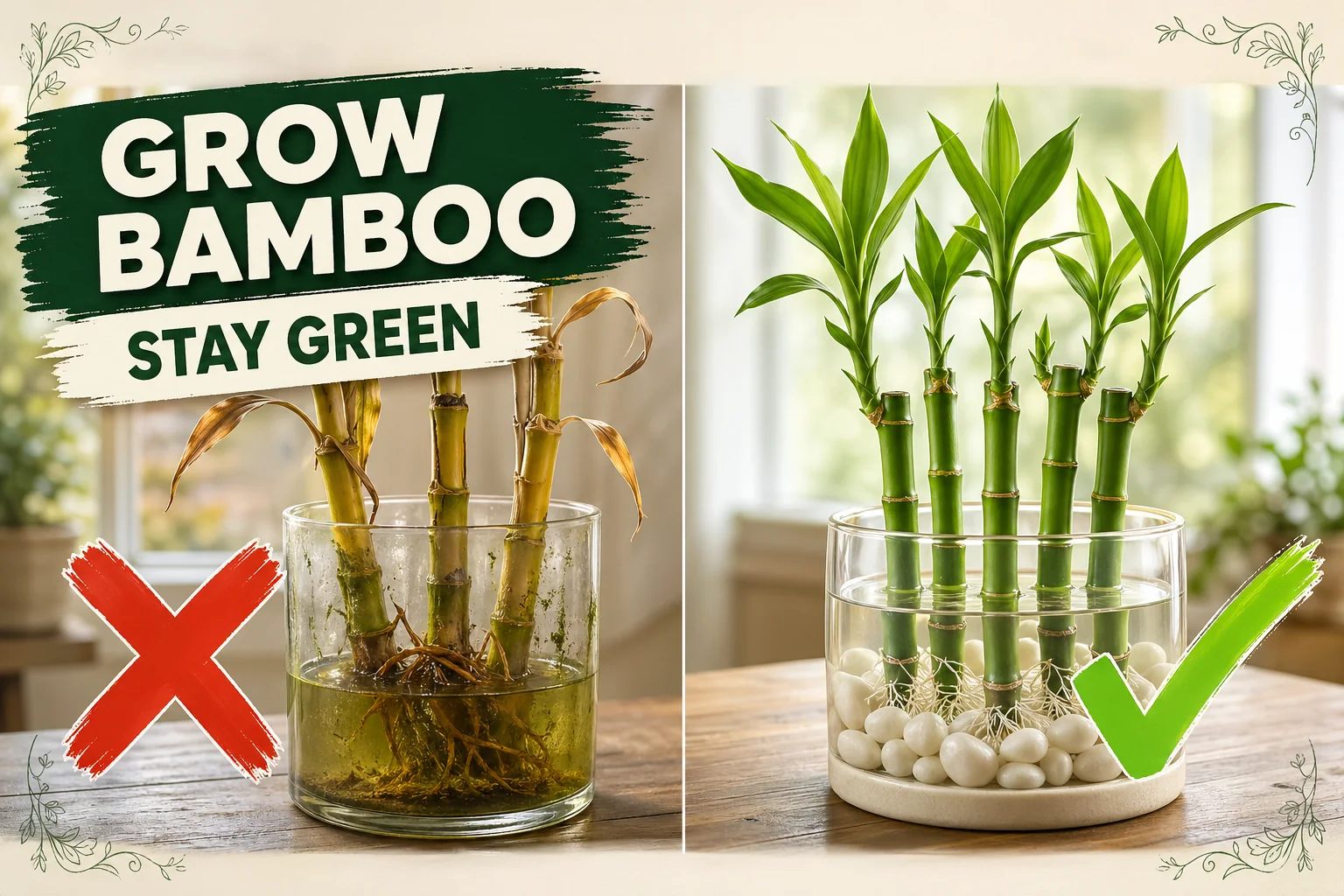
If you grow in water, keep the water level so the roots are submerged but the stalks are above the waterline — roughly 5–8 cm (2–3 in) of water is enough for most vases.
Water quality — the most important rule
This is the single most important thing in lucky bamboo care.
Do not use unfiltered tap water. Most municipal tap water contains fluoride added for dental health, and often chlorine or chloramine as a disinfectant. Dracaena sanderiana is highly sensitive to fluoride. Over time, fluoride accumulates in the leaf tissue and stalks, causing the characteristic yellowing that most growers mistake for a watering problem.
Safe water options:
- Distilled water — the safest choice; zero minerals, zero fluoride
- Filtered water — a countertop filter or pitcher filter (such as Brita) removes chlorine and significantly reduces fluoride
- Rainwater — naturally soft and fluoride-free; collect in a clean container
- Tap water left overnight — fills a jug uncovered for 24 hours to off-gas chlorine; this does NOT remove fluoride, so it is the least-good option
Warning: if your tap water is heavily fluoridated and you have used it for months, the yellowing will not immediately reverse when you switch to clean water. Yellowed tissue is permanent — but new growth will come in green if the water issue is resolved.
How often to change the water
Change the water completely every 1 to 2 weeks. When you change it:
- Lift the stalks out and set them aside.
- Rinse the container with clean water — no soap.
- Rinse the pebbles under running water to remove algae and bacterial film.
- Refill with fresh filtered or distilled water to a depth of 5–8 cm (2–3 in).
- Return the stalks to the container.
In summer or warm rooms, lean toward weekly changes. In cooler, lower-light settings every 2 weeks is fine. Never let water sit longer than 2 weeks — stagnant warm water turns green with algae and harbours the bacteria that rot stalks from the base.
Topping up between changes: if the water level drops between full changes, top up with filtered or distilled water. Don’t just let it run low — exposed roots dry out and die within a day or two.
Light requirements
Lucky bamboo does best in bright indirect light — the quality of light you get 1–2 m (3–6 ft) from a window, out of the direct sun beam.
| Light level | What to expect |
|---|---|
| Bright indirect (1–2 m / 3–6 ft from window) | Vivid green colour, steady growth, best results |
| Medium indirect | Good colour, slower growth |
| Low light (hallway, north window) | Plant survives, grows slowly, adequate for long-term |
| Direct sun (south window, outdoors) | Leaves bleach and yellow within days — avoid completely |
A north-facing windowsill or a spot a few metres inside a room is perfectly fine for lucky bamboo. This is one of the plants that genuinely tolerates being away from windows, which is why it is such a popular office and desk plant.
Keep it away from heating vents and air-conditioning units — both dry the air and cause rapid brown tipping on the leaves.
Fertilizing
Lucky bamboo has low nutrient needs. Over-fertilizing causes more problems than under-fertilizing.
The rule: add 1–2 drops of a balanced liquid fertilizer (10-10-10 or similar) diluted into 500 ml (17 fl oz) of water, once a month in spring and summer. In autumn and winter, stop fertilizing entirely.
This sounds like almost nothing — and it is. Lucky bamboo grows slowly and the roots are constantly bathed in water, so nutrient concentrations that seem dilute can accumulate quickly.
Signs of over-fertilizing: rapid yellowing of the stalks, brown leaf margins, white crusty salt deposits on the container or pebbles. If you see these, do a full water change with plain distilled water immediately, skip the next two months of feeding, and restart at an even lower dose.
For soil-grown lucky bamboo, use the same fertilizer but water it in at half the recommended strength on the bottle label, once a month in the growing season.
Common varieties
Lucky bamboo is sold in dozens of arrangements, almost all of which are Dracaena sanderiana shaped and arranged in different ways.
3-stalk arrangements — the most common. Three stalks represent happiness, long life, and wealth in feng shui tradition. Sold as a gift plant or starter arrangement almost everywhere.
Tower arrangements — a single central column of stalks of graduated height, sometimes 6–12 stalks, bound together with ribbon or wire. Tall and architectural; a statement plant.
Braided stalks — growers spiral multiple young stalks around each other while they are flexible. The braid tightens as the stalks thicken. Dramatic and unusual; care is identical to straight-stalk arrangements.
Curled / spiral stalks — individual stalks trained into spirals by rotating them toward and away from light over several months. A single curled stalk is a popular desk plant. Wider spacing between nodes indicates faster, healthier growth.
All of these are the same species and need the same care. The number of stalks and the shape are aesthetic choices, not care differences.
Why is my lucky bamboo turning yellow?
Yellow stalks are the most common problem in lucky bamboo care. The cause is almost always one of these:
1. Fluoride in tap water (most common) The yellow starts in the leaves and works down into the stalk over weeks. Switch to distilled or filtered water immediately. New growth will come in green; existing yellow tissue will not revert.
2. Direct sun Even a few hours of direct afternoon sun will bleach the green colour out of the stalks and turn leaves yellow-white. Move the plant to bright indirect light.
3. Over-fertilizing Too much fertilizer, or fertilizer that is not diluted properly, causes rapid yellowing. Flush the container with plain water and reduce future doses sharply.
4. Temperature shock Lucky bamboo prefers temperatures of 18–32°C (65–90°F). A cold draft, an air-conditioning vent blowing directly on the plant, or temperatures below 10°C (50°F) will stress the stalks into yellowing within days.
5. Root rot from stagnant water If the stalks are yellow AND soft or mushy at the base, the roots have rotted. This is caused by leaving dirty water too long. Remove the plant, trim any black or brown mushy roots with clean scissors, rinse thoroughly, and restart in fresh filtered water with clean pebbles.
A completely yellow or mushy stalk cannot be revived — remove it from the arrangement so the rot does not spread to healthy stalks.
Brown tips — causes and fixes
Brown leaf tips (the very tips of the strap-like leaves going brown and dry) are almost always one of:
- Dry air — the most common cause. Central heating and air conditioning strip humidity. Move the plant away from vents, or group it with other plants to raise local humidity slightly.
- Fluoride accumulation — also shows up as tip burn. Same fix as above: switch to filtered or distilled water.
- Over-fertilizing — reduce dose and frequency.
- Soil too dry (soil-grown plants only) — water when the top 2–3 cm (1 in) is dry.
Brown tips are cosmetic. You can trim the brown part off with clean scissors, cutting at a slight angle to match the natural leaf tip shape. The brown will not spread once the underlying cause is fixed.
Troubleshooting table
| Symptom | Likely cause | Fix |
|---|---|---|
| Stalks turning yellow, starting from leaves | Fluoride in tap water | Switch to distilled or filtered water immediately |
| Stalks yellow + soft, mushy at base | Root rot from stagnant water | Trim rotten roots, replace water and pebbles, change water weekly |
| Leaves bleaching pale yellow-white | Direct sun | Move to bright indirect light |
| Rapid yellowing after fertilizing | Over-fertilizing | Flush with plain water, skip 2 months of feeding |
| Brown crispy leaf tips | Dry air or fluoride | Move away from vents; switch water type |
| Green slime inside the glass | Algae from light exposure | Move out of direct light; change water and rinse glass more frequently |
| Roots black or brown and slimy | Root rot | Trim dead roots, full water change, weekly changes going forward |
| Stalks leaning to one side | Growing toward light | Rotate container a quarter turn weekly |
| White crust on pebbles or container | Mineral/salt buildup | Rinse pebbles and container thoroughly at each water change; switch to distilled water |
Watch: lucky bamboo care guide
A good visual walkthrough can clarify the water-change process and show you what healthy versus stressed roots actually look like. Search “lucky bamboo care guide” on YouTube for a beginner-friendly tutorial that shows water-growing method, water change steps, and yellow stalk diagnosis — then come back here for the detailed timing rules.
Common mistakes to avoid
- Using tap water long-term. Even if the stalks look fine for the first few months, fluoride accumulates slowly. Switch to filtered or distilled water from the start.
- Leaving water unchanged for more than 2 weeks. Stagnant water smells, grows bacteria, and rots roots. Set a fortnightly reminder.
- Putting the plant in direct sun. Lucky bamboo is a forest-floor plant that evolved under a canopy. It cannot handle direct sun.
- Over-fertilizing. One tiny dose per month is all it needs. More is always worse, not better.
- Ignoring a yellow stalk. Yellow stalks that go soft spread rot to healthy stalks. Remove them early.
- Planting water-grown bamboo directly into dry soil. The root system adapts to water; it needs a gradual transition or a period of acclimatisation in moist (not wet) soil.
A note on conditions
Every home is different. Temperature, humidity, the quality of your local water, the amount of natural light, and the size of your container all affect how quickly issues develop and how well your lucky bamboo grows. Use this guide as a starting point and adjust based on what you observe — if the stalks stay green and new growth appears every few months, you have the conditions right.
Related reading
- ZZ plant care — another near-indestructible low-light houseplant with similarly low watering needs.
- Pothos plant care — fast-growing trailing vines for the same bright-indirect-light spots.
- How to take care of a snake plant — drought-tolerant and low-light tolerant, the third pillar of easy houseplants.
- Track your water-change schedule with the free Tazart plant care app so your lucky bamboo never sits in stagnant water.
Highly recommended
The supplies that make this guide work
Tazart is an Amazon Associate — we earn from qualifying purchases at no extra cost to you. Thank you for helping us keep these guides free.
Frequently asked questions
Why is my lucky bamboo turning yellow?
Yellow stalks on lucky bamboo almost always point to one of three causes: tap water fluoride, too much direct sun, or over-fertilizing. Fluoride is the most common culprit — switch to filtered or distilled water immediately and change the water every 7–10 days. If the problem is sun, move the plant to bright indirect light. If you have been adding undiluted fertilizer, flush the container with clean water and go back to a very dilute dose (just 1–2 drops of liquid fertilizer per 500 ml / 17 fl oz of water, once a month).
How often should I change lucky bamboo water?
Change the water every 1 to 2 weeks. Weekly is ideal in warm rooms or summer. Every 2 weeks is acceptable in cool, low-light settings. Never let the water sit longer than 2 weeks — stagnant water breeds bacteria that turn stalks mushy and causes the distinctive musty smell. When you change the water, rinse the pebbles and the container too.
Can lucky bamboo grow in tap water?
Usually not safely. Most municipal tap water contains fluoride and sometimes chlorine, both of which accumulate in the stalks of Dracaena sanderiana and cause yellowing over time. Use filtered water, distilled water, or rainwater instead. If you must use tap water, fill a jug the night before and let it sit uncovered for 24 hours — this off-gases chlorine but does not remove fluoride.
Does lucky bamboo need sunlight?
Lucky bamboo prefers bright indirect light — the kind you get a metre or two back from a window. It tolerates low light well, which is why it thrives on desks and shelves, but it cannot handle direct afternoon sun. Even a few hours of harsh direct sun will bleach the leaves and turn the stalks yellow within days.
Can lucky bamboo grow in soil?
Yes. Lucky bamboo grows in either water or soil. In water, the roots grip pebbles and absorb nutrients from the water. In soil, use a well-draining indoor potting mix and water only when the top 2–3 cm (1 in) of soil is dry. Many growers find soil easier to manage long-term because it is more forgiving of missed water changes and provides more stable nutrition. Never switch a water-grown plant directly into dry soil — transplant shock is common.
What causes brown tips on lucky bamboo?
Brown leaf tips on lucky bamboo are almost always caused by dry air, fluoride in tap water, or over-fertilizing. Low humidity is the most common cause in centrally heated or air-conditioned rooms. Move the plant away from heating vents and air-con units, increase humidity by grouping it with other plants, and switch to distilled or filtered water. If you have been fertilizing more than once a month, cut back sharply.
How do I fertilize lucky bamboo?
Lucky bamboo needs very little fertilizer. Add just 1–2 drops of a balanced liquid fertilizer (such as 10-10-10) diluted into 500 ml (17 fl oz) of water, once a month during spring and summer. In autumn and winter, skip feeding entirely. Over-fertilizing is a more common problem than under-fertilizing — excess nutrients cause rapid yellowing and can burn the roots.