Houseplants
Aglaonema Plant Care (Chinese Evergreen Guide)
Learn how to care for Aglaonema (Chinese Evergreen) — light, watering, soil, temperature, humidity, propagation, and why over-watering is the #1 killer. Complete guide.
On this page
- Quick answer
- Table of contents
- Light requirements — and why it affects colour
- Watering — the #1 killer
- Soil and potting
- Temperature and cold sensitivity
- Humidity
- Feeding
- Pruning and shaping
- Propagation
- Toxicity warning
- Common mistakes
- Troubleshooting
- Watch: Aglaonema care guide
- Related reading
- A note on conditions
Watch the visual walkthrough
Ultimate AGLAONEMA (Chinese Evergreen) CARE Guide — Ep 207
This Aglaonema Care video is brought to you by one of my newest sponsors—Squarespace. So appropriate because three of my ...
Aglaonema — commonly called Chinese Evergreen — is one of the easiest houseplants you can own. It tolerates low light, forgives the occasional missed watering, and comes in dozens of cultivars ranging from deep forest green to bright pink, red, and silver. Whether you’re a beginner or a seasoned plant owner, there is an Aglaonema that will thrive in your space.
The challenge is keeping the colourful varieties looking their best. Pink and red cultivars fade when light is too low, and over-watering — the number one killer of this plant — rots the roots silently until it’s too late. This guide gives you every specific number and condition you need so you never have to guess.
Quick answer
Aglaonema needs low to medium indirect light (brighter for pink and red varieties), watering when the top 2–5 cm (0.75–2 in) of soil are dry, a well-draining peat-based mix, temperatures between 18–26°C (64–79°F) — never below 13°C (55°F) — and monthly feeding in spring and summer. Over-watering is the number one cause of death.
Table of contents
- Light requirements — and why it affects colour
- Watering — the #1 killer
- Soil and potting
- Temperature and cold sensitivity
- Humidity
- Feeding
- Pruning and shaping
- Propagation
- Toxicity warning
- Common mistakes
- Troubleshooting table
- Watch: Aglaonema care guide
- Related reading
- A note on conditions
Light requirements — and why it affects colour
Aglaonema is genuinely one of the most light-flexible houseplants in existence. Green-leaved varieties like Silver Bay, Maria, Cutlass, and Emerald Bay do well in low to medium indirect light — they are often recommended for offices and interior spaces with no direct window access.
However, there is a rule most beginners don’t know: the more variegation and colour a cultivar has, the more light it needs to hold that colour. Pink and red varieties — Red Siam, Pink Dalmatian, Creta, Wishes — need brighter indirect light, typically 1–2 metres from a bright east or west-facing window. In low light, the pink and red pigments fade to dull green within a few weeks.
What works:
- Low to medium indirect light: green-leaved cultivars (Silver Bay, Maria, Cutlass)
- Medium to bright indirect light: variegated and pink/red cultivars (Red Siam, Pink Dalmatian, Creta)
- 60–200 foot-candles for green types; 200–400 foot-candles for colourful types
What doesn’t work:
- Direct harsh sun — scorches leaves, causes bleaching and brown patches
- Deep dark corners with no natural light at all — even green types slow to a crawl
If your pink Aglaonema is fading, light is almost always the answer. Move it 30–60 cm (12–24 in) closer to a window and watch for new growth with restored colour in 4–6 weeks.
Watering — the #1 killer
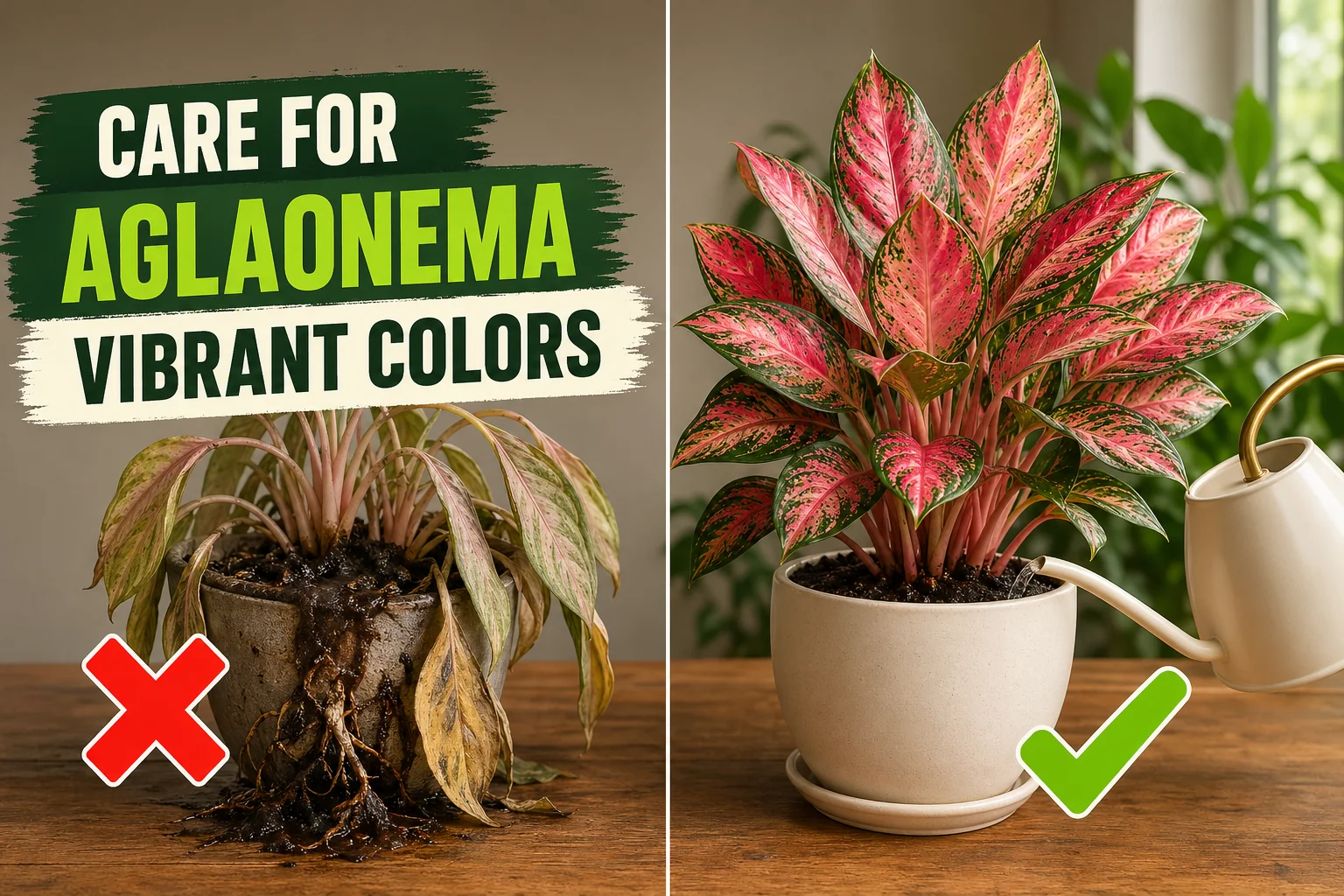
Over-watering kills more Aglaonema than any other mistake. The plant’s thick stems store water, and its roots rot quickly in soggy, oxygen-deprived soil.
The rule: water when the top 2–5 cm (about 1–2 inches) of soil feel dry. Press your finger into the soil — if it comes out with wet soil clinging to it, wait. If it comes out barely damp or dry, water thoroughly until it drains from the bottom.
Seasonal guide:
- Spring and summer: every 7–14 days on average
- Autumn and winter: every 14–21 days — the plant is growing slowly and needs much less water
Signs of over-watering:
- Yellow leaves starting with lower leaves
- Soft, mushy stems at the base
- Soggy soil that smells sour
- Root rot visible when unpotted — brown, mushy roots instead of white, firm ones
Signs of under-watering:
- Leaf curl or drooping with dry, pulling-away-from-pot-edges soil
- Crispy brown leaf tips
- Light, bone-dry pot when lifted
If you struggle to remember when you last watered, a free plant care app like Tazart will track it for you, adjust the schedule seasonally, and send you a reminder when the soil should be checked.
Soil and potting
Aglaonema needs a well-draining, peat-based mix that holds some moisture but never stays waterlogged. The goal is a balance: moist but airy.
Good mix recipe:
- 60% peat-based or coir-based potting compost
- 20% perlite (for drainage and air pockets)
- 20% coarse sand or bark chips
Avoid dense garden soil or cactus mixes that dry out too fast. Aglaonema wants consistent moisture — just not wet feet.
Pot choice:
- Use a pot with drainage holes — no exceptions
- Terracotta dries faster (good for over-waterers); ceramic or plastic retains moisture longer (good for under-waterers)
- Pot size: only go one pot size up (2–3 cm (0.75–1 in) wider) when repotting — too large a pot holds excess moisture the roots can’t use, increasing rot risk
Repotting schedule: every 2–3 years, or when roots start circling the base of the pot or growing out of drainage holes. Spring is the best time to repot. Use fresh mix each time — old, compacted soil holds excess moisture and provides less nutrition.
Temperature and cold sensitivity
Aglaonema is a tropical plant with a genuine intolerance for cold. This is one area where precision matters.
Ideal range: 18–26°C (64–79°F)
Absolute minimum: 13°C (55°F) — never let it drop below this, even briefly.
Cold damage happens faster than most people expect. A single night near a cold window in winter, or an air conditioning vent blowing directly on the plant in summer, can cause:
- Leaf curl within 24–48 hours
- Yellow patches and browning along leaf edges
- Blackening of stems (severe cold damage)
- Sudden collapse of otherwise healthy-looking leaves
Practical tips:
- Move plants away from cold windows in autumn — even heat-retaining glass drops significantly at night
- Never place Aglaonema directly under or beside an air conditioning unit
- In rooms that get cold at night (below 16°C (61°F)), move the plant to an interior wall
Green cultivars tolerate the lower end of the range slightly better than pink/red ones, which are more cold-sensitive.
Humidity
Aglaonema prefers 40–50% relative humidity, which matches most homes in spring and summer. It adapts reasonably well to standard indoor humidity (30–40%) but struggles in very dry, heated air.
Signs of low humidity:
- Brown, crispy leaf tips and edges (not caused by watering)
- Leaf curl, especially on newer growth
Easy fixes:
- Group plants together to raise local humidity
- Place a tray of water with pebbles under the pot (water should sit below the pot base)
- Run a small humidifier nearby in winter when heating dries the air most
- Occasional misting helps temporarily but does not replace consistent humidity
Avoid misting in cold conditions or on plants in direct draughts — wet leaves combined with cold air invite fungal issues.
Feeding
Aglaonema is a light feeder. It doesn’t need frequent fertilising, and too much fertiliser causes salt buildup in the soil, which burns roots and causes brown leaf tips.
Schedule:
- Spring and summer: once a month with a balanced liquid fertiliser (e.g. 10-10-10 or 20-20-20) diluted to half strength
- Autumn and winter: no feeding — the plant is in slow growth mode and cannot use the nutrients
Flush the soil with plain water every 3–4 months to remove salt buildup. Pour water through until it runs freely from the drainage holes, wait a few minutes, and repeat once.
Pruning and shaping
Aglaonema is naturally bushy and rarely needs heavy pruning. Most pruning is cosmetic — removing yellow or damaged leaves, and occasional shaping.
How to prune:
- Remove yellow or brown leaves by cutting the stem at the base with clean scissors or pruning shears
- Wear gloves — the sap contains calcium oxalate crystals that cause skin irritation in sensitive individuals
- Trim brown leaf tips with scissors at a slight angle to maintain a natural look
- Remove leggy stems that have lost lower leaves to encourage new basal growth
You can cut stems back hard (to 5–10 cm (2–4 in) above the soil) if a plant has become very leggy, and new growth will emerge. The plant will look sparse for 4–8 weeks but recovers fully in good conditions.
Propagation
Aglaonema is straightforward to propagate by two methods: stem cuttings and division.
Stem cuttings
- Select a healthy stem with at least 3–4 nodes (the bumps where leaves attach)
- Cut 10–15 cm (4–6 in) below the tip with clean, sharp scissors
- Remove the lowest 1–2 leaves, leaving 2–3 leaves on the cutting
- Place the cut end in a glass of water or in a small pot of moist perlite
- Keep in bright indirect light and maintain warmth (at least 20°C (68°F))
- Roots appear in 3–6 weeks in water; pot up once roots reach 3–5 cm (1–2 in)
Division
Division is the fastest method with the highest success rate.
- Unpot the parent plant carefully at repotting time
- Look for rooted side-shoots or separate crowns growing from the base
- Gently tease apart the root systems — don’t cut unless needed
- Pot each division individually in fresh, well-draining mix
- Water lightly and keep in indirect light for 2 weeks while roots settle
Division gives you an established plant almost immediately — no waiting for roots to develop.
Toxicity warning
Aglaonema is toxic to pets and humans.
It belongs to the Araceae family — the same family as Dieffenbachia, Philodendron, and Pothos — and contains calcium oxalate crystals throughout its leaves, stems, and roots. When any part of the plant is chewed or swallowed, these crystals cause:
- Intense mouth and throat burning
- Excessive drooling and pawing at the mouth (in pets)
- Swelling of the lips, tongue, and throat
- Vomiting and difficulty swallowing
Cats and dogs are most at risk because they’re more likely to chew leaves. If ingestion is suspected, contact a vet or poison control immediately.
Wear gloves when pruning — sap can irritate sensitive skin and eyes. Wash hands thoroughly after handling.
Common mistakes
-
Over-watering on a schedule. Aglaonema roots rot in consistently wet soil. Always check the top 2–5 cm (0.75–2 in) of soil before watering — never water on autopilot.
-
Placing colourful cultivars in low light. Pink and red varieties need brighter indirect light to hold their colour. A dark corner will turn a Red Siam into a dull green plant within weeks.
-
Ignoring cold draughts. Air conditioning vents and cold windows are silent killers. Cold damage often looks like sudden yellowing or blackening that appears with no other explanation.
-
Using a pot without drainage. No drainage = no way for excess water to escape = root rot. Always use a pot with holes, even inside a decorative cachepot.
-
Fertilising in winter. Aglaonema grows slowly or not at all in winter. Adding fertiliser when the plant can’t use it leads to salt buildup and root burn.
-
Misting instead of humidifying. Occasional misting raises humidity for about 20 minutes. In dry heated rooms, it does very little. Use a pebble tray or humidifier for consistent results.
Troubleshooting
| Symptom | Likely cause | Fix |
|---|---|---|
| Yellow leaves, starting from lower leaves | Over-watering / root rot | Check roots; cut off rotten ones; repot in fresh, dry mix; reduce watering frequency |
| Pink or red colour fading to green | Insufficient light | Move 30–60 cm (12–24 in) closer to a bright window; avoid direct sun |
| Leaf curl with dry soil | Under-watering or low humidity | Water thoroughly; check humidity levels; add pebble tray |
| Brown leaf tips and edges (no curl) | Low humidity or fertiliser salt burn | Increase humidity; flush soil with plain water |
| Sudden leaf drop or blackening of stems | Cold damage | Move away from draughts and cold windows; minimum 13°C (55°F) at all times |
| Pale washed-out leaves overall | Too much direct sun or very low light | Aglaonema needs bright indirect light — not direct sun, not a dark corner |
Watch: Aglaonema care guide
A visual walkthrough pairs well with the steps above — watching someone water, repot, and position an Aglaonema next to a real window makes the light and watering rules much easier to internalise. Search for Aglaonema care Chinese Evergreen guide on YouTube — look for videos from plant care channels that show the before/after of common problems like fading colour and root rot recovery.
Related reading
- How to care for Pothos — another forgiving low-light plant with similar watering principles to Aglaonema
- Spider plant care guide — great companion plant that thrives in similar light and humidity conditions
- Aloe vera care guide — if you’re prone to over-watering, aloe’s even stricter dry-out rule will help you build the right instincts
- Caladium plant care guide — show-stopping pink-and-white veined heart-shaped leaves on a fellow aroid relative
- Corn plant care (Dracaena fragrans) — tall woody-stemmed houseplant with similar low-light tolerance and the same “let the soil dry” watering rule
- Money tree care (Pachira aquatica) — the braided-trunk feng shui houseplant with the same “dry between waterings” rhythm as Aglaonema
- Fiddle leaf fig care (stop the brown spots) — for the bright-window tree statement piece, with a stricter watering and light routine than your forgiving Aglaonema
Track your Aglaonema’s watering schedule automatically with the free Tazart plant care app. It adjusts reminders by season, lets you log the last watering date, and Dr. Afrao — the in-app AI plant assistant — can diagnose yellowing, colour fade, and root rot problems from a photo.
A note on conditions
Every home is different. The numbers in this guide — 18–26°C (64–79°F), 40–50% humidity, water every 7–14 days — are solid starting points, but your specific light levels, pot size, soil mix, season, and local climate all affect how your Aglaonema actually behaves. Watch the plant for the first month after you bring it home. It will tell you what it needs through its leaves. That feedback loop — observe, adjust, observe again — is how every confident plant owner is made.
Highly recommended
The supplies that make this guide work
Tazart is an Amazon Associate — we earn from qualifying purchases at no extra cost to you. Thank you for helping us keep these guides free.
Frequently asked questions
How often should I water my Aglaonema?
Water when the top 2–5 cm (about 1–2 inches) of soil feel dry. That typically means every 7–14 days in spring and summer, and every 14–21 days in autumn and winter. Over-watering is the number one cause of Aglaonema death — always check the soil before watering, never water on a fixed schedule.
Why is my Aglaonema losing its pink or red colour?
Low light is the most common cause. Pink and red Aglaonema cultivars (Red Siam, Pink Dalmatian, Creta) need brighter indirect light to maintain their colour — ideally 1–2 metres from a bright window. If light levels drop, the pink pigment fades to dull green. Move the plant closer to a window and you should see colour return in 4–6 weeks.
Can Aglaonema grow in low light?
Yes — green-leaved cultivars like Silver Bay, Maria, and Cutlass tolerate low to medium indirect light and are among the most low-light-tolerant houseplants available. However, pink, red, and heavily variegated varieties need brighter indirect light to maintain their colouration. No Aglaonema does well in direct harsh sun, which scorches the leaves.
Is Aglaonema toxic to cats and dogs?
Yes. Aglaonema belongs to the Araceae family and contains calcium oxalate crystals throughout its leaves and stems — the same compound found in Dieffenbachia and Philodendron. Chewing or swallowing any part causes mouth pain, drooling, swelling, and vomiting in cats, dogs, and humans. Keep out of reach of pets and children, and wear gloves when pruning.
What temperature is too cold for Aglaonema?
Aglaonema is cold-sensitive. Never let it drop below 13°C (55°F). Even brief exposure to cold draughts from air conditioning vents, open windows, or being near cold glass in winter can cause leaf curl, browning, and rapid decline. The ideal range is 18–26°C (64–79°F).
How do I propagate an Aglaonema?
The two easiest methods are stem cuttings and division. For stem cuttings, take a 10–15 cm (4–6 in) cutting with at least 3–4 nodes, remove lower leaves, and place in water or moist perlite until roots reach 3–5 cm (1–2 in). For division, unpot the plant, gently separate a rooted side-shoot from the parent root ball, and pot it up individually. Division is faster and has a near-100% success rate.